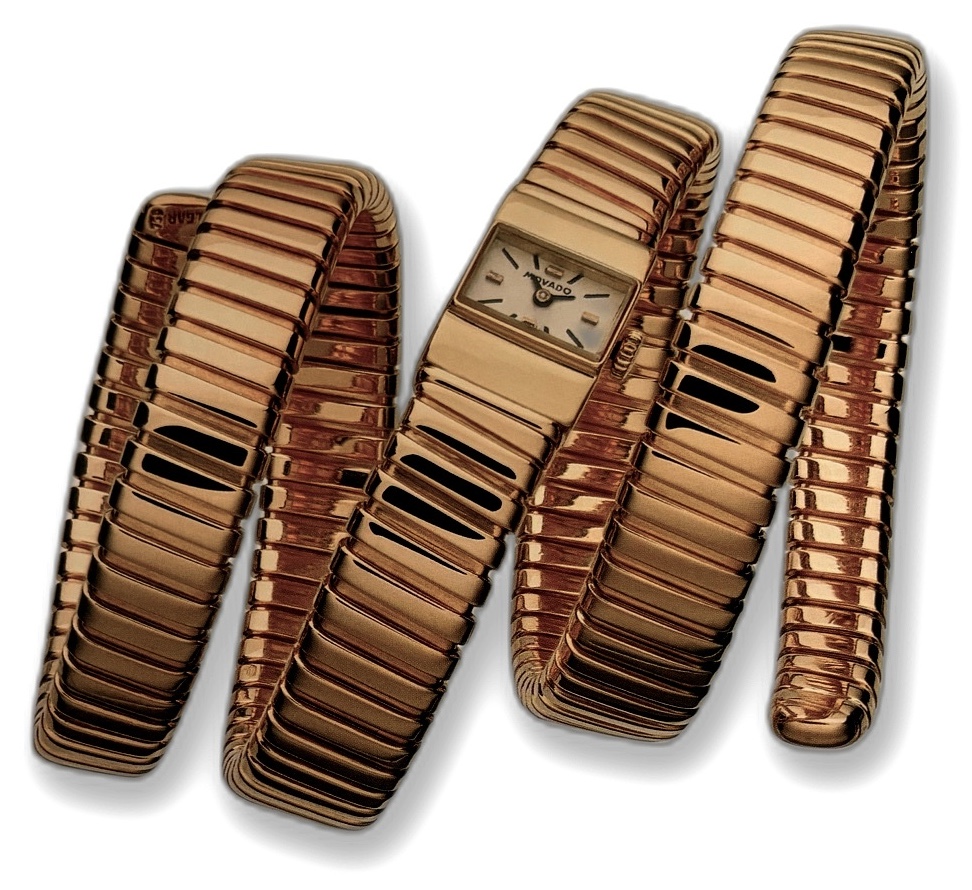
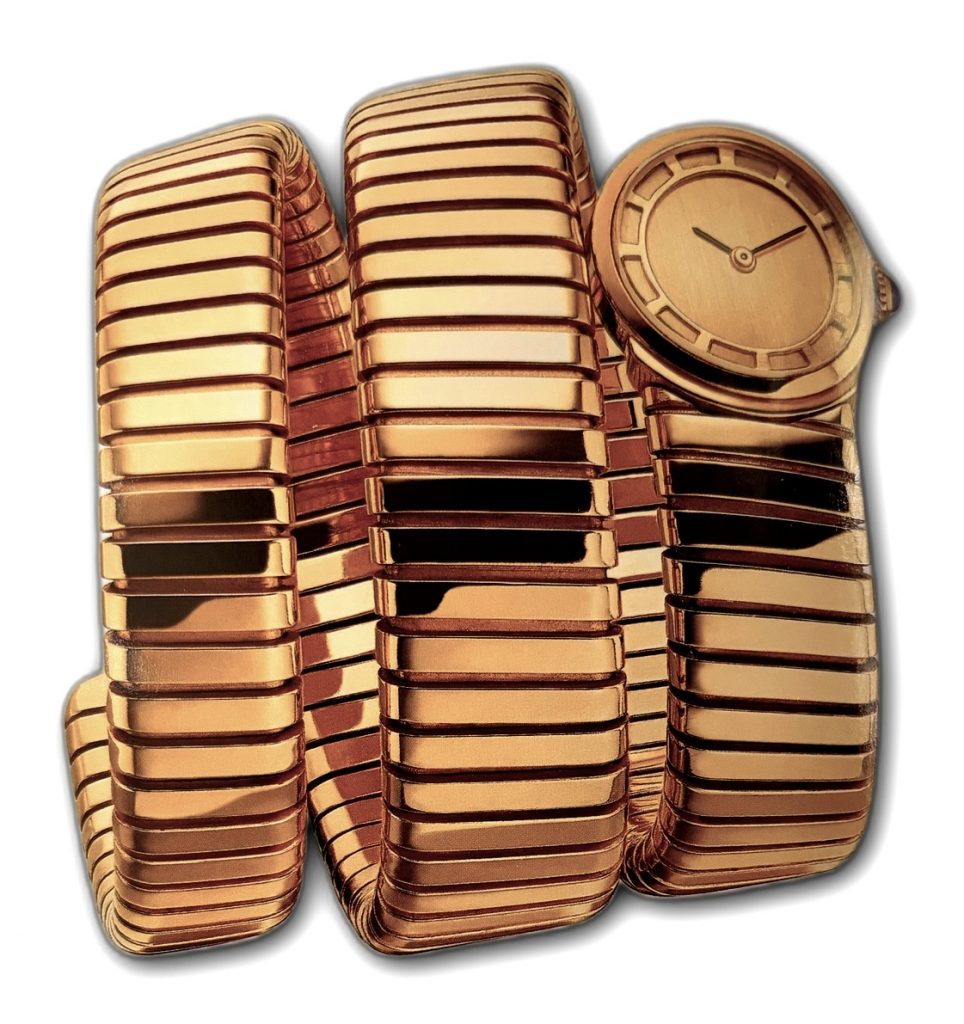
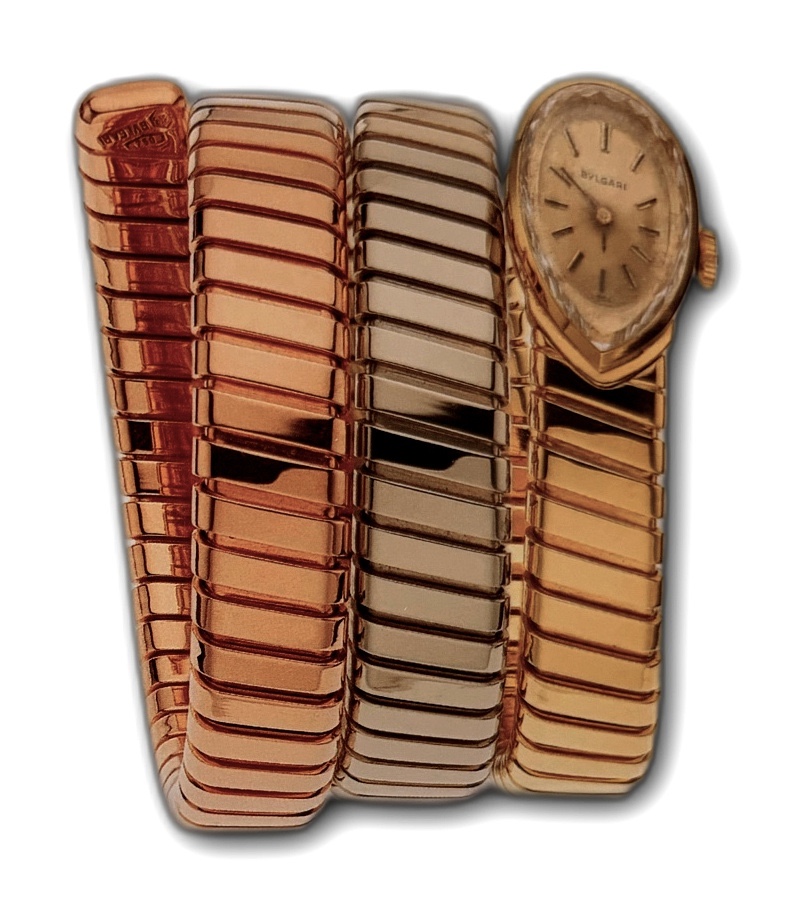
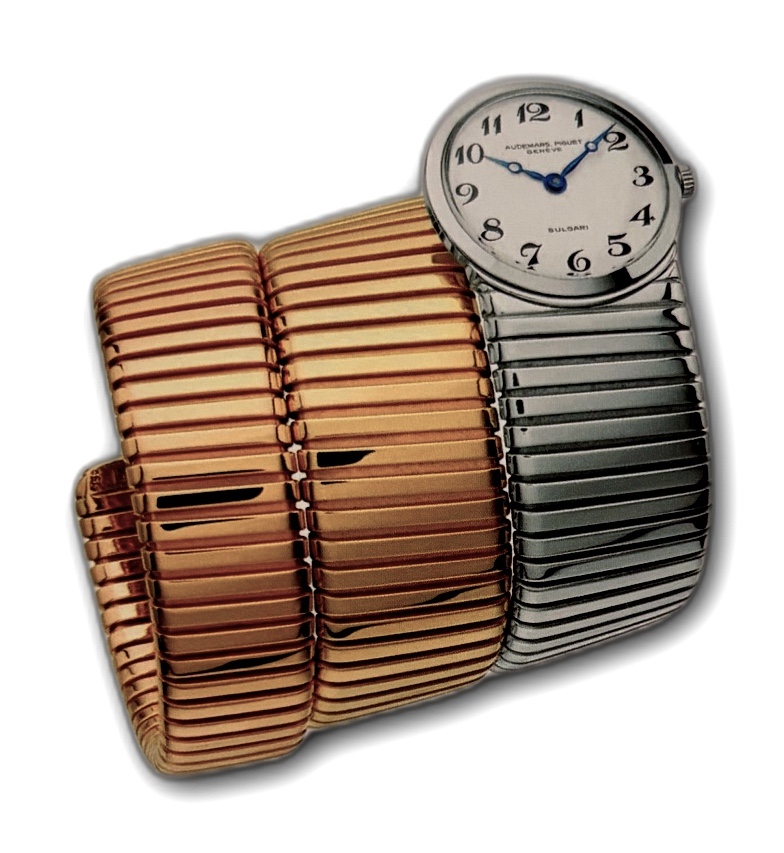
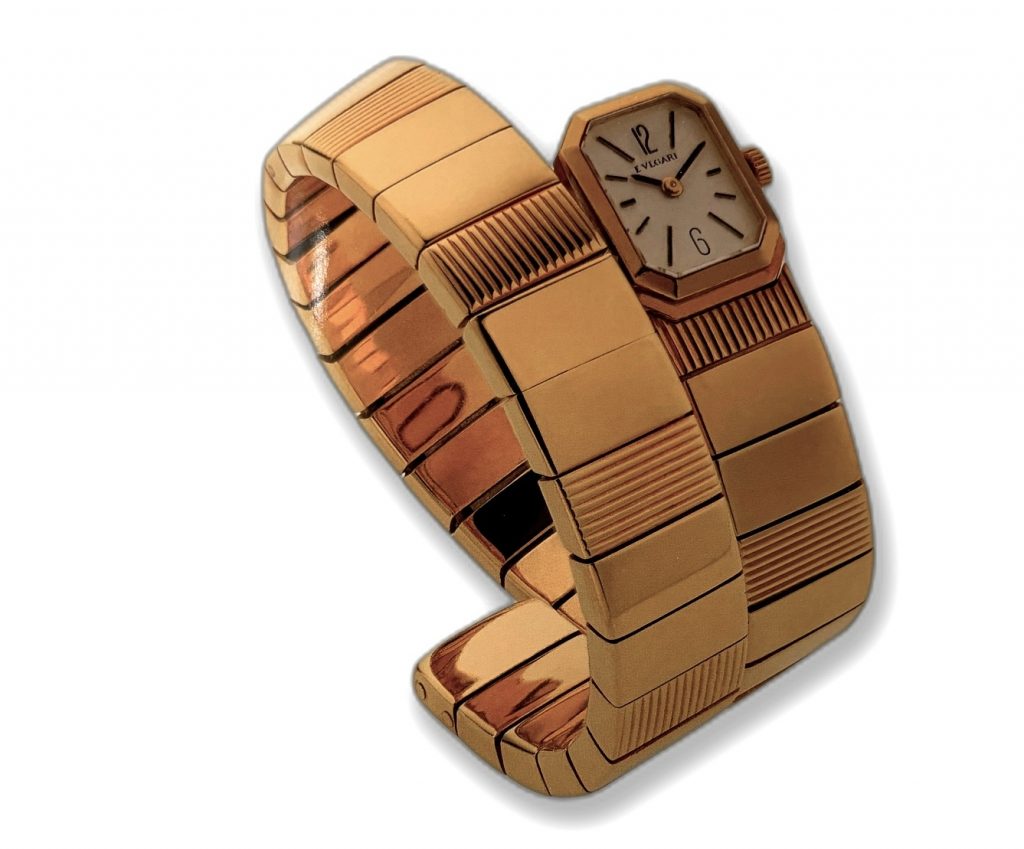
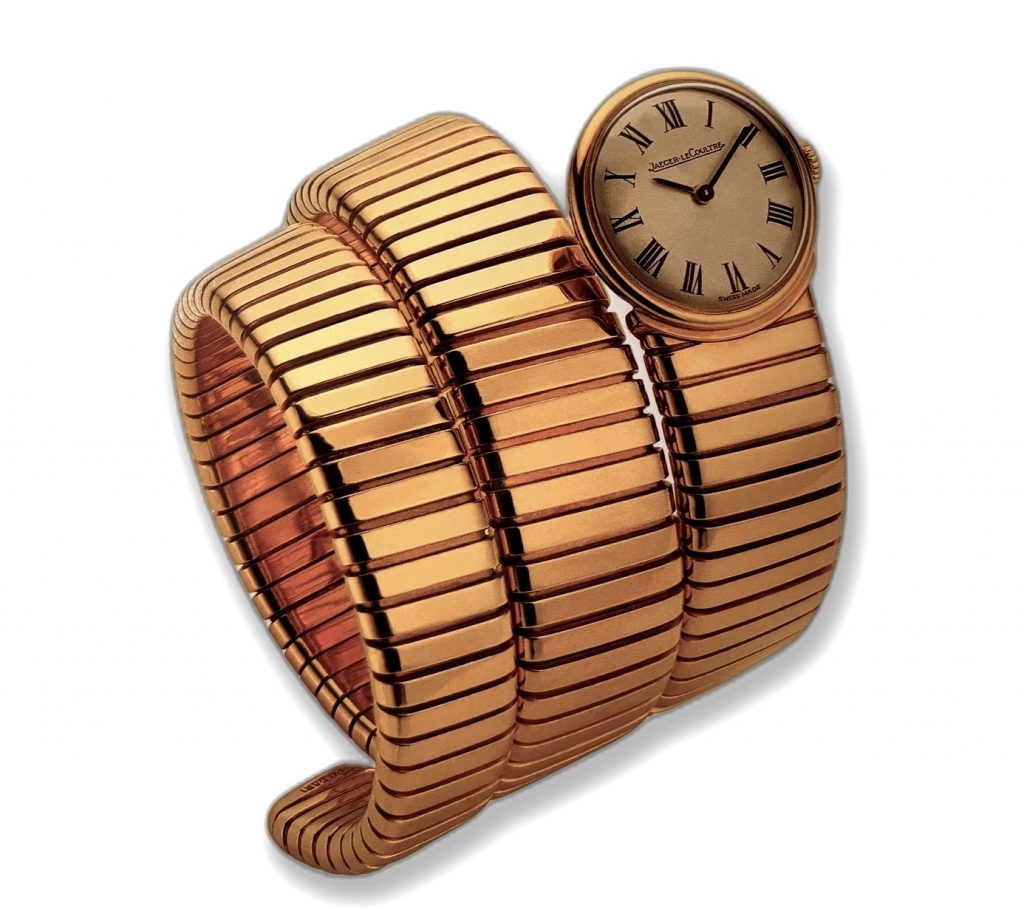
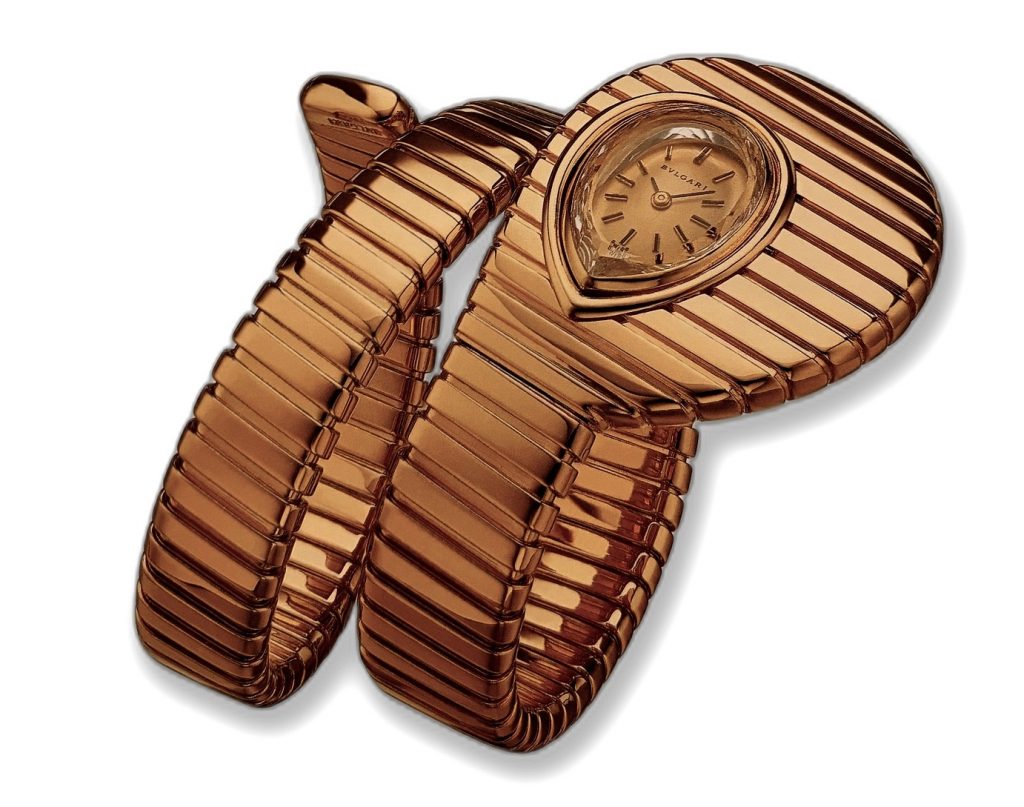
Serpenti Tubogas bracelet-watch in yellow gold, ca. 1960. BVLGARI Heritage Collection. The triple-coil Tubogas construction became the defining structural language of the Serpenti line.
Imagine a serpent coiling around your wrist — not as a creature, but as a masterpiece of Italian goldsmithing that has captivated the world for over 75 years. Since 1948, the Bulgari Serpenti watch has embodied the ancient symbolism of the snake — wisdom, seduction, transformation, vitality, rebirth, and protection — while continuously reinventing itself decade after decade.
The Bulgari Serpenti is more than a timepiece. It is a continuously evolving icon that fuses Italian jewelry artistry with Swiss watchmaking, spanning from its birth in post-war Rome to the cutting-edge innovations of 2026. Bulgari calls it their “true symbol,” one that captures “energy coursing through gold and gems,” creating pieces that “pulse with irresistible magnetism.”
The Serpent Symbol: Ancient Origins, Modern Icon
The serpent motif that defines the Bulgari Serpenti collection is anchored in ancient civilizations, particularly Egyptian and Greek-Roman mythological traditions. In these cultures, the serpent symbolized eternal life, divine wisdom, and perpetual renewal — themes that resonate powerfully in a timepiece designed to mark the passage of time itself.
Bulgari’s Greek-Italian heritage connects directly to these classical traditions. Founded by Greek silversmith Sotirios Voulgaris in Rome in 1884, the house drew naturally from the ancient Roman jewelry traditions that featured snake motifs prominently. When Bulgari transformed the snake from a mere decorative element into a core brand identity in 1948, they were tapping into millennia of symbolic power.
A Chronological History: Decade by Decade
The 1940s: Birth of an Icon
1948 marks the year Bulgari created the first Serpenti bracelet-watch — a gold timepiece with a square-shaped dial and a coiled band that wrapped sinuously around the wrist. This inaugural piece was crafted using the innovative Tubogas goldsmithing technique, an avant-garde method characteristic of the “Retro” or “Machine Style” era.
The Tubogas technique — named after the coiled gas pipes that inspired its form — creates a flexible bracelet through consistent coils of gold without any soldering. The result is a band that moves with the fluidity of a living serpent.
The 1950s: The Secret Watch Emerges
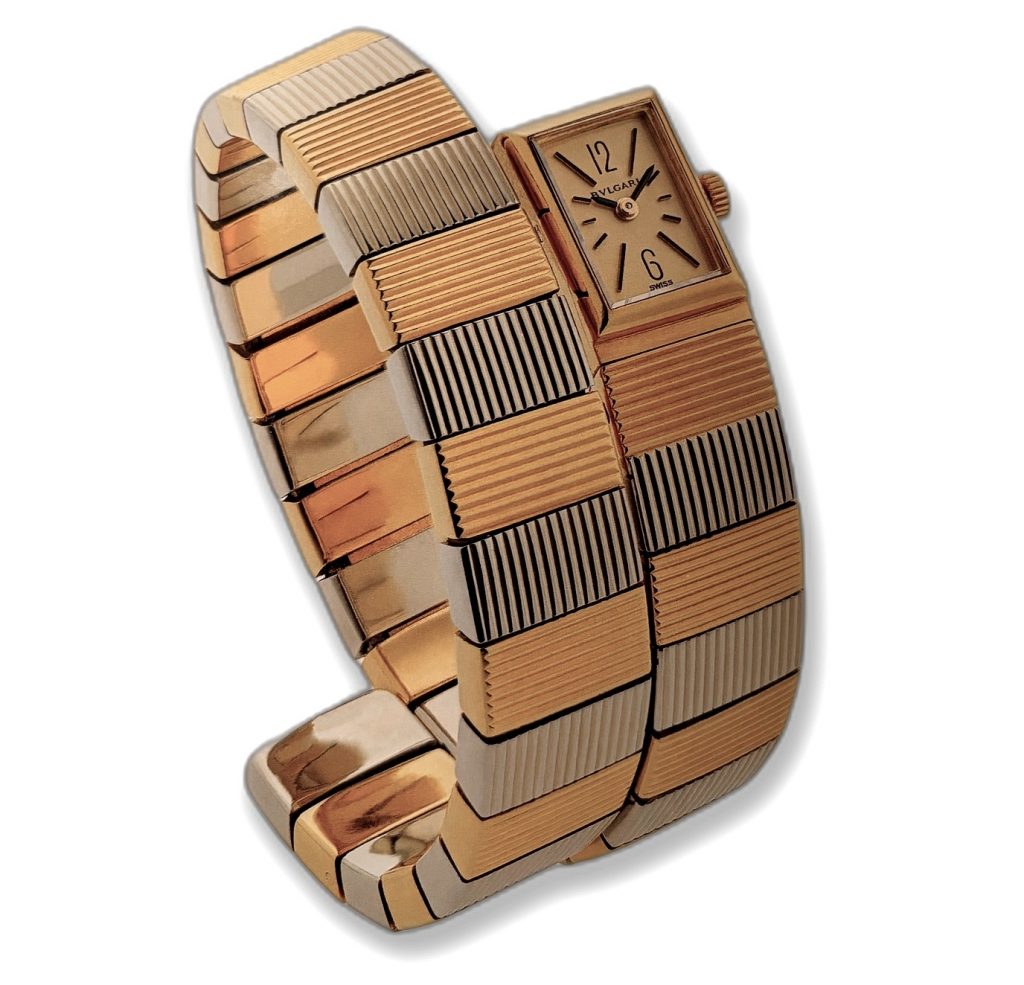
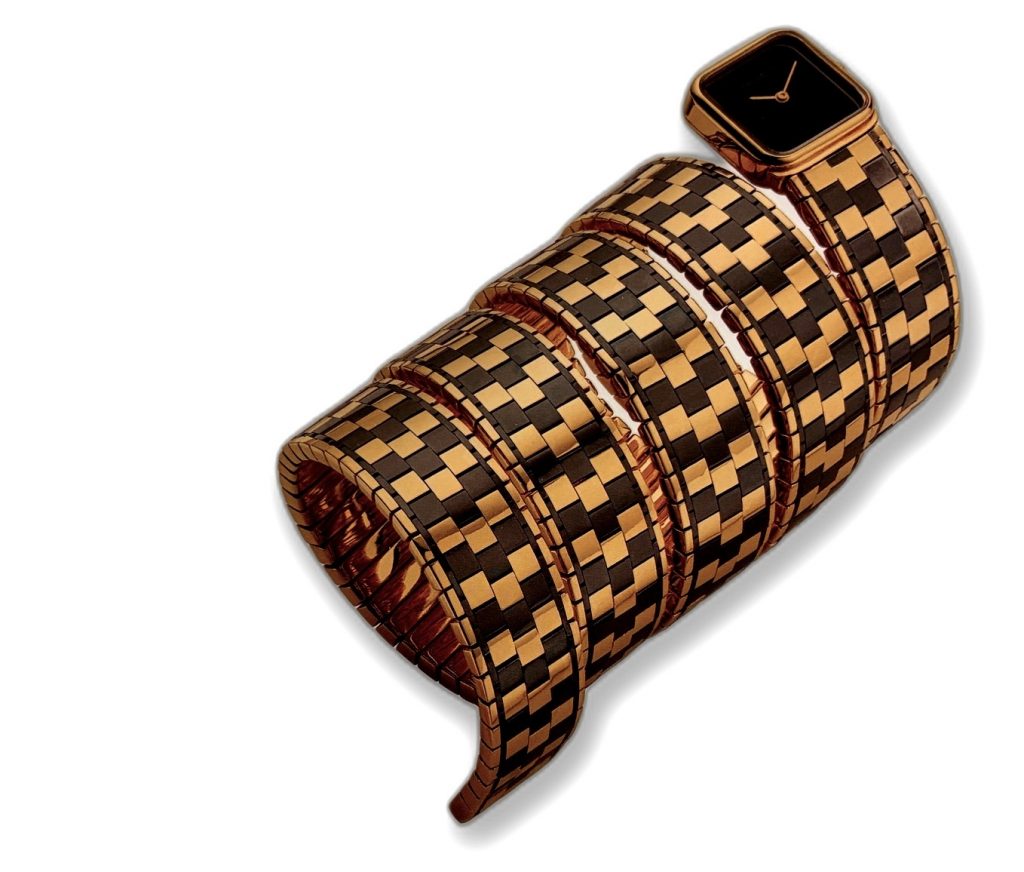
Serpenti bracelet-watch in two-colour gold (yellow and white gold), ca. 1960. BVLGARI Heritage Collection.Thecheckerboard alternation of yellow and white gold segments demonstrates Bulgari’s early mastery of contrastingmetals.
By the mid-1950s, Bulgari had developed the concept of the “secret watch” — a timepiece whose dial was hidden under a small decorative cap, typically fashioned as the serpent’s head. This innovation transformed the Serpenti from a watch that happened to look like a snake into a piece of jewelry that happened to conceal a watch.
The 1960s: Cult Status and the Elizabeth Taylor Moment
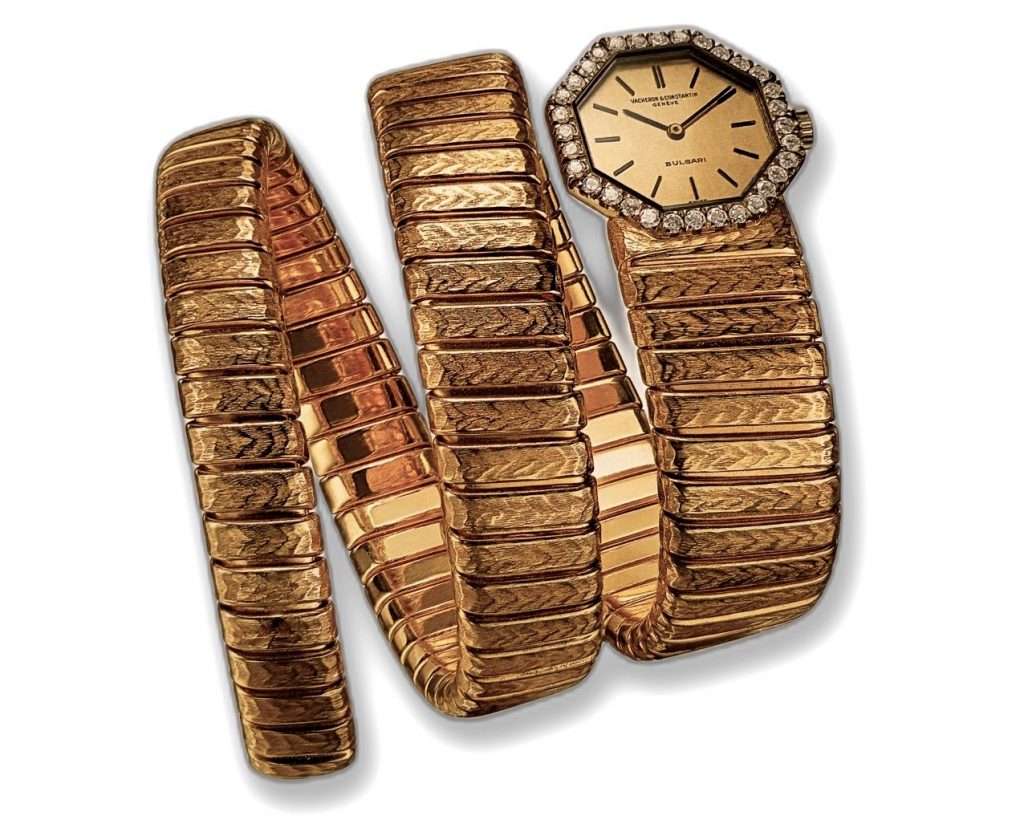
Serpenti Tubogas in satined yellow gold with diamond bezel, 1963. Movement by Vacheron & Constantin, Genève.The engraved herringbone texture and diamond bezel mark this as one of the most refined early Serpenti executions.
The 1960s elevated the Serpenti from a luxury accessory to a cultural phenomenon. The defining moment came in January 1962, when Elizabeth Taylor acquired her Bulgari Serpenti while filming Cleopatra in Rome.
“I introduced Bulgari to the world.” — Elizabeth Taylor
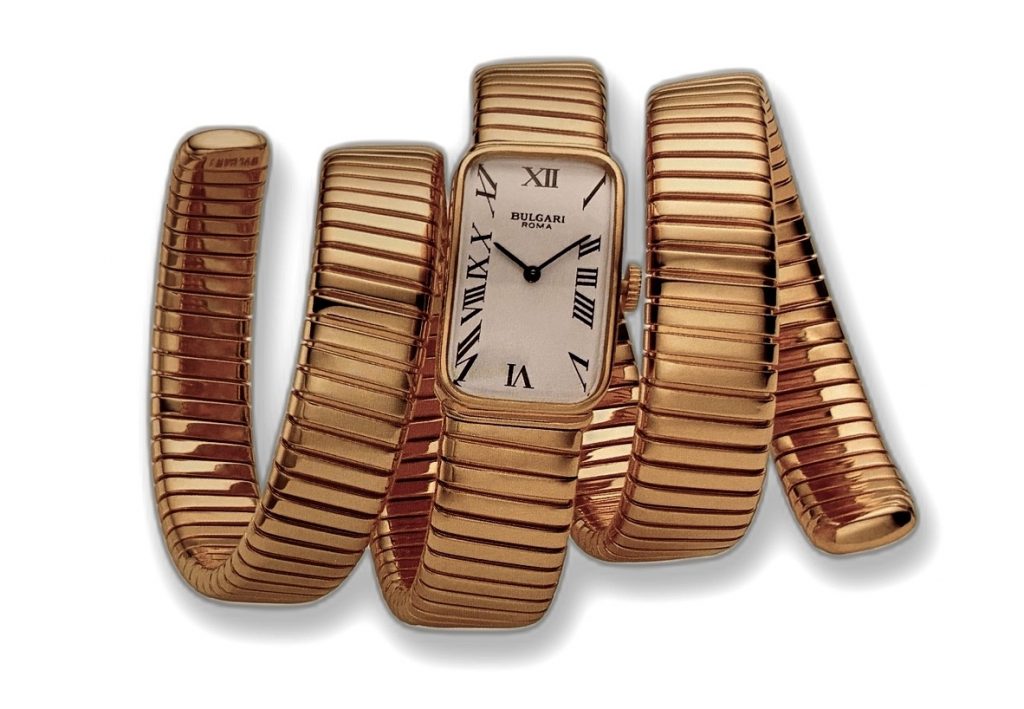
Serpenti Tubogas in yellow gold, ca. 1965. The elongated rectangular case with Roman numeral dial and the “BULGARI ROMA” signature reflect the brand’s confident Roman identity during the dolce vita era.
The 1970s: Revival and Versatility
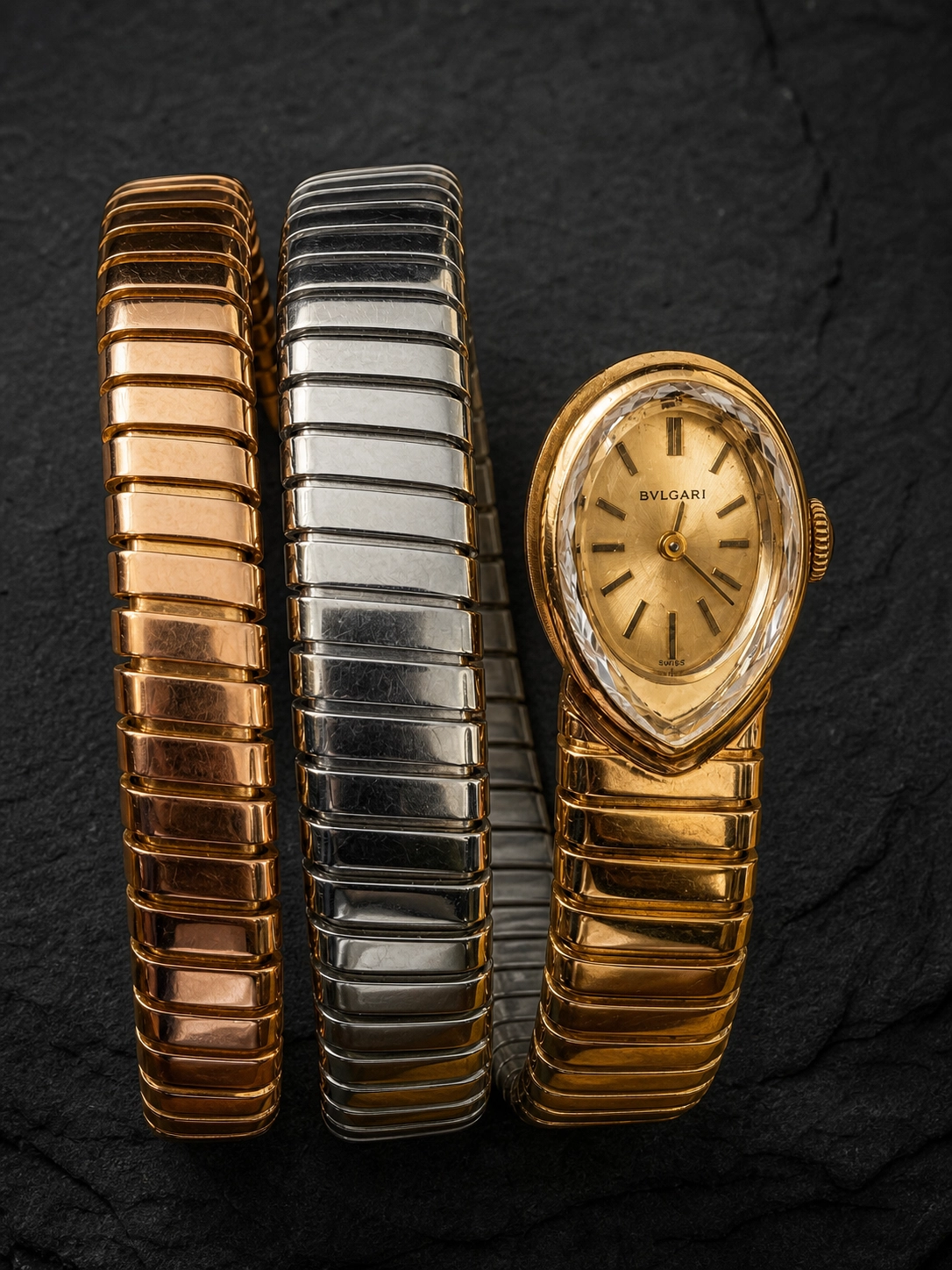
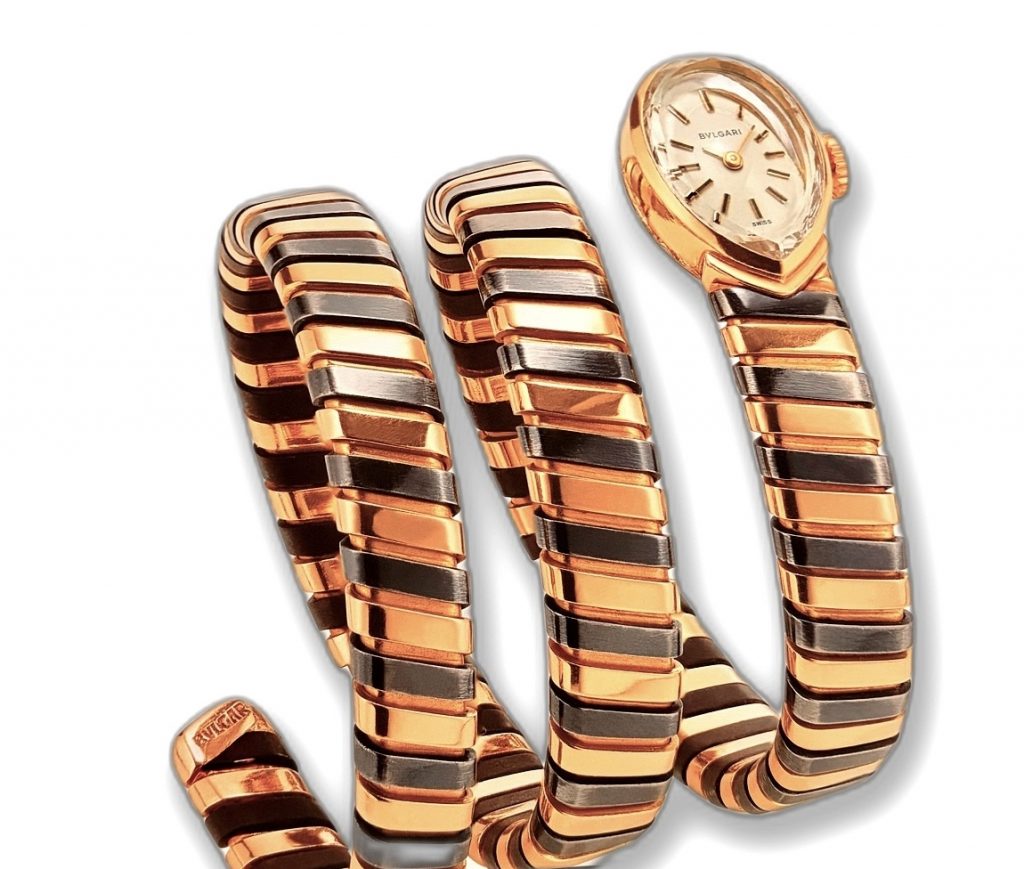
Serpenti Tubogas in yellow gold and burnished steel, ca. 1970. BVLGARI Heritage Collection.The bold alternationof polished gold and matte steel segments gives this triple-coil Serpenti a distinctly modern, graphic energy.
The Tubogas technique experienced a significant revival in the late 1960s and 1970s. This was the decade that democratized the Serpenti — at least within the realm of luxury. Two-tone gold and stainless steel combinations appeared for the first time, making the collection more accessible while maintaining its distinctive serpentine character.
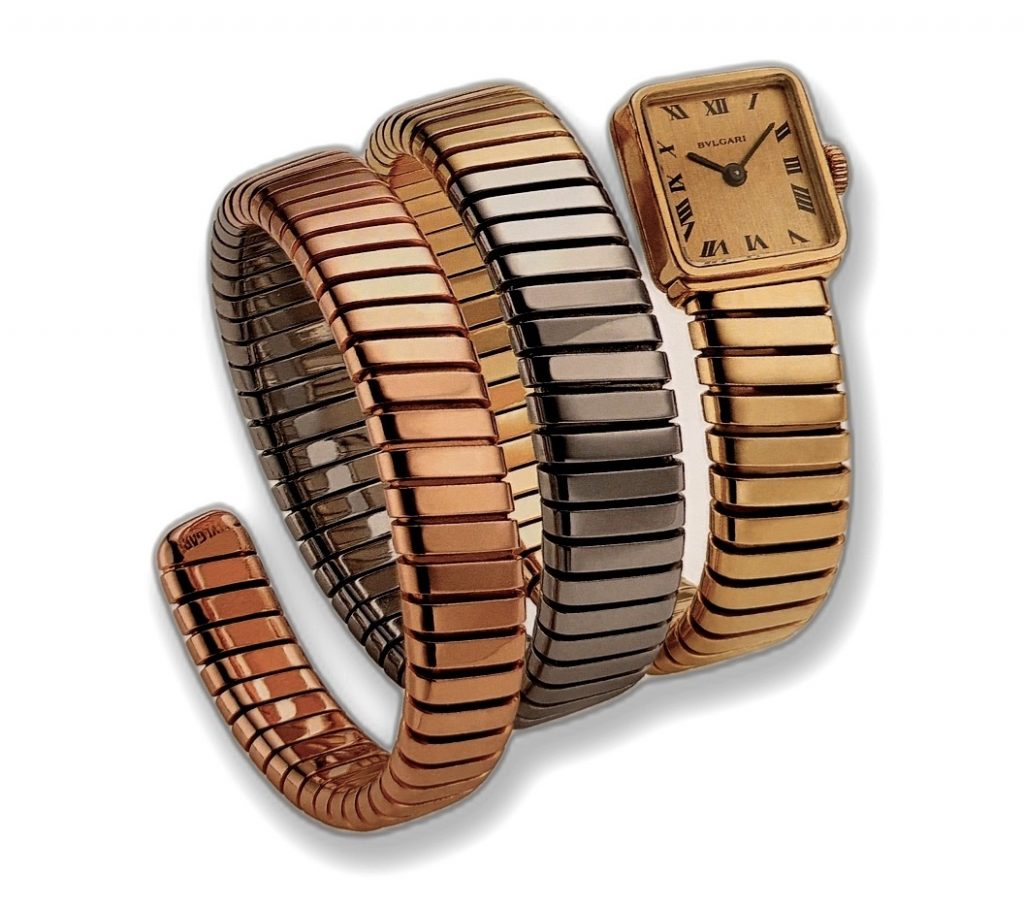
Serpenti Tubogas in three-colour gold (yellow, white, and rose gold), ca. 1970. BVLGARI Heritage Collection. A technical and aesthetic tour de force — three distinct gold alloys in a single continuous Tubogas body.
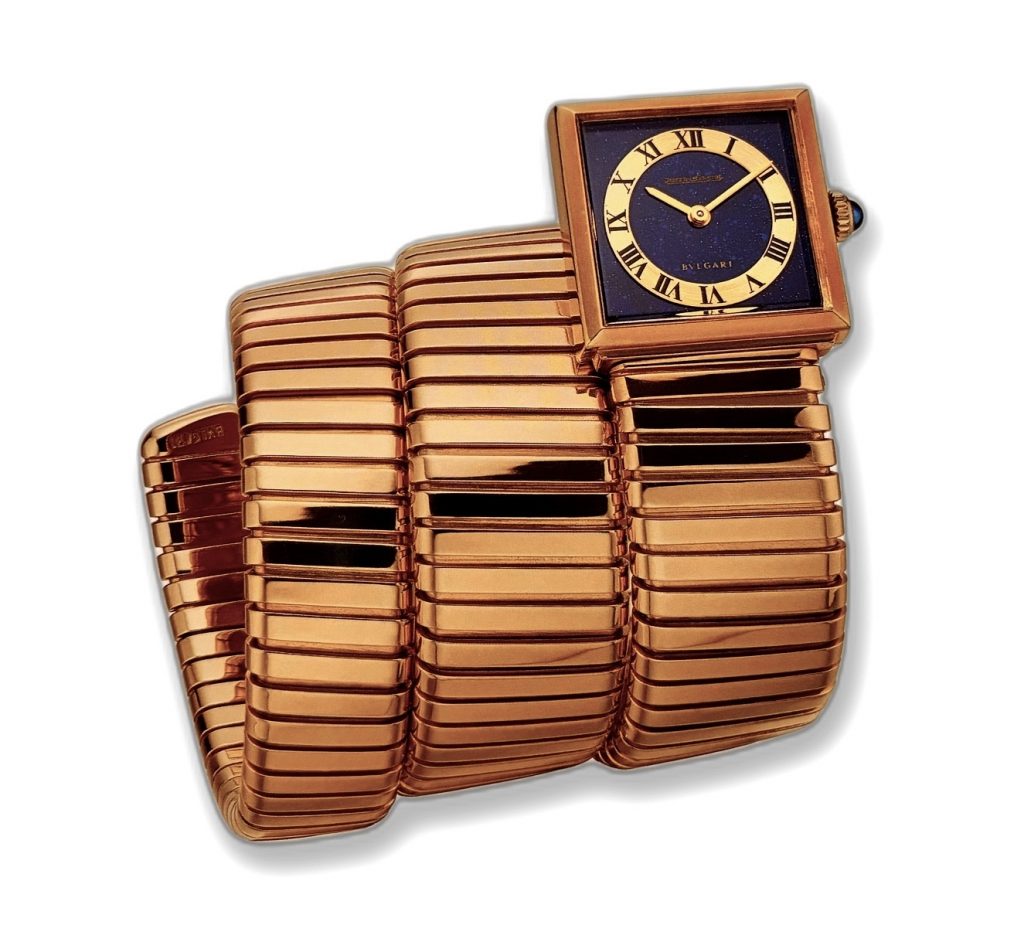
Serpenti Tubogas in yellow gold with full lapis lazuli dial, ca. 1971. BVLGARI Heritage Collection.The deep ultramarine lapis field framed by Roman numerals in gold represents the most opulent expression of Bulgari’sgemstone integration.
The 1980s and 1990s: Gold Dominance and New Forms
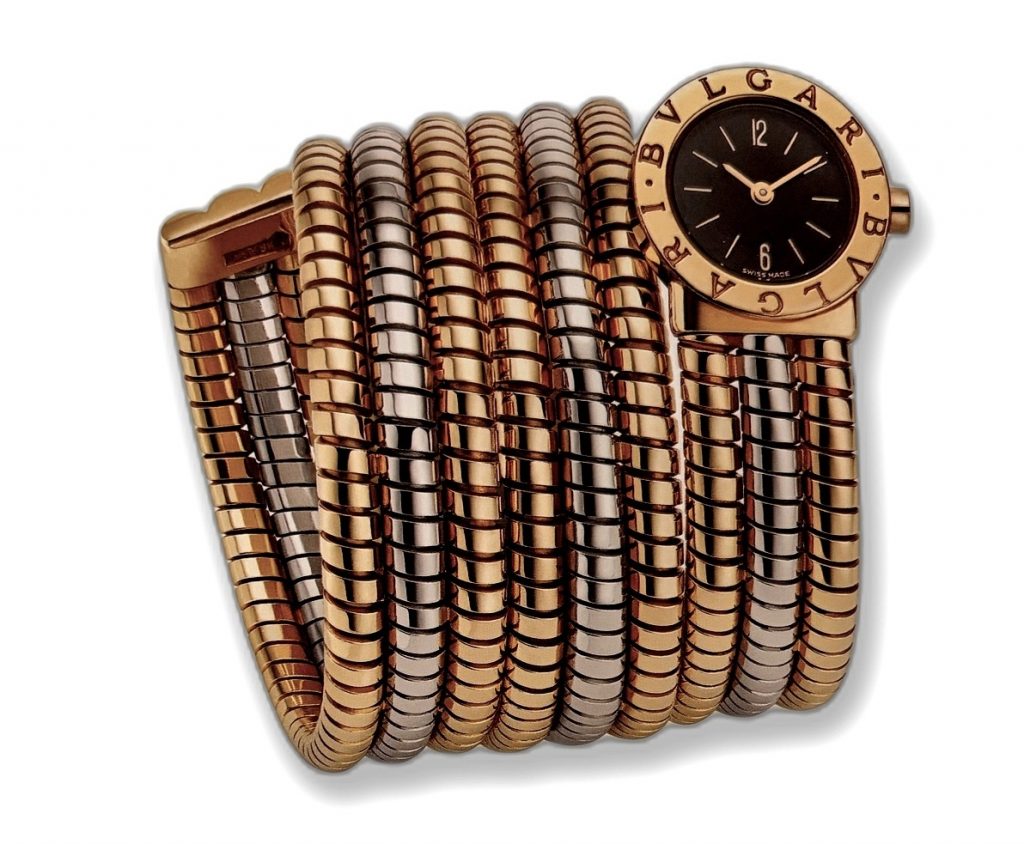
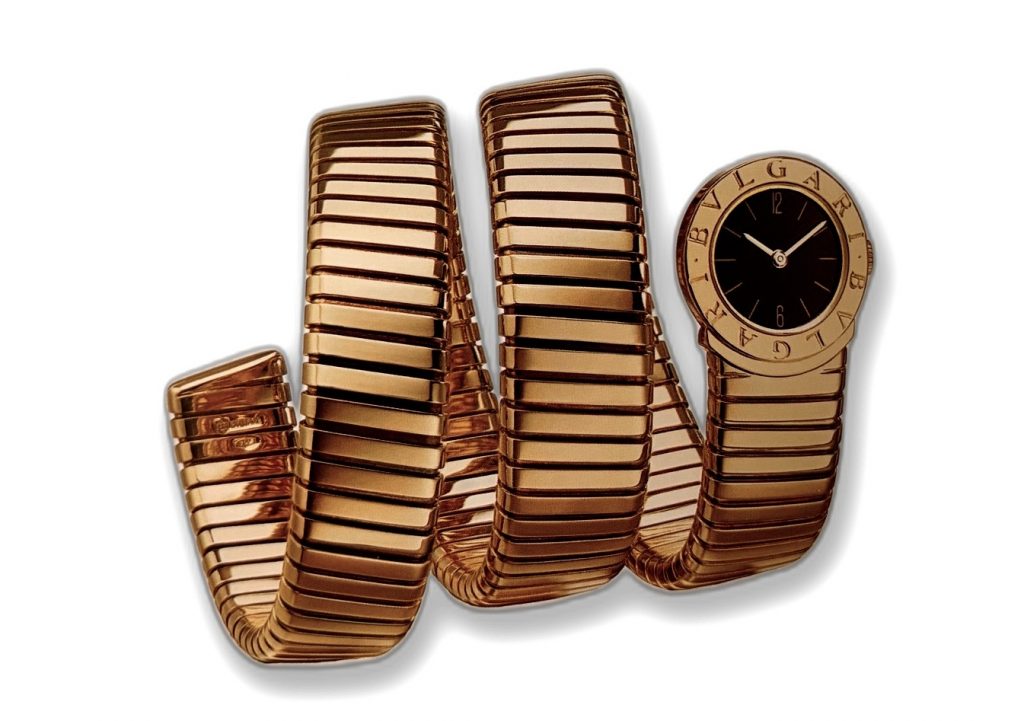
“BVLGARI BVLGARI” Serpenti Tubogas in two-colour gold, 1980. BVLGARI Heritage Collection.The extraordinary seven-turn spiral showcases the Tubogas technique at its most extravagant.
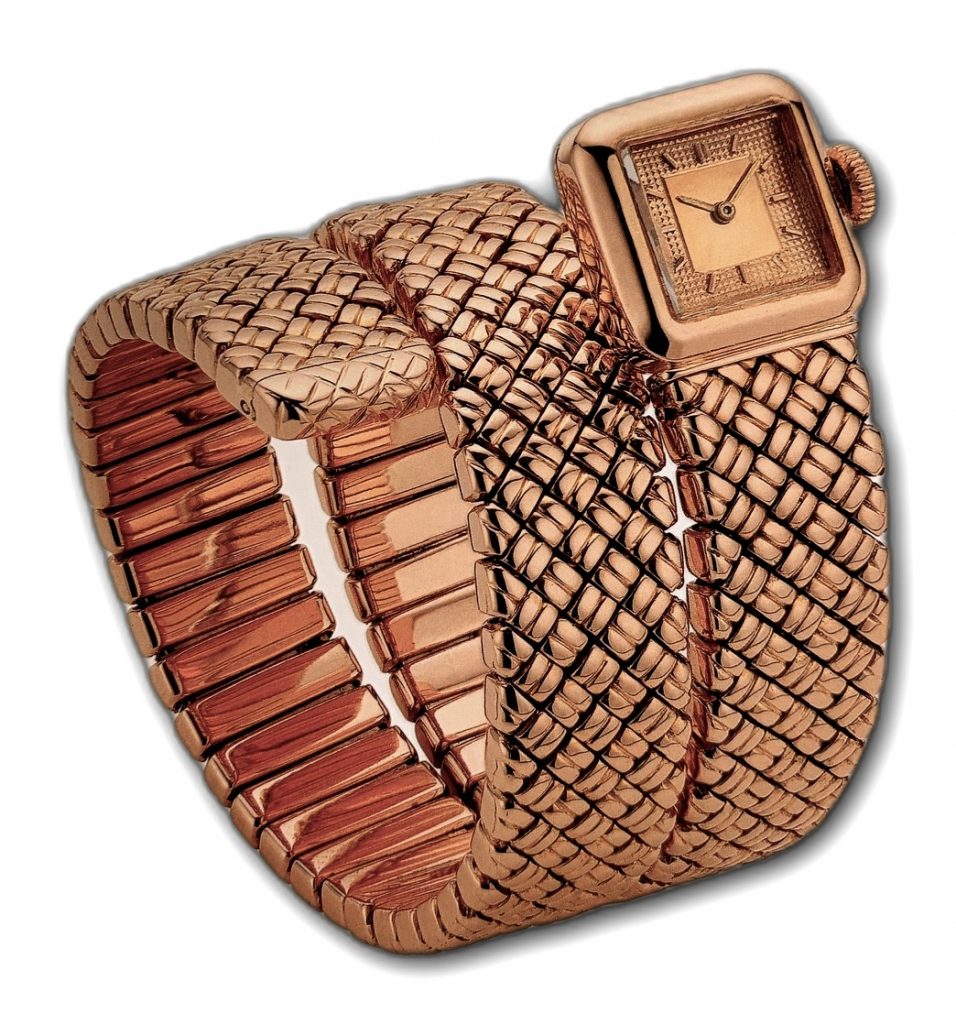
Yellow and white-gold renditions dominated the 1980s Serpenti lineup, reflecting the decade’s appetite for bold, unapologetic luxury. The 1990s brought fresh architectural thinking to the Serpenti collection, most notably with the introduction of square cases mounted on double-coiled bracelets.
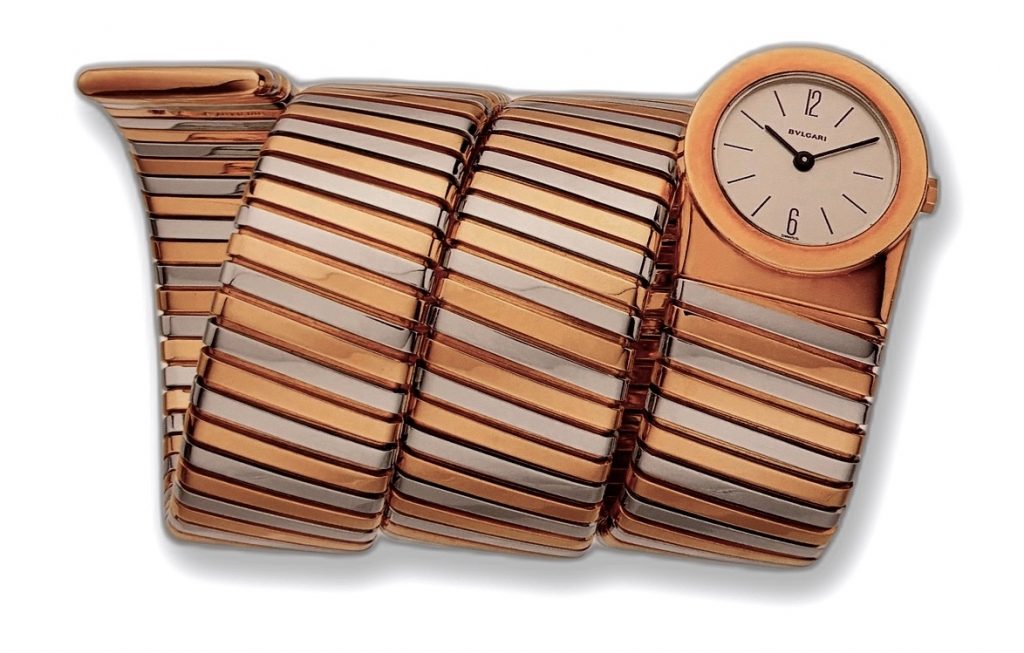
Serpenti Tubogas in two-colour gold, ca. 1985. BVLGARI Heritage Collection.The round case with clean white dial represents the refined, more restrained direction of the mid-1980s Serpenti.
The 2010s and 2020s: Modern Renaissance and Technical Innovation
The 2010s represented a modern renaissance for the Serpenti, with the introduction of multiple new sub-collections like the Serpenti Incantati (2016), the Seduttori, and the Spiga.
The current decade has been defined by serious horological innovation. In 2022, Bulgari introduced the Piccolissimo (Caliber BVL 100) movement: just 12mm in diameter, 2.5mm thick, and weighing a mere 1.30 grams. In 2025, Bulgari unveiled the new Caliber BVS 100 Lady Solotempo — an automatic movement designed and assembled entirely in Bulgari’s Swiss manufacture.
Summary Tables
Table 1: Models by Era
Model
Year Introduced
Key Features
Materials
Original Serpenti
1948
Square dial, Tubogas coiled band
Gold
Serpenti Secret Watch
Mid-1950s
Hidden dial under cap
18k gold, diamonds, enamel
Elizabeth Taylor’s
1962
Cuff bracelet, concealed dial
Gold, diamonds, emeralds
1970s Tubogas Revival
Late 1960s
Two-tone metals, wearable design
Gold, stainless steel
Serpenti Seduttori
2010s
Hexagonal case inspired by scales
Steel, rose gold, yellow gold
Serpenti Spiga
2010s
Matelassé bracelet, ceramic
Steel, ceramic, rose gold
Serpenti Misteriosi
2022
Piccolissimo mechanical movement
White/rose gold, diamonds
Serpenti Aeterna
2025
Sculptural bangle design
18kt rose gold, diamonds
Serpenti Tubogas Studs
2026
Stud accents on Tubogas
Stainless steel, 18kt yellow gold
Table 2: Auctions Pricing Data
Model
Auction Price Range
Collectibility Rating
Serpenti Seduttori
$3,700 – $28,000
Moderate (entry-level)
Serpenti Tubogas
$5,200 – $57,000+
High (iconic design)
Serpenti Spiga
$7,550 – $57,000
Moderate
Serpenti Incantati
$36,900 – €39,300+
High (limited, high jewelry)
Serpenti Aeterna
Starting ~$82,000
High (new, limited)
Serpenti Secret/Misteriosi
$285,600 – $300,000+
Very High (GPHG winner)
Vintage 1960s Enamel
Auction: $1,107,038 (record)
Exceptional
Elizabeth Taylor’s Serpenti
Auction: $974,500 (2011)
Legendary (provenance)
Conclusion: The Serpent Endures
The Bulgari Serpenti is one of the longest-running, most iconic watch designs in history — over 75 years of continuous production, continuous evolution, and continuous cultural relevance. It uniquely bridges the worlds of high jewelry and serious watchmaking in a way that few other collections can claim.
For collectors and investors, the numbers speak clearly: 84% value retention, record-breaking auction results, and a trajectory of appreciation for vintage pieces that shows no signs of slowing. The serpent continues to shed its skin and be reborn — just as the Bulgari Serpenti collection reinvents itself decade after decade while remaining unmistakably, irresistibly itself.
Gallery: The Evolution of Forms
Serpenti bracelet watch in pink gold ,1957 private collection
Serpenti tubogas bracelet watch in gold with sapphire, 1959 private collection
Serpenti bracelet-watch in yellow gold, ca. 1960. The octagonal case head is here paired with a clean white dial.
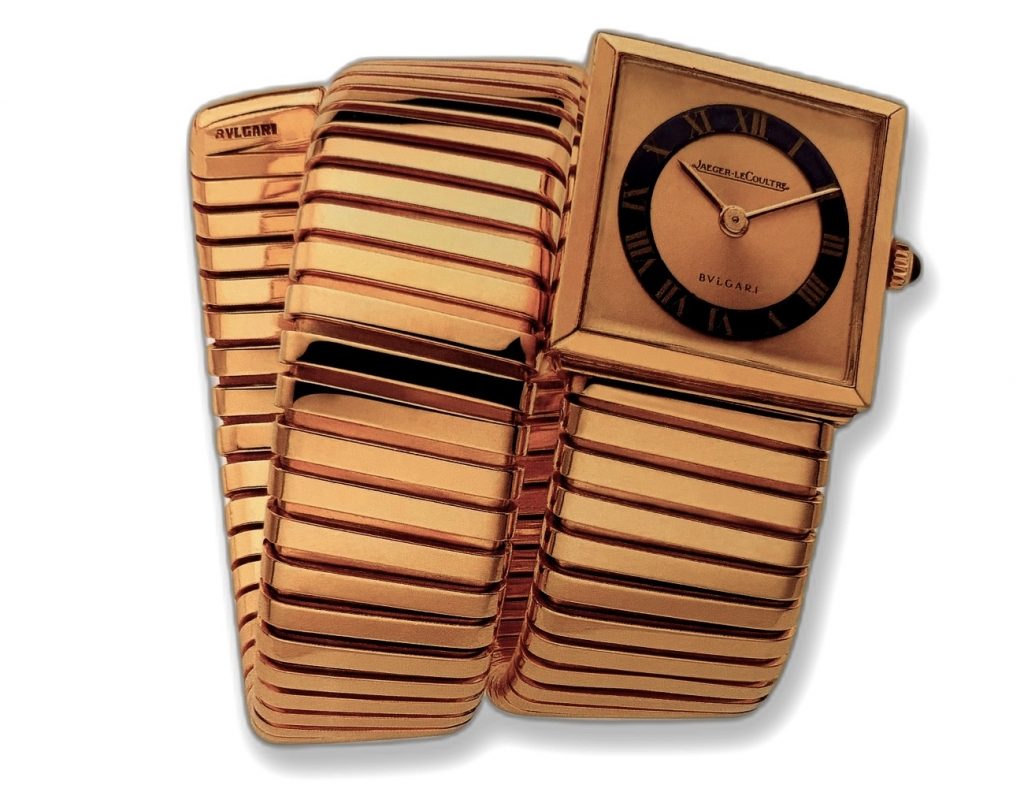
Serpenti Tubogas in yellow gold, ca. 1965. Movement by Jaeger-LeCoultre. The round case head epitomizes the opulent aesthetic of mid-1960s Bulgari.
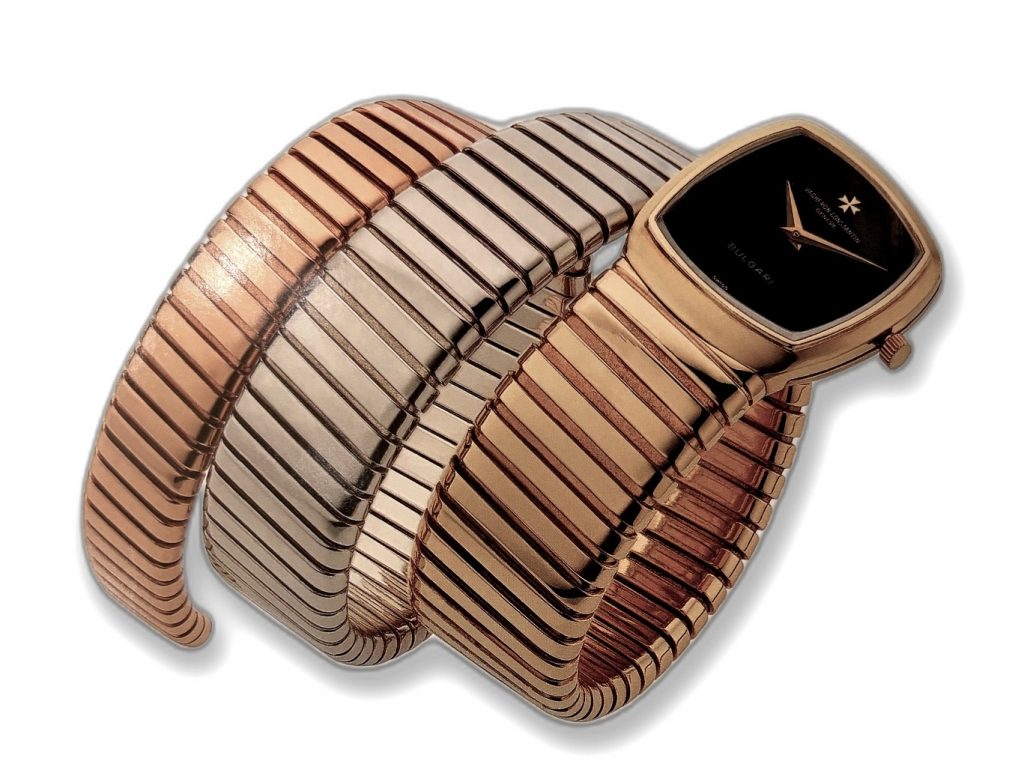
Serpenti Tubogas in three-colour gold, ca. 1970. Movement by Vacheron & Constantin. The cushion-shaped case with black lacquer dial represents a modernist direction.
Serpenti Tubogas in yellow gold with lapis lazuli and sapphire, ca. 1971. The square case demonstrates Bulgari’s use of semi-precious stones.
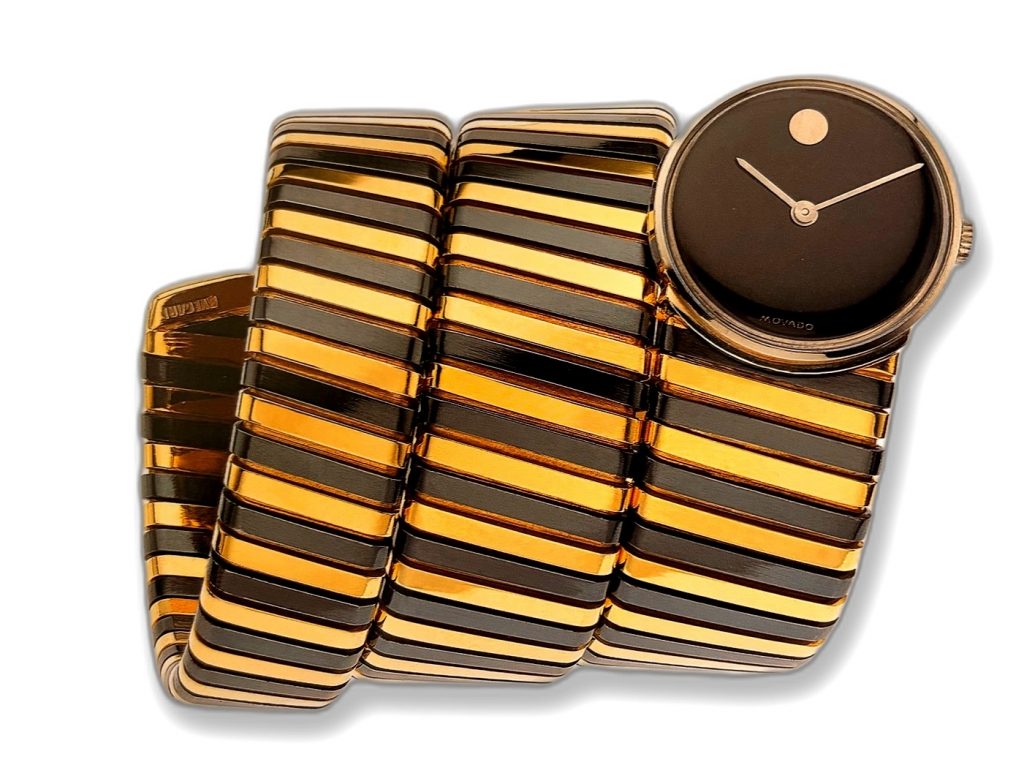
Serpenti Tubogas in yellow gold and burnished steel with Movado Museum dial, ca. 1972. An exceptional collaboration piece.
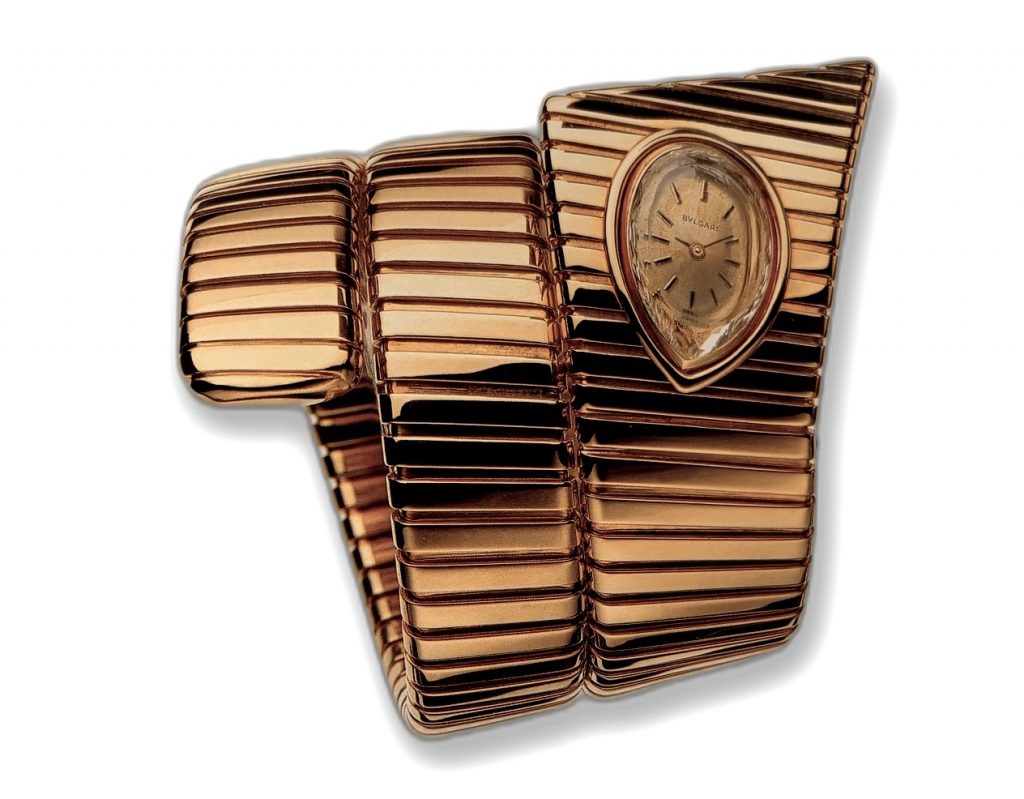
Serpenti Tubogas in yellow gold with pear-shaped case, ca. 1972. The teardrop-shaped case head illustrates Bulgari’s willingness to experiment.
Serpenti Tubogas in yellow gold, 1974. The wider, more voluminous Tubogas body reflects the decade’s taste for bold jewelry.
Serpenti bracelet-watch in yellow gold and burnished steel with woven “Intrecciato” link construction, ca. 1975.
“BVLGARI BVLGARI” Serpenti Tubogas in yellow gold, 1978. The introduction of the circular bezel marks a pivotal moment.
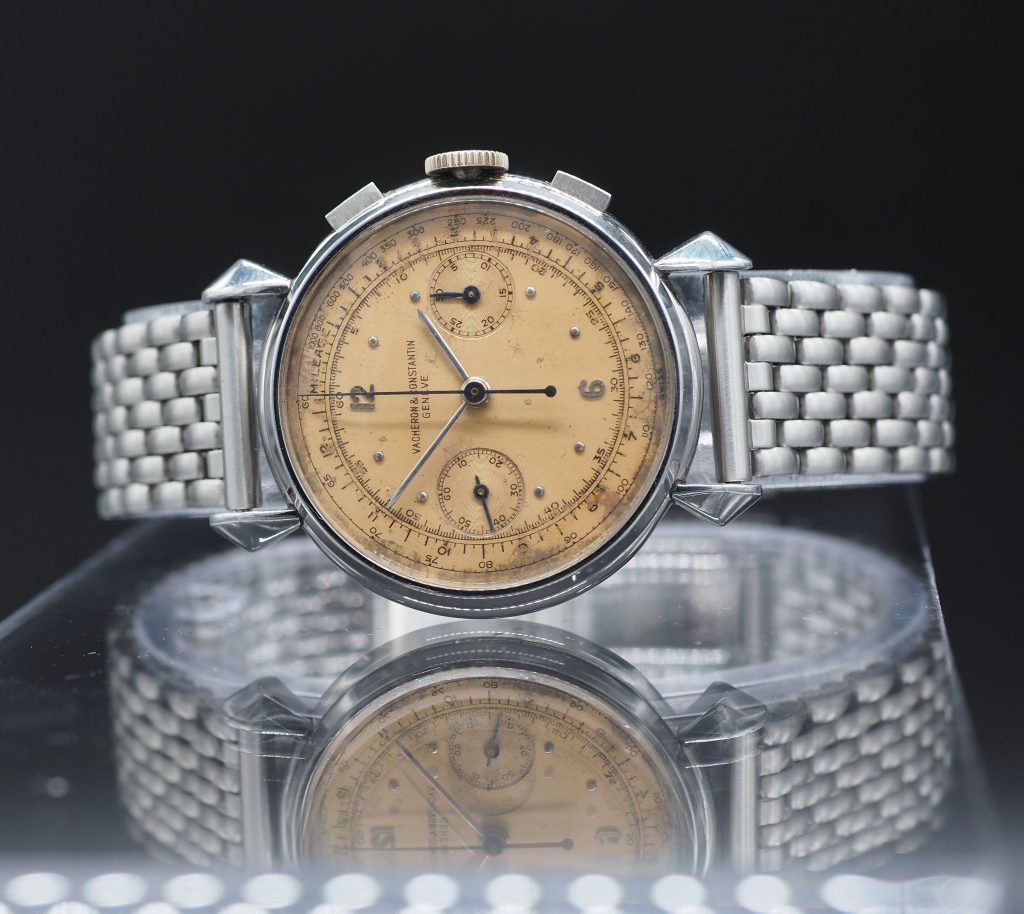
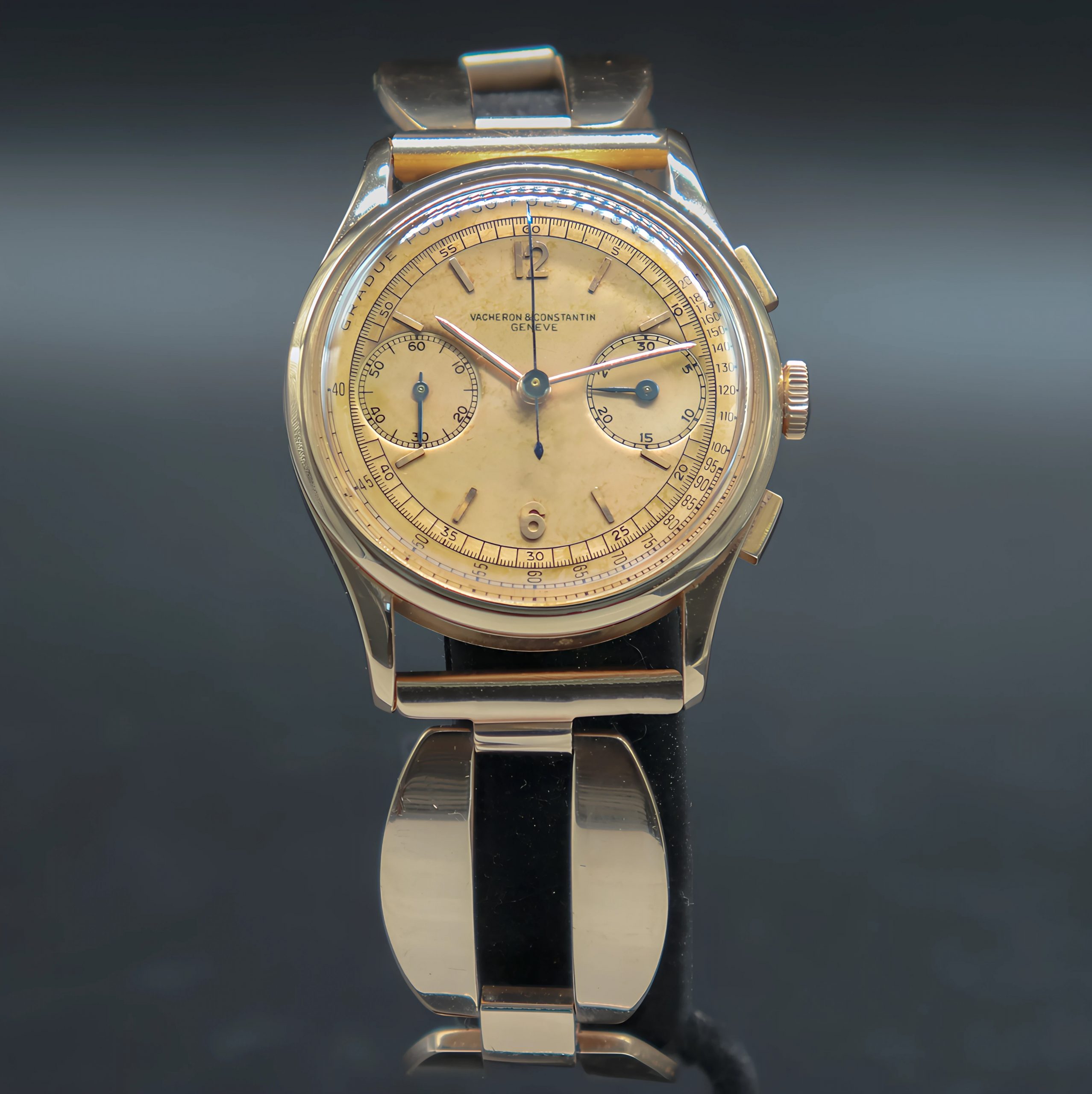
When discussing the golden era of mid-century chronographs, the conversation inevitably turns to the “Holy Trinity” of Swiss watchmaking. While Patek Philippe often dominates auction headlines, astute collectors have long recognized that Vacheron Constantin produced some of the most aesthetically perfect and mechanically refined chronographs of the 20th century. At the very heart of this legacy sits the Reference 4072.
Introduced in 1938 and remaining in the catalog until the early 1970s, the reference 4072 is one of Vacheron Constantin’s most iconic and enduring chronograph designs. Despite its long production run, it remains an exceptionally rare timepiece. Total production across all metals over more than three decades reached only 1,178 examples. This scarcity, combined with its flawless proportions and exceptional movement finishing, makes the 4072 a true connoisseur’s choice.
2. Design and Dial Variations: A Study in Nuance
The reference 4072 is instantly recognizable by its elegant 34mm case, which, despite its modest dimensions by modern standards, wears with remarkable presence due to its elongated, slightly faceted lugs and thin bezel. The pushers are typically rectangular, though extremely rare early examples feature oval pushers — a detail that makes an already rare watch even more exceptional.
What truly sets the 4072 apart for collectors is the incredible variety of dial designs produced over its lifespan. A comprehensive study by horological scholars has identified at least six distinct dial variants.
The Six Dial Variants of Ref. 4072
Variant 1 (Late 1930s): Entirely printed dials with no applied hour markers. Often features sector-dial layouts, highly prized by collectors.
Variant 2 (1940s–1950s): The most common variant, featuring applied hour markers (bead or rectangular) with Arabic or Roman numerals at 12 and 6 o’clock. Outer scales often include tachymeter or telemeter.
Variant 3 (Circa 1948): The ultra-rare black enamel dial. Only a handful of examples are known to exist.
Variant 4 (Early 1940s–1950s): Features applied gold hour markers with Roman numerals XII and VI, an open seconds track, and notably larger sub-dials.
Variant 5 (The Doctor’s Watch): Defined by a unique snail scale (pulsometer and respirometer) at the center of the dial.
Variant 6: Similar to Variant 3 but with double applied hour markers at 12 and 6 o’clock and an applied gold Maltese cross.
Metal
Estimated Production
Rarity
Yellow Gold
~600 pieces
Rare
Rose / Pink Gold
~285 pieces
Very Rare
Stainless Steel
~200 pieces
Extremely Rare
Two-Tone (Steel/Gold)
< 100 pieces
Ultra Rare
3. The Heart of the Matter: Calibre 13’VZ 434
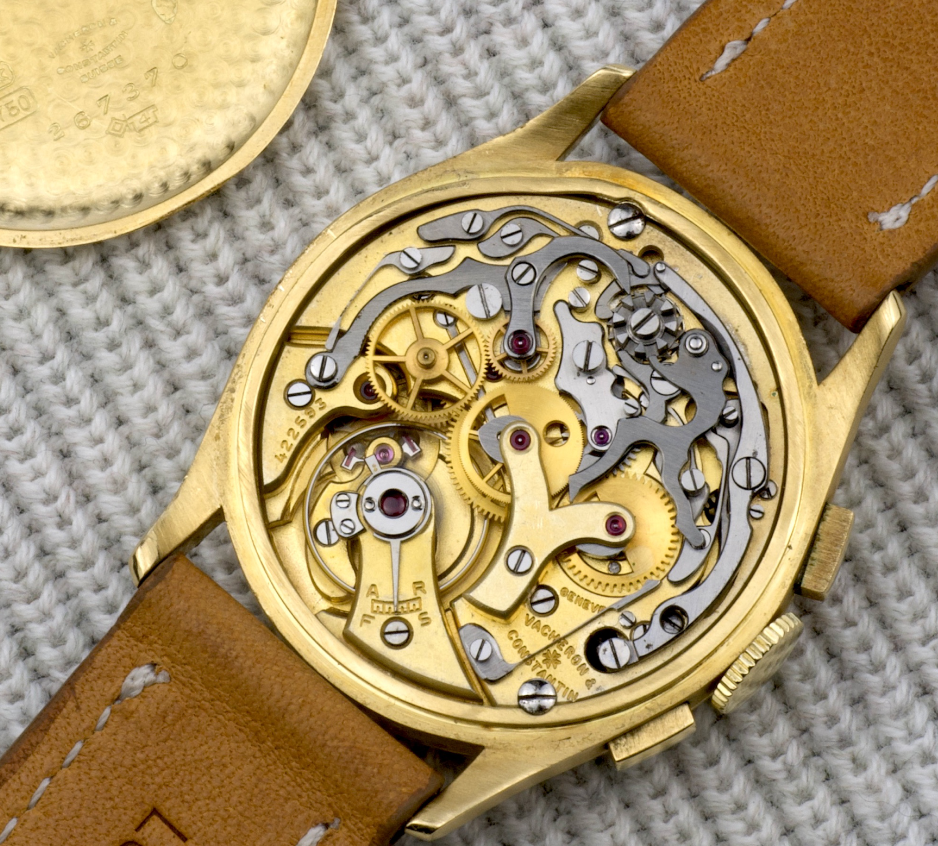
The mechanical soul of the reference 4072 is as impressive as its exterior. Vacheron Constantin utilized ébauches from Valjoux, specifically the Valjoux 22, which was heavily modified and finished to the manufacture’s exacting standards. This movement, designated as the Calibre 13’VZ 434 (and later the 13’VZ 492), represents the zenith of mid-century chronograph finishing.
Vacheron Constantin’s watchmakers applied straight graining to the flat surfaces of the steel levers, mirror-polished the screw heads and countersinks, and meticulously hand-beveled the angles of the bridges. The result is a movement that rewards close inspection with a loupe, revealing a level of artisanship rarely encountered outside of the very top tier of Swiss horology.
“This movement is based on a Valjoux 22, but has undergone the specific (very high) finishing standards of Vacheron Constantin… Having such a piece of history on the wrist is always fascinating, mainly because of what the watch represents… it has a soul!” — Monochrome Watches
4. The Allure of the Sector Dial
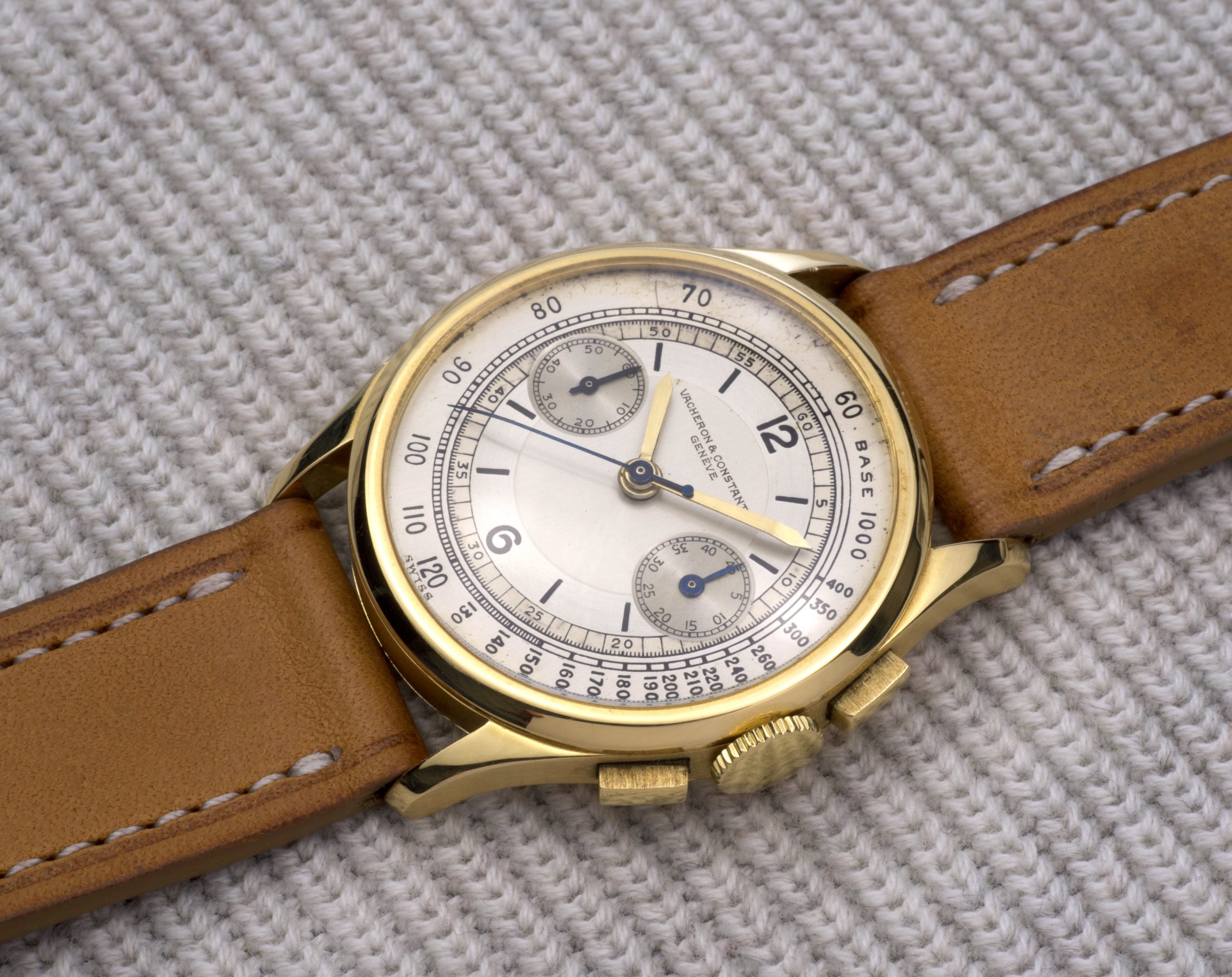
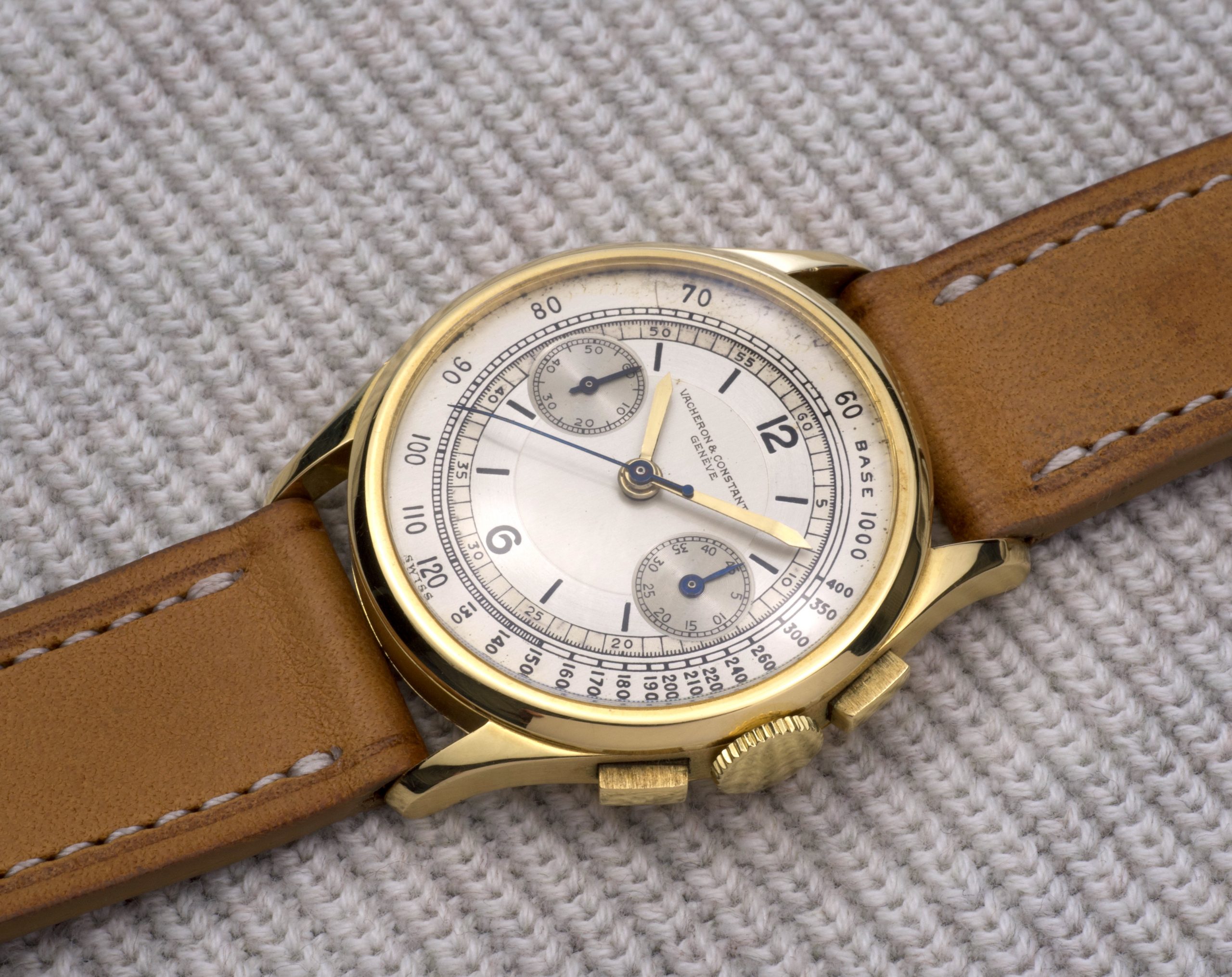
Among the various dial configurations of the reference 4072, the sector dial (often found in Variant 1) holds a special place in the hearts of collectors. Sector dials, characterized by concentric circles and distinct “sectors” for hours and minutes, were popular in the 1930s and 1940s. They offer a highly legible, almost scientific aesthetic that contrasts beautifully with the elegant case of the 4072.
The sector dial variants are incredibly rare, representing the earliest production years of the reference. Finding a reference 4072 with an original, unrestored sector dial is a significant event in the vintage watch market. The combination of the complex dial layout, the elongated lugs, and the exceptional movement makes these specific examples some of the most desirable chronographs ever produced by Vacheron Constantin.
the sector dial Ref. 4072
5. Buying Guide: Evaluating a Reference 4072
Acquiring a vintage Vacheron Constantin reference 4072 requires careful consideration and a deep understanding of the model’s nuances. Here are the key factors to evaluate.
Dial Authenticity and Condition
The dial is the most critical component of any vintage watch. For the 4072, it is essential to verify that the dial variant matches the production era of the case and movement. Many dials have been washed, reprinted, or replaced over the decades. Look for crisp printing, correct typography (especially the ampersand in “Vacheron & Constantin”), and appropriate aging. An original, untouched dial, even with some patina, is vastly preferable to a poorly executed redial.
Case Integrity
The 34mm case of the 4072 is defined by its sharp facets and elegant proportions. Over-polishing is a common issue that can ruin the watch’s aesthetic appeal. Examine the lugs carefully; they should retain their distinct shape and not appear overly rounded or thin. The hallmarks on the caseback and lugs should be visible, though some wear is expected on a watch of this age.
Movement Originality
The Calibre 13’VZ 434 should exhibit the high-level finishing characteristic of Vacheron Constantin. Ensure that all components are original and that the movement is free from significant corrosion or damage. The serial numbers on the movement and case should correspond to the correct production period.
Extract from the Archives
Whenever possible, obtain an Extract from the Archives from Vacheron Constantin. This document confirms the original configuration of the watch, including the case material, dial type, and production date, providing invaluable peace of mind for the collector.
6. The Collector’s Verdict
The Vacheron Constantin reference 4072 is not a watch for the novice. It requires a discerning eye to appreciate the subtle variations in dial typography, the crispness of the case facets, and the unparalleled finishing of the movement. For the advanced collector, acquiring a 4072 — particularly an early example with a sector dial or a rare pink gold variant — is a milestone. It represents an era when chronographs were transitioning from pure utilitarian tools to objects of immense elegance and prestige.
7. Discover the Reference 4072 at Luca Musumeci
At Vintage Watches Milano & Miami, we are thrilled to offer two exceptional examples of this legendary reference, catering to the highest echelons of vintage collecting:
Vacheron & Constantin Ref. 4072 First Series Chronograph with Sector Dial — An incredibly rare early execution (Variant 1) featuring the highly sought-after sector dial layout.
Vacheron Constantin Chronograph Pink Gold Ref. 4072 — A stunning example in the highly desirable and rare pink gold case.
Military Provenance in Vintage Rolex: The Story of the Daytona F.A.P. (Fuerza Aérea del Perú)
By Luca Musumeci | Vintage Watches Miami
1. Introduction: The Ultimate Tool Watch
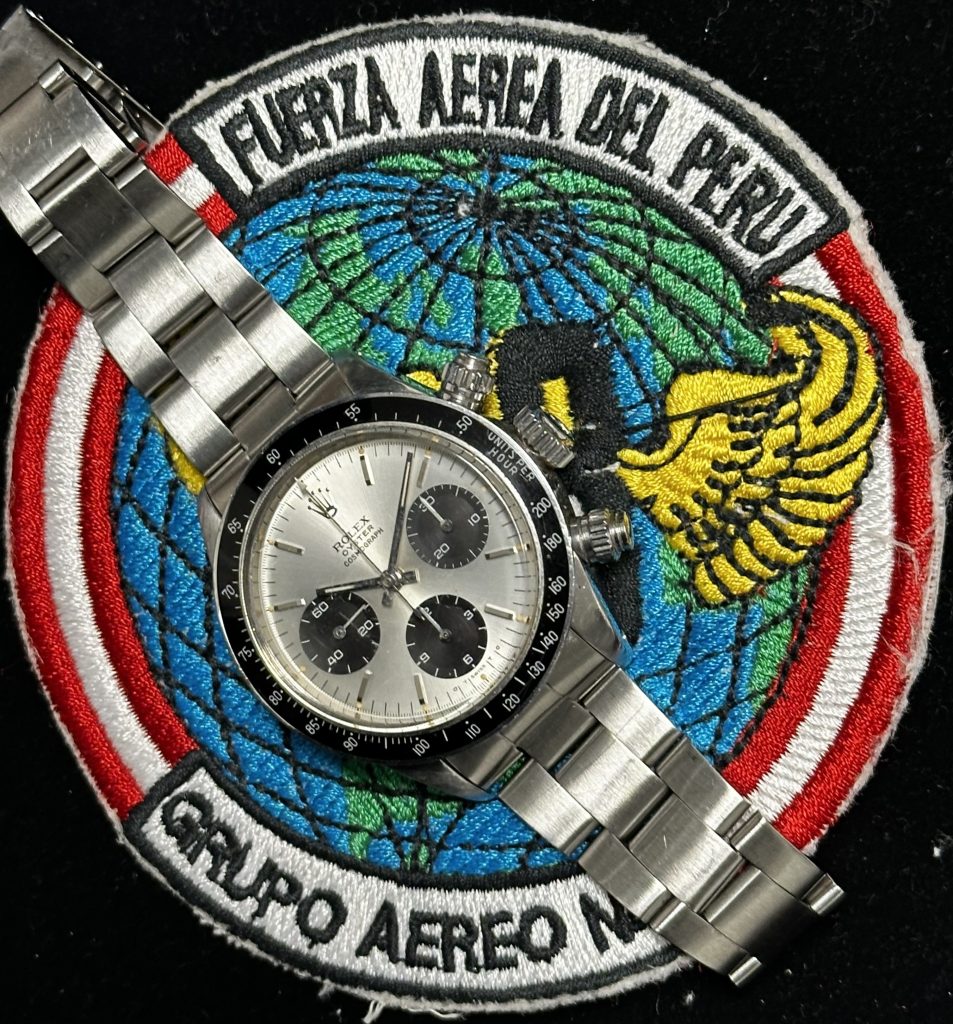
In the realm of vintage Rolex collecting, military provenance elevates a watch from a mere luxury item to a historical artifact. While the British Ministry of Defense (MoD) Submariners (“MilSubs”) often steal the spotlight, there is another, arguably more glamorous chapter in Rolex’s military history: the watches issued to the Fuerza Aérea del Perú (FAP), the Peruvian Air Force.
During the 1960s and 1970s, the FAP commissioned a variety of professional Rolex models for their officers and pilots, including Submariners, GMT-Masters, and most notably, the Cosmograph Daytona. The idea of a South American air force equipping its pilots with manual-wind Rolex chronographs — watches that today command extraordinary prices at auction — adds a layer of romance and intrigue that is unmatched in the vintage watch world.
Key Facts: The FAP Daytona at a Glance Issuing Authority: Fuerza Aérea del Perú (Peruvian Air Force) References Issued: 6238, 6239, 6241, 6262, 6263, 6265 Estimated Total Issued: 700–800 pieces (all references combined) Period of Delivery: Early 1960s to mid-1980s Serial Number Range: 1M to 6M
2. The Rolex-Peru Connection
The collaboration between Rolex and the Peruvian Air Force was not a standard military procurement contract. It was born out of a close personal friendship between the official Rolex dealer in Lima, Peru, and the late André Heiniger, the visionary Managing Director of Rolex SA (and father of Patrick Heiniger, who would later succeed him). This unique relationship allowed the FAP to order highly specialized batches of watches directly from Geneva.
It is estimated that between the early 1960s and the mid-1980s, only 700 to 800 Rolex chronographs were delivered to the FAP. These deliveries spanned several references, from the early pre-Daytona ref. 6238 to the later screw-down pusher models, ref. 6263 and 6265. The FAP also issued other Rolex professional models, including the Submariner ref. 1680, the GMT-Master ref. 1675, and steel Datejusts — but it is the Daytona that has captured the imagination of collectors worldwide.
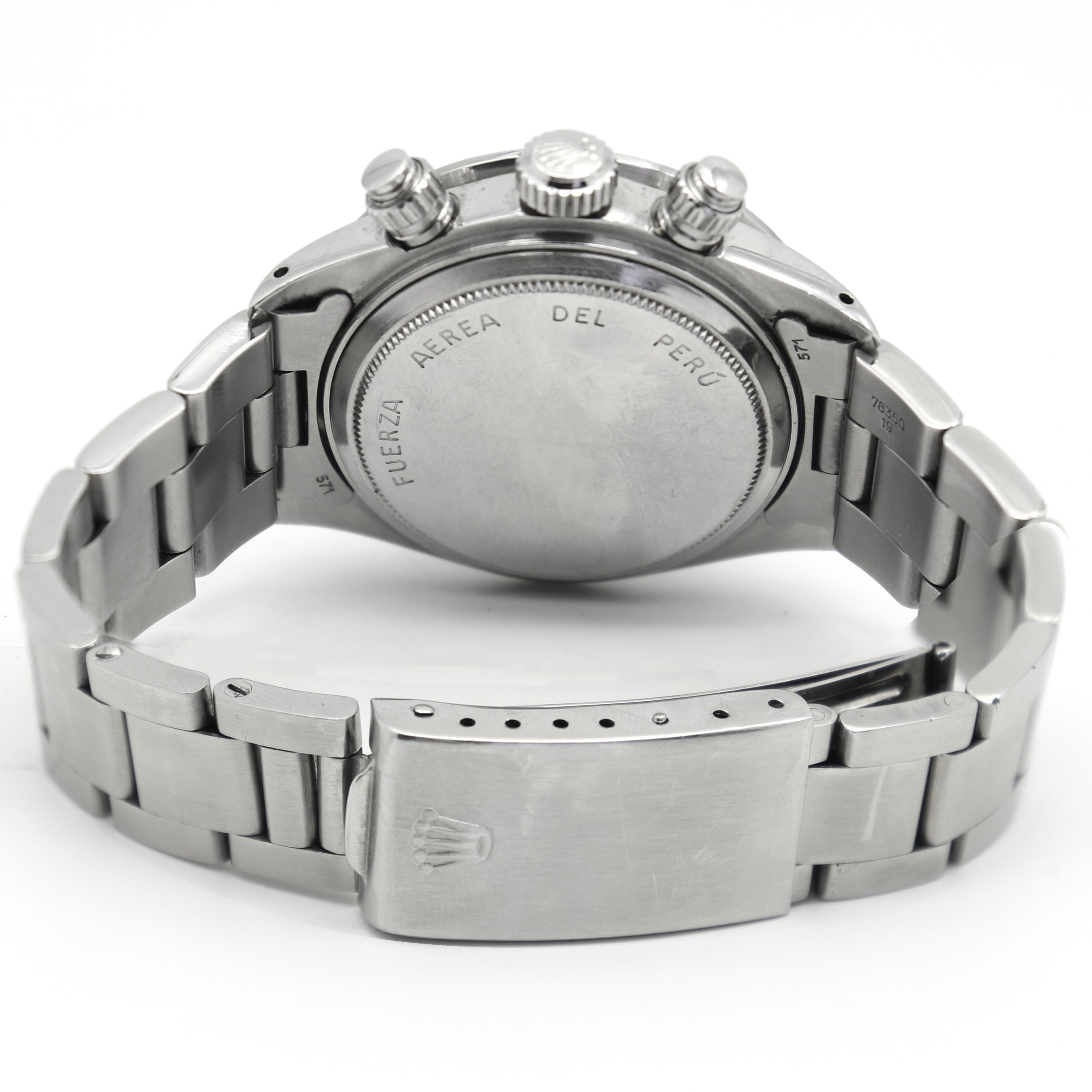
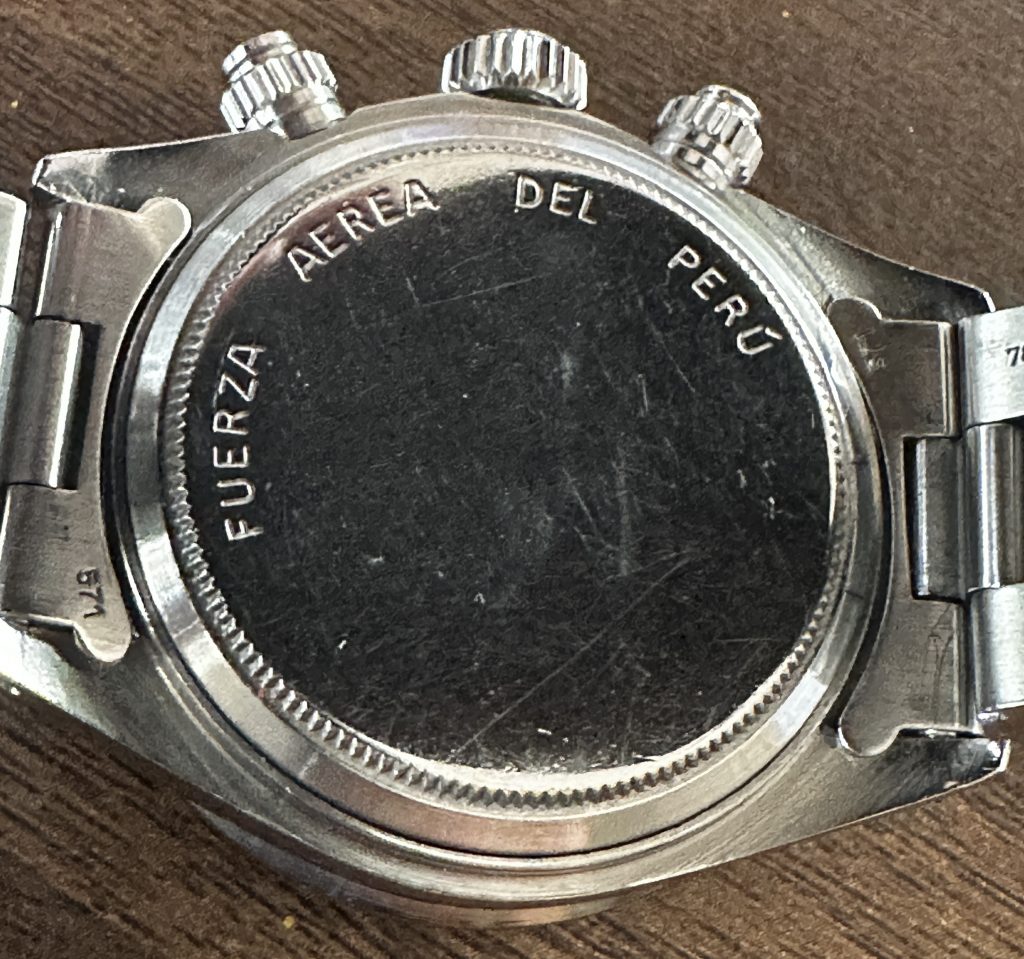
engraving caseback
3. Identifying a True F.A.P. Daytona
Given their rarity and value, authenticating a FAP Daytona requires meticulous attention to detail. The Peruvian Air Force models possess specific characteristics that distinguish them from standard civilian production.
The Engravings
The most obvious identifier is the caseback engraving. Authentic FAP Daytonas feature the words “Fuerza Aérea del Perú” engraved on the outer caseback. These engravings were done by Rolex in Geneva before delivery. Crucially, these watches also feature the watch’s serial number engraved on the inside of the caseback — a practice not standard for civilian Daytonas of the era. Furthermore, the last three digits of the serial number were often (though not always) engraved in a miniaturized font on the outer caseback, though these are frequently lost to polishing over the decades.
The Dials
The dials of FAP Daytonas are also a subject of intense study. Many of the chronographs delivered to Peru, particularly across references 6239 to 6263/5, feature dials that omit the word “Daytona” entirely. This is consistent with Rolex’s practice for tool watches supplied to military and professional organizations during this era.
“Say what you will about the Peruvian Air Force… their military had style. Where the UK military made due with a few Subs and the US was telling its crew to buy Tudors themselves, Peru ordered Pre-Daytonas, Subs, Seamasters, GMT-Masters, Speedmasters, Railmasters, and this 6263… Rolex then really had a job to do as a tool, not just fashion.” — Hairspring
Feature
Standard Civilian Daytona (6263/6265)
F.A.P. Issued Daytona
Outer Caseback
Plain
Engraved “Fuerza Aérea del Perú”
Inner Caseback
Reference number only
Reference number + Full Serial Number
Dial Text
Usually includes “Daytona”
Often omits “Daytona”
Production Numbers
Tens of thousands
~700–800 total (all references)
4. The Significance of the Sigma Dial
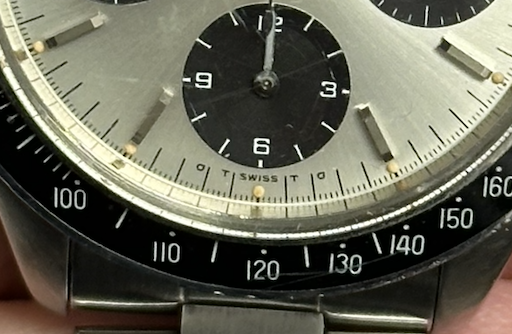
When discussing the reference 6263 FAP Daytona, the presence of a “Sigma dial” adds another layer of collectibility. Sigma dials, produced roughly between 1970 and the late 1970s, are characterized by the presence of two lowercase Greek sigma letters (σ) flanking the “T SWISS T” designation at the bottom of the dial.
These symbols indicate that the applied hour markers and hands are made of solid gold (either white or yellow), rather than steel or other base metals. This initiative was spearheaded by the APRIOR (Association pour la Promotion Industrielle de l’Or) to highlight the use of precious metals in Swiss watchmaking. Finding a FAP-issued Daytona with an original, well-preserved Sigma dial is exceptionally rare, as it combines military provenance with a highly sought-after dial variation.
Sigma dial
5. Buying Guide: What to Look For
Acquiring a FAP Daytona is a significant investment, and careful due diligence is required.
Verifying the Engravings
The outer caseback engraving “Fuerza Aérea del Perú” should be crisp and consistent with known examples. However, because these watches were used in military service, the engravings may be worn or partially polished away. The inner caseback engraving of the full serial number is a critical authentication point — it must match the serial number engraved between the lugs.
Dial and Hands
The dial should be original and untouched. As mentioned, many FAP Daytonas lack the “Daytona” text. The luminous material on the dial and hands should match and show consistent aging. Any signs of reluming or dial refinishing significantly impact the watch’s value.
Case Condition
While military watches are expected to show signs of wear, a well-preserved case is highly desirable. Look for thick, even lugs and original pushers and crown. Over-polishing is a common issue that detracts from the watch’s historical integrity.
Provenance
Any documentation or provenance linking the watch to its original military owner adds immense value and historical context. While rare, such provenance is the ultimate prize for a military watch collector.
6. The Market and Collectibility
The market for FAP Daytonas has matured significantly over the last decade. Once considered a niche sub-category, they are now recognized as blue-chip collector’s items. While a standard reference 6263 is a highly desirable watch, an authentic FAP-issued 6263 commands a substantial premium — often double the price of a civilian model. This premium is justified not only by the extreme rarity of the watches but by the fact that they were genuine military tools, used in the cockpits of Mirage and Canberra fighter jets.
The condition of the dial is paramount. A lightly patinated silver dial with golden tritium plots, like the Sigma dial variant, is considered highly desirable. Any cracks in the acrylic crystal, polishing of the case, or replacement of original components significantly diminishes both authenticity and value.
7. Discover the F.A.P. Daytona at Luca Musumeci
At Vintage Watches Milano & Miami, we understand the profound historical significance of military-issued Rolexes. We are incredibly proud to offer a museum-quality example of this rare breed:
Rolex Daytona Ref. 6263 F.A.P. Silver Sigma Dial — An exceptional and highly original example of the Peruvian Air Force Daytona, featuring the correct engravings and a stunning silver Sigma dial in remarkable condition.
Patek Philippe Reference 2526: An In-depth Analysis of a Vintage Watchmaking Icon
The Patek Philippe manufacture is universally recognized as a bastion of haute horlogerie, celebrated for creating timepieces of exquisite craftsmanship and profound historical significance. Among its numerous creations, the reference 2526 holds a place of particular importance. Introduced in 1953, this model marked a fundamental step in the brand’s history, representing its first self-winding wristwatch. This innovation, combined with an elegant design and meticulous execution, has made the 2526 a highly desirable piece for collectors and a symbol of watchmaking excellence. This report aims to provide an in-depth analysis of the Patek Philippe reference 2526, exploring its historical context, technical specifications, design characteristics, rarity, market value, opinions of the collector community, and the importance of its provenance.
Genesis of an Icon: Historical Context and Development
The reference 2526 made its appearance at the Basel Fair in 1953, a period of significant evolution for the watchmaking industry, characterized by a growing focus on automatic movements. In this context, Patek Philippe, while maintaining its reputation for the highest quality manual-winding movements, recognized the importance of embracing this emerging technology. The result of this vision was the development of the caliber 12-600 AT, the first automatic movement entirely designed and manufactured by the company. This caliber represented a remarkable technical achievement for Patek Philippe, testifying to its commitment to innovation and independence. The choice to develop an in-house automatic movement, rather than relying on external suppliers, allowed Patek Philippe to maintain its high quality standards and exercise complete control over the production process.
It is interesting to note that the introduction of an automatic movement by Patek Philippe occurred at a time when automatic winding technology had already been present on the market for several decades. Rolex’s patent on the “perpetual” movement with a 360-degree rotor, filed about twenty years earlier, may have represented a legal constraint for other watchmaking houses. However, evidence suggests that Patek Philippe had already begun working on its own automatic movement for years, meticulously perfecting it while awaiting the expiration of the Rolex patent. This strategy demonstrates Patek Philippe’s philosophy, oriented towards quality and technical precision, rather than the hasty introduction of a product not yet up to its standards. The wait and subsequent introduction of the caliber 12-600 AT confirmed Patek Philippe’s dedication to watchmaking excellence.
Anatomy of a Classic: Design and Technical Specifications
Case Construction and Materials
The case of the reference 2526 typically featured a three-part construction, with a screw-down case back designed to ensure a certain degree of water resistance. This feature, innovative for the time, contributed to the robustness of the watch and made it more suitable for everyday use. The 2526 was produced in various precious metal versions: 18-karat yellow gold (the most common), 18-karat rose gold, 18-karat white gold, and platinum. The availability in all four noble metals underscores the luxurious nature of this timepiece. The case dimensions generally hovered around 35-36 mm in diameter, a size that was considered quite generous at the time and gave the watch a notable presence on the wrist.
The Distinctive “PP” Crown
An iconic detail of the reference 2526 is its cast gold crown, characterized by the intertwined “PP” logo. This particular crown not only facilitated manual winding and time setting but also became a distinctive element highly appreciated by collectors, often associated with the era of the caliber 12-600 AT. Its presence adds a touch of refinement and recognizability to the overall design of the watch.
The Revolutionary Caliber 12-600 AT
The beating heart of the Patek Philippe reference 2526 is the caliber 12-600 AT. This self-winding movement, awarded the prestigious Geneva Seal, was composed of 30 jewels and featured a Gyromax balance and an 18-karat gold rotor finely decorated with a guilloché pattern. The caliber 12-600 AT was not only technically advanced for its time but also beautifully finished, reflecting Patek Philippe’s commitment to haute horlogerie. The innovative automatic winding mechanism was the subject of a Swiss patent, number 289758, granted in 1953, testifying to the originality of the technology developed by Patek Philippe.
The Enamel Dial: A Masterpiece of Craftsmanship
Characteristics of the Double-Fired Enamel Dial
One of the most distinctive elements of the reference 2526 is its enamel dial. Made using the “double-fired on sterling silver disc” technique, this type of dial was conceived to offer greater beauty and durability, resisting color change and scratches. The typical hue of many enamel dials of the 2526 is a cream or ivory white, a shade that has become a hallmark of the vintage model and is particularly appreciated by collectors. The earliest versions of the dial featured applied 18-karat gold baton indexes riveted or fixed with pins.
First Series vs. Subsequent Dials
A significant difference between the first series and subsequent dials concerns the method of fixing the indexes. In the first series dials, the indexes were inserted into the enamel through pins, a process that left subtle “dimples” visible on the surface of the dial. In later series, this technique was abandoned, and the indexes were glued directly onto the enamel surface. The first series dials, with indexes fixed with pins, are often considered more desirable by collectors for their rarity and for being a testament to an initial production technique later abandoned.
The Rarity of Black Enamel Dials
Another peculiarity that significantly increases the value of the reference 2526 is the presence of a black enamel dial. Examples with a black dial are extremely rare and highly sought after by collectors, fetching significantly higher prices at auction due to their scarcity. The difficulty in producing perfect black enamel dials contributed to their limited distribution.
The Fragility of Enamel Dials
Despite their beauty and presumed durability, enamel dials are inherently fragile and susceptible to cracks or damage, especially in the event of shocks. Therefore, the condition of the dial is a crucial factor in the evaluation of a vintage Patek Philippe 2526. Collectors pay particular attention to the absence of cracks or chips, as even a small defect can significantly affect the value of the watch.
Rarity and Variations: Exploring Different Metals and Series
Production Numbers and Metal Rarity
Estimates of the total production of the reference 2526 hover around 2500 examples, distributed among the different metal variants. Yellow gold is considered the most common metal, with an estimated production of around 2400 examples. Rose gold is significantly rarer, with approximately 360 examples produced. White gold and platinum are the rarest variants, with an estimated production of around 70 examples each. This scarcity makes the white gold and platinum versions particularly coveted by the most discerning collectors. Some sources suggest that, despite the estimated production number being the same for white gold and platinum, white gold examples are even harder to find on the market today.
Distinctive Features of Different Series/Generations
Over the course of its production, the reference 2526 underwent some evolutions, giving rise to different series or generations. Although the differences may be subtle, collectors hold them in high regard. Generally, four main series are distinguished. The first series is characterized by a domed screw-down case back and an enamel dial with applied indexes fixed with pins. The second series also features a domed screw-down case back and an enamel dial with inlaid indexes. The third series is identical to the second but with a practically flat screw-down case back. Finally, the fourth series has a flat screw-down case back and an enamel dial with inlaid luminescent indexes. Understanding these differences between the series helps collectors identify the specific characteristics and relative rarity of each example.
The Auction Block: Tracing Market Value and Notable Sales
The Patek Philippe reference 2526 is a highly sought-after watch in the vintage and collectible watch market, and its performance in international auctions reflects this interest. The prices achieved vary considerably depending on the case metal, dial color, condition, and the presence of any special features such as the signature of a prestigious retailer or the completeness of the original accessories.
Table 1: Notable Auction Results for the Patek Philippe Reference 2526
Auction House
Date
Reference (Metal/Dial)
Realized Price (Currency)
Estimated Price (Currency)
Notable Features
Christie’s
May 2012
Ref. 2526 Rose Gold/Enamel
HKD 524,000
HKD 240,000 – 380,000
Extract from the Archives
Sotheby’s
October 2024
Ref. 2526 Platinum/Enamel (Serpico Y Laino)
HKD 5,700,000 (approx. USD 732,690)
HKD 1,200,000 – 2,400,000
Retailed by Serpico Y Laino
Christie’s
November 2017
Ref. 2526 Yellow Gold/Black Enamel (Gobbi Milano)
CHF 100,000
Not specified
Signed by Gobbi Milano, Black Dial Certified Original
Sotheby’s
November 2024
Ref. 2526 Yellow Gold/Enamel
CHF 20,000 – 30,000
Not specified
With Patek Philippe box
Sotheby’s
April 2023
Ref. 2526 Yellow Gold/Enamel (First Series)
Not specified
Not specified
Extract from the Archives
Sotheby’s
December 2024
Ref. 2526 Yellow Gold/Enamel (First Series)
USD 25,000 – 50,000
Not specified
Extract from the Archives, Service Box
Sotheby’s
October 2024
Ref. 2526 Platinum/Enamel (Serpico Y Laino)
HKD 1,200,000 – 2,400,000
Not specified
Signed by Serpico Y Laino, Extract from the Archives
Antiquorum
November 2007
Ref. 2526 Yellow Gold/Enamel (Third Generation)
CHF 13,000 (Hammer Price)
CHF 8,000 – 12,000 (Estimate)
Extract from the Archives
Antiquorum
November 2007
Ref. 2526 Rose Gold/Enamel (Hausmann & Co.)
CHF 64,900 (Hammer Price)
CHF 60,000 – 70,000 (Estimate)
Patek Philippe rose gold bracelet, Extract from the Archives
First Patek Philippe automatic wristwatch, Sold to J.B. Champion
The analysis of auction results highlights how platinum examples, especially those signed by prestigious retailers such as Serpico Y Laino, tend to fetch the highest prices. Examples with the rare black enamel dial also achieve significantly higher prices due to their scarcity. The overall condition of the watch, particularly that of the delicate enamel dial, and the presence of original accessories, such as the box and papers, play a fundamental role in determining the final hammer price.
Voices of Collectors: Opinions from Forums and Online Communities
The Patek Philippe reference 2526 is held in high regard by the vintage watch collector community. On specialized forums such as Rolex Forums, WatchProSite, and WatchUSeek, there is a general appreciation for its historical importance as the brand’s first automatic watch, for its refined design, and for the exceptional quality of the caliber 12-600 AT and the enamel dial.
A recurring theme in discussions is the fragility of the enamel dial. Collectors are aware of its vulnerability to cracks and emphasize the importance of carefully examining the condition of the dial before a potential purchase. The search for examples with immaculate enamel dials is a priority for many enthusiasts.
Some collectors believe that the reference 2526 is an “underrated” model in the landscape of vintage Patek Philippe watches. Despite its historical significance and horological value, its market price may not always fully reflect its importance compared to other iconic models of the brand. This aspect makes it, for some, an interesting opportunity to acquire a piece of watchmaking history at a relatively accessible price.
Navigating the Market: Retailer Listings and Availability
The Patek Philippe reference 2526 is available for purchase through various channels, including retailers specializing in vintage watches and online platforms such as Chrono24. The presence of the model on different platforms offers collectors a variety of acquisition options but also requires careful research and due diligence.
The prices requested by retailers can vary significantly depending on the case metal, dial variant, condition, and the presence of original accessories. For example, a Patek Philippe 2526J Vintage Hausmann Automatic Calatrava Watch from the years 1954-5 was found for sale on Patekmonger at a price of $52,900.00 1. Several listings for the reference 2526 are present on Chrono24, including an 18-karat yellow gold version with an enamel dial from 1955 2.
Often, retailers highlight particularly desirable features such as “first series,” “enamel dial,” or the signature of a renowned retailer in their listings to attract experienced buyers. The presence of these specifications can significantly influence the asking price.
The Significance of Provenance: Retailer Signatures and Historical Documentation
The presence of a retailer’s signature on the dial, such as Tiffany & Co., Gobbi Milano, Serpico Y Laino, and Hausmann & Co., can add significant value and increase the historical importance of a vintage Patek Philippe 2526 4. These signatures testify to the partnership between Patek Philippe and internationally renowned jewelers and confer an aura of exclusivity to the watch.
Equally crucial for collectors is the presence of original documentation, particularly the Extract from the Archives of Patek Philippe 8. This official document certifies the authenticity of the watch, its production date, and its original specifications, providing a fundamental guarantee for collectors. The availability of the original box and papers, although not always possible for watches of this age, further contributes to the completeness and collectible value of the timepiece.
Conclusion: The Enduring Legacy of the Patek Philippe 2526
In summary, the Patek Philippe reference 2526 represents a milestone in the history of watchmaking as the first self-winding wristwatch produced by Patek Philippe . Its timeless design, the technical brilliance of the caliber 12-600 AT, and the enduring appeal of the enamel dial make it a piece of great value for collectors . The rarity of certain variants, particularly those in white gold, platinum, and with a black enamel dial, is reflected in their high prices in the auction market . For collectors, the condition, provenance, and presence of signatures from prestigious retailers are factors of primary importance in evaluating an example . The Patek Philippe 2526 remains a highly collectible and historically significant watch, testifying to a crucial moment in the evolution of Patek Philippe and automatic watchmaking .
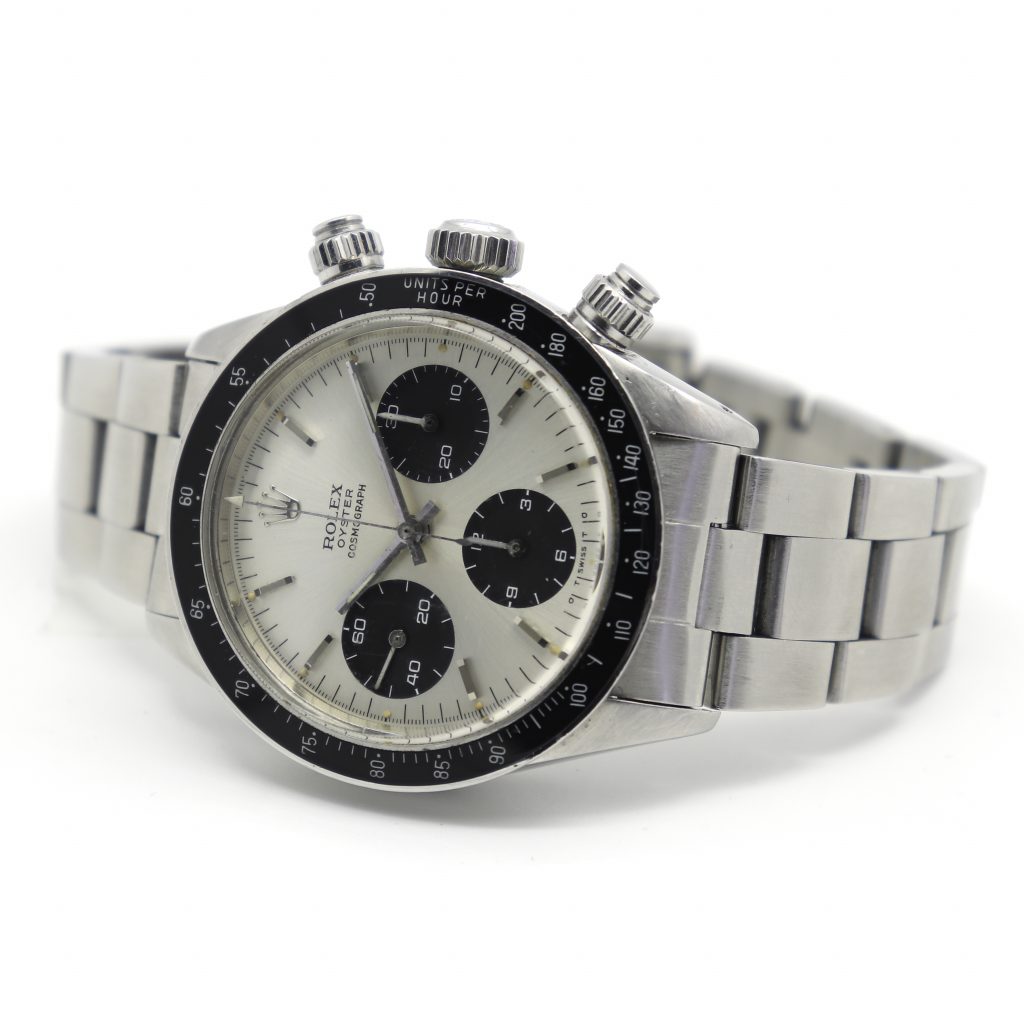
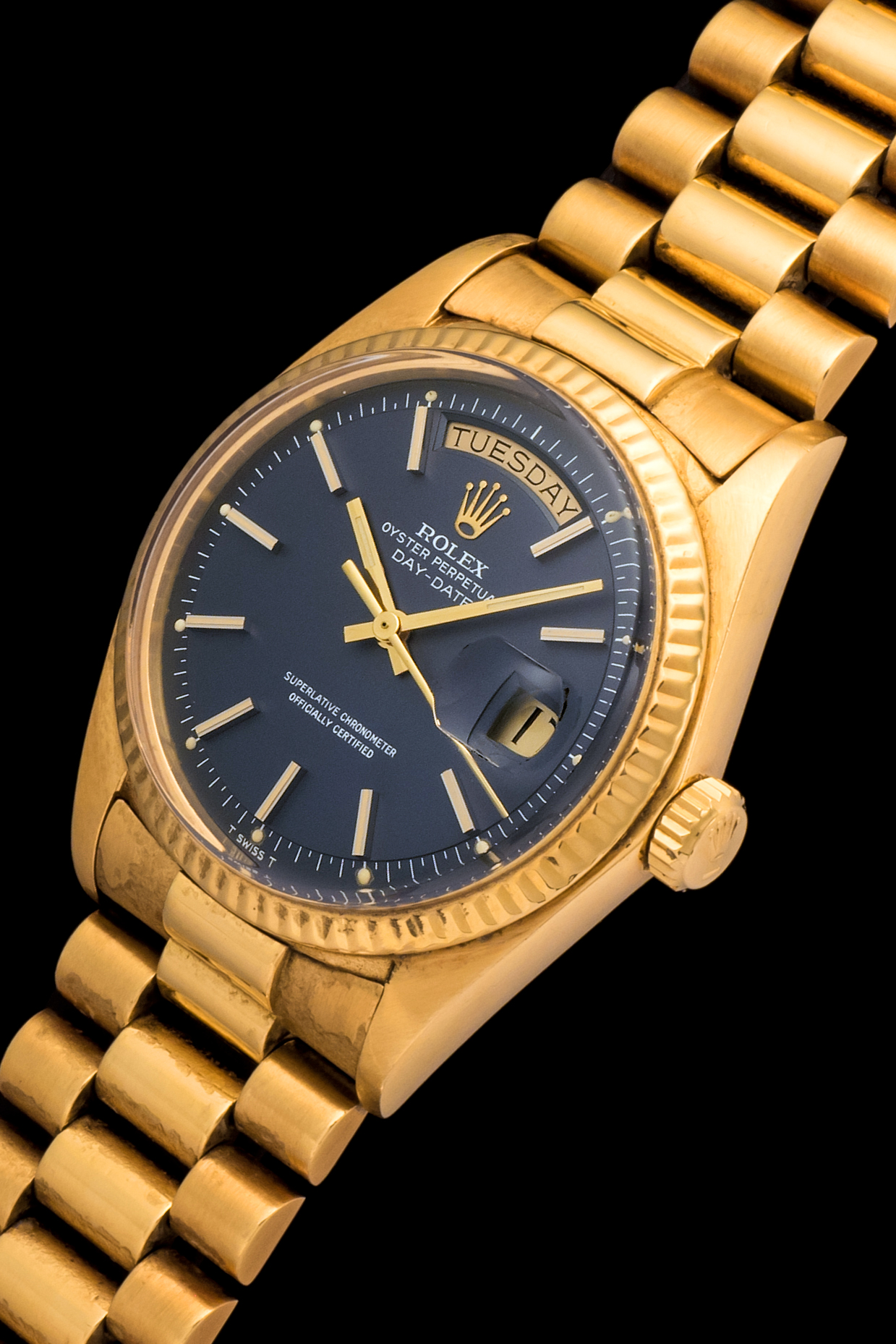
In 1956 Rolex introduced the Day-Date and its doing ensured its relevance for perpetuity. The release of the Day-Date was as magnificent as it was bewildering to its fans, some still attempting to embrace the reference 8171 “Padellone” that had just ceased production and the charm of the newer reference 6062 at the same time. The Day-Date brought about an era that celebrated luxury and elegance, and it joined the 6062 to show the world that Rolex could do luxury watches just as well as it did tool watches. The novelty behind the Day-Date was its capability of displaying both the day and the date, and to add an additional degree of luxury the watch was only to be cased in precious metals such as gold and platinum. Note: handful of examples in steel were made for special Rolex clients.
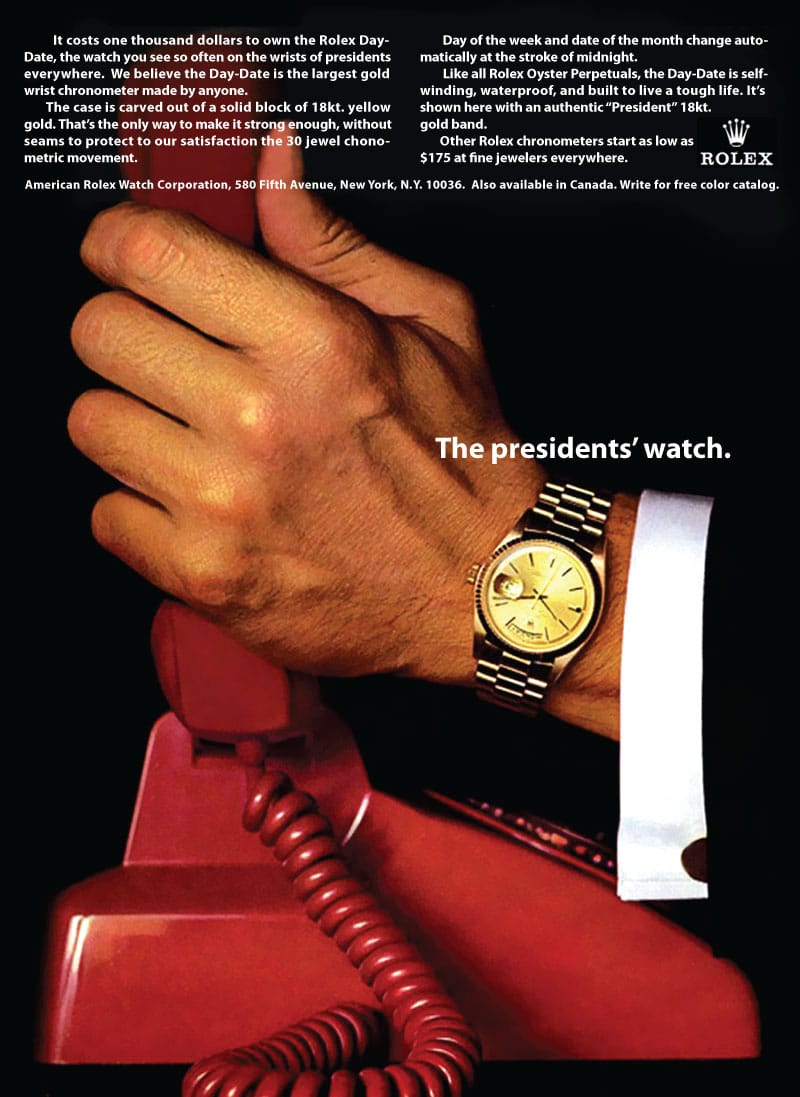
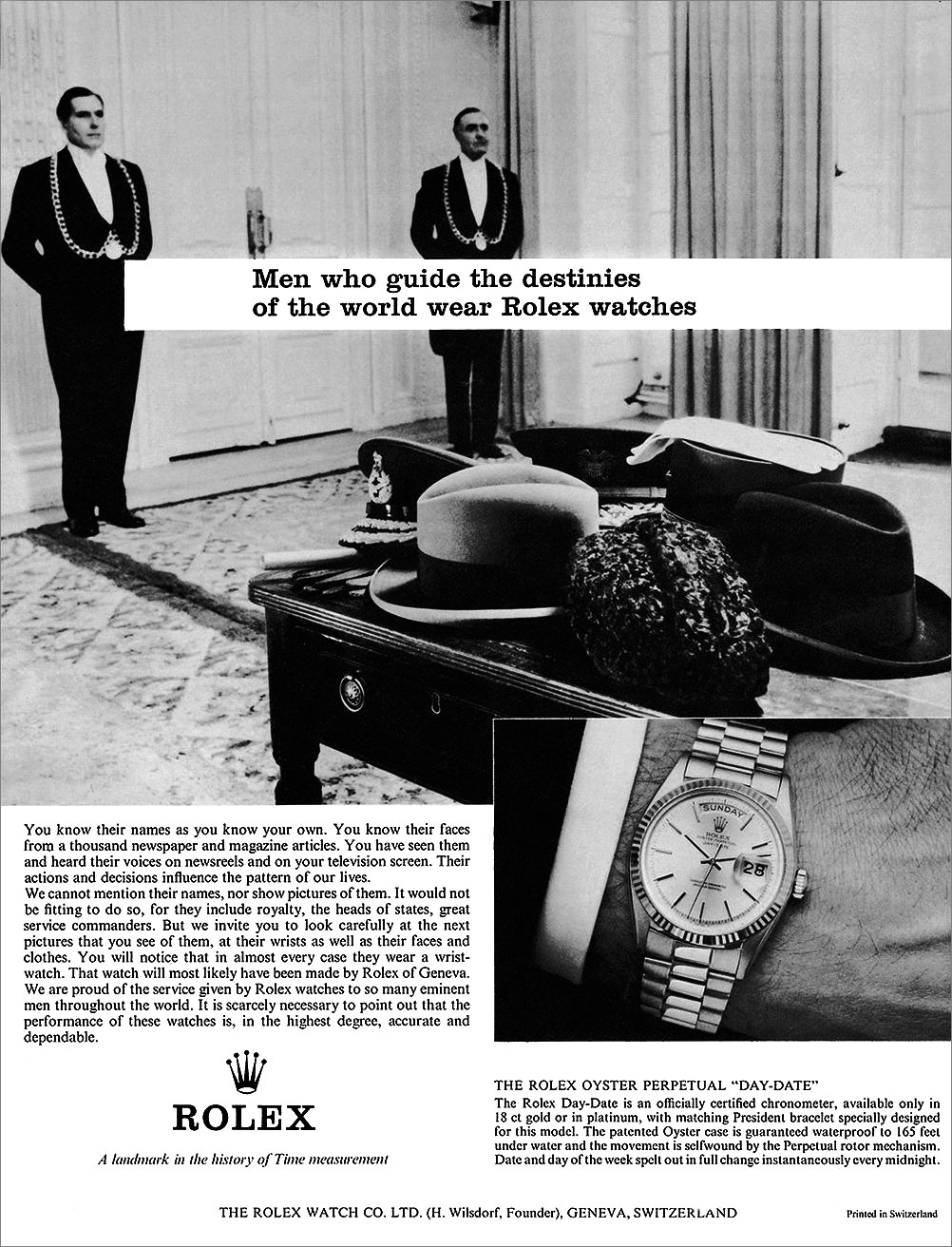
The Day-Date put Rolex in an unbeatable path through brilliant manufacture practices and forward thinking advertising. Early Day-Date adverts remain as cool today as they were back then. The fact that the Day-Date would go on to become President Lyndon B. Johnson’s go-to watch played right into Rolex’s brilliant marketing plan. Through unofficial spokesmen the Day-Date snowballed into success and Rolex into a household name. Now that modern times have rolled in and symbolic references have ceased production the Day-Date continues to be an intrinsic symbol of elegance, power, and distinction. In our collection are some of the most beautiful and rare Day-Dates available to the public. Read on to learn more about the Rolex Day-Date.
Rolex Day-Date 6611B
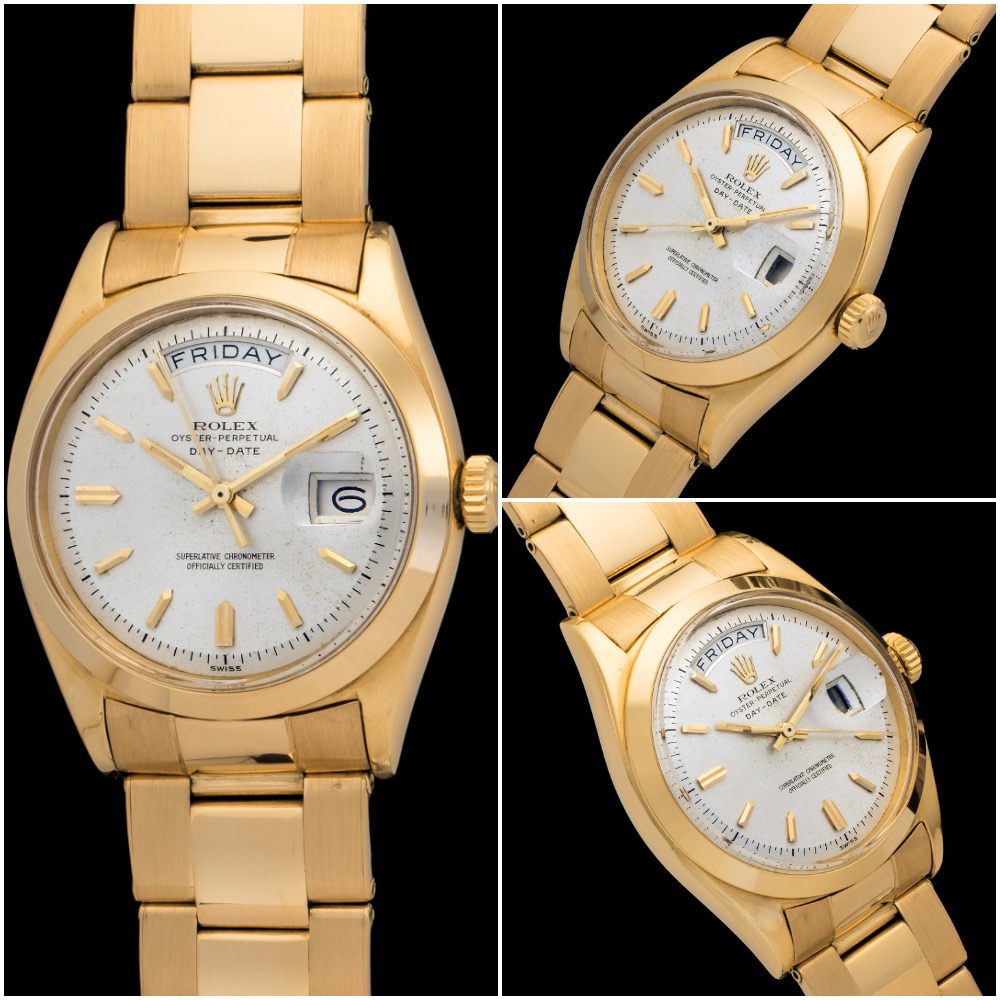
Following the reference 6611B came an equally as beautiful model, the Day-Date 6612 (see ours pictured) Along with a re-designed watch came two additional novelties: a smooth bezel and a slightly better movement. Our Day-Date 6612B from 1959 is put together by an 18K yellow gold oyster rivet band, which is an incredibly rare detail as Day-Dates were sold with jubilee bands, very select few were sold with gold oyster rivets.
Rolex Day-Date 1803
The reference 1803 came out in 1961 with an array of details that earned it a decades long production period. The first three references allowed Rolex to make changes and technological advances, which eased in the design and launch of the Day-Date 1803. This was the model that became a staple on the wrists of the worlds most powerful men. With the reference 1803 the Day-Date adapted its identity and pedigree that is palpable today. From 1961 to 1968 the Day-Date 1803 stayed its course with no features added or taken, although during this time Rolex did introduce a wide array of dial variations. However in 1969 Rolex introduced a detail that would forever become synonymous with the model and that was the hidden clasp bracelet later deemed the Presidential bracelet. The moniker comes about thanks to United States president Lyndon B. Johnson as he was pictured wearing his reference 1803, which included the new bracelet style. In our collection are two special full sets 1803’s. One is fitted with a doorstop dial and the other An 1803 manufactured in 1962 and accompanied by its original box and papers. A nice detail aside from its complete set is its doorstop dial. If you notice the indexes positioned at 6 o’clock and 9 o’clock resemble a doorstop. This watch comes with a leather band and not a hidden clasp gold bracelet. Pictured is another 1803 fitted with a hidden clasp bracelet and accompanied by box and papers. The papers denote a full Rolex service done to the watch in Saudi Arabia.
Rolex Day-Date 18038
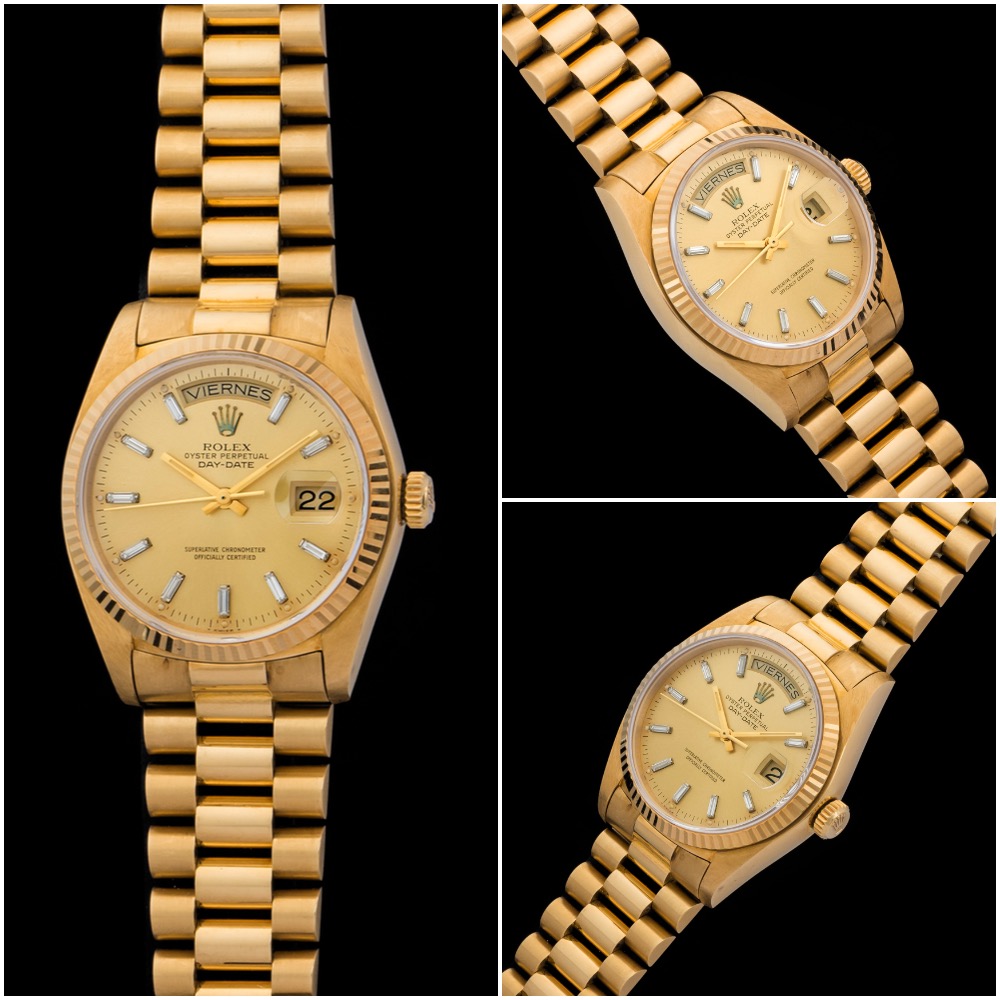
The successful Day-Date 1803 was replaced in 1977 with the reference 18038. This new reference introduced two details that are now staples on modern Day-Dates. The sapphire crystal replacing the plexiglass and the quick-set capable movement. Pictured is an early iteration of the reference, this one being manufactured in 1977 and fitted with a rare champagne colored baguette diamond index dial. An added plus is the Spanish calendar.
Rolex Day-Date 18048
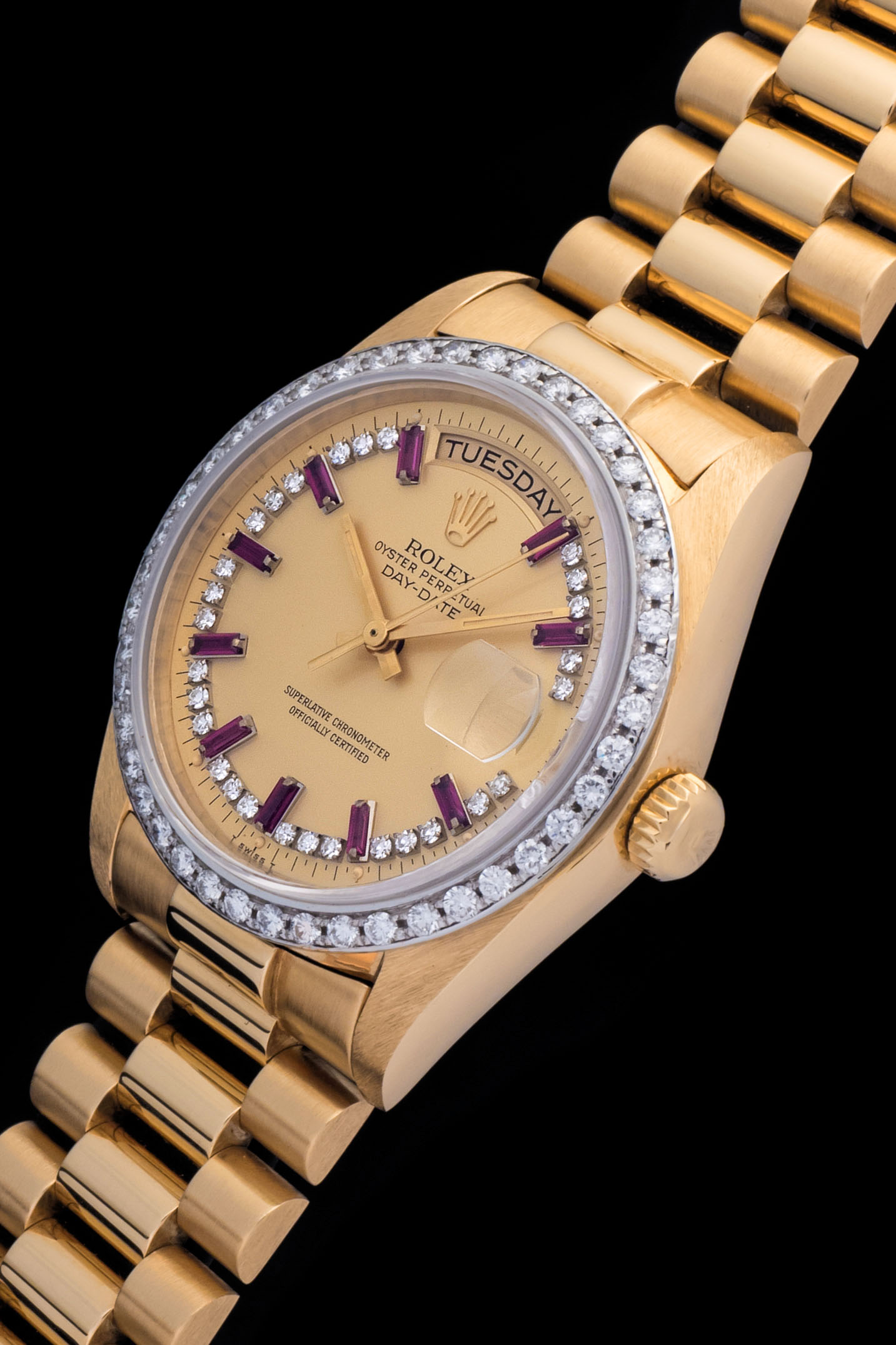
The Day-Date reference 18048 is an interesting reference as it incorporates highly luxurious details. This says a lot considering the Day-Date is altogether synonymous with luxury. A glance at this beautiful example will provide understanding as to why the watch is not like its contemporaries. Pictured is a Day-Date manufactured in 1981 and fitted with a diamond bezel and diamond & rubies stringed dial. This watch embodies luxury at its finest.
Rolex Day-Date 18238
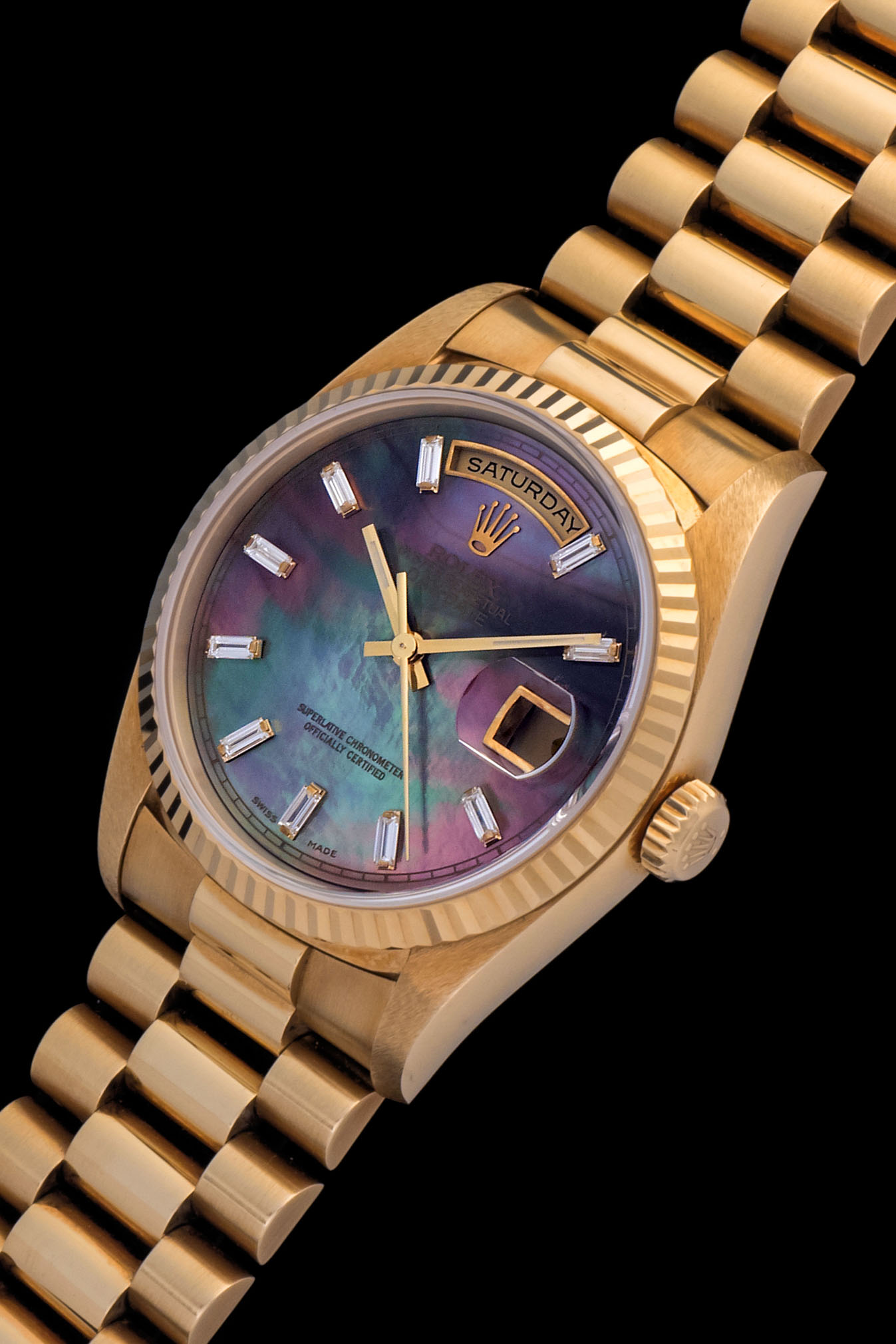
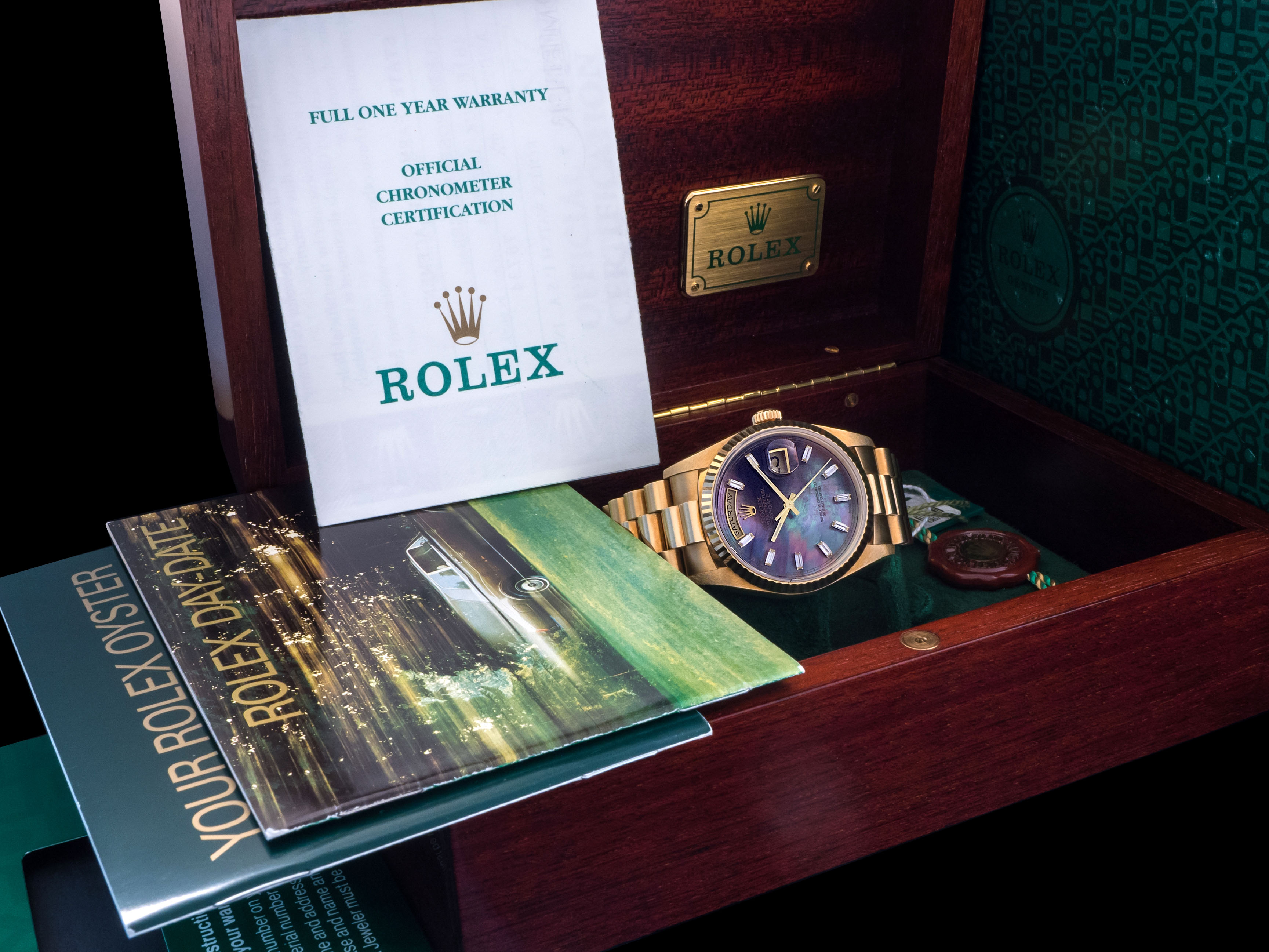
The reference 18238 added a new novelty to the Day-Date family in the form of the double quick-set. This new movement update allows the user to change both the date and day with more ease. Aside from that function the reference retains its standard details such as sapphire crystal and concealed buckle bracelet. Bear in mind not all 18238’s were made the same. Pictured is a special iteration. A never worn full set Day-Date fitted with an ultra rare Tahitian mother of pearl and diamond baguette dial. The look and feel of this watch is fantastic.
Rolex Day-Date 18206
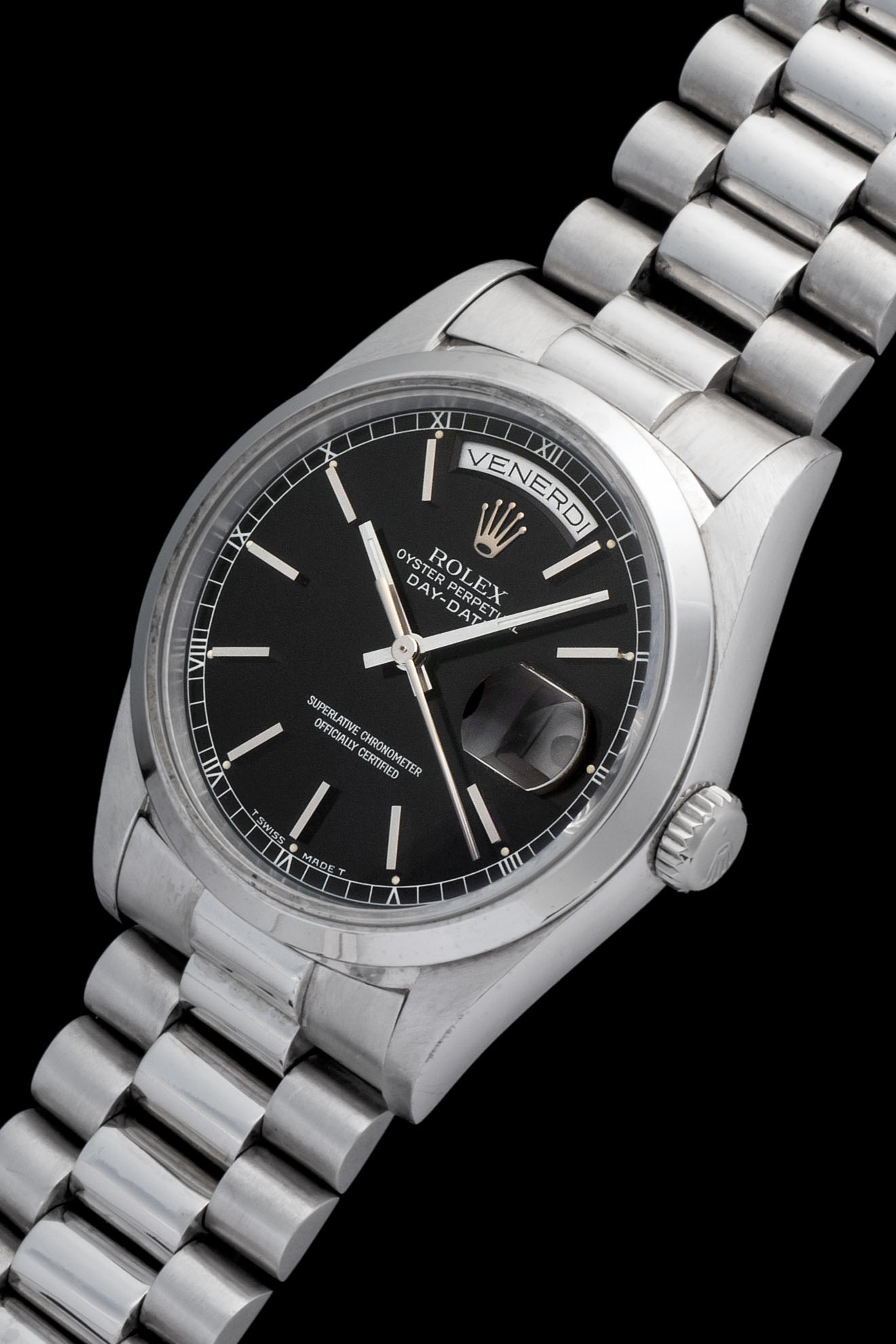
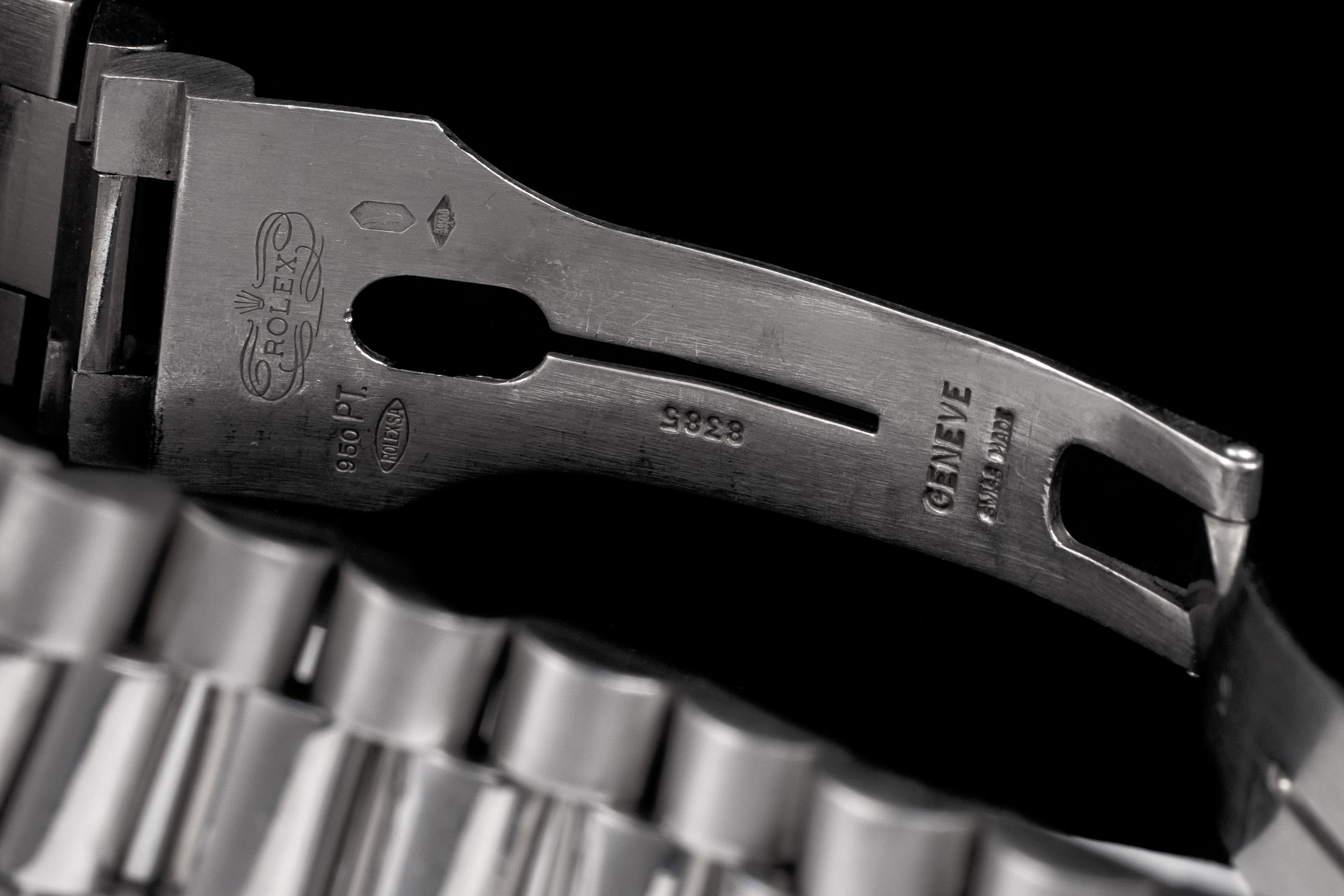
The reference 18206 is arguably one of the most beautiful models in the Day-Date family. This watch is elegance at its purest. It strays away from the luxurious gold case and array of dial variations with a clean dial fitted on a hefty platinum case. A lot can be said about the 18206 but it would not make it proper justice. The watch is best appreciated when worn. In our collection are two examples of the Day-Date 18206. One’s fitted with a blue dial and another fitted with a black dial.
Rolex Day-Date 18296
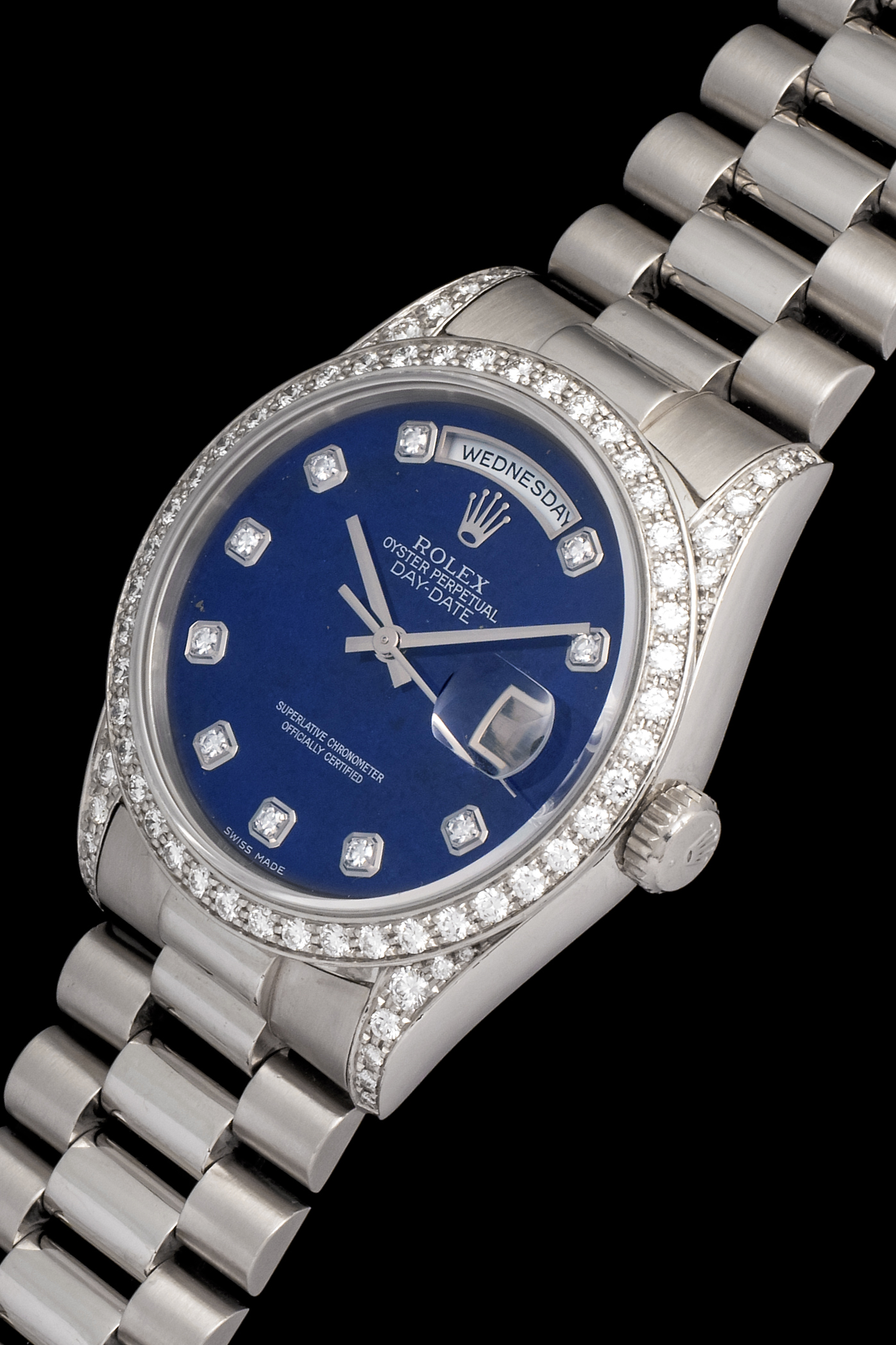
Unlike the previous mentioned reference, our 18296 is an amalgamation of elegance, rarity, and an example of Rolex’s attention to detail. Pictured is a watch that is seldom seen, a watch with so many rare details that only a handful have appeared publicly. For starters this Day-Date is cased in platinum with lugs and bezels adorned with factory diamonds and fitted with a Lapis Lazuli dial coupled with diamond indexes. If the Day-Date family had a hierarchy this watch would be at the top.
Collectability
The Rolex Day-Date is rich in history and is without a doubt slated to be a part of the Rolex lineup for decades to come. But note that with endless references available and with an immeasurable amount of dial variations bear in mind not every Day-Date is created equal. There are highly rare and collectible examples that deserve greater attention and pursuit. The Day-Dates highlighted in this article are on a level of their own. They are the special kind of outliers we collectors travel the world to find.
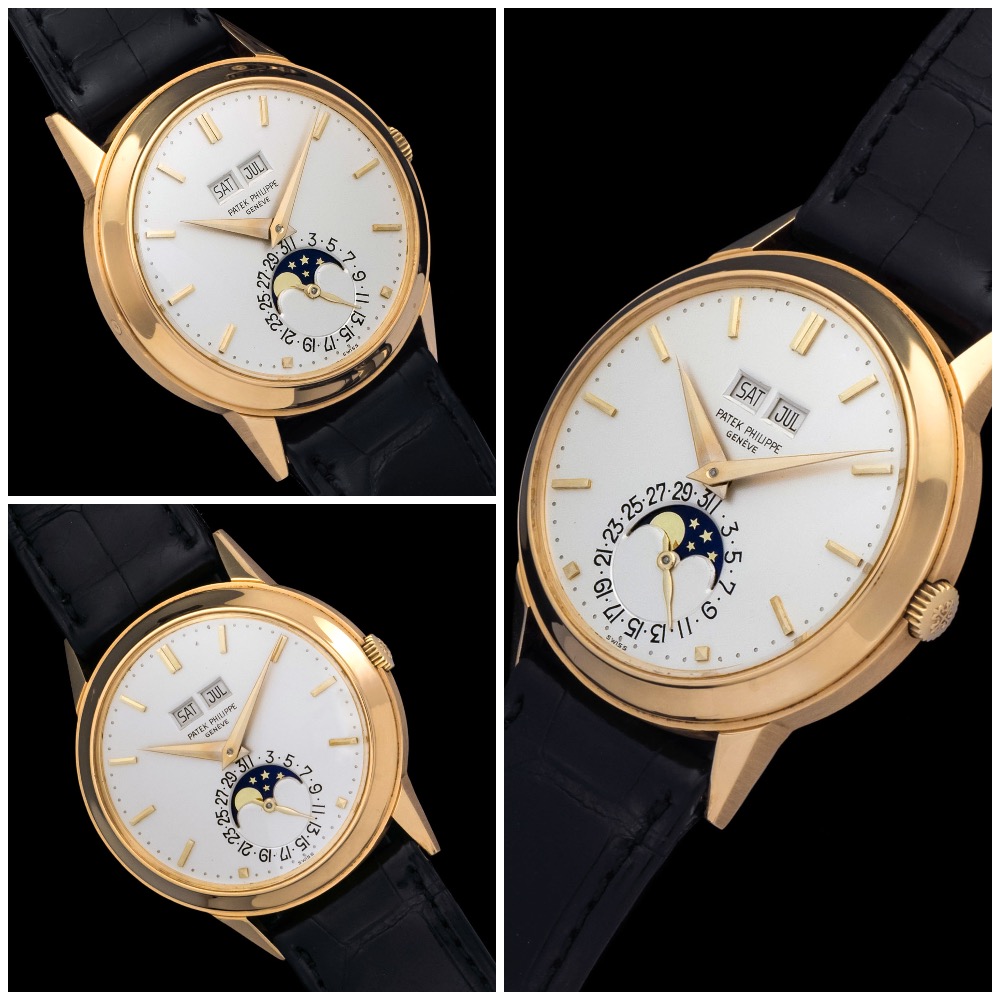
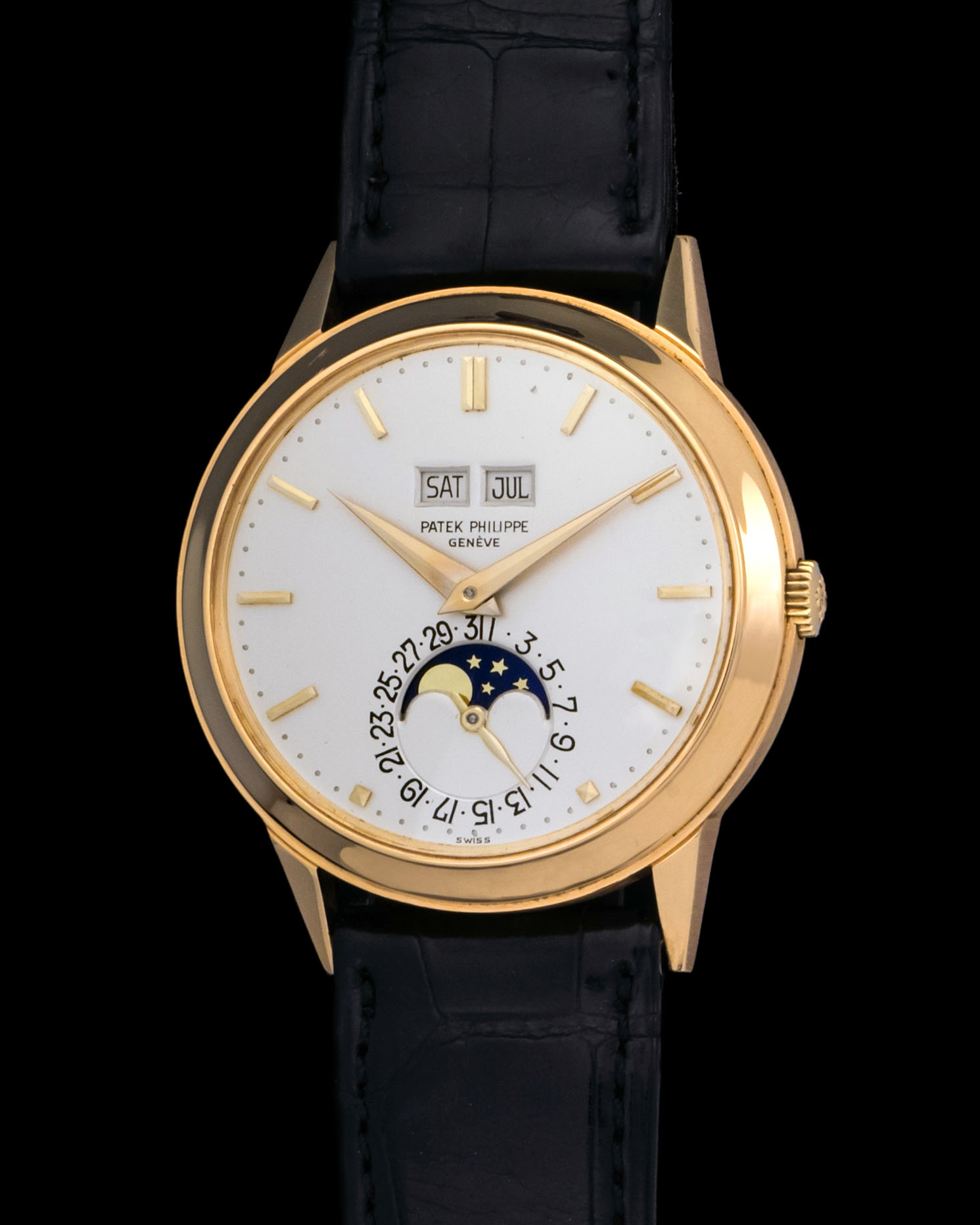
The Patek Philippe ref.3448 is one of the most beautifully designed watches in existence. Records indicate 580 examples were made between 1962 and 1981 (Our 3448 hails from 1971.)
Click Image for Details on ref. 3448
Design
When the watch was released in 1962 critics described it as an elegant yet futuristic watch because it strayed away from what was a normal Patek. The ref.3448 is known by collectors as the “Padellone” and the “Disco Volante”, or “Flying Saucer” in English.
Click Image for Details on ref.3448
Perpetual Movement
A beautifully striking feature about this watch is its integrated crown to the case. The movement inside the watch is also very significant as it was Patek’s first automatic movement capable of carrying a perpetual calendar. The movement in question is the 27-460 Q (Q is the designation given to Perpetual Calendars).
The genius behind Rolex is that even though they manufacture droves of watches per year they don’t half ass at anything. They put the same amount of love and care into the Datejust as they do into the Daytona Platinum Pave Diamond Dial. The best part about it is the manufacture has been true to its practice ever since it was a small brand headquartered in the United Kingdom.
Hard-Stone Dials
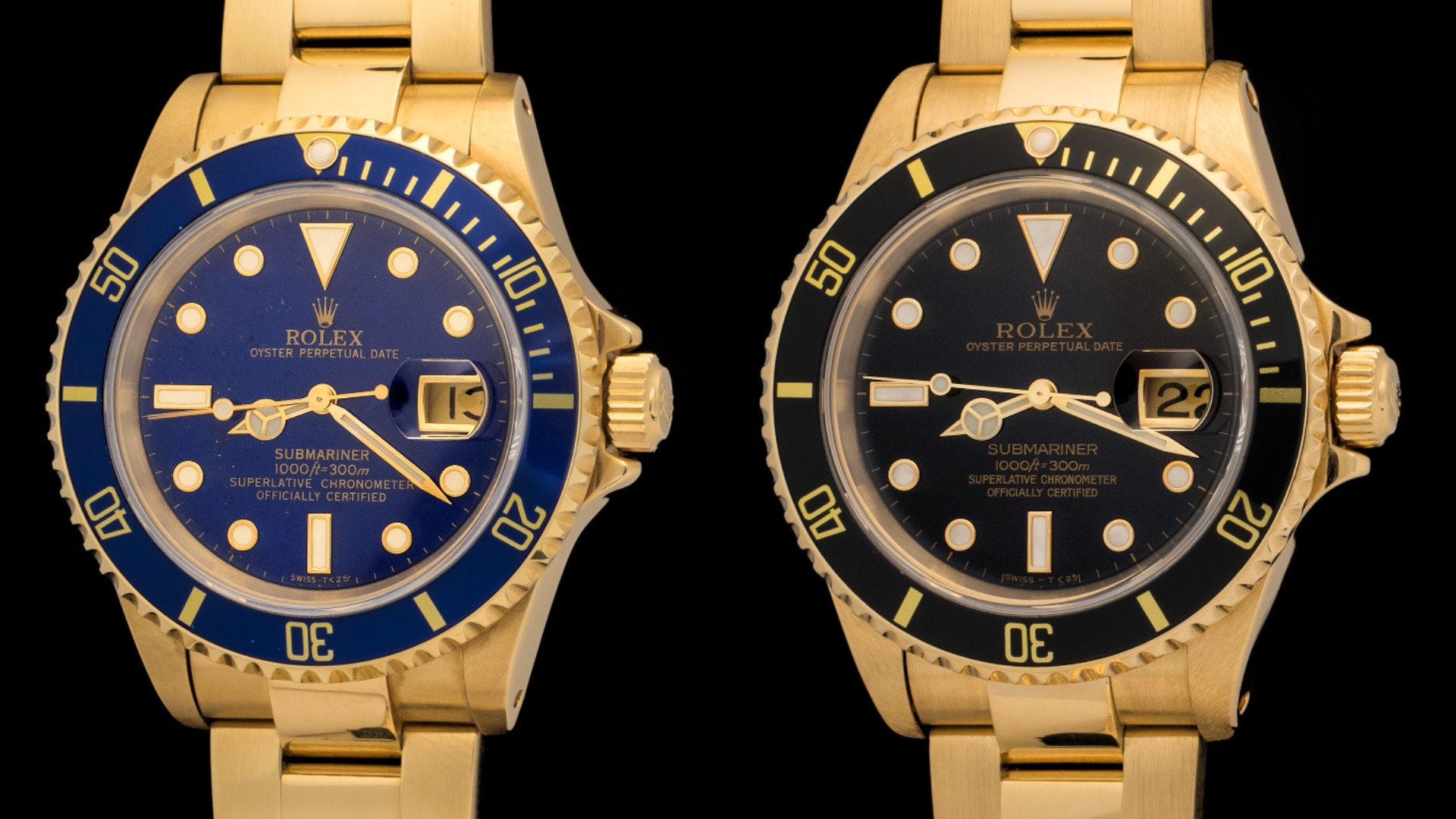
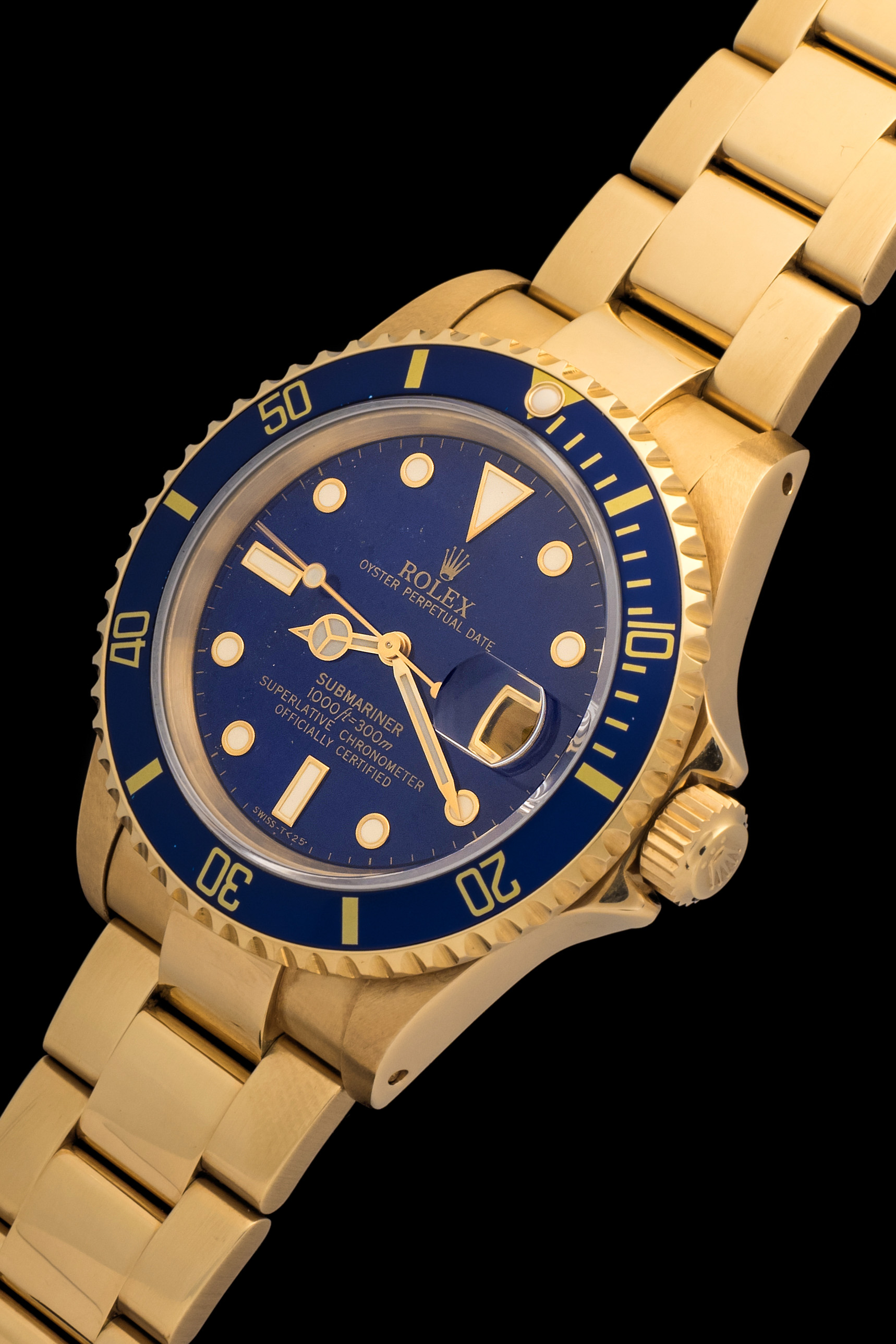
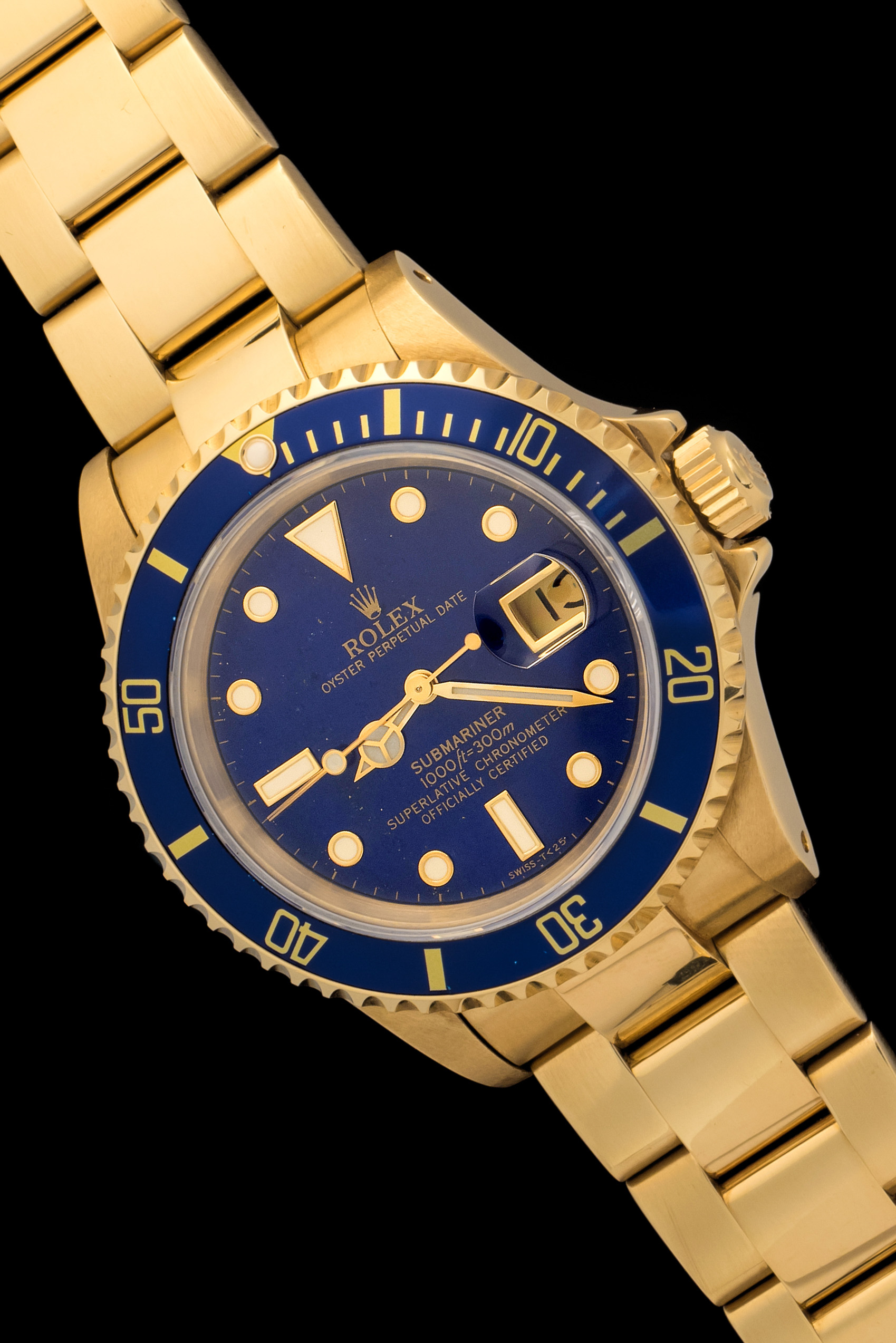
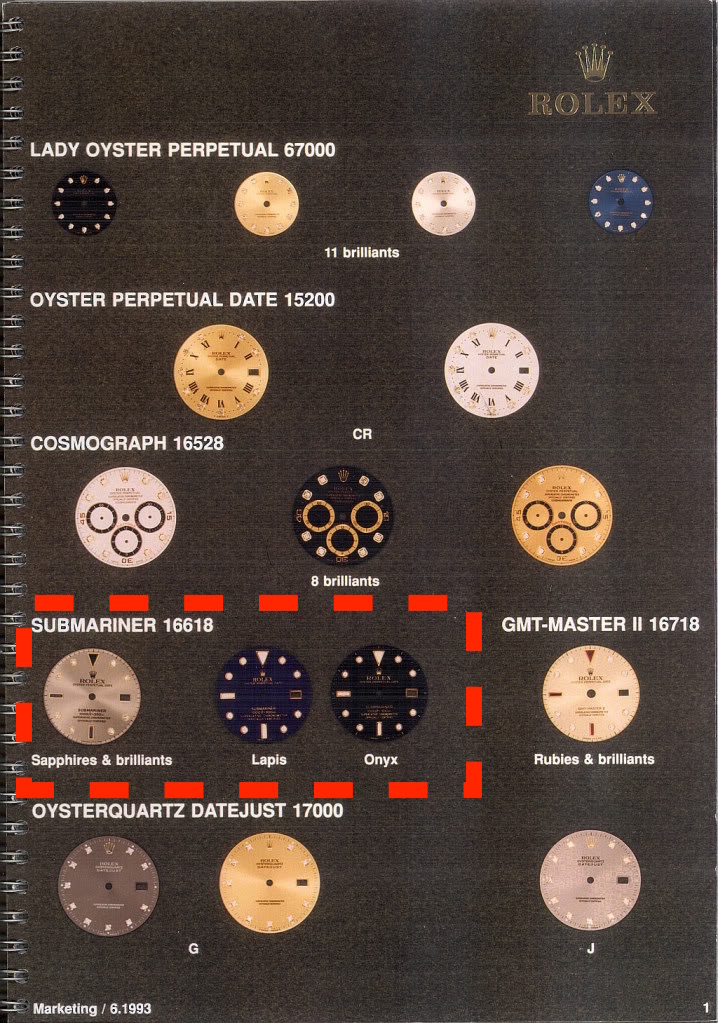
Rolex is known for its founding role in the tool watch department with the introduction of the first Submariners and GMT’s, but their role in the sporty-elegance department is also worthy of much attention. Here we’ll cover two watches that are as unique as they are wearable. The Onyx Dial Submariner Ref.16618 and the Lapis Dial Submariner Ref.16618.
Subamariner Lapis and Onyx Dials
90’s Innovation
The 90’s were an inventive era for Rolex as they began to merge various types of hard-stones with dial production. Take the 1997 Rolex Submariner 16618 Onyx dial as an example. Rolex watchmakers delved into the process of trimming a 1-kilogram the rock into a 0.20mm piece to later be mounted onto the copper dial plate.
Click For More Information
Rolex Submariner Onyx Dial
This process of manufacture was so complicated that it’s estimated that out of 10 dials only 2 made it past the rigorous Rolex inspection phase. The rejection ratio was unfathomable but the dials that made it through made it all worth it. Since Onyx rocks cannot be man made no two dials will ever be the same, which is astonishing for a company like Rolex.
Identifying an original Rolex Onyx dial is simple as they all have a small golden frame surrounding the date function. Do not trust a dial that does not have this detail.
Click For More Information
Rolex Submariner Lapis Lazuli Dial
The Rolex Submariner with Lapis dial is another work of art, and it’s without a doubt Rolex’s most elusive dial as its production was incredibly sporadic. The manufacturing process of this dial is the same as that of the Onyx dial. A large portion of the stone is needed to then trim it down to a small circular 0.20mm piece.
Click For More Information
Rarest Dial Variation
The Lapis stone is entirely blue but it also has specks of green, white, and gold when seen in the light. The look of the dial on a gold Submariner leaves us without words. These are watches that are hardly found and we are not exaggerating. In our 32 years of experience we have only seen a handful pop up.
Click For More Information
Lapis Lazuli & Onyx Dials
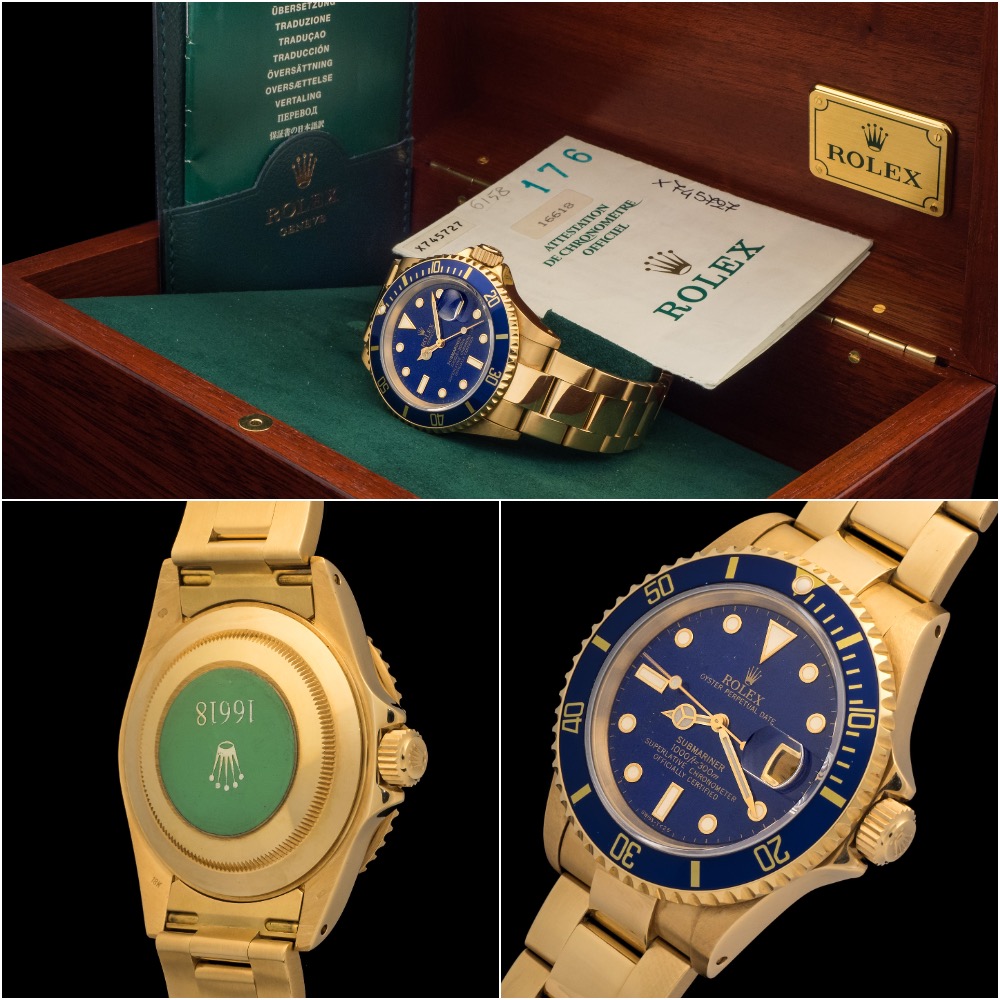
Our 16618 is a magnificent example as it’s in new old stock conditions and is accompanied by its original papers and box, a true collection item.
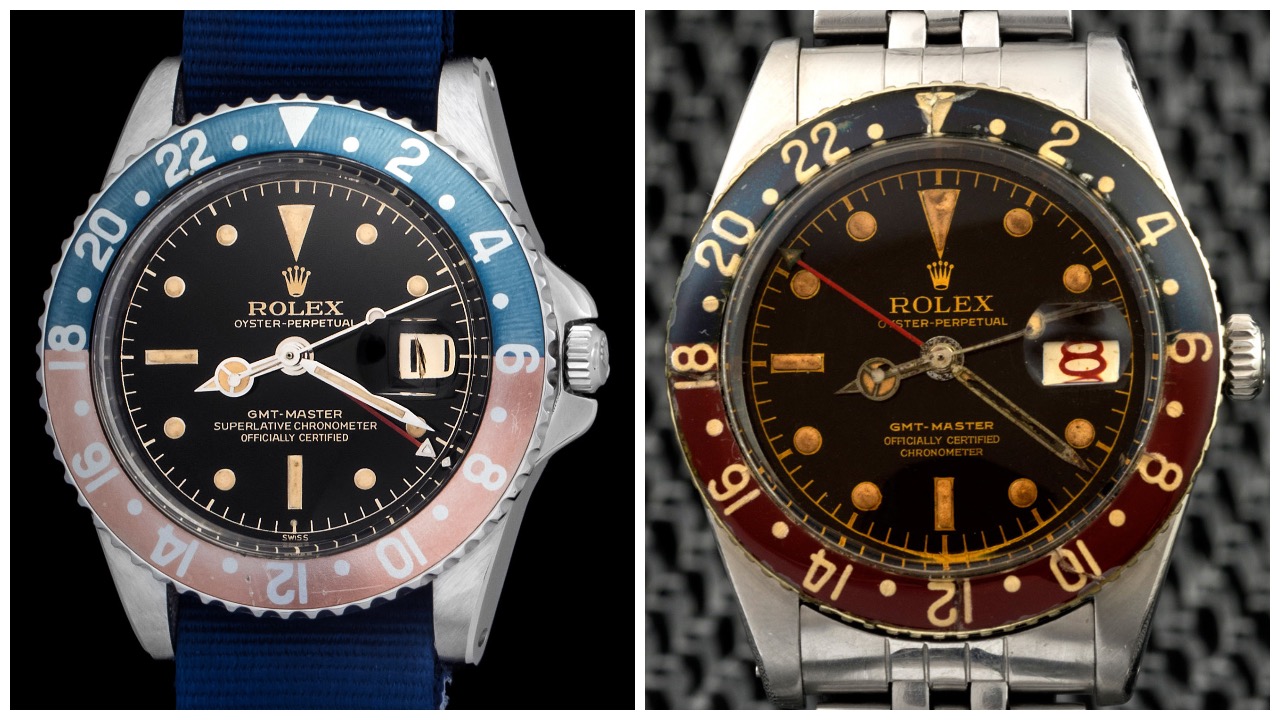
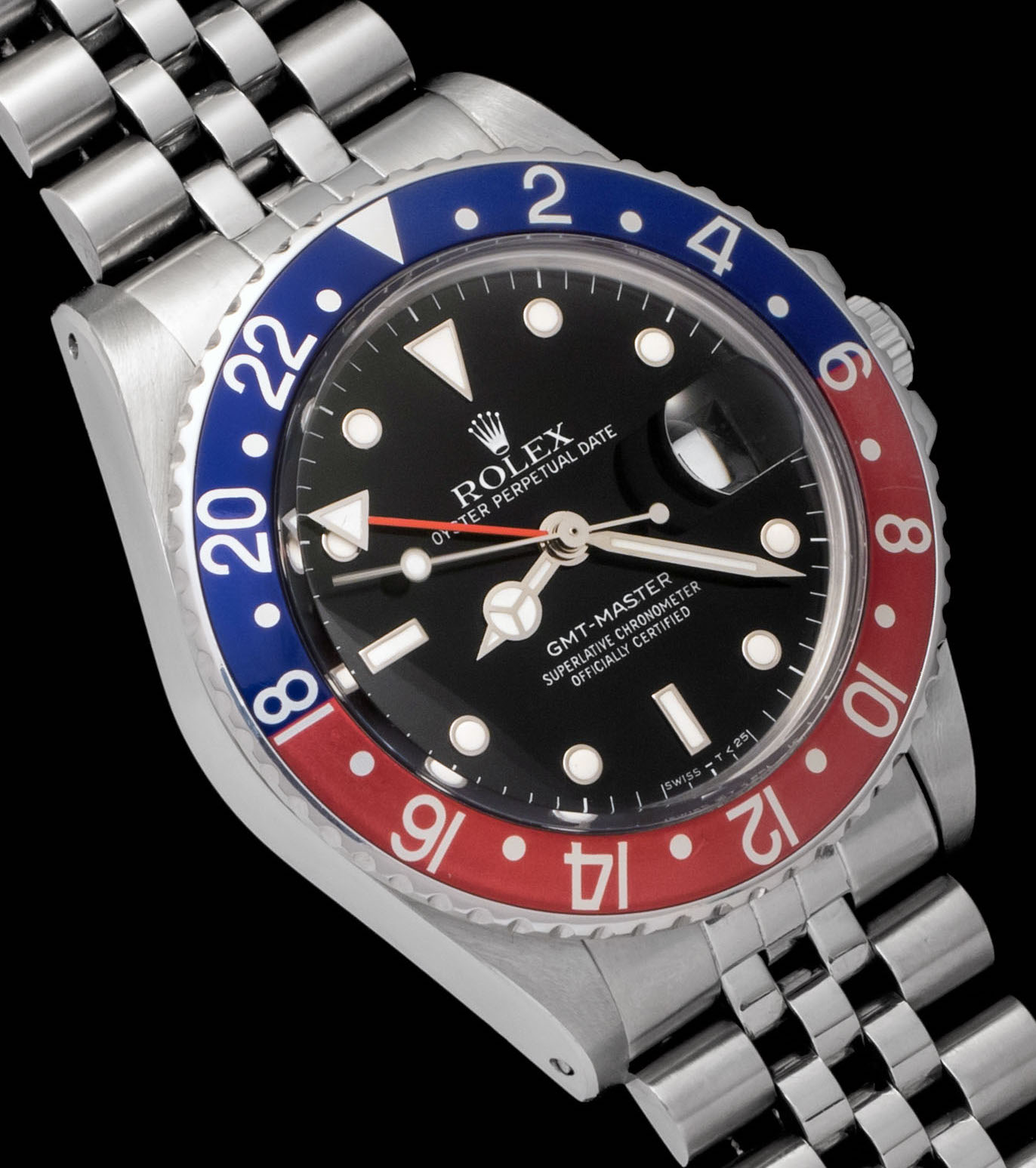
OCC stands for Officially Certified Chronometer while SCOC stands for Superlative Chronometer Officially Certified. A seemingly insignificant wording on the dial will make a world of a difference to a seasoned and informed collector.
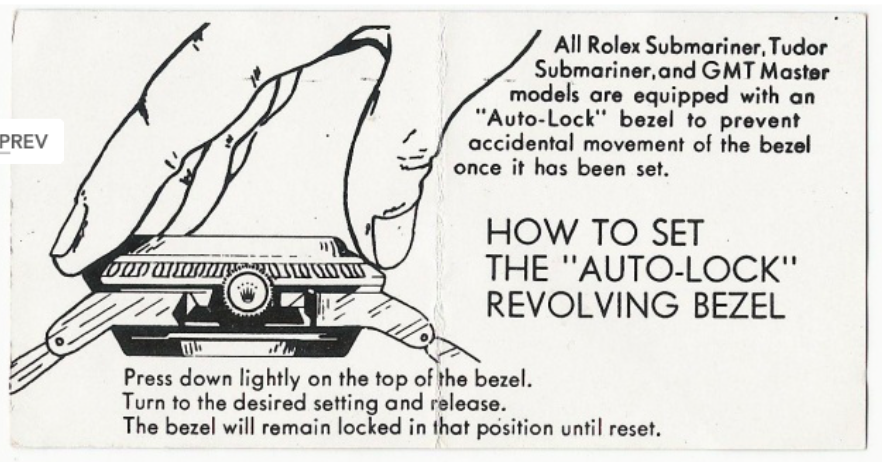
Rolex GMT-Master Collection
An OCC movement is one, which has successfully passed a test conducted by the Swiss Official Chronometer Testing Institute or COSC.
The test consists of testing a watch for 15 days and 15 nights putting it through five positions and 3 types of temperatures (normal, oven-heat, and refrigerator). OCC movements feature a regulator, which allow the wearer to manually adjust the movement to run faster or slower. The process of manually adjusting a movement can be cumbersome and inefficient.
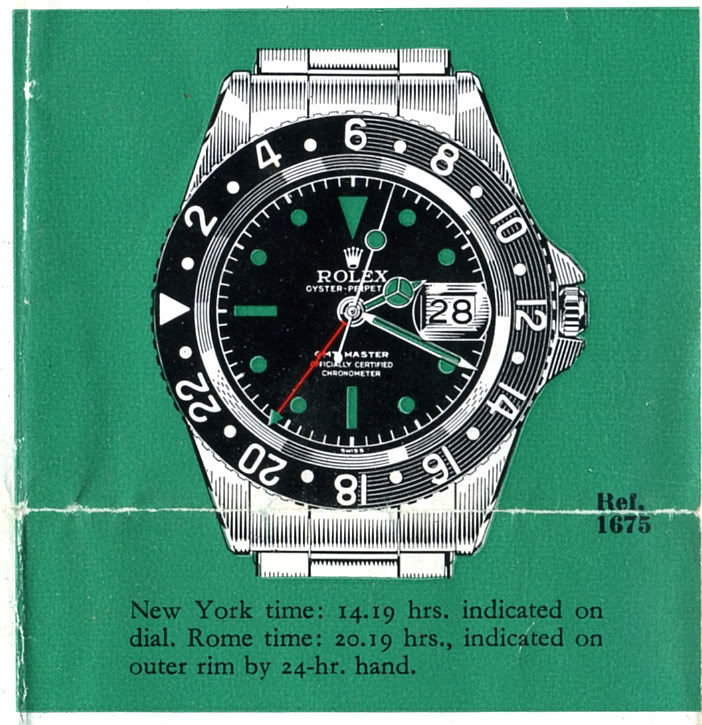
Vintage Rolex GMT-Master Booklet
The Rolex GMT-MASTER Ref. 6542 for example was fitted with an OCC movement while its successor the 1675 was not. These ones were fitted with SCOC movements.
A SCOC movement is an upgrade from the OCC. These movements have also passed the rigorous COSC testing but are not fitted with regulators, and this allows them to keep accurate timing for much longer.
There is no denying that Rolex is the king. Each and every Rolex encompasses a craftsmanship and history not replicated by any other manufacturer. It might seem easy to deviate from Rolex in the search for other types of watches but ultimately most collectors will return to the brand. Below is an official Rolex video, which captures the brand’s essence beautifully.
Rolex Submariner Date – The World’s First Elegant Diving Watch
Early Years
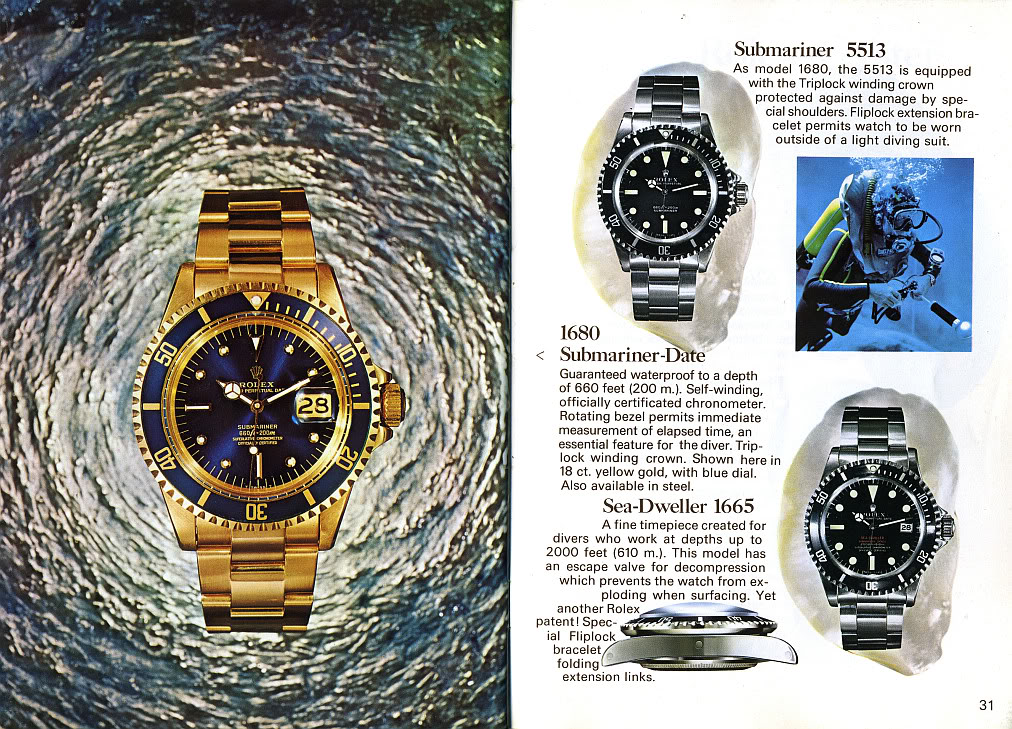
In 1967, 14 years after Basel’s release of the first Submariner Rolex introduced one of its finest creations the Submariner Date Ref. 1680. With this reference Rolex showed the world they could make equally as marvelous every day watches as they did tool watches.
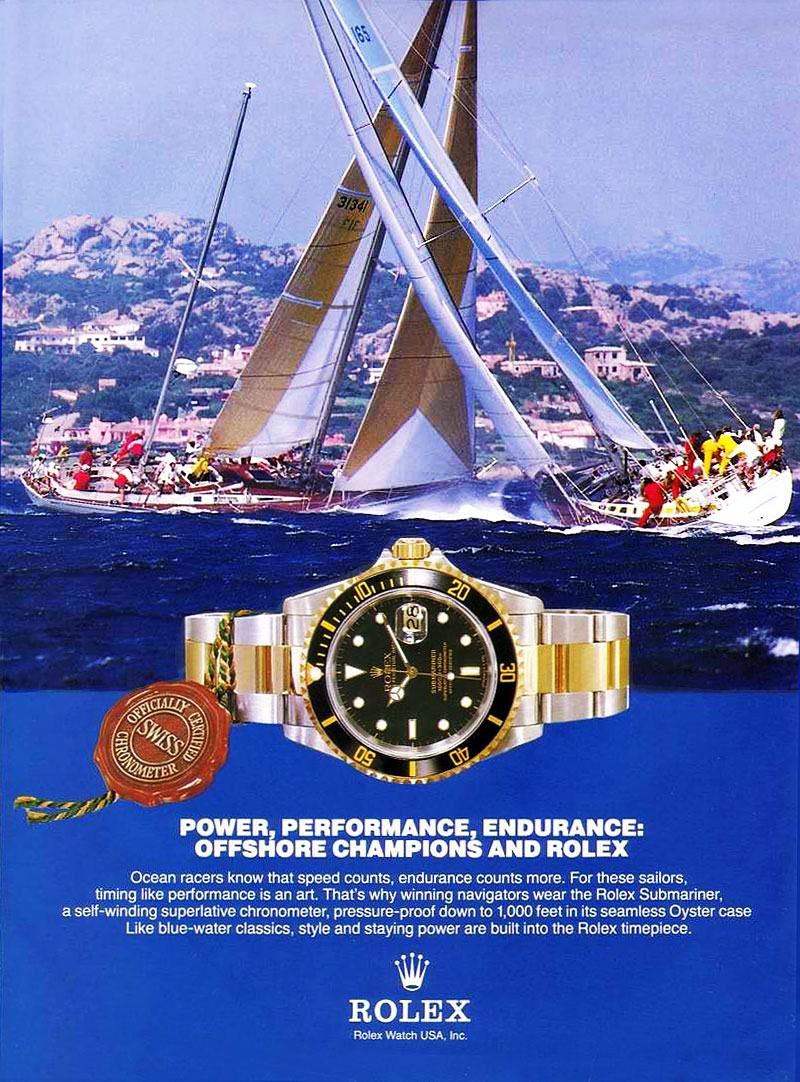
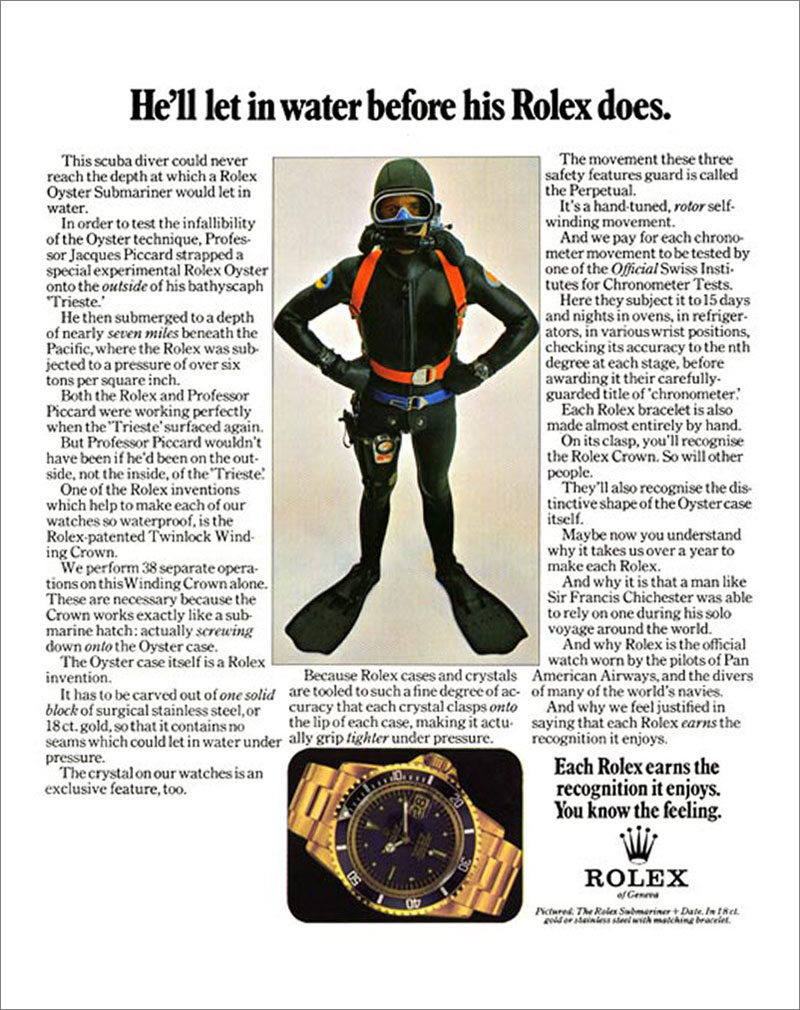
Vintage Rolex Advertising
The 1680 was the first Submariner to feature a date function, which did not come in handy when diving but it made the world of a difference when worn on a casual setting. Rolex’s underlying message with the Submariner was: “now you can keep your Rolex on forever. Take it diving but also take it to the office”. Soon after its 1967 release the 1680 became the most wearable Rolex. The rapid success of the Submariner prompted Rolex to shock the world two years later with the release of the Submariner Date in 18K yellow gold. This new permutation of Submariner showed the market that Rolex had surpassed its standing as a tool watch manufacturer and become a dynamic watchmaker.
Rolex Advertising (Circa 1970)
Dial Variations
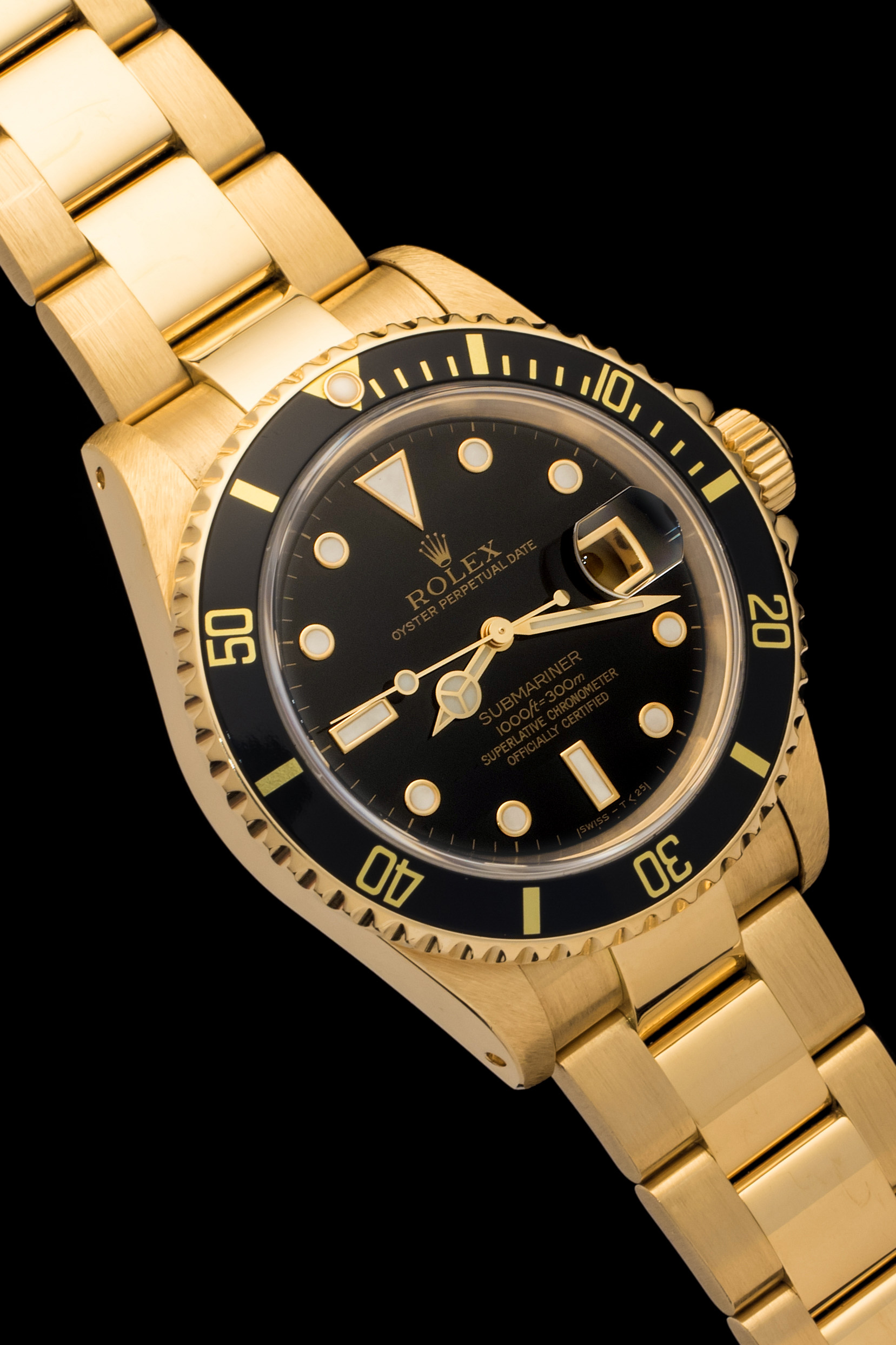
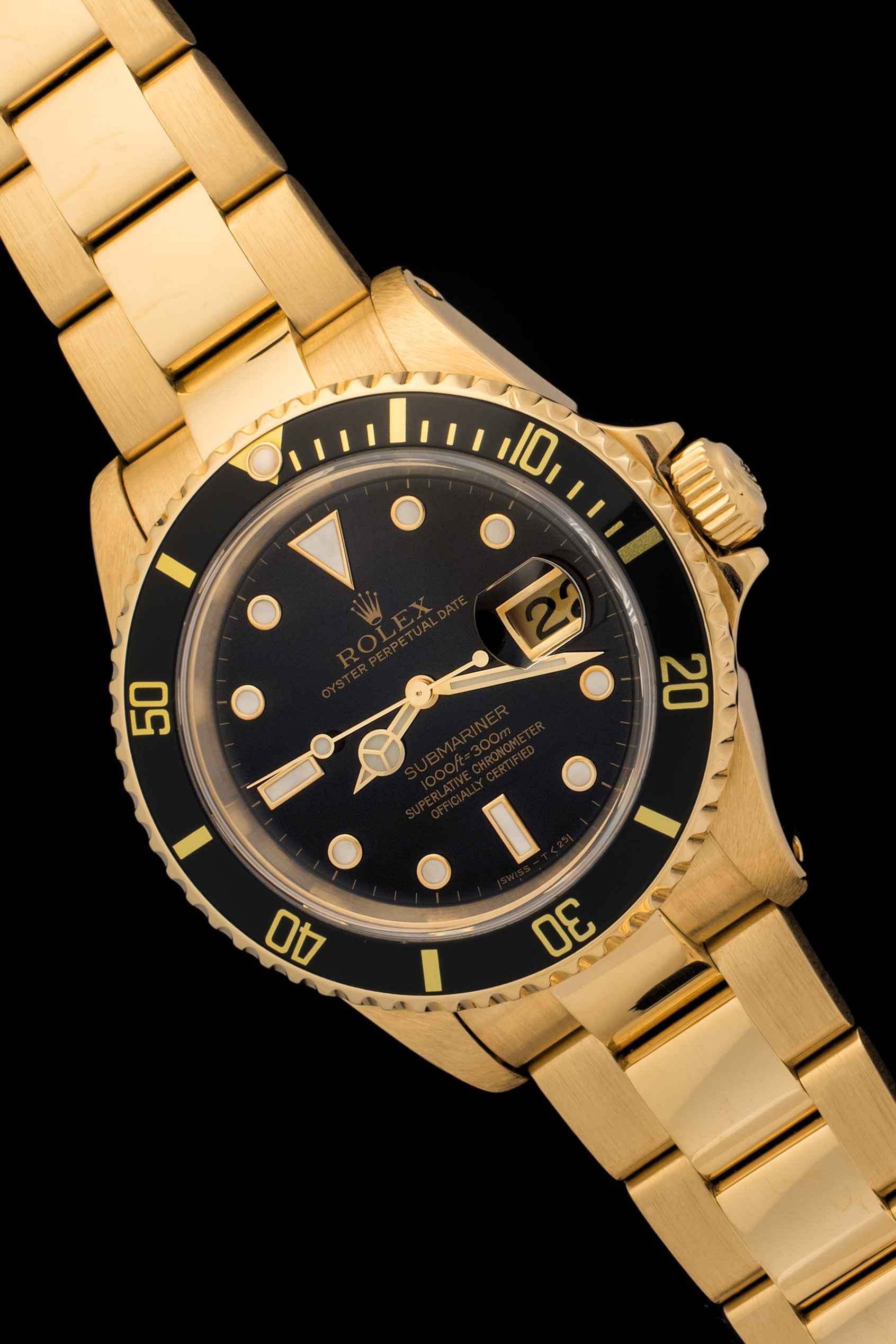
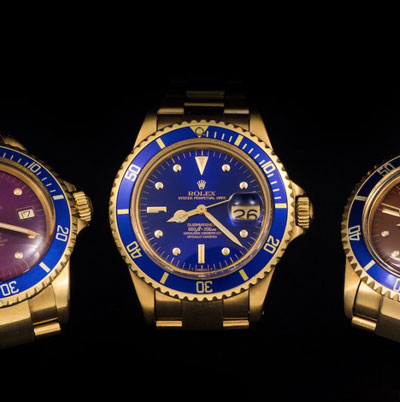
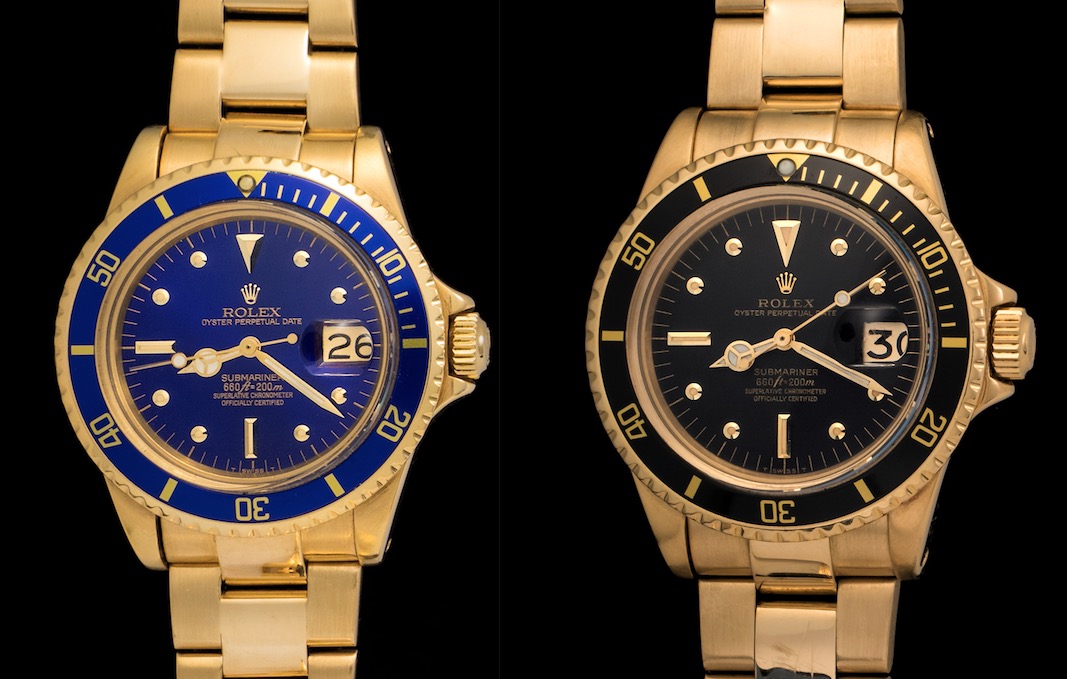
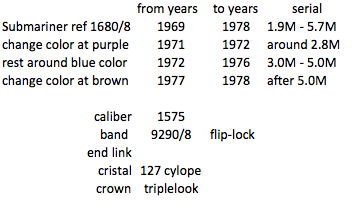
The 1680 from 1969 saw two dial variations, which will forever remain iconic. Rolex experimented with black dials and gold lettering as well as blue and gold lettering. Little did Rolex know that their blue dials would soon begin to change colors due to a pigmentation issue brought by the factory made dials. Some blue dials turned into a rich purple, others became brown, while others turned into a hue of navy blue.
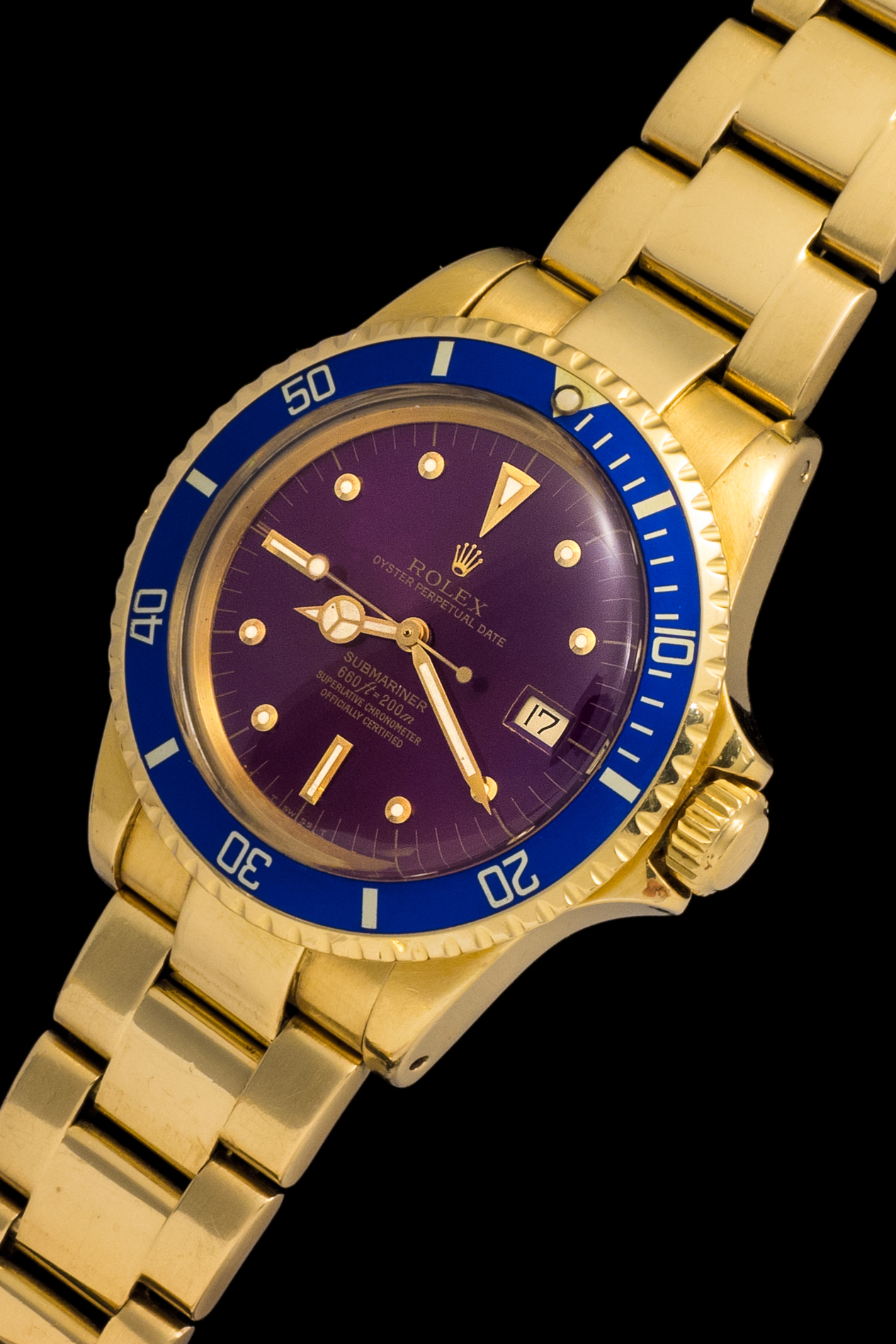
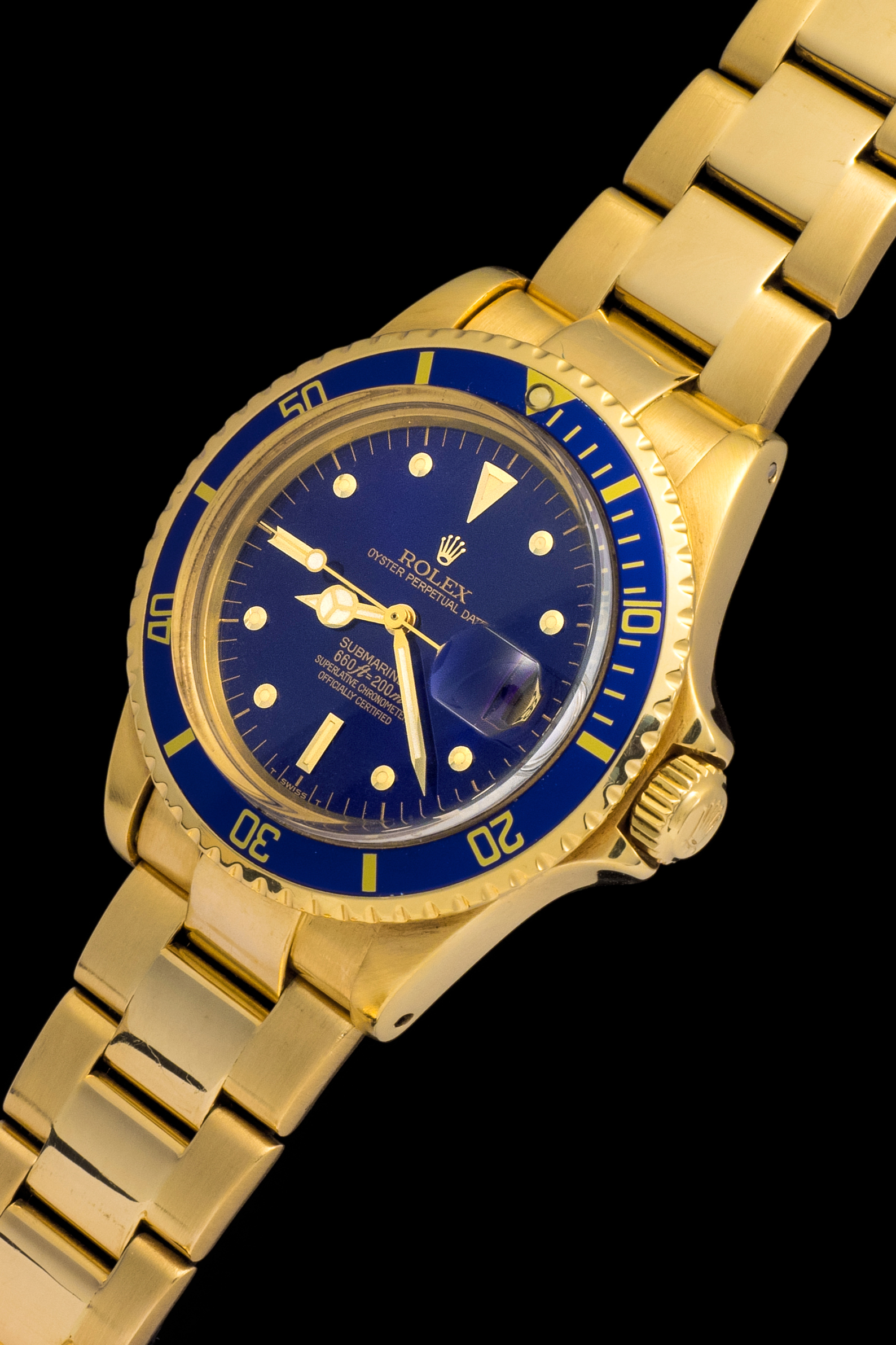
Rolex Submariner-Date ref 1680/8″ Purple”
The first strand of discolored dials occurred with 1680’s manufactured around 1969. Submariners belonging to serials in the 2.8 million range turned into a strong purple color almost looking aubergine. Finding dials with this type of discoloration is very rare, as the occurrence was quickly reversed.
Click on the image for more info about that watch
Rolex Submariner-Date Ref 1680/8 “blue Navy”
The second strand of discolored dials occurred with Submariners ranging from the 3 million to 5 million serials. The discoloration here was not as dramatic as the latter ones but they were equally as fascinating. These dials ranged from intense navy blue hues to others not showing strong blue colorations. Naturally navy blue dials fetch a premium whereas the others do not.
Click on the image for more info about that watch
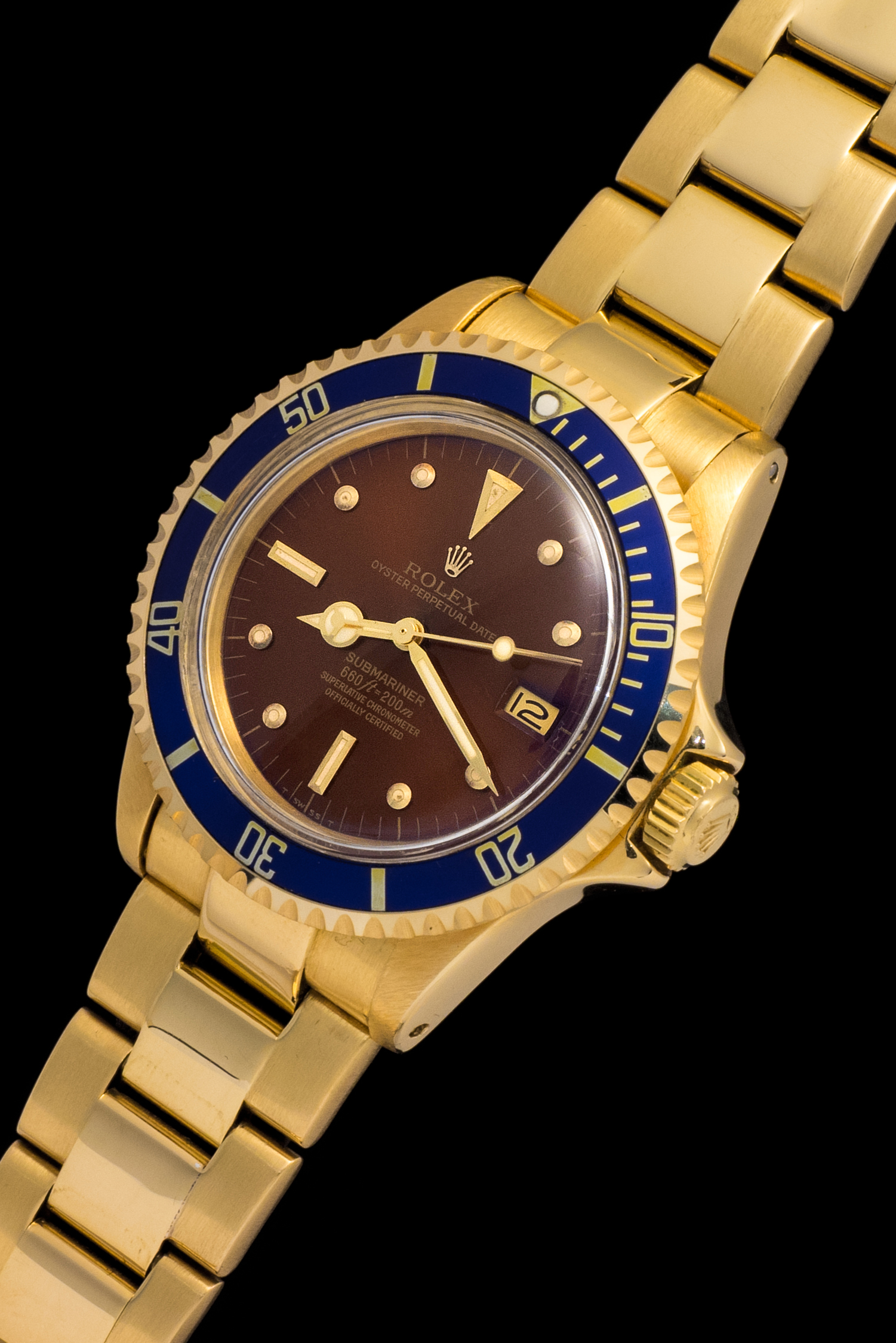
Rolex Submariner-Date Ref 1680/8 “tropical brown”
The third and last strand of discolored dials occurred with the last serial numbers belonging to the 1680, those in the 5 million range. In an effort to stabilize dial colorings Rolex decided to produce their last batch of dials using materials reserved for their new lines of upcoming sport models. The manufacture assumed that their newer dials were going to retain their factory made coloring. This notion of belief was quickly contradicted as those dials began to transform into a brownish color, the now revered Tropical dials. These dials will remain the most fascinating strand of dials ever produced by Rolex.
Click on the image for more info about that watch
Collectability
The 1680 in yellow gold’s production span for nearly 10 years, ending on 1978 when Rolex introduced a newer model fitted with a sapphire crystal. Nonetheless the 1680 will remain an icon for eternity, as it was Rolex’s foray into the world of sporty/elegant watches. The key in collecting the special dials belonging to the 1680 era is to find examples with even coloring throughout the entire dial. Meaning purple dials are more sought after when the entire area is covered by the same tone of color. That being said it is important to understand that discolored Rolex dials are unique to their watch. Meaning that no two discolored dials will ever be the same. Collectors find this happening fascinating, as they appreciate the rarity of their Rolex 1680. After trial and error Rolex has only been able to master the coloring applied to dials fitted on sport models.
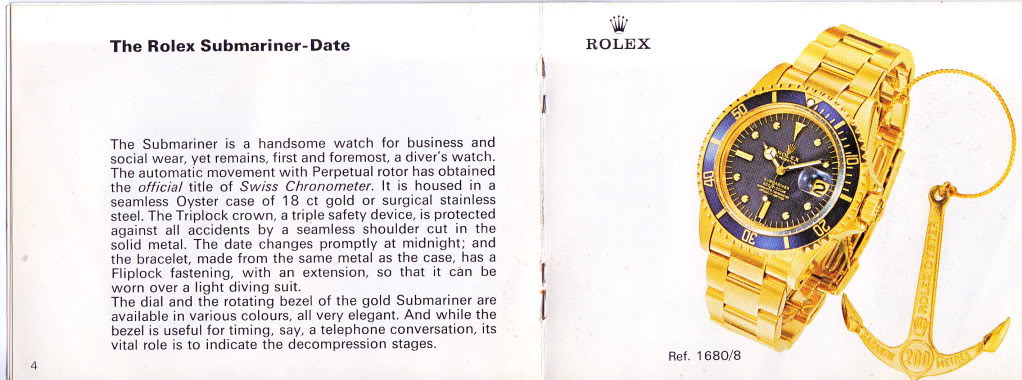
FROM ORIGINAL SUBMARINER BOOKLET:
The Submariner is a handsome watch for business and social wear, yet remains, first and foremost, a diver’s watch.
The automatic movement with perpetual rotor has obtained the official title of Swiss Chronometer. It is housed in a seamless ouster case 18ct gold or surgical stainless steel. the trip look crown, a triple safety device, is protected against all accident by a seamless shoulder cut in the solid metal. the date change promptly at midnight, and the bracelet ,made from the same metal as the case ,has a flip look fastening with an extension so that it can be worn over a light diving suit.
the dial and the rotating bezel of the gold submariner are available in various colours all very elegant And while the bezel is useful for timing say a telephone conversation its vital role is to indicate the decompression stages