Cart

Your cart is currently empty.

Reaching for the Stars: The Rolex Oyster Perpetual “Galaxy” Ref. 6098

A collector’s deep dive into one of the rarest and most romantic time-only Rolex watches ever produced
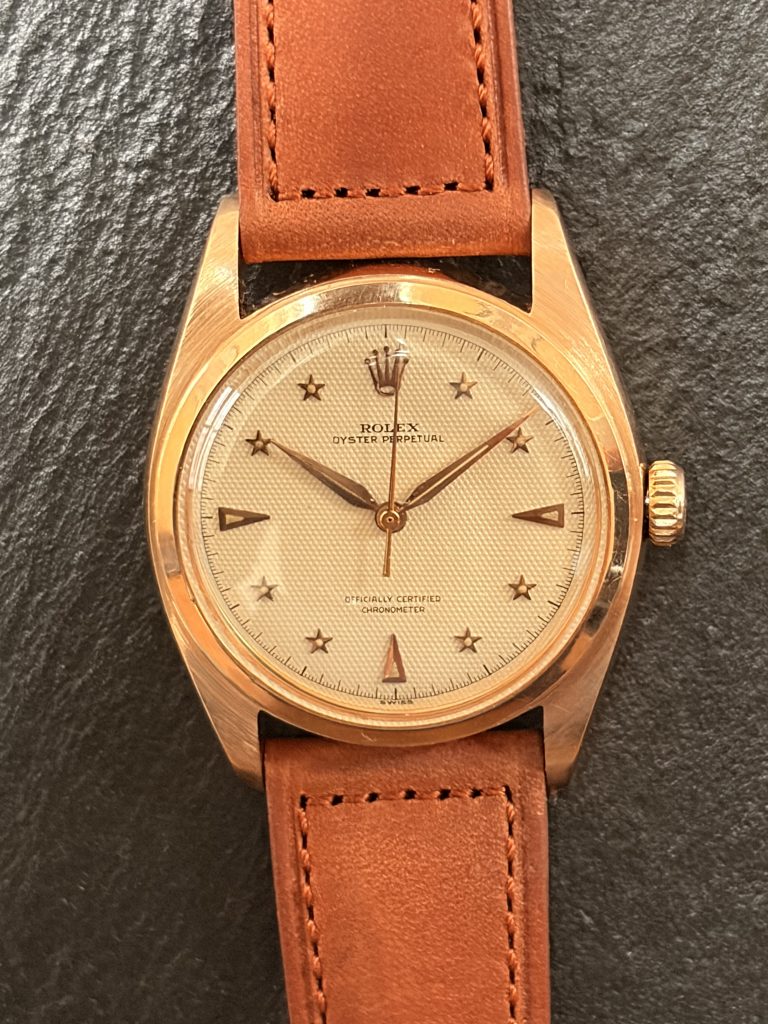
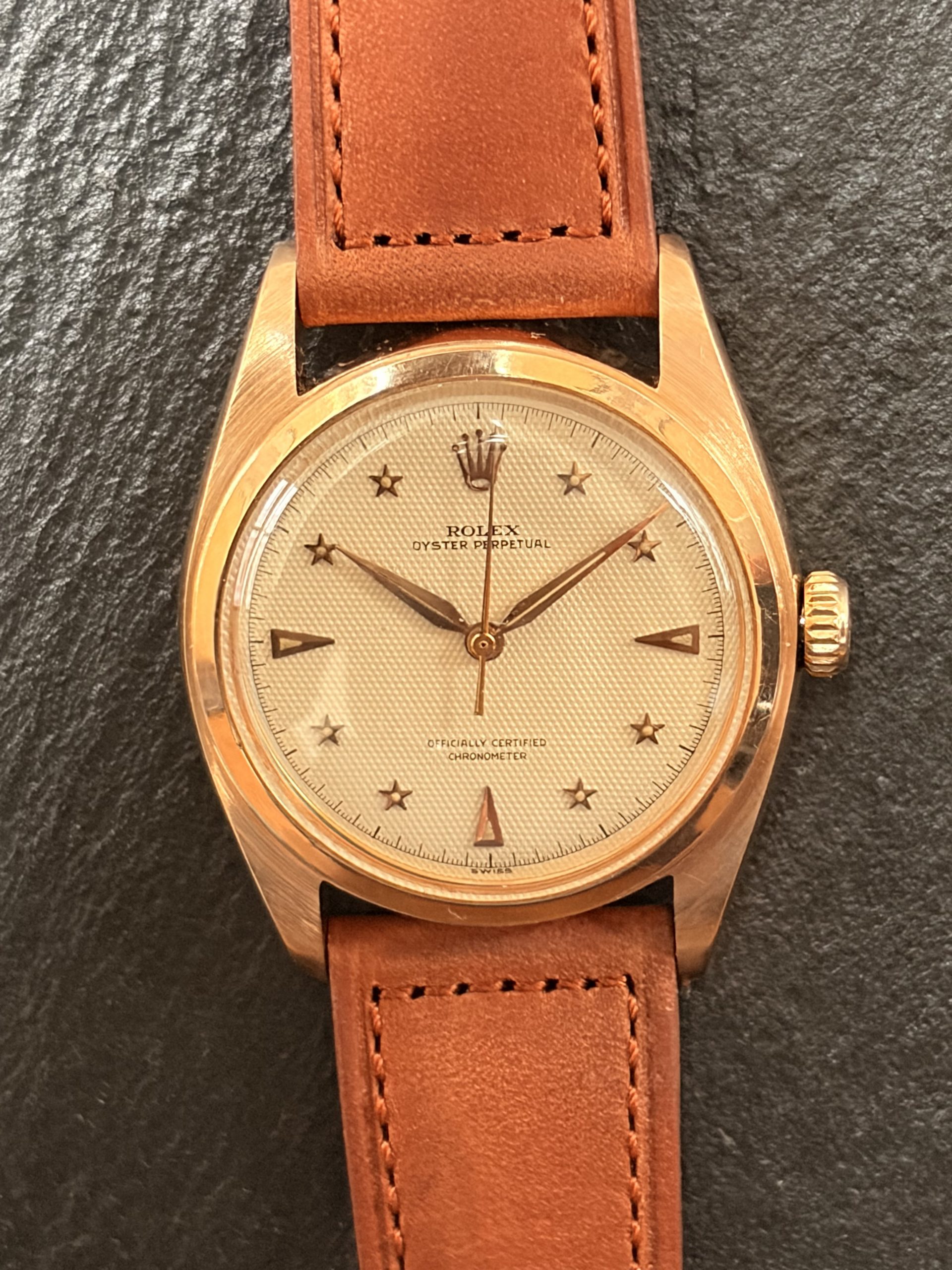
The exceedingly rare Rolex Oyster Perpetual “Galaxy” Ref. 6098 in 18k pink gold with honeycomb star dial, circa 1952–1953.

In the vast and heavily studied universe of vintage Rolex, few configurations evoke as much romance, mystery, and pure collector desire as the “Star Dials.” While the triple-calendar moon-phase Ref. 6062 “Stelline” often steals the spotlight, the true connoisseur’s choice lies in the time-only realm: the exceedingly rare Rolex Oyster Perpetual “Galaxy” Ref. 6098.

This is not merely a watch; it is a testament to a brief, playful era in Rolex’s history when the brand dared to dream beyond the utilitarian constraints of the Oyster case. Today, we explore the history, the extreme rarity, and the allure of the Ref. 6098 Galaxy — with a special focus on the almost mythical pink gold variant.

The Post-War Renaissance and the Birth of the “Galaxy”

To understand the Galaxy, one must understand the era in which it was born. The early 1950s marked a period of post-war optimism and creative renaissance in watchmaking. Brands that had spent the 1940s producing strict, utilitarian military watches suddenly found themselves free to experiment with imaginative and audacious designs.

Rolex, typically known for its robust tool watches, embraced this newfound playfulness. The brand introduced dials adorned with applied gold stars for hour markers. The name “Galaxy” is not a modern collector’s invention; it was the official nomenclature used by Rolex in their 1950s marketing materials to describe these specific time-only star dial models.

The star dials were produced for a very short window, primarily between 1950 and 1953, with case numbers ranging tightly between 698,xxx and 947,xxx. The dials themselves were manufactured by the legendary dial maker Stern Frères — the same artisans responsible for the dials of the Patek Philippe 1518 and 2499. Each dial was stamped with a Stern Frères code: for example, “103·989 2”, where 103 is the Stern Frères code for Rolex, 989 refers to the dial type, and 2 indicates the second example of that particular dial produced.

“These watches are truly connoisseur’s watches. Many consider these the most sophisticated time-only Rolex watches ever made.”— e. w.

The Anatomy of the Ref. 6098 “Ovettone”

The Reference 6098 is a watch of significant proportions for its era. Collectors affectionately refer to it as the “Ovettone”(Italian for “large egg”) due to its substantial 36mm Oyster case and prominently domed case back — a design necessitated by the thickness of the automatic movement within.

The Genex Case

The 36mm case was manufactured by Genex S.A., a renowned casemaker that was a subsidiary of Stern Frères. This is the exact same case design utilized for the legendary triple-calendar Ref. 6062, giving the 6098 a substantial, modern presence on the wrist that belies its 1950s origins. The case features a screw-down Oyster back — a hallmark of Rolex’s commitment to robustness even in their most decorative pieces.

The Honeycomb Dial

The dial of the Galaxy is a masterpiece of mid-century texture. The matte silvered surface features a complex “honeycomb” guilloché pattern — a fine waffle-like texture that catches the light and creates an almost three-dimensional depth. This textured canvas serves as the perfect backdrop for the applied gold star indices and the faceted dagger numerals at 3, 6, and 9 o’clock. The Rolex crown appears at 12. The luminous material was applied directly to the center of each star, making the dial literally glow in low light.

The Caliber A296 and the Copper-Gilt Mystery

Powering the 6098 is the Caliber A296 (or A260 super balance), a robust automatic perpetual movement. Because this movement was relatively thick, it necessitated the deeply domed “bubbleback” style case back.

Interestingly, several known examples of the 6098 Galaxy feature a highly unusual copper-colored gilt movement. Combined with a “double signed” interior caseback — bearing both the standard “Rolex Geneva Swiss Patented” stamp and a vertical “Montres Rolex S.A., Geneva, Swiss” engraving — scholars at Christie’s speculate that these specific watches may have been produced for special exhibition or demonstration purposes, perhaps for trade fairs or commercial presentations in the early 1950s.

TECHNICAL SPECIFICATIONS — ROLEX REF. 6098 “GALAXY”

SpecificationDetail
Reference6098
Nicknames“Galaxy” / “Stelline” / “Ovettone”
Production Periodcirca 1950–1953
Case Material18k Pink Gold (also yellow gold and stainless steel)
Case Diameter36 mm
Case MakerGenex S.A. (subsidiary of Stern Frères)
MovementAutomatic — Caliber A296 / A260 super balance
DialMatte silvered honeycomb with applied gold star indices
Dial MakerStern Frères, Geneva
CrystalDomed Plexiglass
CasebackScrew-down, double-signed interior
Water ResistanceNone
Serial Number Range698,xxx – 947,xxx

The Numbers: A Study in Extreme Rarity

When we discuss the rarity of the 6098 Galaxy, we are talking about numbers that rival the most elusive Patek Philippe complications. According to extensive research by Christie’s, Phillips, and leading independent scholars, the known public population of the Ref. 6098 with a silvered honeycomb star dial is astonishingly small.

ConfigurationKnown Public Examples
Yellow Gold + Honeycomb Star Dial8 – 10 examples
Yellow Gold + Black Star Dial3 examples
Stainless Steel + Honeycomb Star Dial2 examples
Pink Gold + Honeycomb Star Dial1 example (the only one known)

The Complete Register of Known Examples

The following table represents every publicly documented Ref. 6098 Galaxy, compiled from Christie’s lot notes, Le Monde Edmond’s research, and the John Goldberger reference book 100 Superlative Rolex Watches:

Case NumberEst. YearMaterialDialPublic Record
725’4501950Stainless SteelHoneycomb StarSotheby’s Hong Kong, 2008
727’0601950Stainless SteelHoneycomb StarChristie’s, 2007
740’0361950Yellow GoldHoneycomb StarAuction record
911’9921952/53Yellow GoldHoneycomb StarAuction record
912’0061952/53Yellow GoldHoneycomb StarAuction record
912’0151952/53Yellow GoldHoneycomb StarPrivate (Goldberger book)
912’0191952/53Yellow GoldHoneycomb StarAuction record
912’1071952/53Yellow GoldHoneycomb StarAuction record
912’1201952/53Yellow GoldHoneycomb StarGoldberger book
919’0391953Yellow GoldHoneycomb StarChristie’s, May 2023 — CHF 126,000
928’1281953Yellow GoldHoneycomb StarWind Vintage
947’7781953Yellow GoldHoneycomb StarAuction record
947’8301953Yellow GoldHoneycomb StarChristie’s, Dec 2024 — USD 100,800
947’8481953Yellow GoldHoneycomb StarPrivate transaction
Unknown1952/53Pink GoldHoneycomb StarThe only known example

The Pink Gold Unicorn

While yellow gold was the standard for luxury watches in the 1950s, pink gold was produced in vastly smaller quantities — often representing less than 10% of a reference’s total production. In the case of the 6098 Galaxy, Christie’s research is unambiguous:

“According to our research, including the present watch, only eight reference 6098 are known publicly with a yellow gold case and silvered ‘stelline’ type dial. Three examples are known in yellow gold with a black dial, three in steel with silvered dial and one example in pink gold.”— Christie’s, Lot Essay, Rare Watches, Geneva, 13 May 2023

This makes the pink gold 6098 Galaxy not just a rare watch, but a true “unicorn” in the vintage Rolex collecting sphere — a watch of which the entire known population consists of a single example.

The Sister References: Placing the 6098 in Context

The 6098 did not exist in isolation. It was part of a small family of time-only Rolex references that received the star dial treatment during the same brief production window.

ReferenceCase SizeCase StyleMovementKnown Star Dial Examples
6024~34mmFlat OysterManual wind2 (honeycomb only)
608836mmOyster (Genex)Automatic A296~3 (incl. unique black dial)
609836mmOvettone (Genex)Automatic A296~17 (all variants)
609032.5mmBombé / “Bombay Lugs”Auto A260 / cal. 645~2 (in 14k and 18k gold)

Of all the time-only star dial references, the 6098 is the most “collected” — in the sense that it has the largest known population and the most auction history. Yet even so, the total number of known examples across all configurations barely exceeds twenty. For context, a single year of production of a modern Rolex Datejust yields hundreds of thousands of examples.

The Collector’s Verdict

The Rolex 6098 Galaxy represents the absolute pinnacle of time-only Rolex collecting. It combines the robust, wearable 36mm “Ovettone” case with one of the most romantic, delicate, and playful dials ever produced by Stern Frères. It is a watch that tells you the time — and nothing else — yet manages to be more desirable than almost any complicated watch from the same era.

For the collector who seeks the ultimate intersection of Rolex history, mid-century design, and extreme exclusivity, the Galaxy 6098 is the ultimate prize. It is a reminder that once upon a time, even the most serious watchmaker in the world took a moment to look up at the stars — and decided to put them on a dial.


Sources & Further Reading

[1] Le Monde Edmond — “Rolex: A closer look at star dials” (Edmond Saran, December 2018)
[2] vintage watches miami — “Rolex Stelline Star Dial Galaxy Reference 6098 in 18K Yellow Gold”
[3] WatchProSite — “Rolex 6098: Vintage Reference Guide” (September 2023)
[4] Christie’s — “Lot 34: Rolex Ref. 6098 ‘Galaxy'”, Rare Watches, Geneva, 13 May 2023
[5] Phillips — “Appreciating The History Of Rolex’s Rare, Vintage ‘Star’ Dials”
[6] Revolution Watch — “Rolex Explorer: Everything You Need to Know”
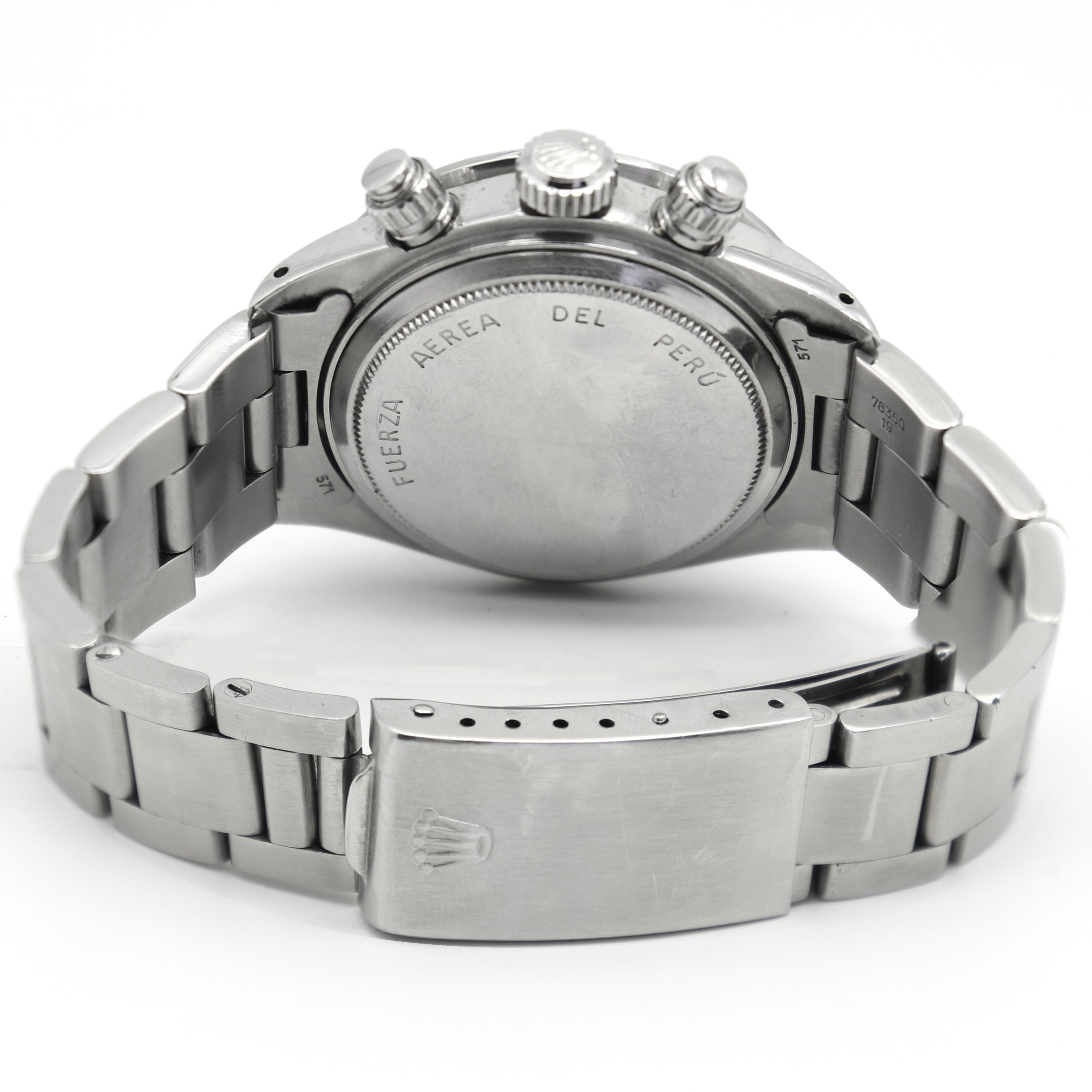
Rolex Daytona 6263 FAP

Military Provenance in Vintage Rolex: The Story of the Daytona F.A.P. (Fuerza Aérea del Perú)

By Luca Musumeci  |  Vintage Watches Miami

1. Introduction: The Ultimate Tool Watch

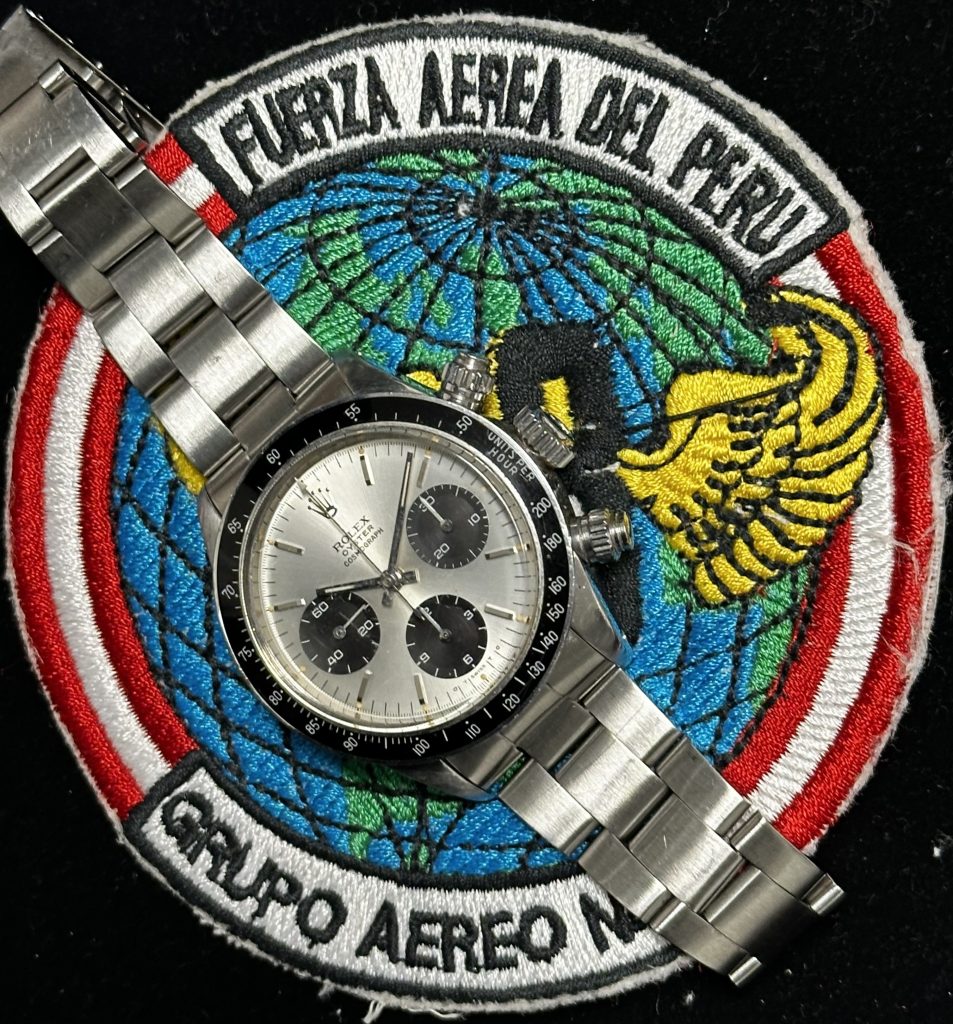
In the realm of vintage Rolex collecting, military provenance elevates a watch from a mere luxury item to a historical artifact. While the British Ministry of Defense (MoD) Submariners (“MilSubs”) often steal the spotlight, there is another, arguably more glamorous chapter in Rolex’s military history: the watches issued to the Fuerza Aérea del Perú (FAP), the Peruvian Air Force.

During the 1960s and 1970s, the FAP commissioned a variety of professional Rolex models for their officers and pilots, including Submariners, GMT-Masters, and most notably, the Cosmograph Daytona. The idea of a South American air force equipping its pilots with manual-wind Rolex chronographs — watches that today command extraordinary prices at auction — adds a layer of romance and intrigue that is unmatched in the vintage watch world.

Key Facts: The FAP Daytona at a Glance
Issuing Authority: Fuerza Aérea del Perú (Peruvian Air Force)
References Issued: 6238, 6239, 6241, 6262, 6263, 6265
Estimated Total Issued: 700–800 pieces (all references combined)
Period of Delivery: Early 1960s to mid-1980s
Serial Number Range: 1M to 6M

2. The Rolex-Peru Connection

The collaboration between Rolex and the Peruvian Air Force was not a standard military procurement contract. It was born out of a close personal friendship between the official Rolex dealer in Lima, Peru, and the late André Heiniger, the visionary Managing Director of Rolex SA (and father of Patrick Heiniger, who would later succeed him). This unique relationship allowed the FAP to order highly specialized batches of watches directly from Geneva.

It is estimated that between the early 1960s and the mid-1980s, only 700 to 800 Rolex chronographs were delivered to the FAP. These deliveries spanned several references, from the early pre-Daytona ref. 6238 to the later screw-down pusher models, ref. 6263 and 6265. The FAP also issued other Rolex professional models, including the Submariner ref. 1680, the GMT-Master ref. 1675, and steel Datejusts — but it is the Daytona that has captured the imagination of collectors worldwide.

engraving caseback

3. Identifying a True F.A.P. Daytona

Given their rarity and value, authenticating a FAP Daytona requires meticulous attention to detail. The Peruvian Air Force models possess specific characteristics that distinguish them from standard civilian production.

The Engravings

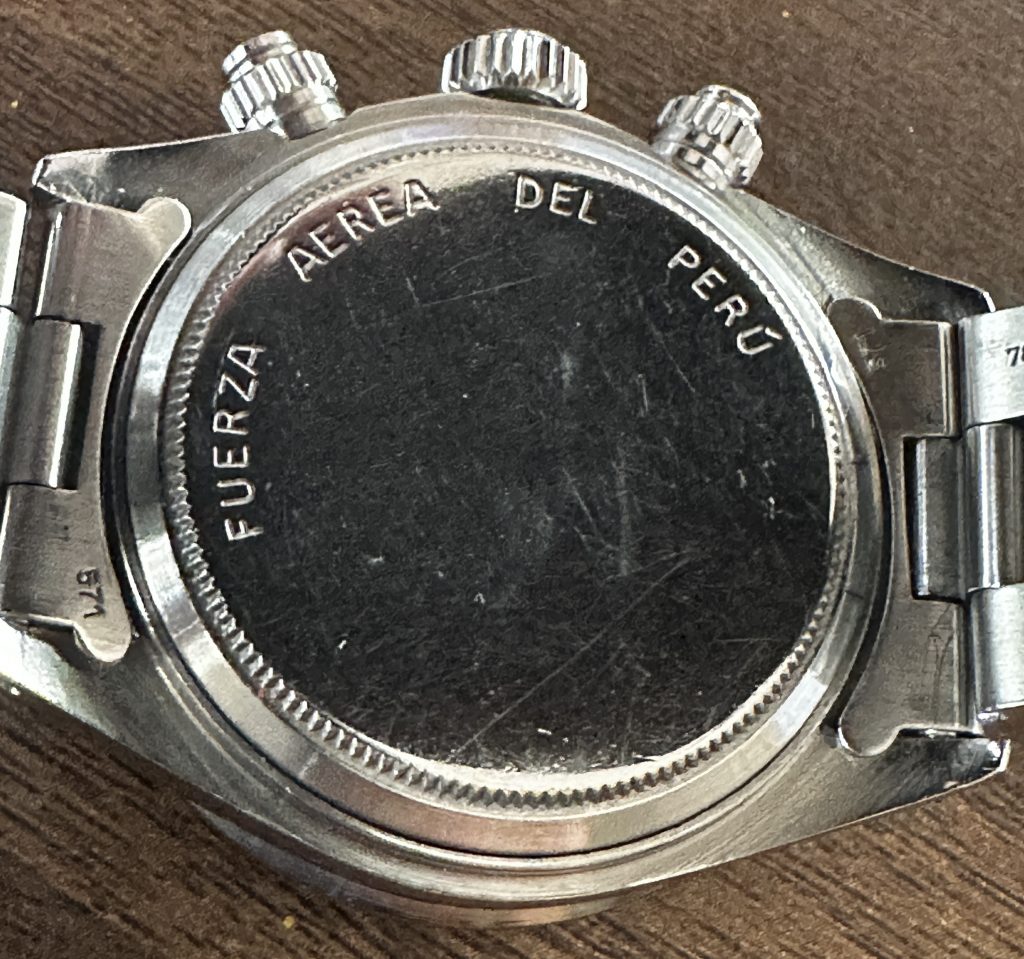
The most obvious identifier is the caseback engraving. Authentic FAP Daytonas feature the words “Fuerza Aérea del Perú” engraved on the outer caseback. These engravings were done by Rolex in Geneva before delivery. Crucially, these watches also feature the watch’s serial number engraved on the inside of the caseback — a practice not standard for civilian Daytonas of the era. Furthermore, the last three digits of the serial number were often (though not always) engraved in a miniaturized font on the outer caseback, though these are frequently lost to polishing over the decades.

The Dials

The dials of FAP Daytonas are also a subject of intense study. Many of the chronographs delivered to Peru, particularly across references 6239 to 6263/5, feature dials that omit the word “Daytona” entirely. This is consistent with Rolex’s practice for tool watches supplied to military and professional organizations during this era.

“Say what you will about the Peruvian Air Force… their military had style. Where the UK military made due with a few Subs and the US was telling its crew to buy Tudors themselves, Peru ordered Pre-Daytonas, Subs, Seamasters, GMT-Masters, Speedmasters, Railmasters, and this 6263… Rolex then really had a job to do as a tool, not just fashion.” — Hairspring

FeatureStandard Civilian Daytona (6263/6265)F.A.P. Issued Daytona
Outer CasebackPlainEngraved “Fuerza Aérea del Perú”
Inner CasebackReference number onlyReference number + Full Serial Number
Dial TextUsually includes “Daytona”Often omits “Daytona”
Production NumbersTens of thousands~700–800 total (all references)

4. The Significance of the Sigma Dial

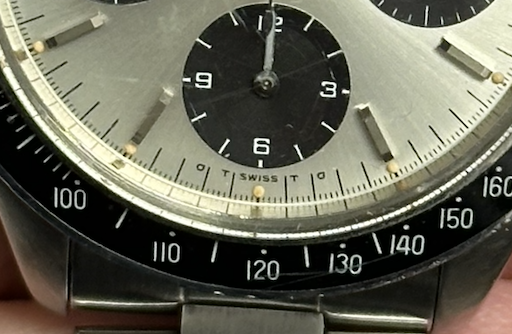
When discussing the reference 6263 FAP Daytona, the presence of a “Sigma dial” adds another layer of collectibility. Sigma dials, produced roughly between 1970 and the late 1970s, are characterized by the presence of two lowercase Greek sigma letters (σ) flanking the “T SWISS T” designation at the bottom of the dial.

These symbols indicate that the applied hour markers and hands are made of solid gold (either white or yellow), rather than steel or other base metals. This initiative was spearheaded by the APRIOR (Association pour la Promotion Industrielle de l’Or) to highlight the use of precious metals in Swiss watchmaking. Finding a FAP-issued Daytona with an original, well-preserved Sigma dial is exceptionally rare, as it combines military provenance with a highly sought-after dial variation.

Sigma dial

5. Buying Guide: What to Look For

Acquiring a FAP Daytona is a significant investment, and careful due diligence is required.

Verifying the Engravings

The outer caseback engraving “Fuerza Aérea del Perú” should be crisp and consistent with known examples. However, because these watches were used in military service, the engravings may be worn or partially polished away. The inner caseback engraving of the full serial number is a critical authentication point — it must match the serial number engraved between the lugs.

Dial and Hands

The dial should be original and untouched. As mentioned, many FAP Daytonas lack the “Daytona” text. The luminous material on the dial and hands should match and show consistent aging. Any signs of reluming or dial refinishing significantly impact the watch’s value.

Case Condition

While military watches are expected to show signs of wear, a well-preserved case is highly desirable. Look for thick, even lugs and original pushers and crown. Over-polishing is a common issue that detracts from the watch’s historical integrity.

Provenance

Any documentation or provenance linking the watch to its original military owner adds immense value and historical context. While rare, such provenance is the ultimate prize for a military watch collector.

6. The Market and Collectibility

The market for FAP Daytonas has matured significantly over the last decade. Once considered a niche sub-category, they are now recognized as blue-chip collector’s items. While a standard reference 6263 is a highly desirable watch, an authentic FAP-issued 6263 commands a substantial premium — often double the price of a civilian model. This premium is justified not only by the extreme rarity of the watches but by the fact that they were genuine military tools, used in the cockpits of Mirage and Canberra fighter jets.

The condition of the dial is paramount. A lightly patinated silver dial with golden tritium plots, like the Sigma dial variant, is considered highly desirable. Any cracks in the acrylic crystal, polishing of the case, or replacement of original components significantly diminishes both authenticity and value.

7. Discover the F.A.P. Daytona at Luca Musumeci

At Vintage Watches Milano & Miami, we understand the profound historical significance of military-issued Rolexes. We are incredibly proud to offer a museum-quality example of this rare breed:

  • Rolex Daytona Ref. 6263 F.A.P. Silver Sigma Dial — An exceptional and highly original example of the Peruvian Air Force Daytona, featuring the correct engravings and a stunning silver Sigma dial in remarkable condition.

Discover this extraordinary piece of military horological history →

Sources & Further Reading:
[1] Bulang and Sons — Throw Back Thursday – The Rolex 6265 FAP Daytona
[2] Hairspring — FAP 6263 Rolex Daytona
[3] WatchProSite — Rolex and the Fuerza Aérea del Perú
[4] Wind Vintage — Rolex Daytona Reference 6263 FAP Peruvian Air Force

How has the style changed and what has influenced watch design over the last 100 years

chronological overview of the styles, trends, technical features, and influences that have shaped watchmaking over the past 100 years, from the 1920s to the present day:

1920s: Art Deco and the Rise of the Wristwatch

* Style: Art Deco. Geometric lines, stylized patterns, use of precious materials like platinum, diamonds, and enamel. Rectangular, tonneau (barrel), and cushion shapes.

* Fashion and Influences: Art Deco reflected the optimism and modernity of the post-World War I era. The wristwatch, previously considered a feminine accessory, became a status symbol for men as well, gradually replacing the pocket watch.

* Technical Features: Manually wound mechanical movements, small and flat to fit the reduced size of wristwatches.

* Trends: Elegant and refined watches designed for special occasions. The Cartier Tank and Jaeger-LeCoultre Reverso are iconic examples from this period.

1930s: The Great Depression and Functionality
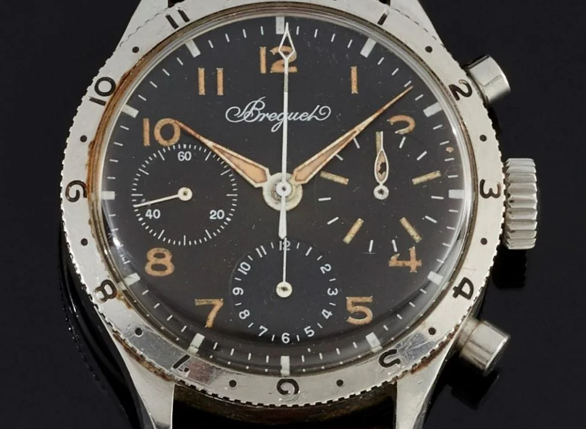
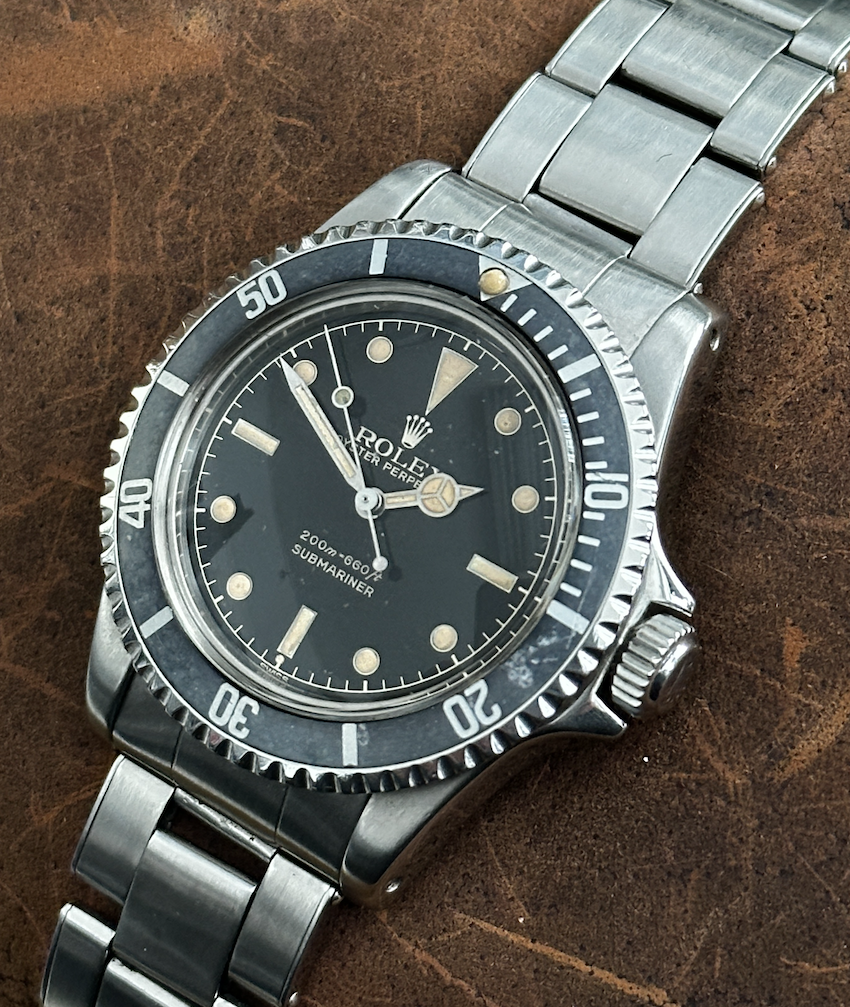
* Style: More sober and functional design, with clean lines and legible dials. Use of stainless steel and less expensive metals to keep prices down.

* Fashion and Influences: The Great Depression influenced watch design, making watches more practical and accessible. Aviation and exploration inspired the creation of robust and reliable watches.

* Technical Features: Development of chronograph watches and pilot’s watches with useful functions such as world time and the measurement of time intervals.

* Trends: Durable and reliable watches for everyday use, such as the Rolex Oyster and Omega CK2129.

1940s: War and Military Watches

* Style: Utilitarian and robust design, with high-legibility black dials and luminous hands. Cases in stainless steel or chrome-plated metal.

* Fashion and Influences: World War II led to the mass production of military watches for the armed forces. These watches had to be reliable, accurate, and easy to read in any condition.

* Technical Features: Shock-resistant and water-resistant mechanical movements. Luminous hands and markers with radium (later replaced with less dangerous materials).

* Trends: Military watches with precise specifications, such as the “Dirty Dozen” (12 watches supplied to the British Army by various Swiss manufacturers).

1950s: The Golden Age of Sports Watchmaking
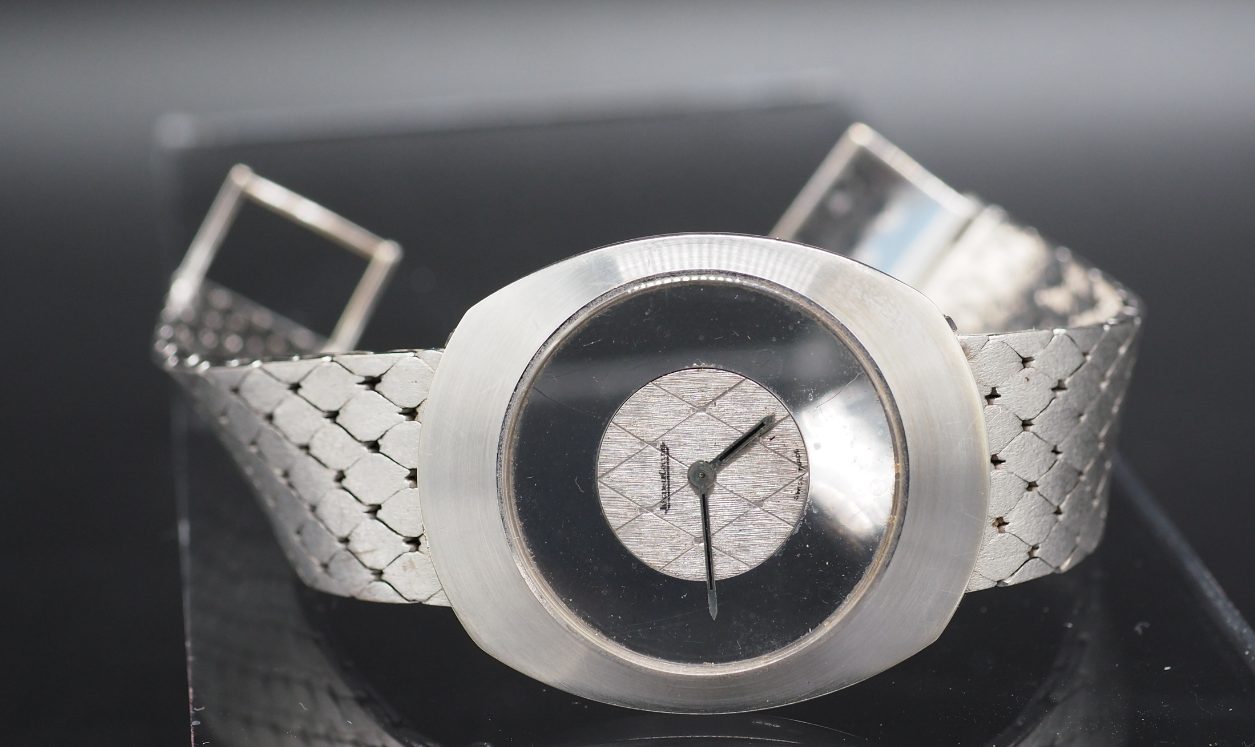
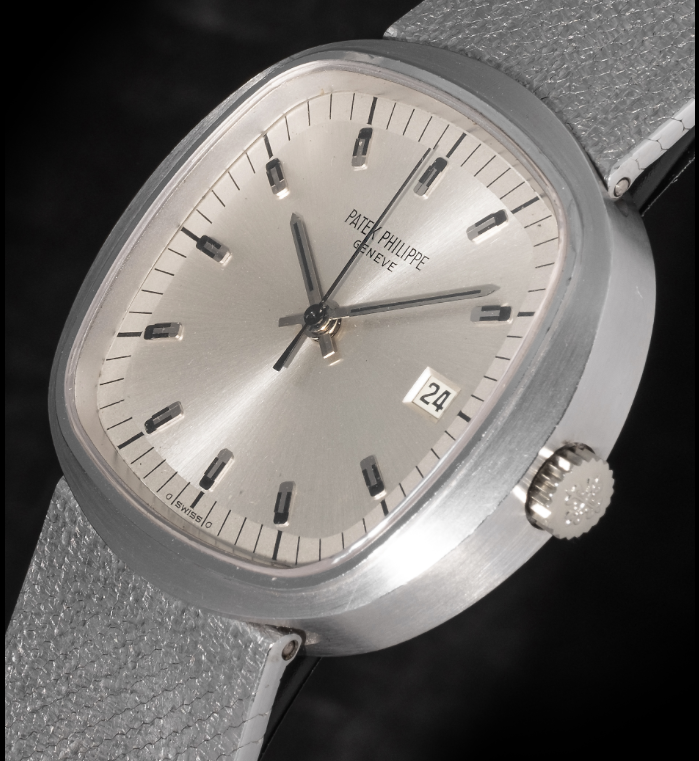
* Style: Sporty and elegant design, with stainless steel cases, rotating bezels, and colorful dials.

* Fashion and Influences: The passion for water sports and motor racing inspired the creation of diving watches and sports chronographs.

* Technical Features: Improved water resistance, automatic movements, and chronographs with useful complications such as the date and tachymeter.

* Trends: Diving watches like the Rolex Submariner and Blancpain Fifty Fathoms, and sports chronographs like the Omega Speedmaster and Rolex Daytona.

1960s: Technical Innovation and Modern Design

* Style: Modern and minimalist design, with clean lines and simple dials. Use of new materials such as brushed stainless steel and plexiglass.

* Fashion and Influences: Space exploration inspired the creation of watches with futuristic design and innovative functions.

* Technical Features: Introduction of more precise and reliable automatic movements, and new shock-resistant and water-resistant materials.

* Trends: Elegant and sporty watches like the Patek Philippe Calatrava and Rolex Datejust, and sports chronographs like the Heuer Carrera.

1970s: The Quartz Crisis and the Explosion of Design
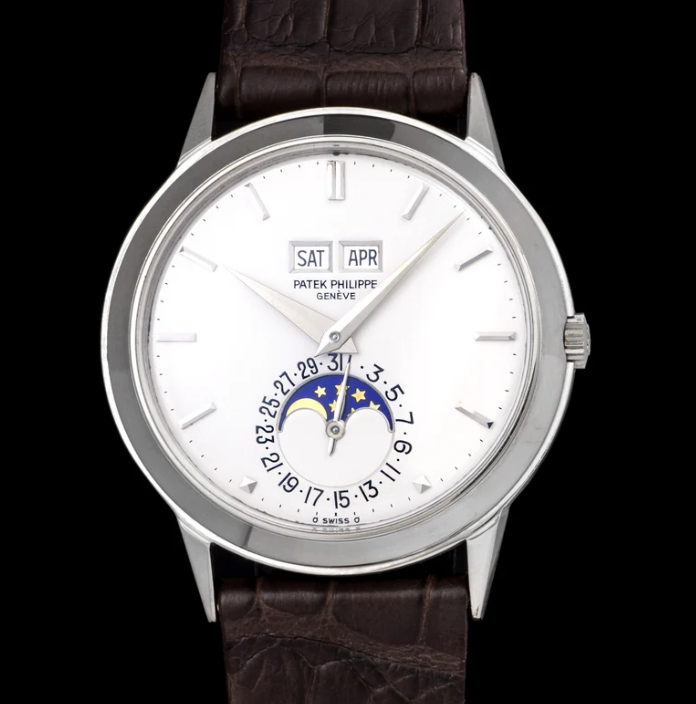
* Style: Bold and experimental design, with geometric shapes, bright colors, and unusual materials such as plastic and titanium.

* Fashion and Influences: The quartz crisis led to a diversification of production, with the creation of inexpensive quartz watches and luxury watches with innovative design.

* Technical Features: Spread of quartz technology, which offered greater accuracy and reliability at a lower cost.

* Trends: Inexpensive quartz watches and luxury watches with iconic design like the Audemars Piguet Royal Oak and Patek Philippe Nautilus.

1980s: The Return to Luxury and the Renaissance of the Mechanical Watch

* Style: Classic and luxurious design, with gold cases and decorated dials. Return to traditional watchmaking and craftsmanship.

* Fashion and Influences: The economic recovery led to a renewed interest in luxury mechanical watches, considered symbols of status and refined taste.

* Technical Features: Revival of mechanical watchmaking, with the production of complicated and high-quality movements.

* Trends: Classic and luxurious watches like the Patek Philippe Perpetual Calendar and Breguet Tourbillon.

1990s: Complication and Transparency
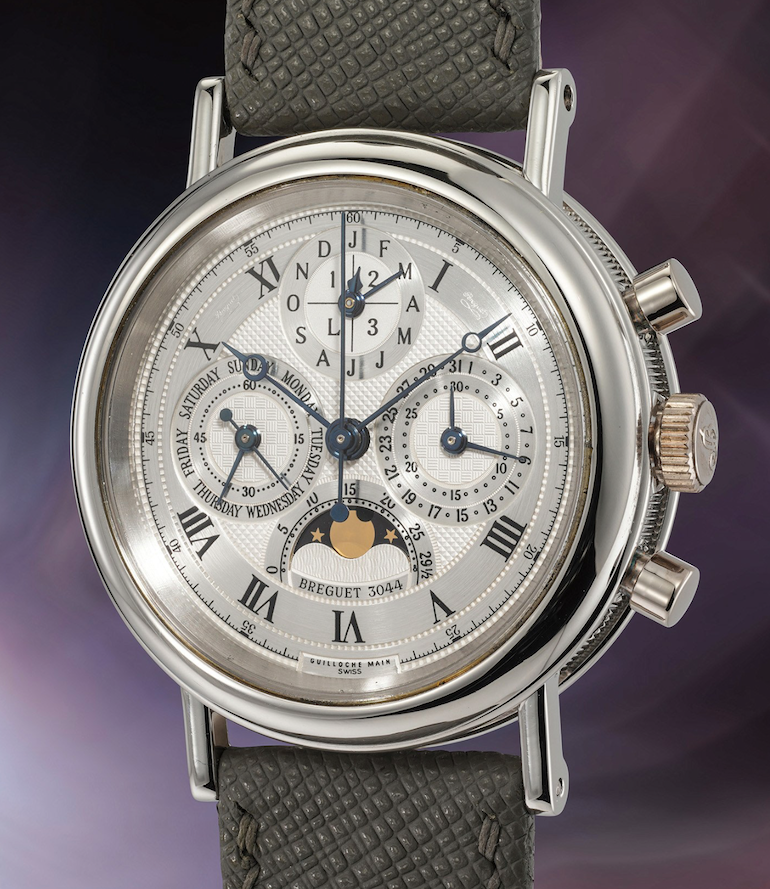
* Style: Design that showcases the internal mechanics of the watch, with skeletonized dials and transparent case backs.

* Fashion and Influences: The passion for mechanical watchmaking led to the creation of watches with sophisticated complications such as the tourbillon, minute repeater, and perpetual calendar.

* Technical Features: Development of automatic movements with advanced complications and new materials such as silicon to improve accuracy and reliability.

* Trends: Watches with sophisticated complications like the A. Lange & Söhne Datograph and Franck Muller Crazy Hours.

2000s and 2010s: Personalization and Material Innovation

* Style: Increasingly customizable design, with the ability to choose from a wide range of materials, colors, and finishes.

* Fashion and Influences: The influence of the fashion and luxury world led to the creation of watches with original design and innovative materials such as carbon, ceramic, and titanium.

* Technical Features: Development of automatic movements with extended power reserve and new scratch-resistant and wear-resistant materials.

* Trends: Luxury watches with personalized design like the Hublot Big Bang and Richard Mille RM 011.

2020s: Sustainability, Technological Integration, and the Return to Vintage

* Style: Greater attention to sustainability, with the use of recycled materials and eco-friendly production processes. Return to vintage aesthetics, with the re-edition of iconic models from the past. Minimalist and functional design, with a focus on legibility and usability.

* Fashion and Influences: Growing environmental and social awareness, with an impact on the design and materials used. Influence of social media and vintage culture, with a renewed interest in watches of the past. Integration of smart technologies, such as Bluetooth connectivity and health monitoring functions.

* Technical Features: Development of automatic movements with greater energy efficiency and durability. Use of new ecological and sustainable materials. Integration of smart technologies, such as Bluetooth connectivity and activity sensors.
* Trends: Watches with recycled materials and high-efficiency movements. Modern reinterpretations of iconic vintage watches. Hybrid watches that combine traditional aesthetics with smart features.
In summary, over the past 100 years, watchmaking has been influenced by a variety of factors, including fashion, historical events, technological innovations, and social trends. Each decade has seen the emergence of new styles, materials, and technical features, which have helped to shape modern watchmaking.

The Special Rolex Daytona Dial – Quick 101 Lesson

The Special Rolex Daytona Dial 

There is no vintage watch topic that does not touch on the prevalence of the Rolex Daytona. Lets all face it, it’s a watch that brings about an unchartered amount of curiosity and lore. Written below we will delve into a brief and very condensed overview of the Daytona family lineup. It will allow you to differentiate one model from another. We will explain where all these terms come from and what they actually mean.

The Red Daytona

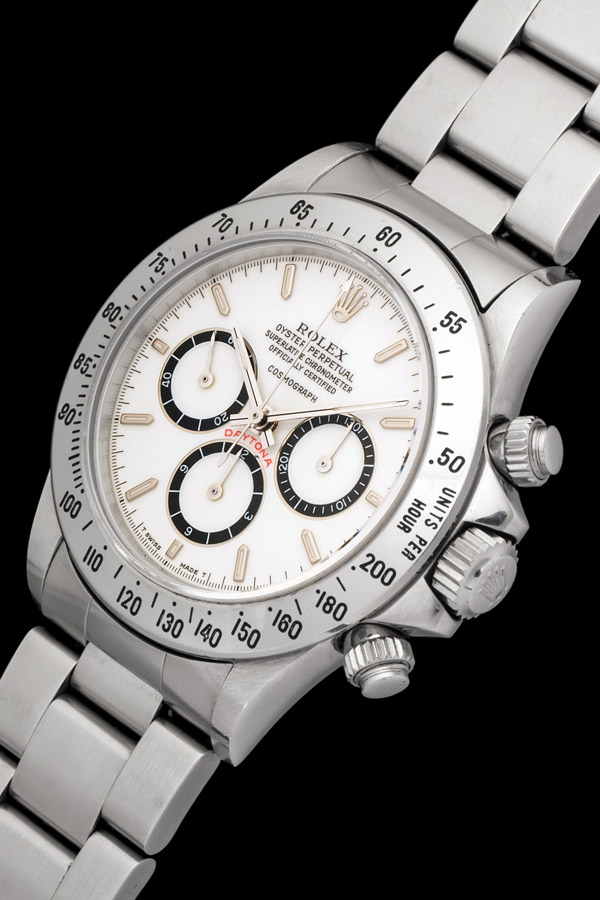
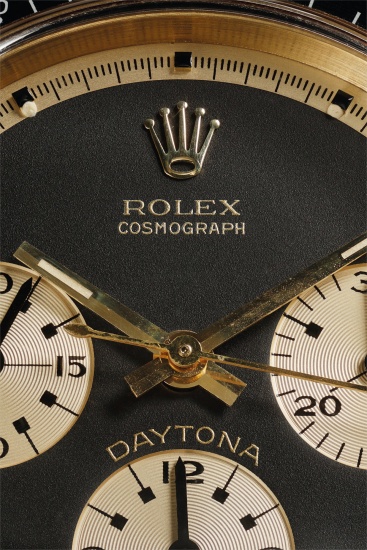
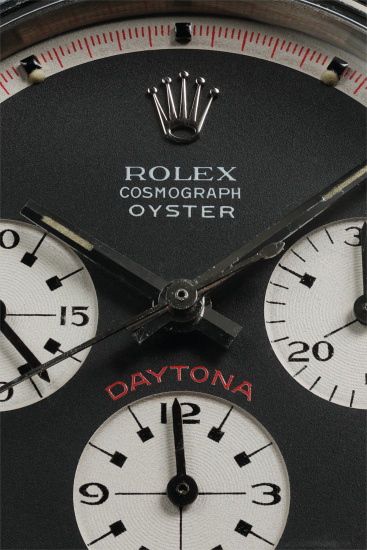
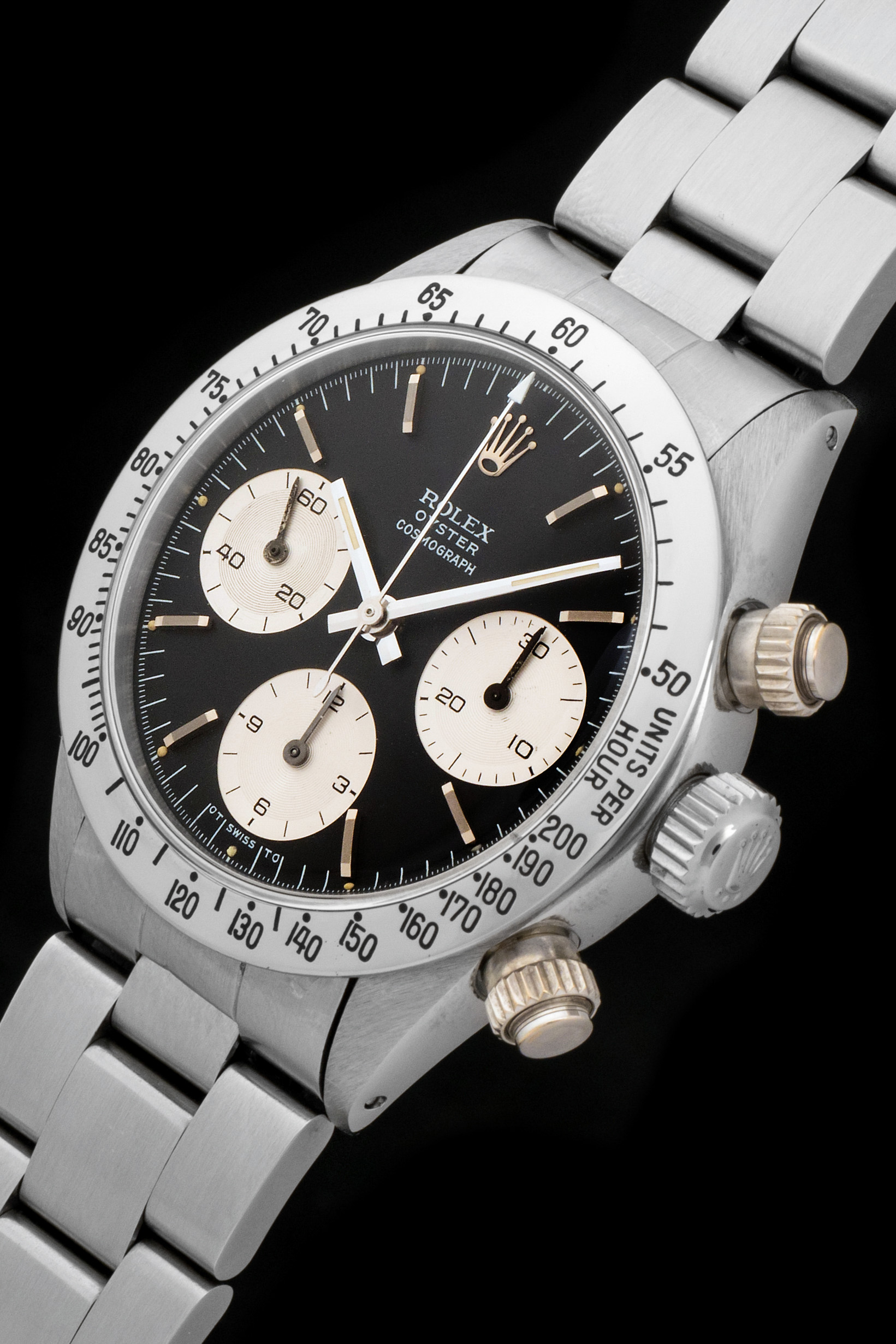
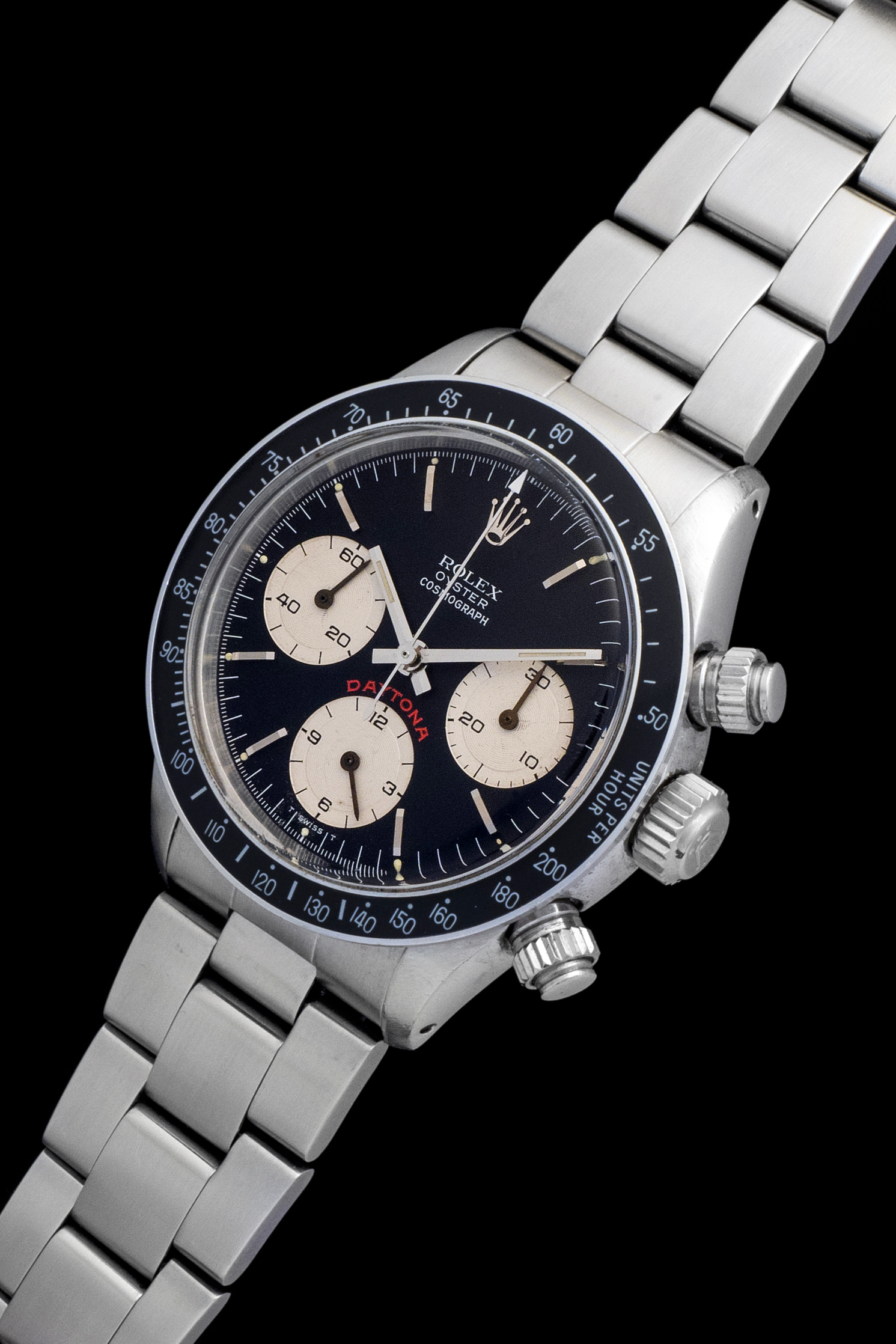
The ever-cool signature found on the dial above the six o’clock sub-dial. Distinctive recognition due to its oversized red color printed “Daytona”. This feature is found on references 6263 and 6265.


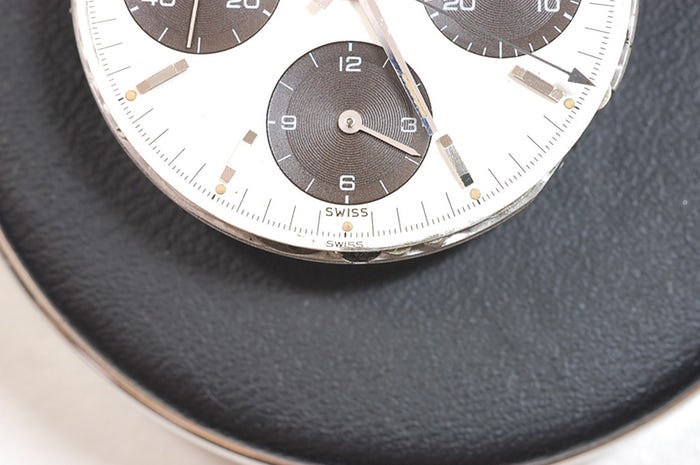
Double Swiss

Found on early Daytona’s and features a double printed “Swiss” on the six o’clock sector of the dial. This occurrence came about due to the presence of a large bezel that covered the lower part of the dials. As per regulation Rolex had to re-print these dials with an additional “Swiss”. A double Swiss print on a dial is coveted and carries a substantial premium price tag.


Image via 10PastTen

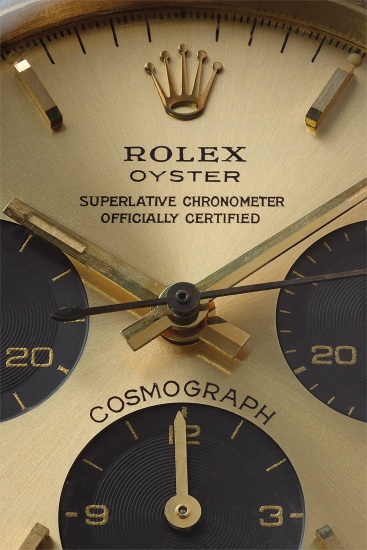
Floating Cosmograph

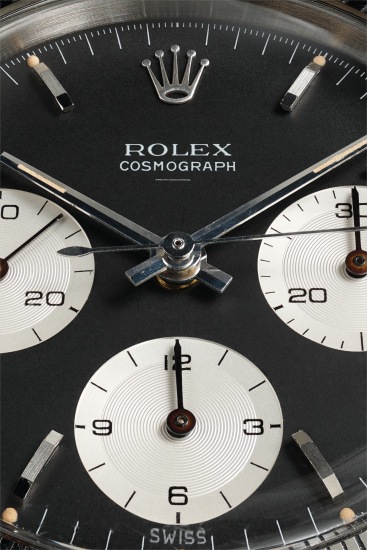
Rolex vocab is applied when a line of text is floating or suspended below the text or above the chronograph sub dial. Really cool detail to see in person.


Oyster First Series

Another form of “floating” occurrence where there are gaps between multiple lines of text. This detail is prevalent on some gold screw down Daytona’s such as the ref. 6263 and 6265. An Oyster split Daytona is incredibly rare.


Lot 4 from Phillips Daytona Ultimatum Auction

John Player Special

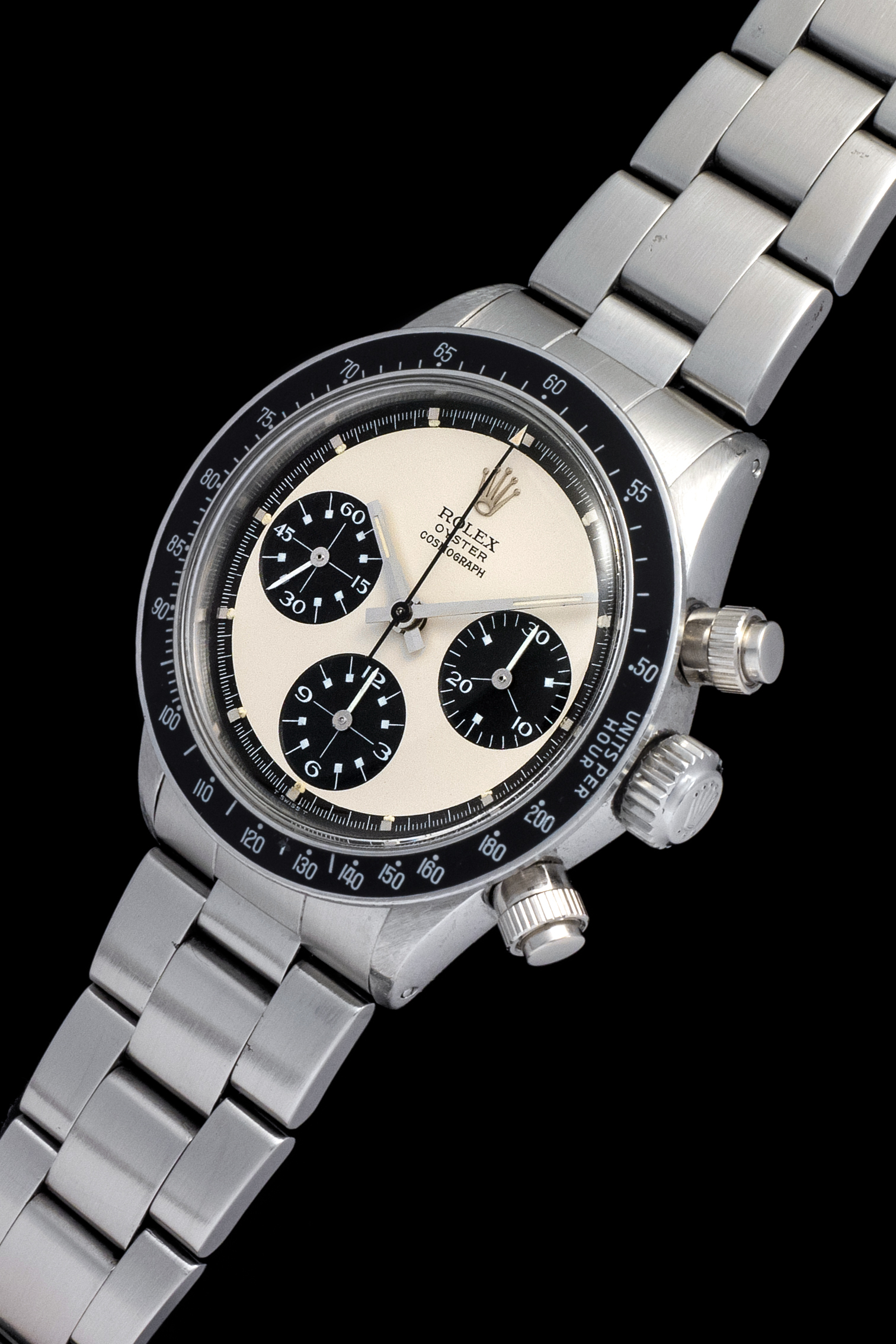
The highly lauded JPS Daytona is found on yellow gold models and is fitted on black dialed “Exotic Paul Newman’s” and text is printed in gold lettering. Named John Player Special after its similarity with the color schemes of the 1970’s John Player Special car racing team. There was never an affiliation between the team and the Rolex manufacture.


Lot 24 from Phillips Daytona Ultimatum Auction

Oyster Sotto

Is seen on Daytona’s with the “Oyster” print located beneath the “Cosmograph” print. Oyster Sotto’s are found on early batches of the exotic dialed screw down chronographs. Sotto’s are amongst the most coveted variations and those who own them know exactly what they are doing.


Lot 14 from Phillips Daytona Ultimatum Auction

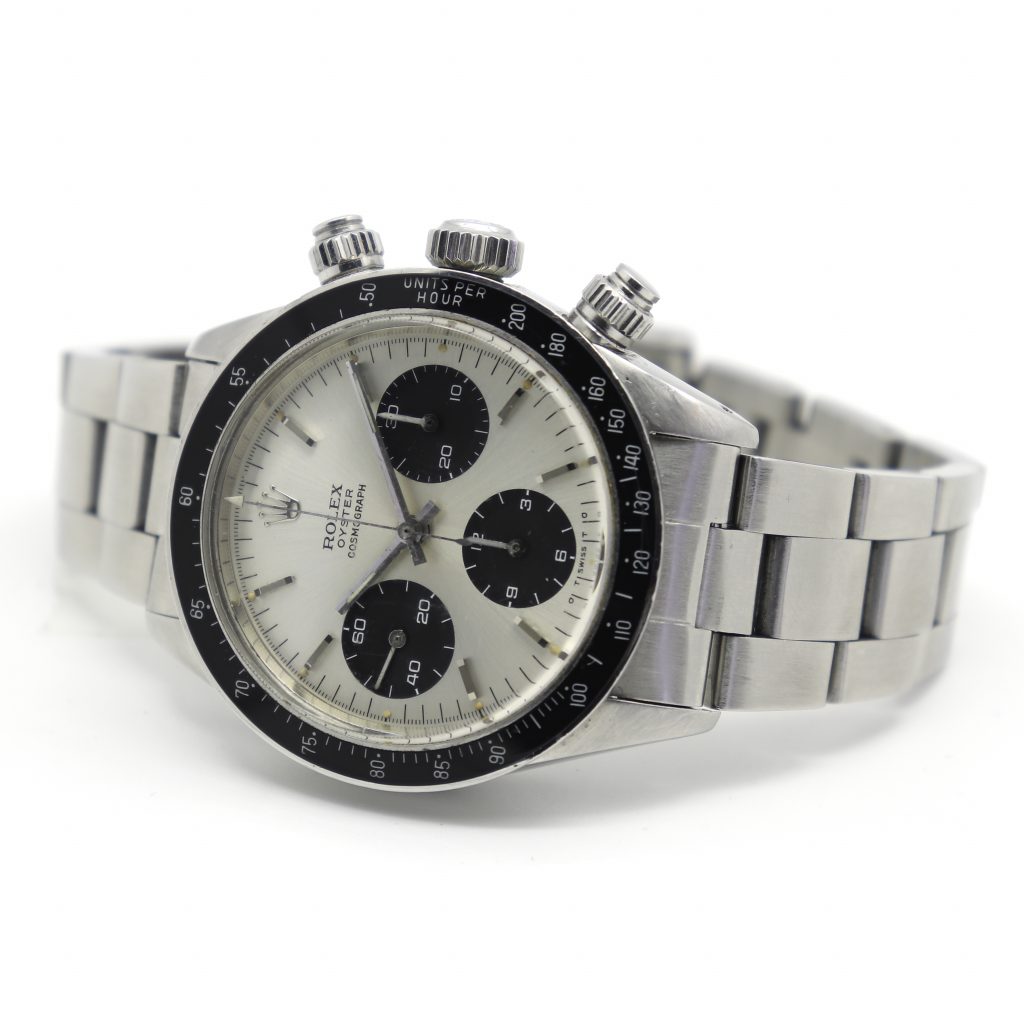
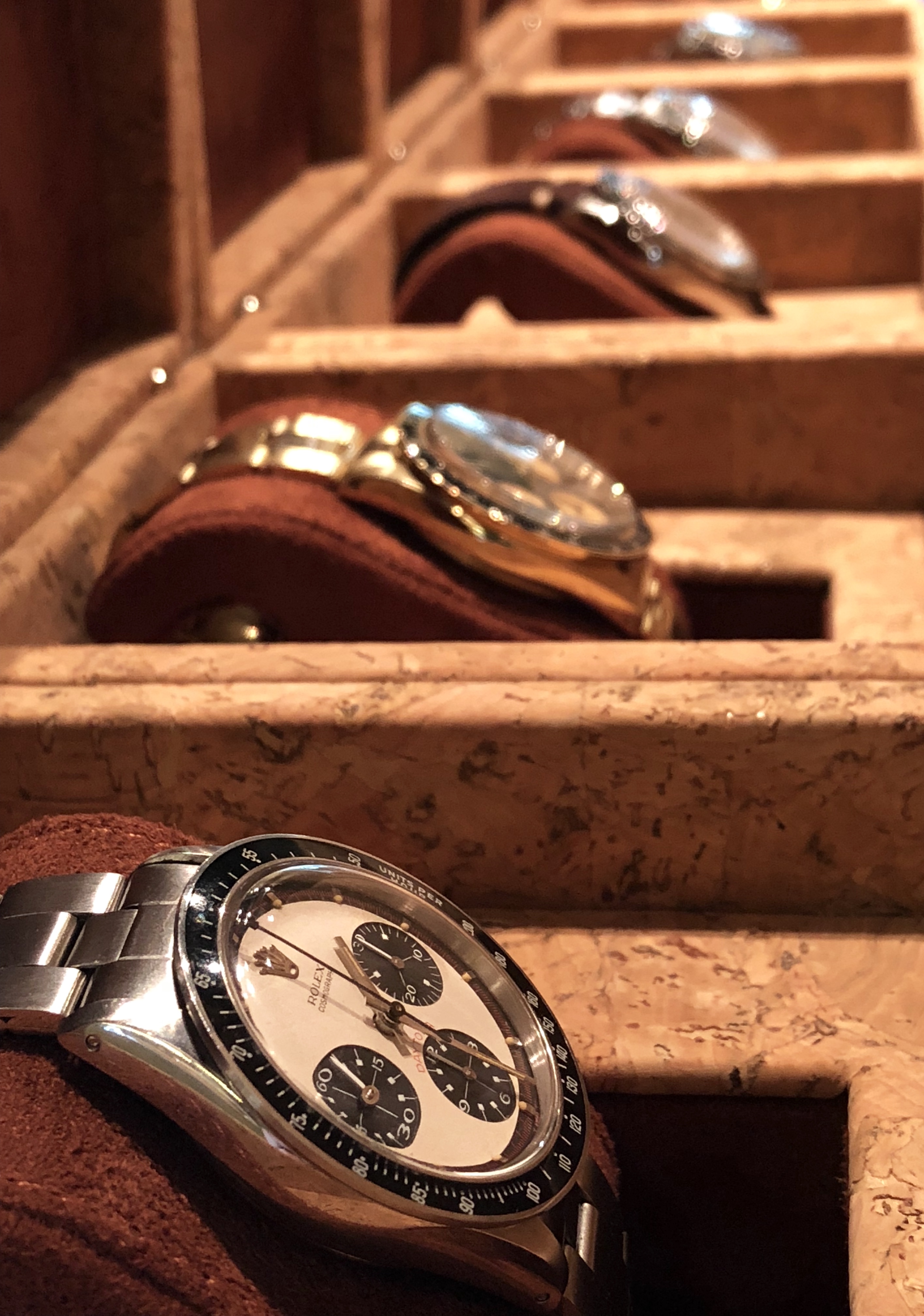
Panda Chronograph

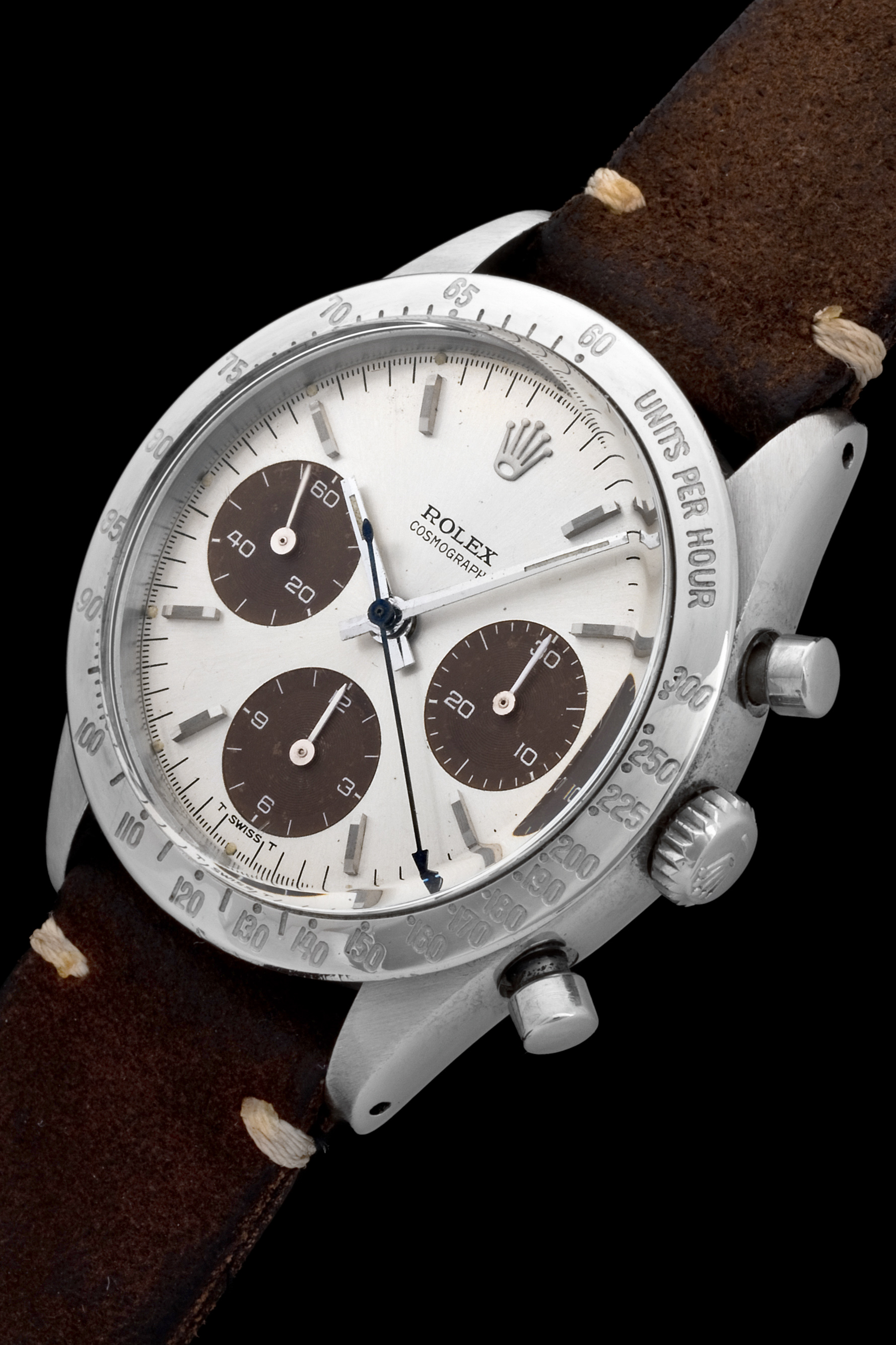
Is a Daytona fitted with a white dial accompanied by black sub dials. Much like a panda bear.


Double Stamped Daytona

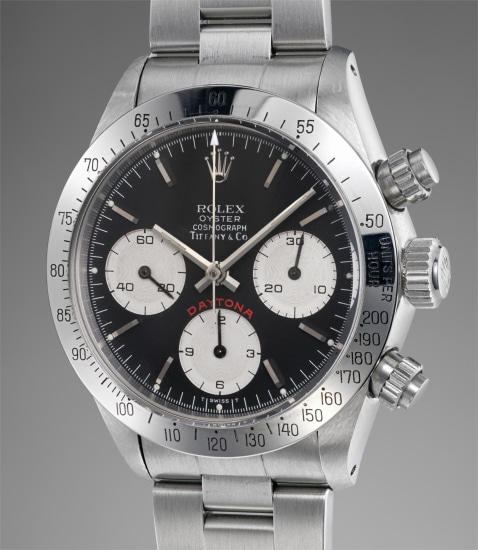
A double stamped Daytona is the dream for many a collector. A twice stamped dial features the Rolex name but also the name of the retailer that originally sold the watch. Tifanny & Co. remains to the day the most significant partner of the Swiss manufacturer. It is common for double stamped Daytona’s to feature a hand engraved inventory number inscribed on the back side of the case lug.


Lot 171 from Phillips The Geneva Watch Auction: Seven

Sigma Daytona

Are those dials that feature solid white gold indexes and hands. These types of dials are found on both steel and gold models, and they represent an additional step taken in the quality control. A Sigma dial can be identified by observing the small Greek sigma letters printed below the six o’clock mark.


Tropical Daytona

Is a dial that has become brown from its original black color. This phenomenon is caused by an error in pigmentation coupled with exposure to UV rays. An evenly brown dial on a Daytona is an unbelievable sight and a detail that drives collectors and auction houses afire.


Underline Daytona

Dial features a short line underneath the text at 12 o ‘clock or 6 o’clock. Rolex introduced as a measure to indicate their transition from using radioactive radium with tritium as the source of dial luminescence. The underline Daytona ceased after dials incorporated the tritium indicating wording conveniently located below the six o’clock marking.


Lot 23 from Phillips Daytona Ultimatum Auction


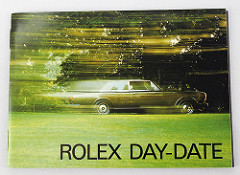
The Beautiful History of the Rolex Day-Date

History

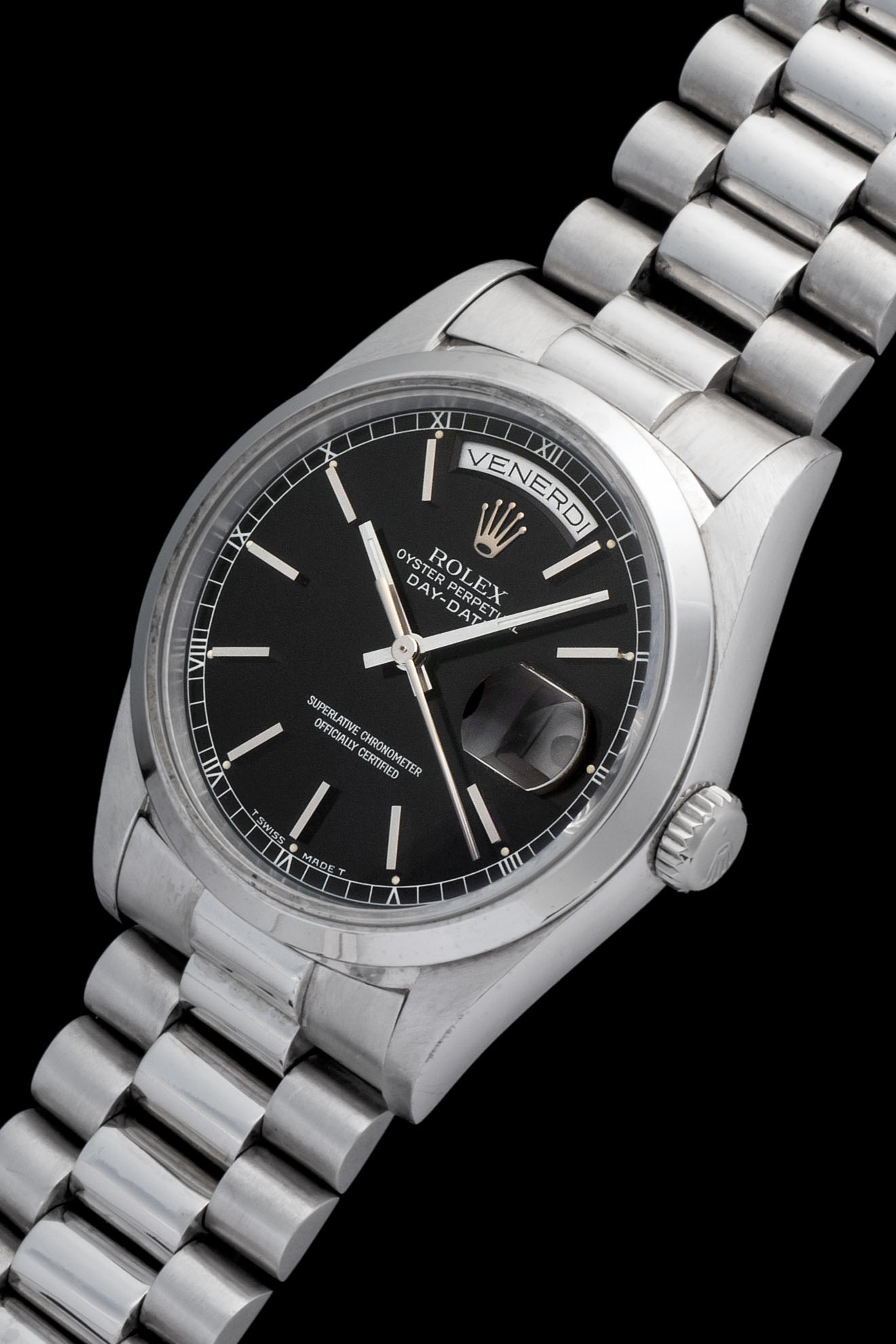
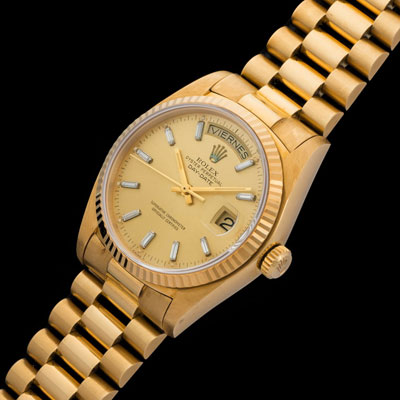
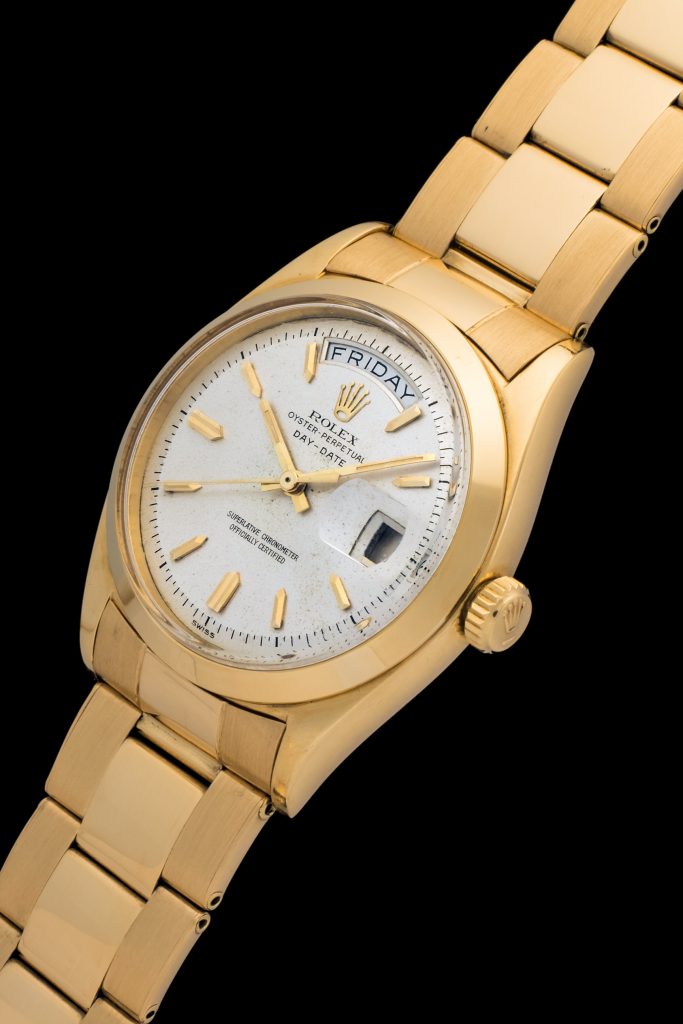
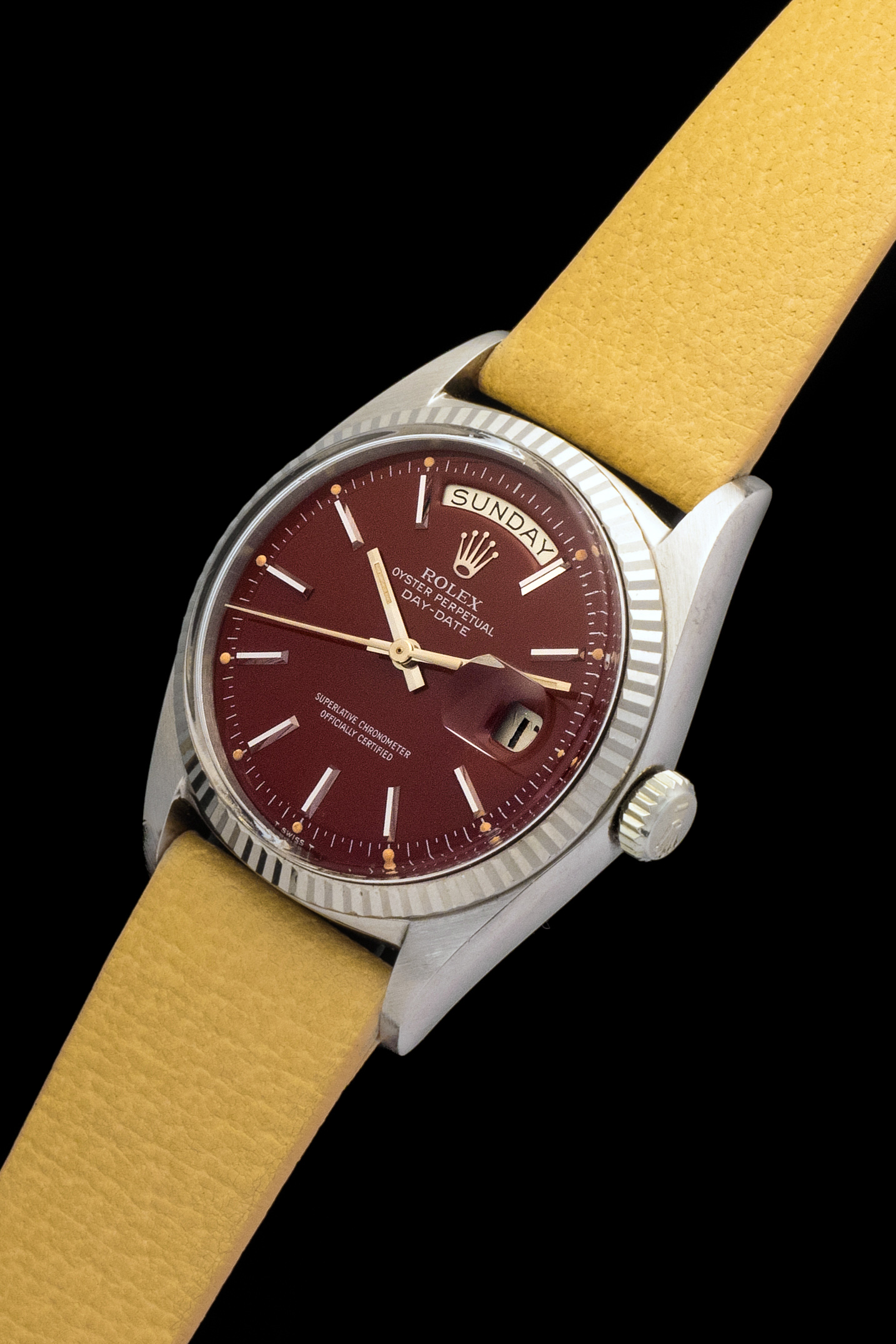
In 1956 Rolex introduced the Day-Date and its doing ensured its relevance for perpetuity. The release of the Day-Date was as magnificent as it was bewildering to its fans, some still attempting to embrace the reference 8171 “Padellone” that had just ceased production and the charm of the newer reference 6062 at the same time. The Day-Date brought about an era that celebrated luxury and elegance, and it joined the 6062 to show the world that Rolex could do luxury watches just as well as it did tool watches. The novelty behind the Day-Date was its capability of displaying both the day and the date, and to add an additional degree of luxury the watch was only to be cased in precious metals such as gold and platinum. Note: handful of examples in steel were made for special Rolex clients.

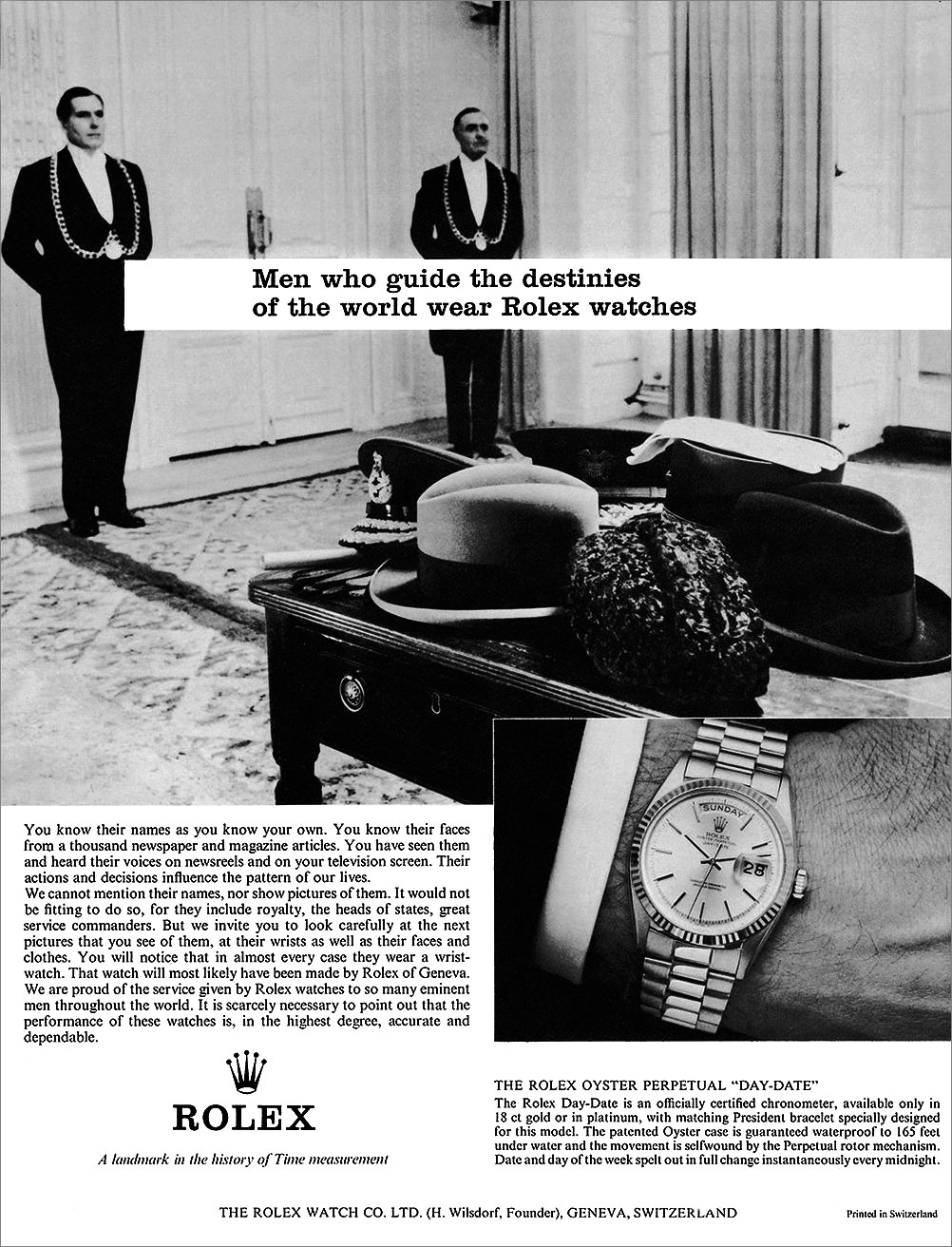
1964-Men-Who-Guide-The-Destinies-Of-The-World-Wear-Rolex-Watches

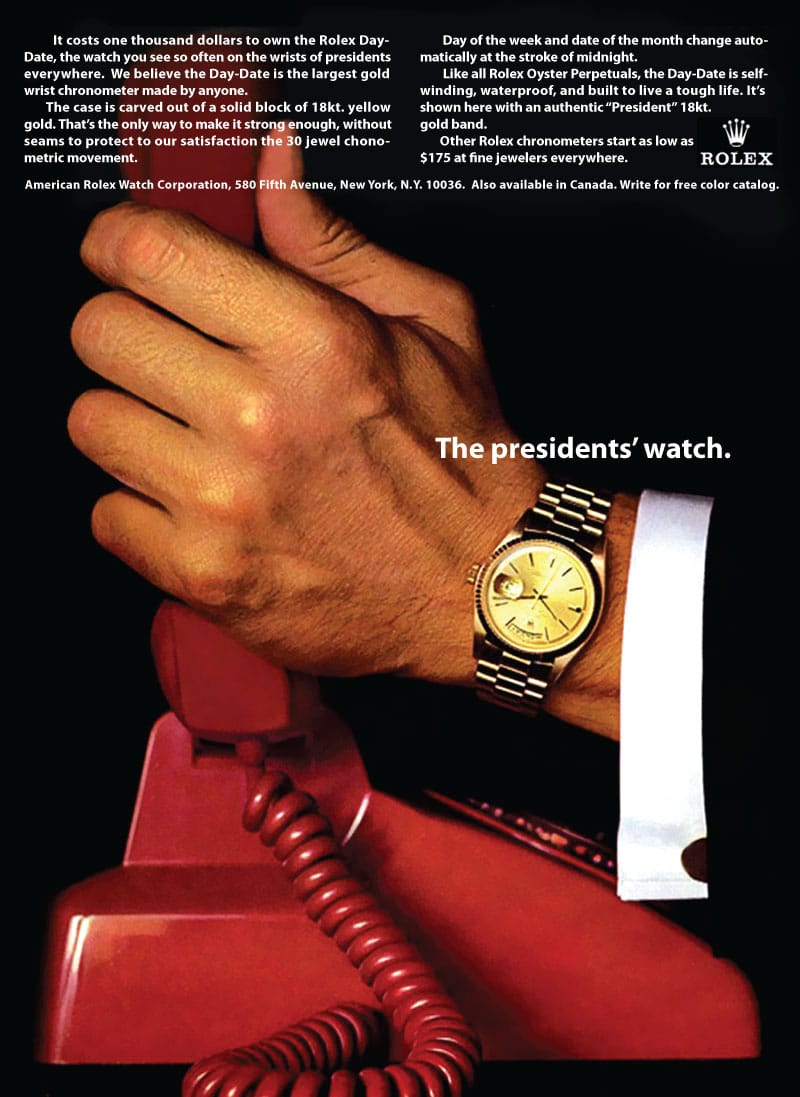
The Day-Date put Rolex in an unbeatable path through brilliant manufacture practices and forward thinking advertising. Early Day-Date adverts remain as cool today as they were back then. The fact that the Day-Date would go on to become President Lyndon B. Johnson’s go-to watch played right into Rolex’s brilliant marketing plan. Through unofficial spokesmen the Day-Date snowballed into success and Rolex into a household name. Now that modern times have rolled in and symbolic references have ceased production the Day-Date continues to be an intrinsic symbol of elegance, power, and distinction. In our collection are some of the most beautiful and rare Day-Dates available to the public. Read on to learn more about the Rolex Day-Date.

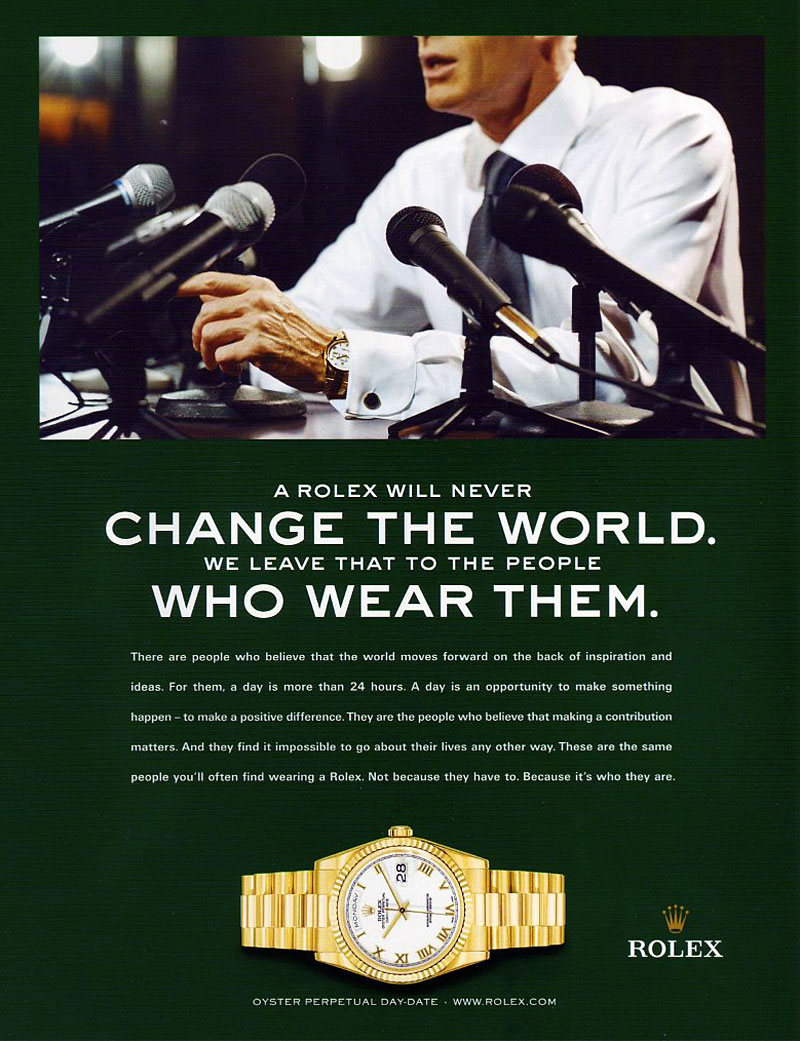
Rolex-Change-The-World

Rolex Day-Date 6611B

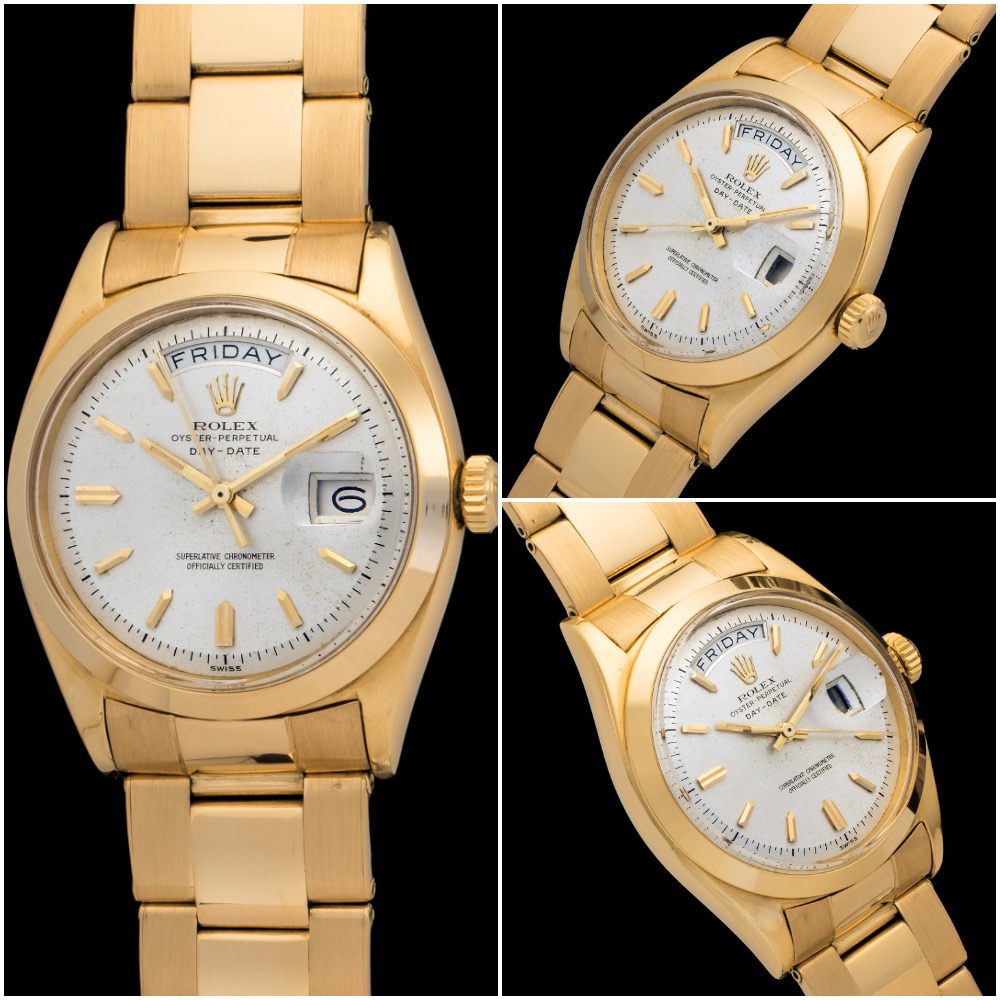
Following the reference 6611B came an equally as beautiful model, the Day-Date 6612 (see ours pictured) Along with a re-designed watch came two additional novelties: a smooth bezel and a slightly better movement. Our Day-Date 6612B from 1959 is put together by an 18K yellow gold oyster rivet band, which is an incredibly rare detail as Day-Dates were sold with jubilee bands, very select few were sold with gold oyster rivets.


pjimage-11j

Rolex Day-Date 1803

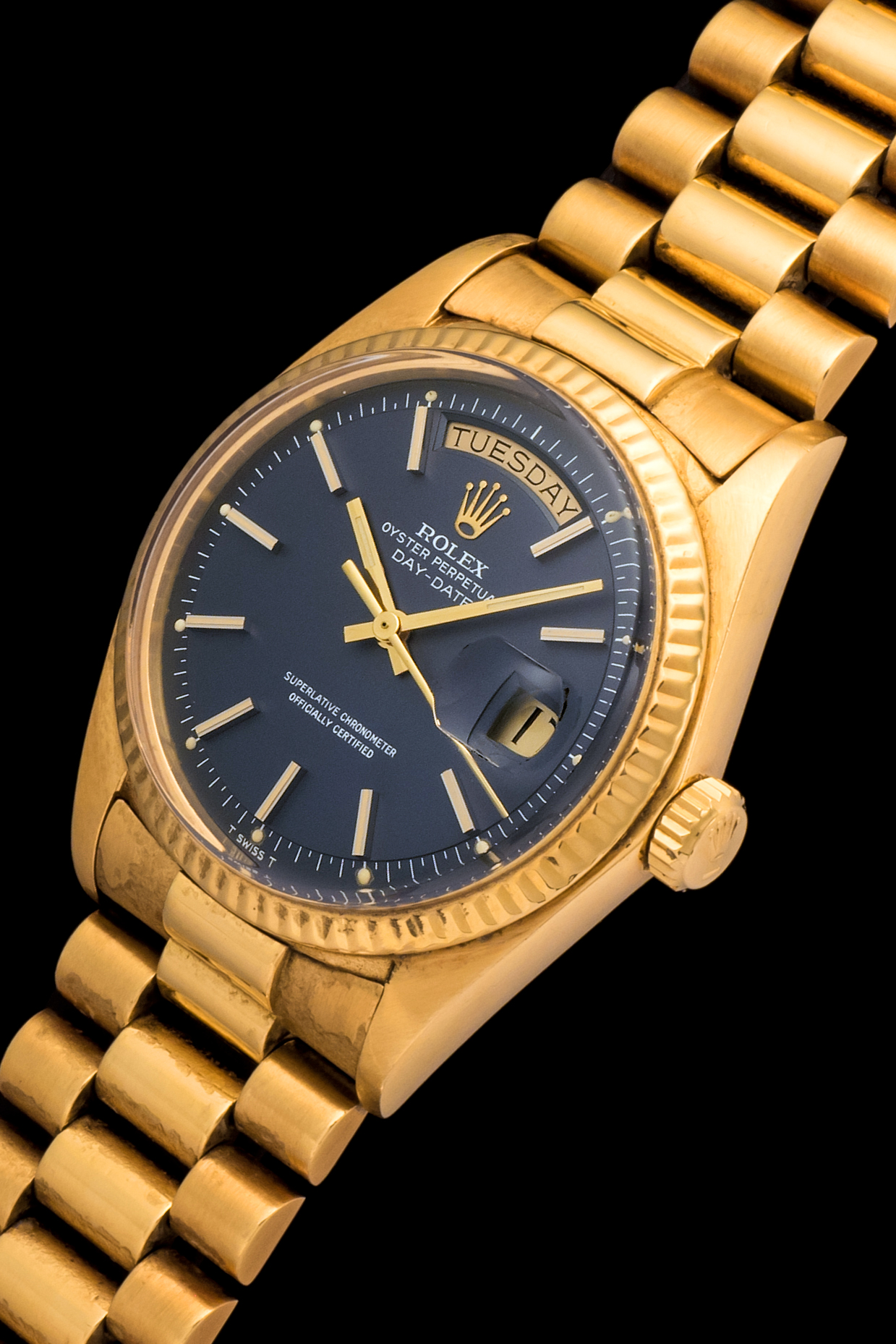
The reference 1803 came out in 1961 with an array of details that earned it a decades long production period. The first three references allowed Rolex to make changes and technological advances, which eased in the design and launch of the Day-Date 1803. This was the model that became a staple on the wrists of the worlds most powerful men. With the reference 1803 the Day-Date adapted its identity and pedigree that is palpable today. From 1961 to 1968 the Day-Date 1803 stayed its course with no features added or taken, although during this time Rolex did introduce a wide array of dial variations. However in 1969 Rolex introduced a detail that would forever become synonymous with the model and that was the hidden clasp bracelet later deemed the Presidential bracelet. The moniker comes about thanks to United States president Lyndon B. Johnson as he was pictured wearing his reference 1803, which included the new bracelet style. In our collection are two special full sets 1803’s. One is fitted with a doorstop dial and the other An 1803 manufactured in 1962 and accompanied by its original box and papers. A nice detail aside from its complete set is its doorstop dial. If you notice the indexes positioned at 6 o’clock and 9 o’clock resemble a doorstop. This watch comes with a leather band and not a hidden clasp gold bracelet. Pictured is another 1803 fitted with a hidden clasp bracelet and accompanied by box and papers. The papers denote a full Rolex service done to the watch in Saudi Arabia.

OLYMPUS DIGITAL CAMERA

Rolex Day-Date 18038

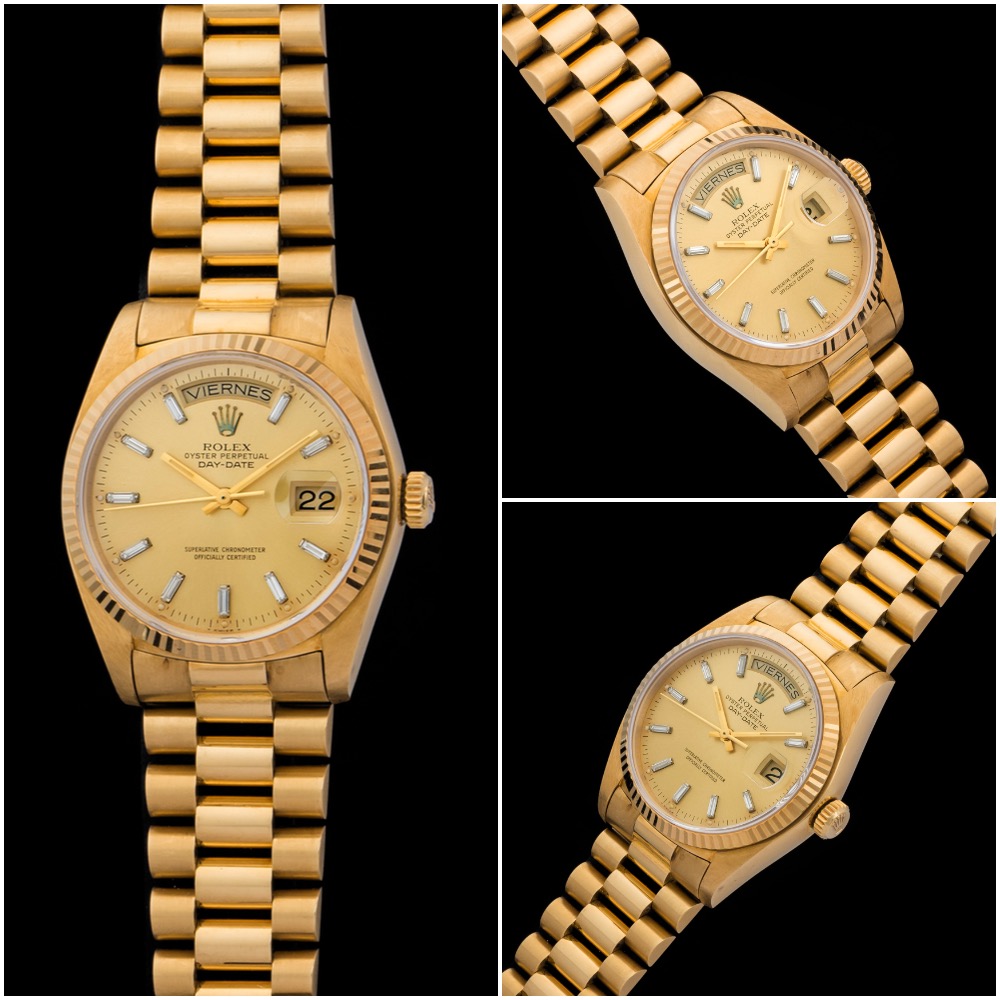
The successful Day-Date 1803 was replaced in 1977 with the reference 18038. This new reference introduced two details that are now staples on modern Day-Dates. The sapphire crystal replacing the plexiglass and the quick-set capable movement. Pictured is an early iteration of the reference, this one being manufactured in 1977 and fitted with a rare champagne colored baguette diamond index dial. An added plus is the Spanish calendar.

pjimage-111

Rolex Day-Date 18048

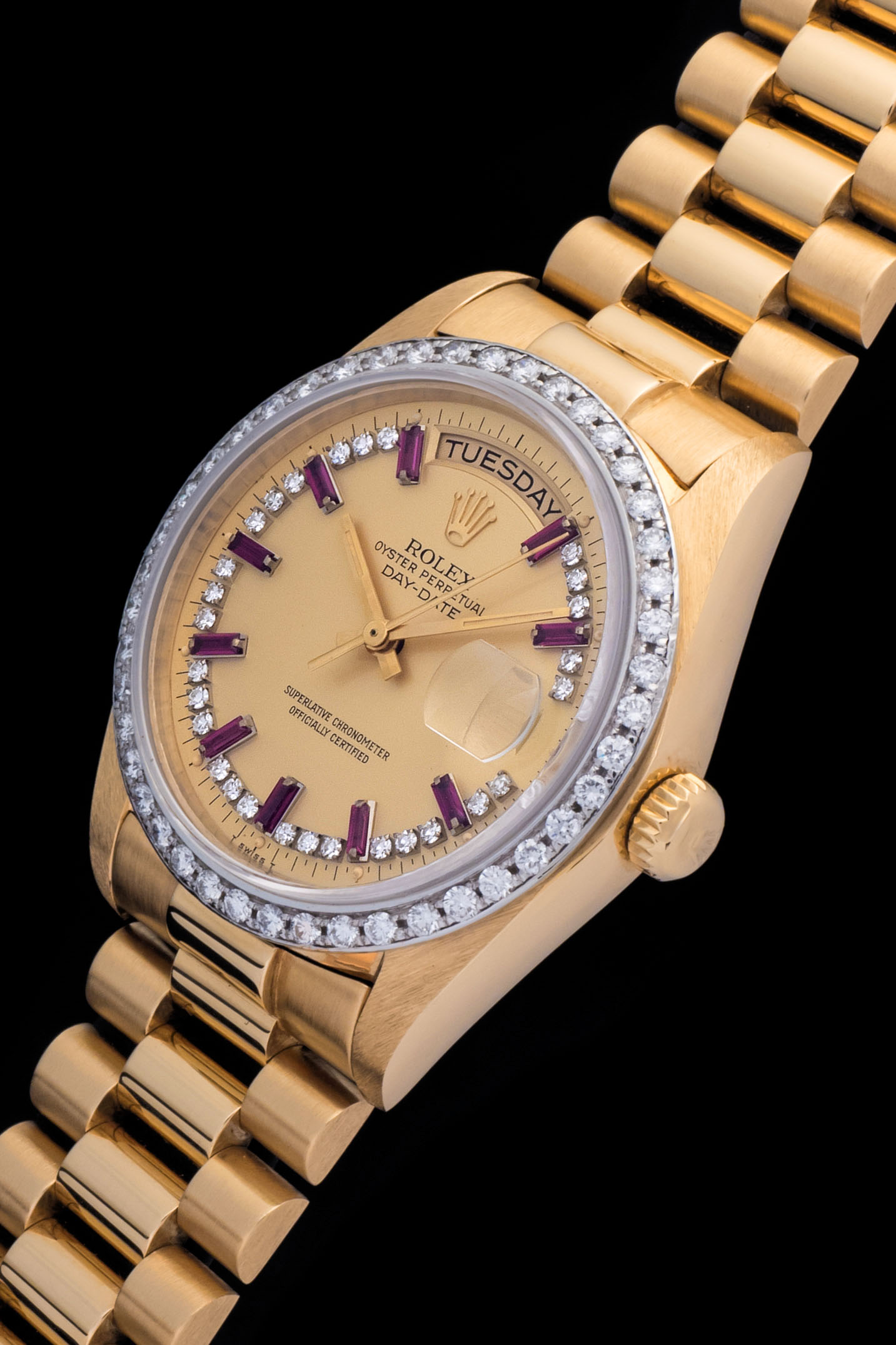
The Day-Date reference 18048 is an interesting reference as it incorporates highly luxurious details. This says a lot considering the Day-Date is altogether synonymous with luxury. A glance at this beautiful example will provide understanding as to why the watch is not like its contemporaries. Pictured is a Day-Date manufactured in 1981 and fitted with a diamond bezel and diamond & rubies stringed dial. This watch embodies luxury at its finest.

OLYMPUS DIGITAL CAMERA

Rolex Day-Date 18238

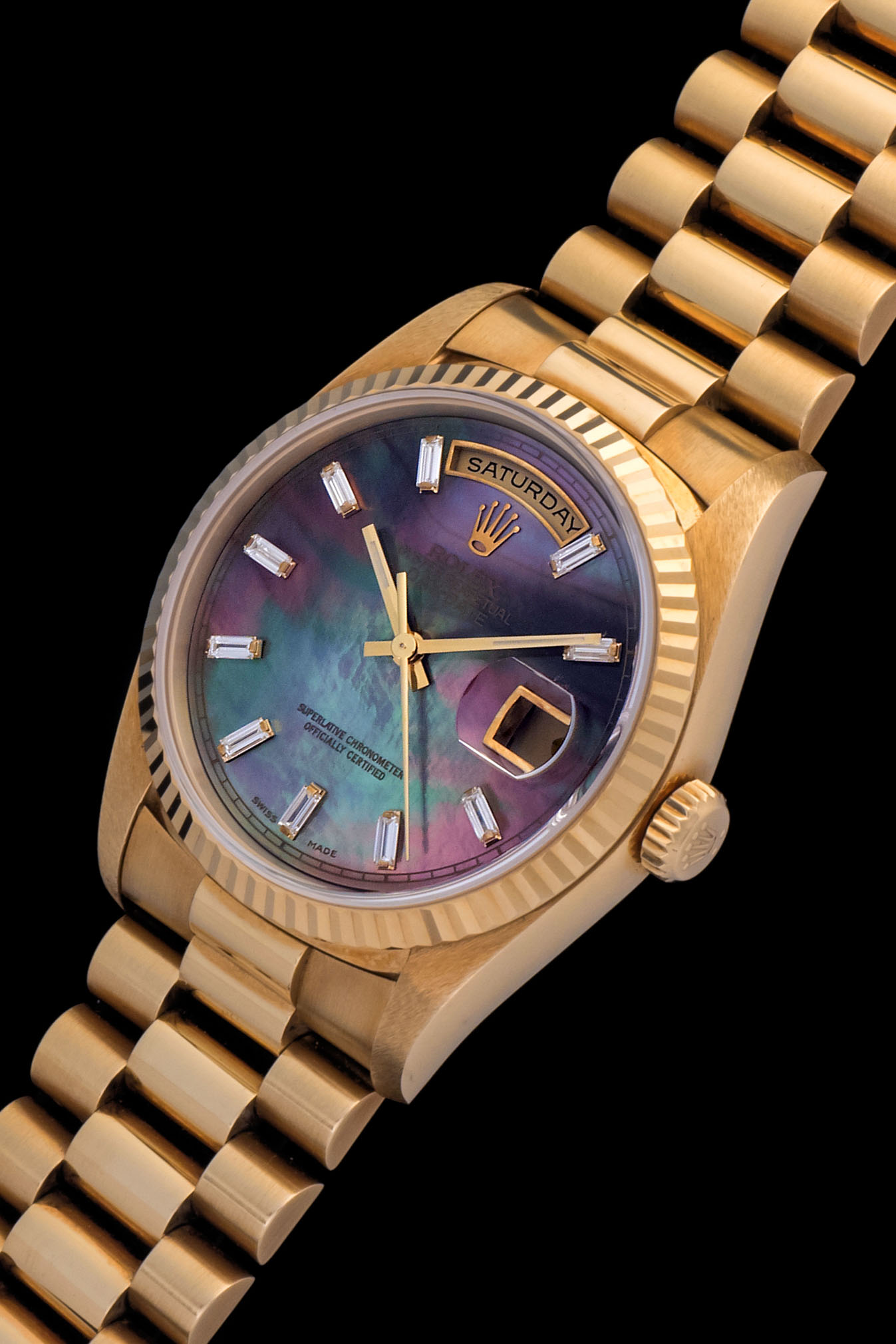
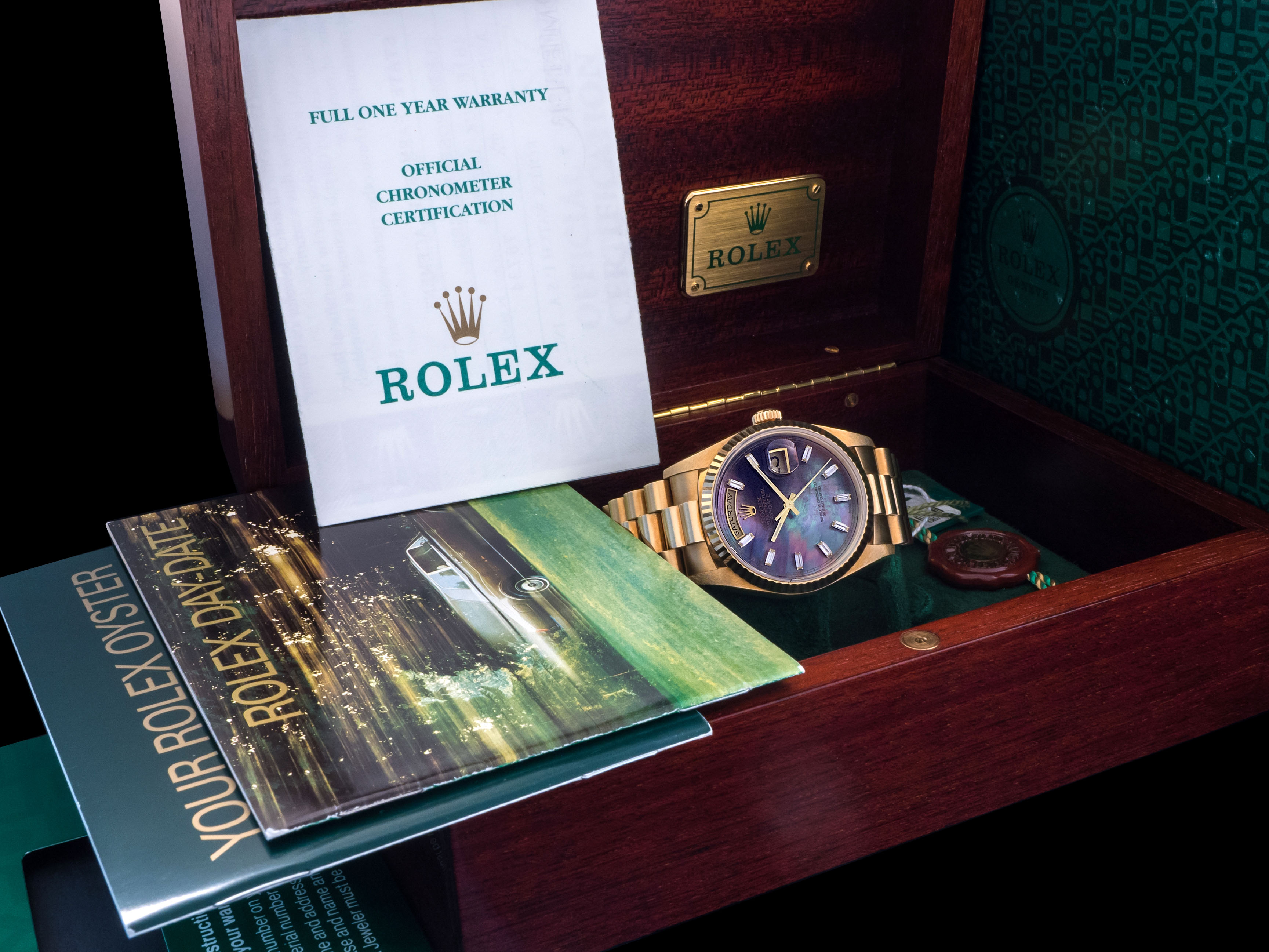
The reference 18238 added a new novelty to the Day-Date family in the form of the double quick-set. This new movement update allows the user to change both the date and day with more ease. Aside from that function the reference retains its standard details such as sapphire crystal and concealed buckle bracelet. Bear in mind not all 18238’s were made the same. Pictured is a special iteration. A never worn full set Day-Date fitted with an ultra rare Tahitian mother of pearl and diamond baguette dial. The look and feel of this watch is fantastic.

OLYMPUS DIGITAL CAMERA

OLYMPUS DIGITAL CAMERA

Rolex Day-Date 18206

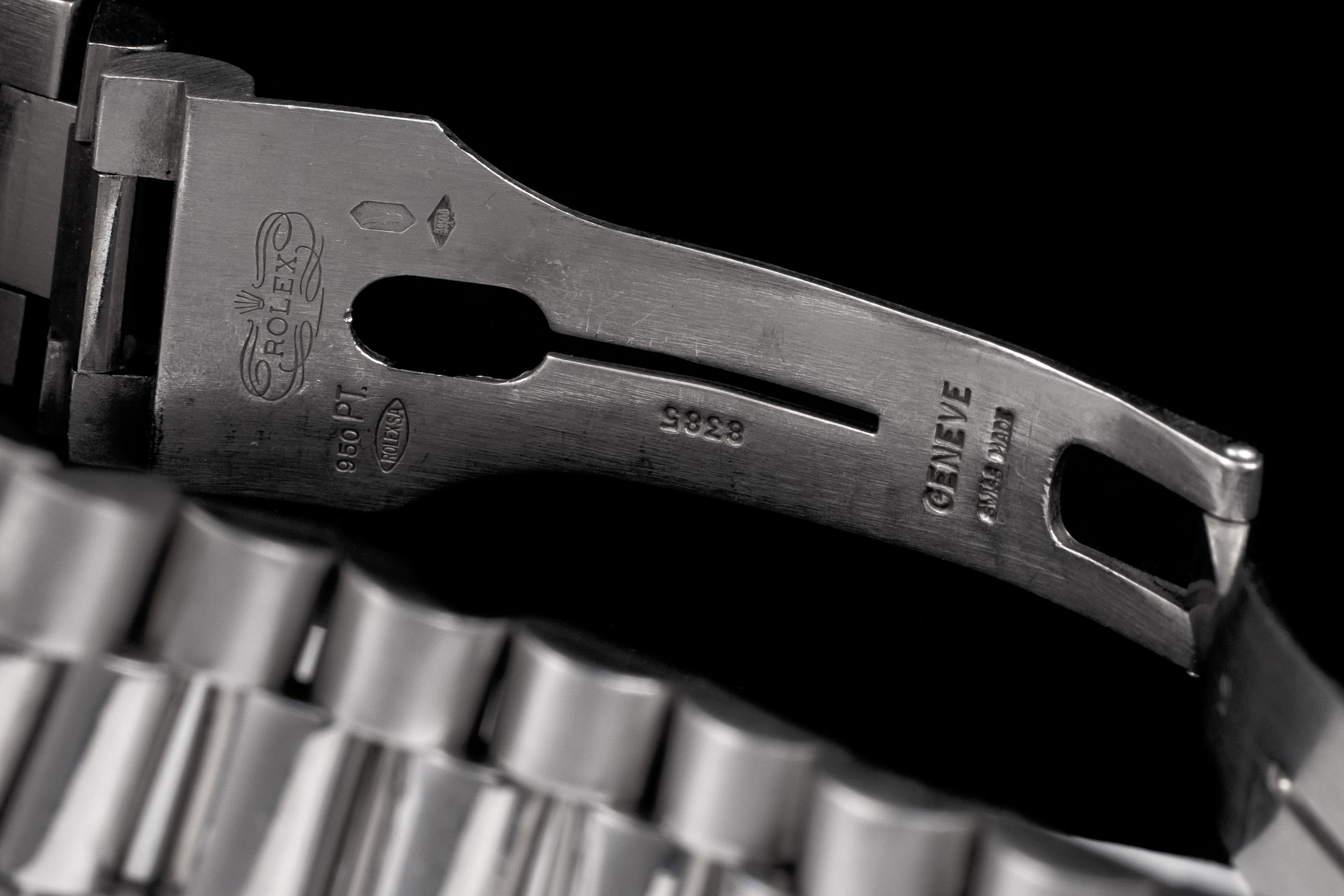
The reference 18206 is arguably one of the most beautiful models in the Day-Date family. This watch is elegance at its purest. It strays away from the luxurious gold case and array of dial variations with a clean dial fitted on a hefty platinum case. A lot can be said about the 18206 but it would not make it proper justice. The watch is best appreciated when worn. In our collection are two examples of the Day-Date 18206. One’s fitted with a blue dial and another fitted with a black dial.

Available Here

OLYMPUS DIGITAL CAMERA

Rolex Day-Date 18296

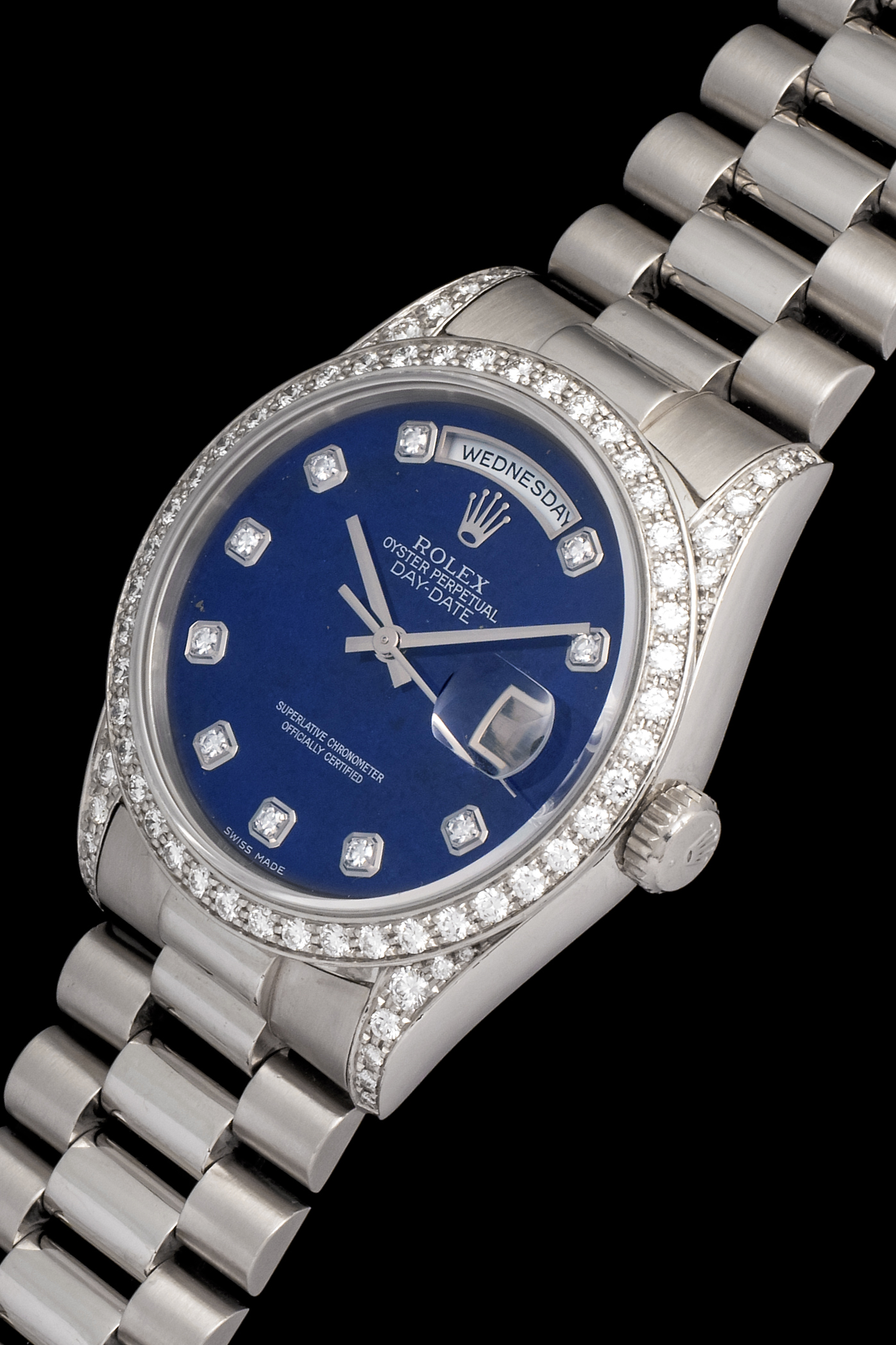
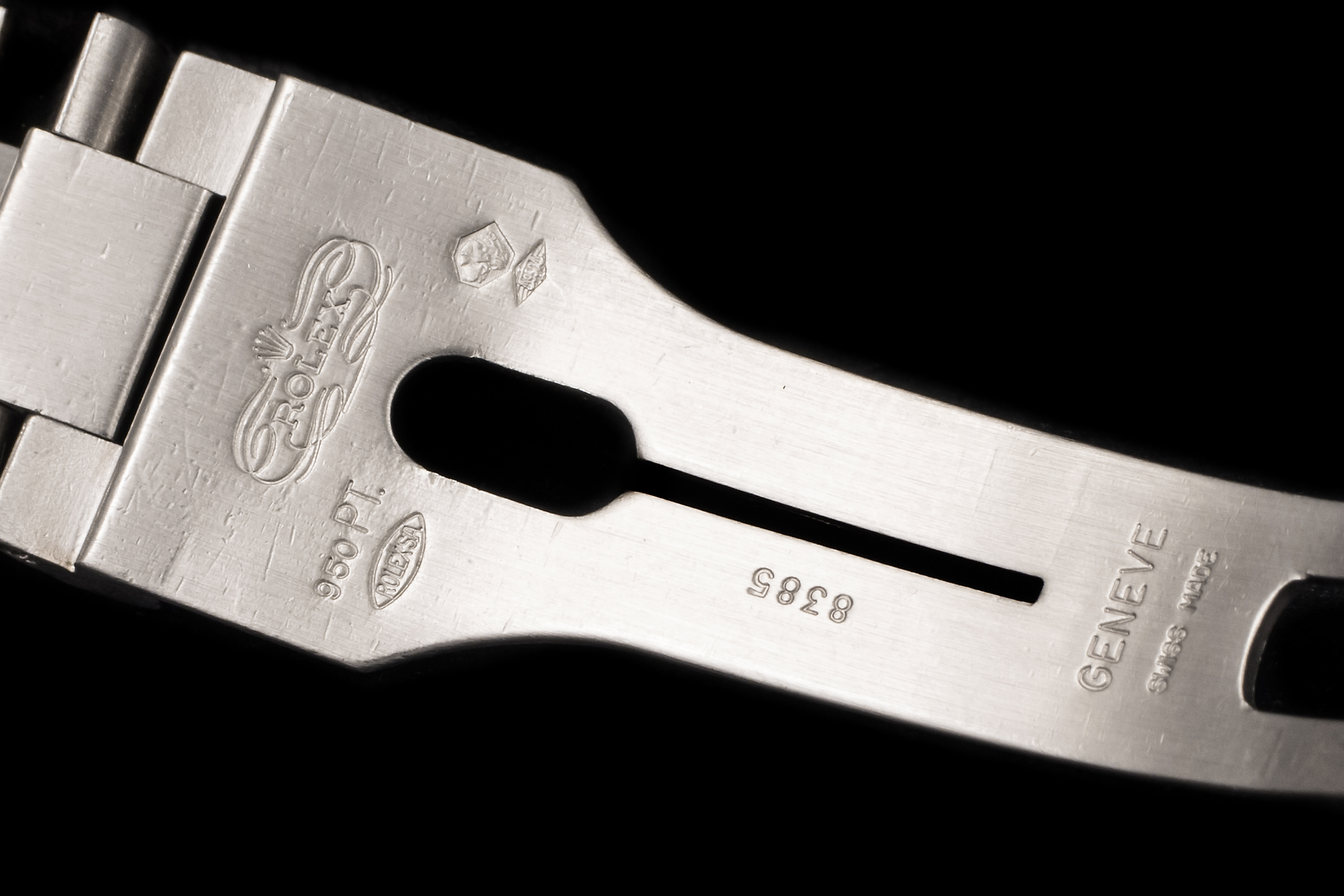
Unlike the previous mentioned reference, our 18296 is an amalgamation of elegance, rarity, and an example of Rolex’s attention to detail. Pictured is a watch that is seldom seen, a watch with so many rare details that only a handful have appeared publicly. For starters this Day-Date is cased in platinum with lugs and bezels adorned with factory diamonds and fitted with a Lapis Lazuli dial coupled with diamond indexes. If the Day-Date family had a hierarchy this watch would be at the top.

OLYMPUS DIGITAL CAMERA

Available Here

Collectability

The Rolex Day-Date is rich in history and is without a doubt slated to be a part of the Rolex lineup for decades to come. But note that with endless references available and with an immeasurable amount of dial variations bear in mind not every Day-Date is created equal. There are highly rare and collectible examples that deserve greater attention and pursuit. The Day-Dates highlighted in this article are on a level of their own. They are the special kind of outliers we collectors travel the world to find.


Rolex Submariner, Lapis and Onyx Dials


The Rolex Practice 

The genius behind Rolex is that even though they manufacture droves of watches per year they don’t half ass at anything. They put the same amount of love and care into the Datejust as they do into the Daytona Platinum Pave Diamond Dial. The best part about it is the manufacture has been true to its practice ever since it was a small brand headquartered in the United Kingdom.


sub

Hard-Stone Dials 

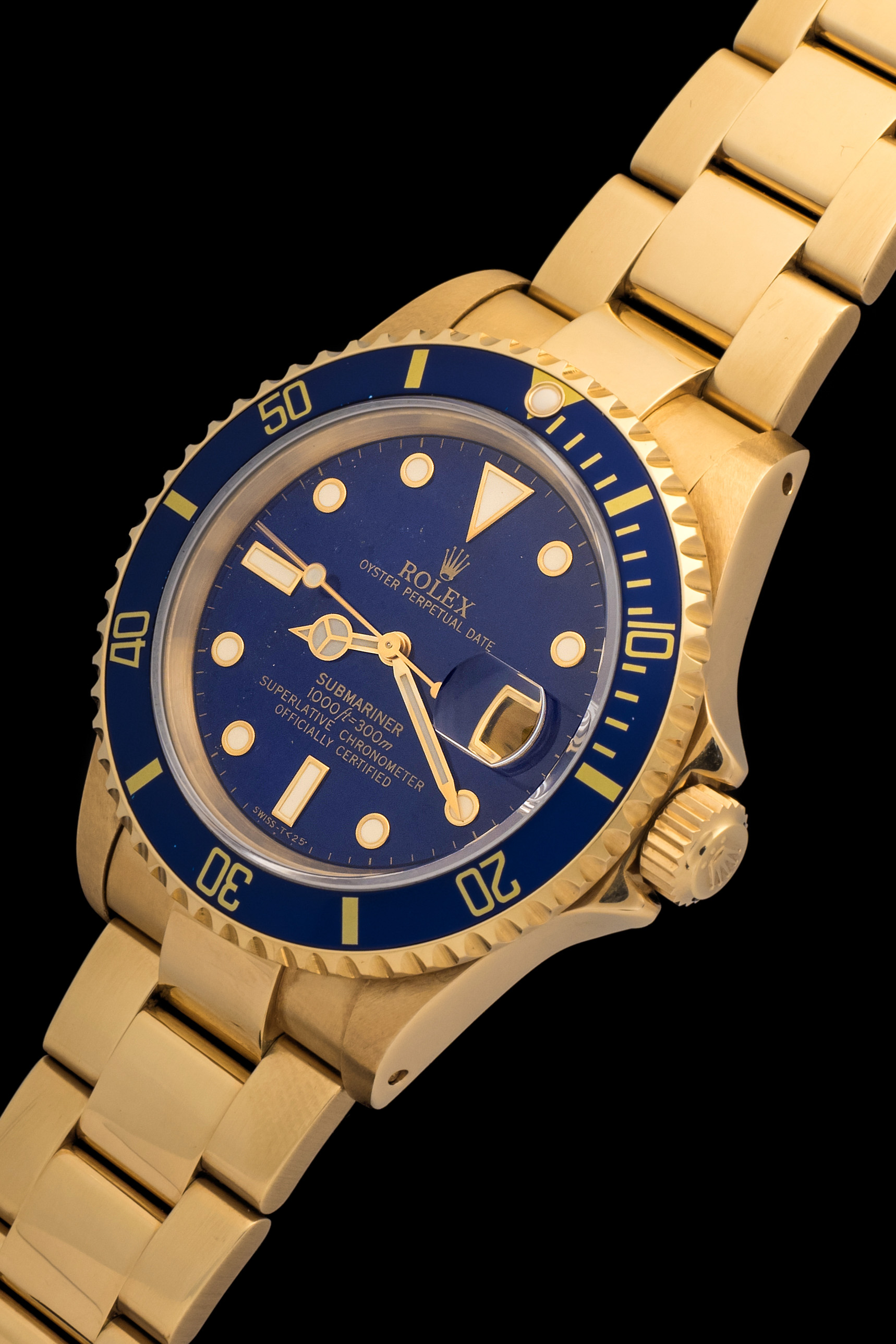
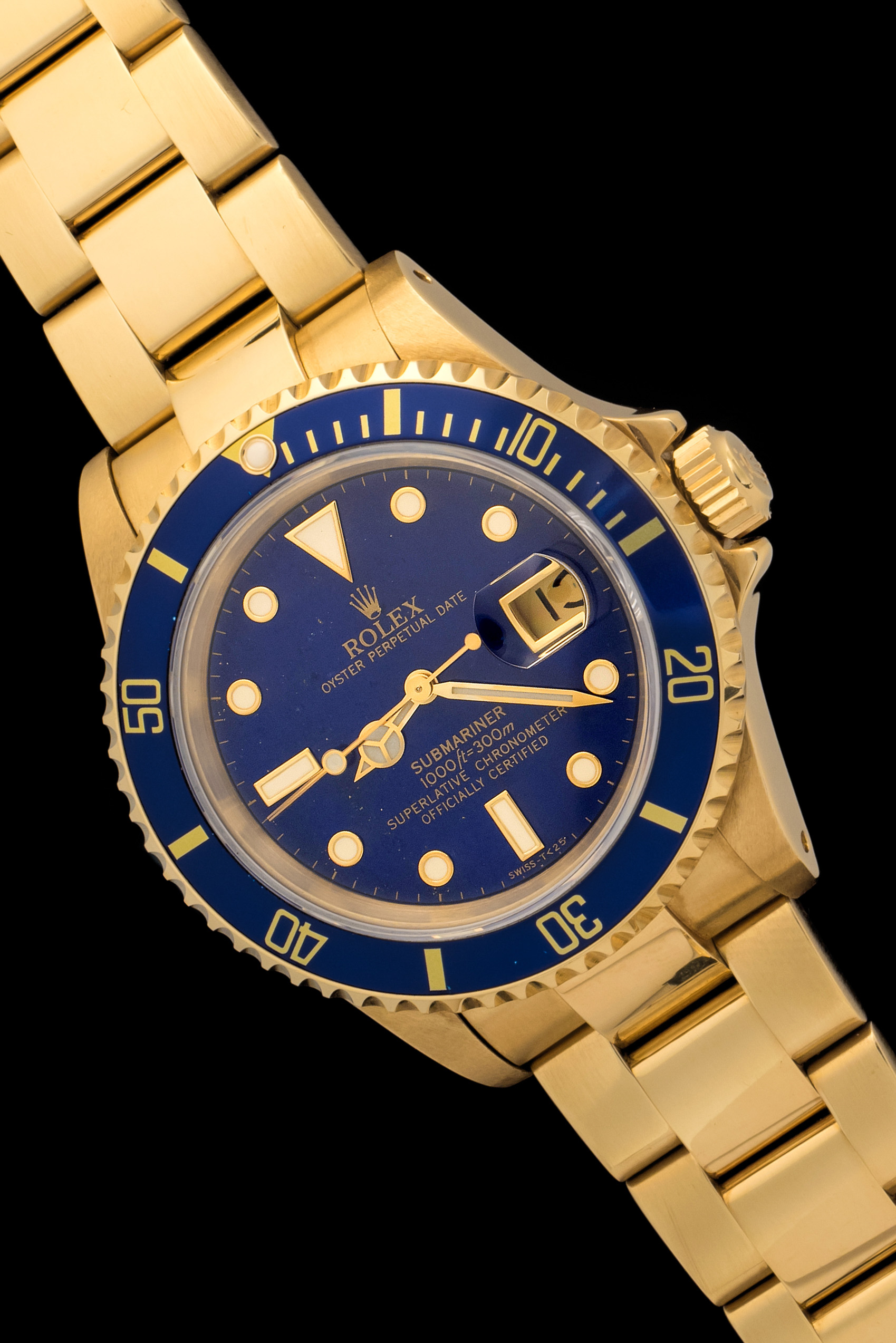
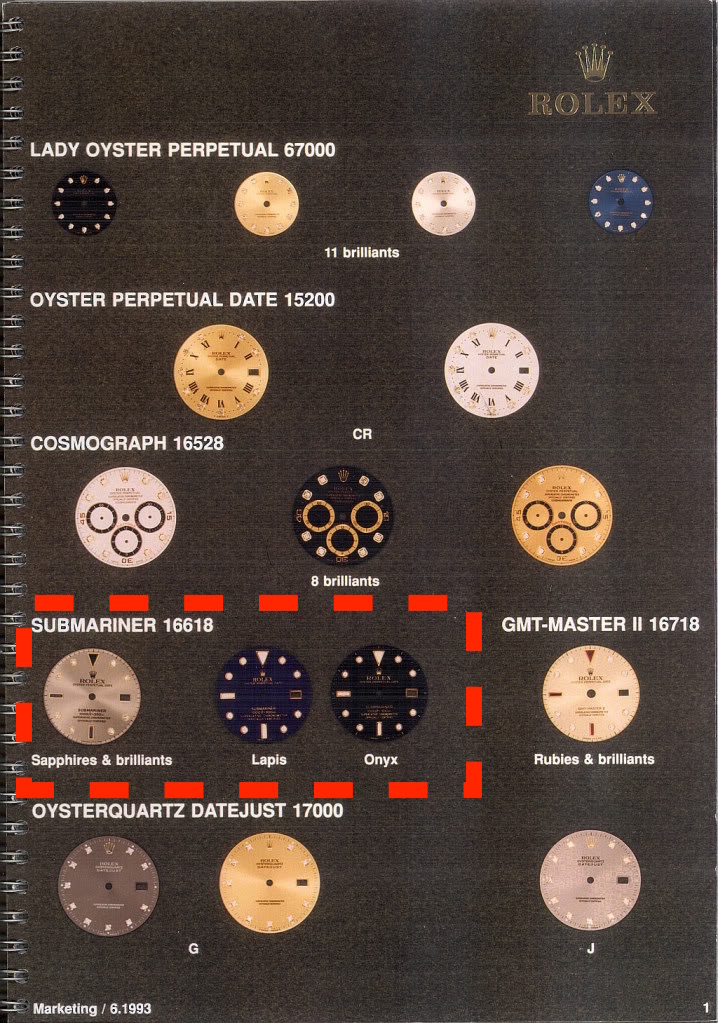
Rolex is known for its founding role in the tool watch department with the introduction of the first Submariners and GMT’s, but their role in the sporty-elegance department is also worthy of much attention. Here we’ll cover two watches that are as unique as they are wearable. The Onyx Dial Submariner Ref.16618 and the Lapis Dial Submariner Ref.16618.

Lapis and Onyx Dials
Subamariner Lapis and Onyx Dials

90’s Innovation 

The 90’s were an inventive era for Rolex as they began to merge various types of hard-stones with dial production. Take the 1997 Rolex Submariner 16618 Onyx dial as an example. Rolex watchmakers delved into the process of trimming a 1-kilogram the rock into a 0.20mm piece to later be mounted onto the copper dial plate.

Click For More Information

Rolex Submariner Onyx Dial 

This process of manufacture was so complicated that it’s estimated that out of 10 dials only 2 made it past the rigorous Rolex inspection phase. The rejection ratio was unfathomable but the dials that made it through made it all worth it. Since Onyx rocks cannot be man made no two dials will ever be the same, which is astonishing for a company like Rolex. 

Identifying an original Rolex Onyx dial is simple as they all have a small golden frame surrounding the date function. Do not trust a dial that does not have this detail. 

Click For More Information

Rolex Submariner Lapis Lazuli Dial 

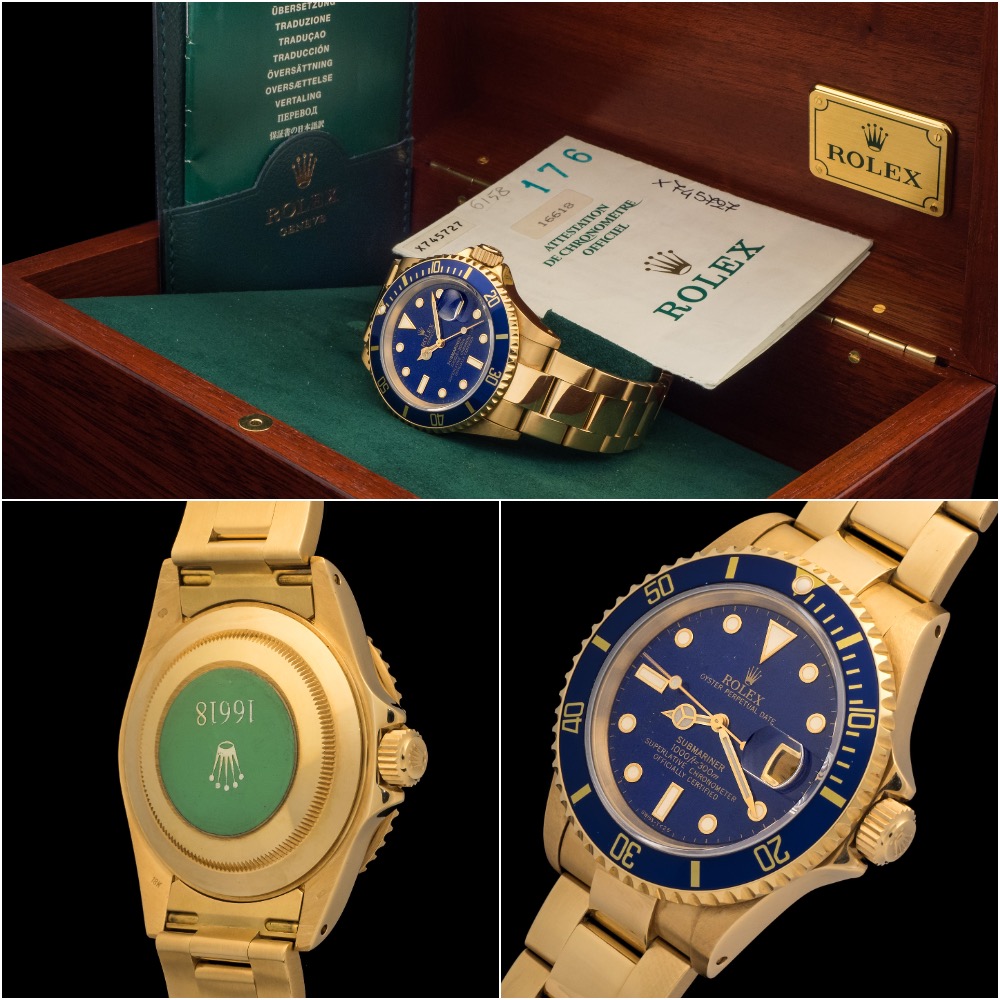
The Rolex Submariner with Lapis dial is another work of art, and it’s without a doubt Rolex’s most elusive dial as its production was incredibly sporadic. The manufacturing process of this dial is the same as that of the Onyx dial. A large portion of the stone is needed to then trim it down to a small circular 0.20mm piece.

Click For More Information

Rarest Dial Variation

The Lapis stone is entirely blue but it also has specks of green, white, and gold when seen in the light. The look of the dial on a gold Submariner leaves us without words. These are watches that are hardly found and we are not exaggerating. In our 32 years of experience we have only seen a handful pop up.

Click For More Information

Lapis Lazuli & Onyx Dials

Our 16618 is a magnificent example as it’s in new old stock conditions and is accompanied by its original papers and box, a true collection item.

dial-sub

Click For More Information


OCC Caliber vs. SCOC Caliber

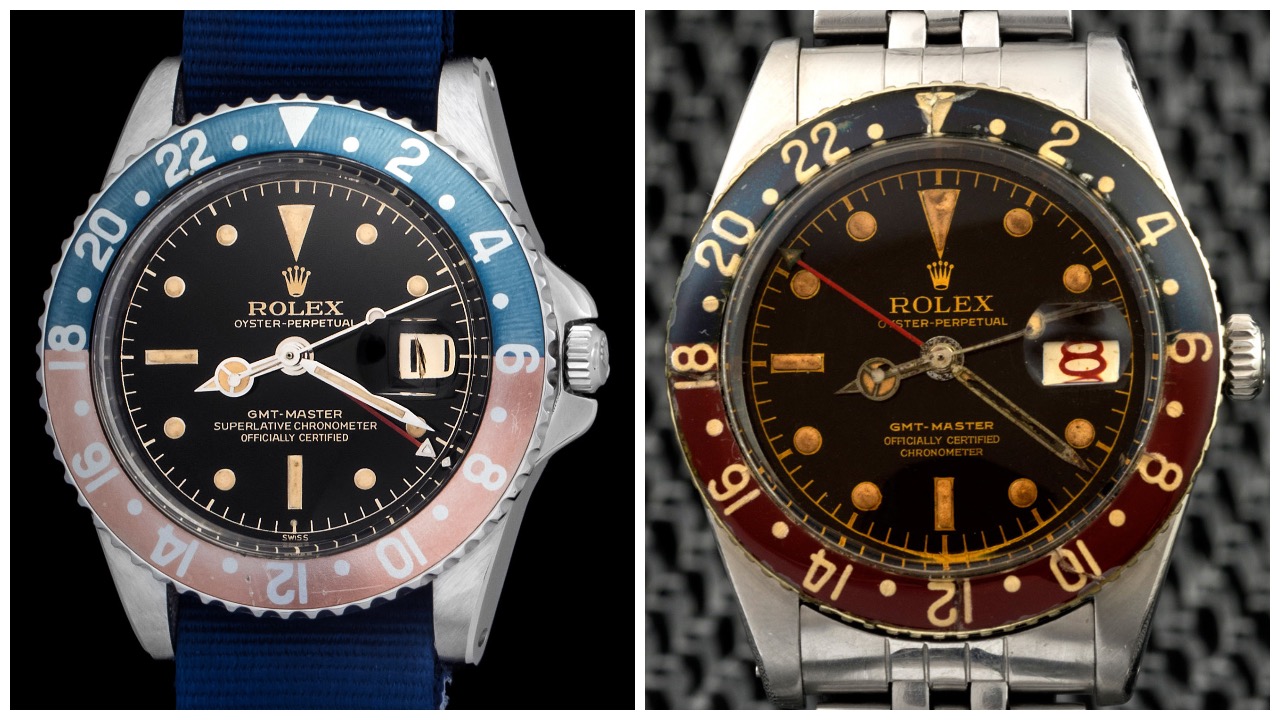
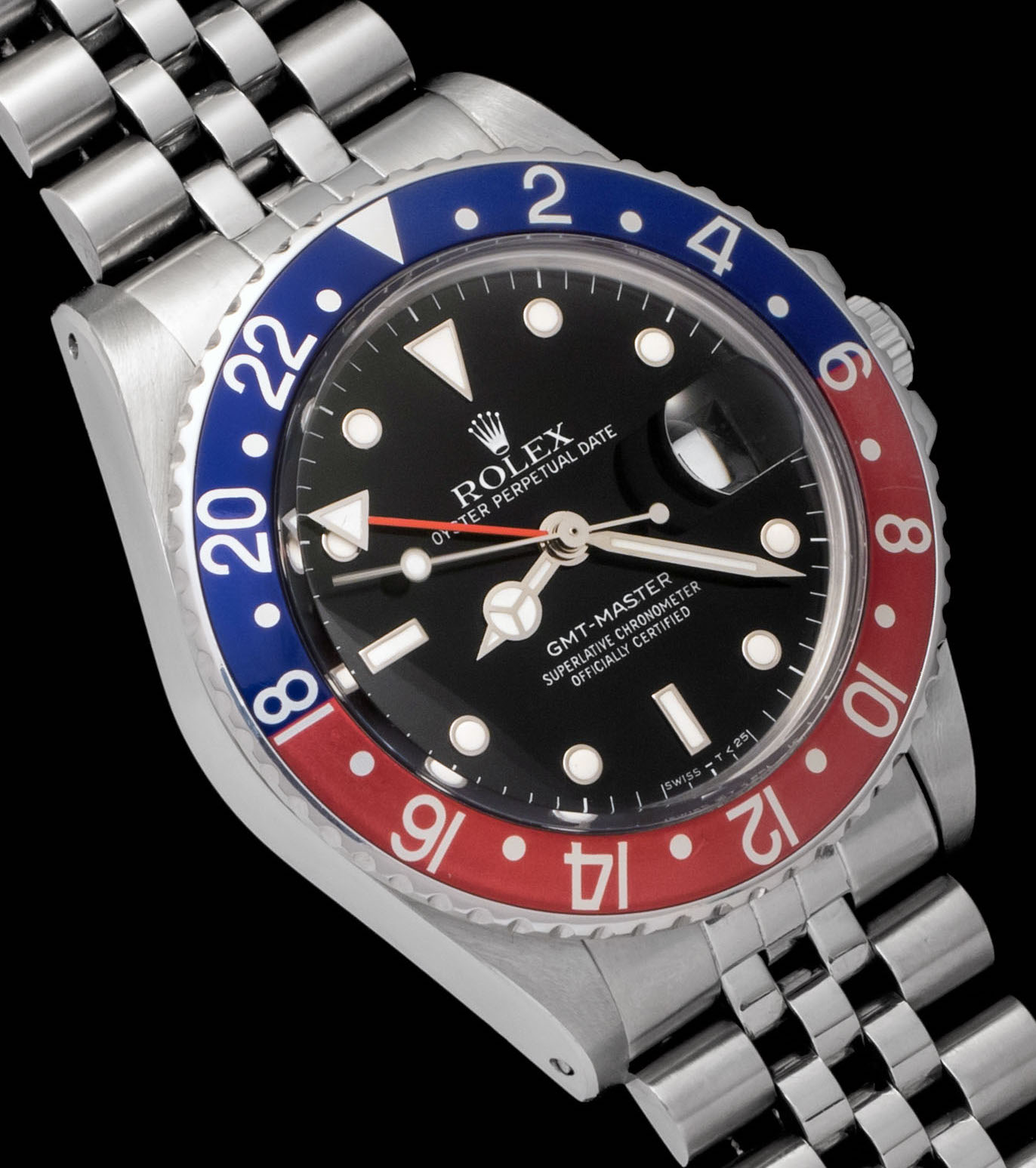
Rolex Gmt-Master : SCOC Dial vs. OCC Dial

OCC stands for Officially Certified Chronometer while SCOC stands for Superlative Chronometer Officially Certified. A seemingly insignificant wording on the dial will make a world of a difference to a seasoned and informed collector.

Rolex GMT-Master Collection

An OCC movement is one, which has successfully passed a test conducted by the Swiss Official Chronometer Testing Institute or COSC.

The test consists of testing a watch for 15 days and 15 nights putting it through five positions and 3 types of temperatures (normal, oven-heat, and refrigerator). OCC movements feature a regulator, which allow the wearer to manually adjust the movement to run faster or slower. The process of manually adjusting a movement can be cumbersome and inefficient.

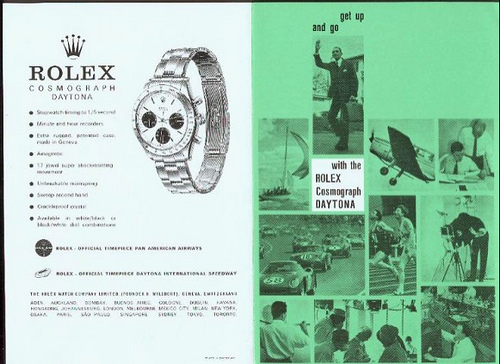
Vintage Rolex GMT-Master Booklet

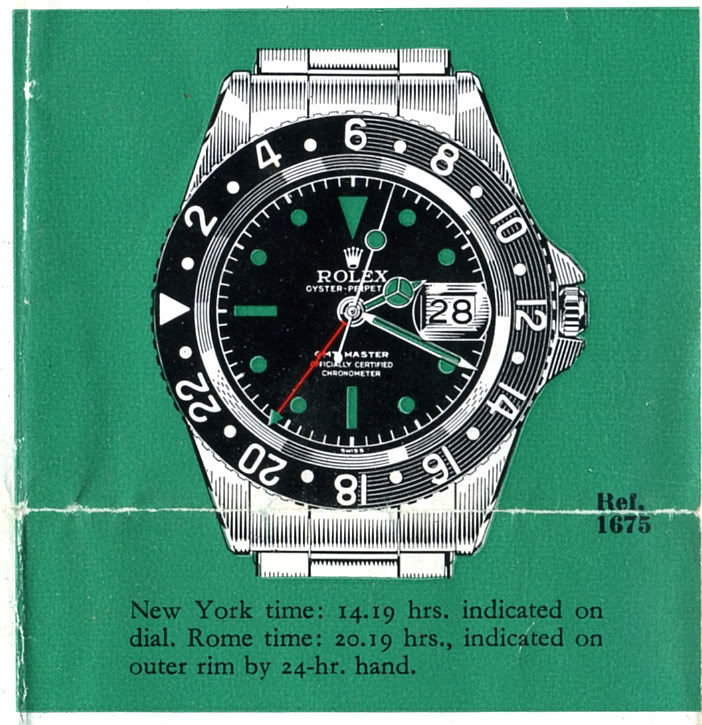
The Rolex GMT-MASTER Ref. 6542 for example was fitted with an OCC movement while its successor the 1675 was not. These ones were fitted with SCOC movements.

A SCOC movement is an upgrade from the OCC. These movements have also passed the rigorous COSC testing but are not fitted with regulators, and this allows them to keep accurate timing for much longer.    

Rolex GMT-Master 16750
Rolex GMT-Master Ref.16750

Rolex Daytona 6262 “Transitional Cosmograph”

Vintage Watches Miami Official Logo

The Transitional Cosmograph

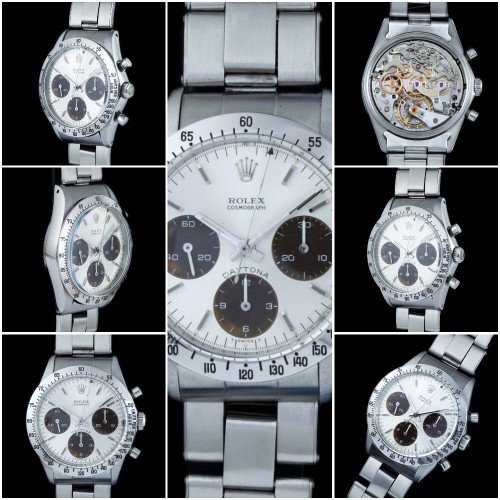
No other family of watches causes as much excitement as Valjoux powered Rolex Daytona’s. These chronographs are in a realm of their own as they can singlehandedly influence market trends. We were at Christies when 50 Daytona’s broke world records for auction prices causing a collectors frenzy in the process. Click here to browse through our Daytona collection for sale.


the_6262_ss_bobby_unser_daytona_nero_aka_the_star_of_indianapolis_square
Rolex Daytona “Lesson One” Record Breaking Auction

Car Racing Heritage

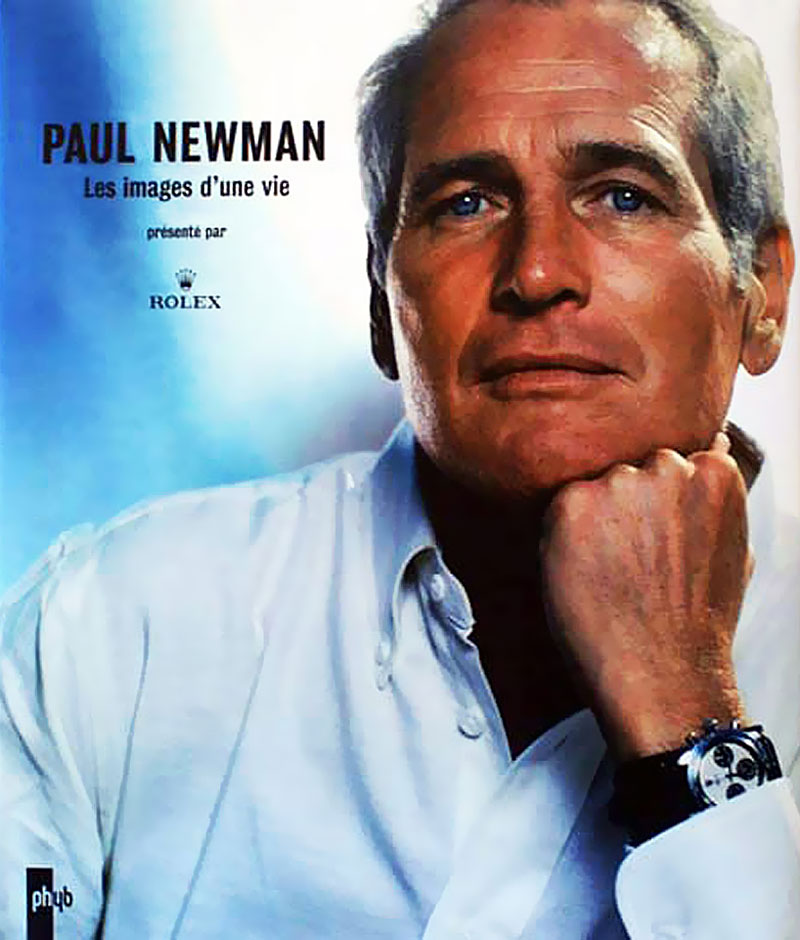
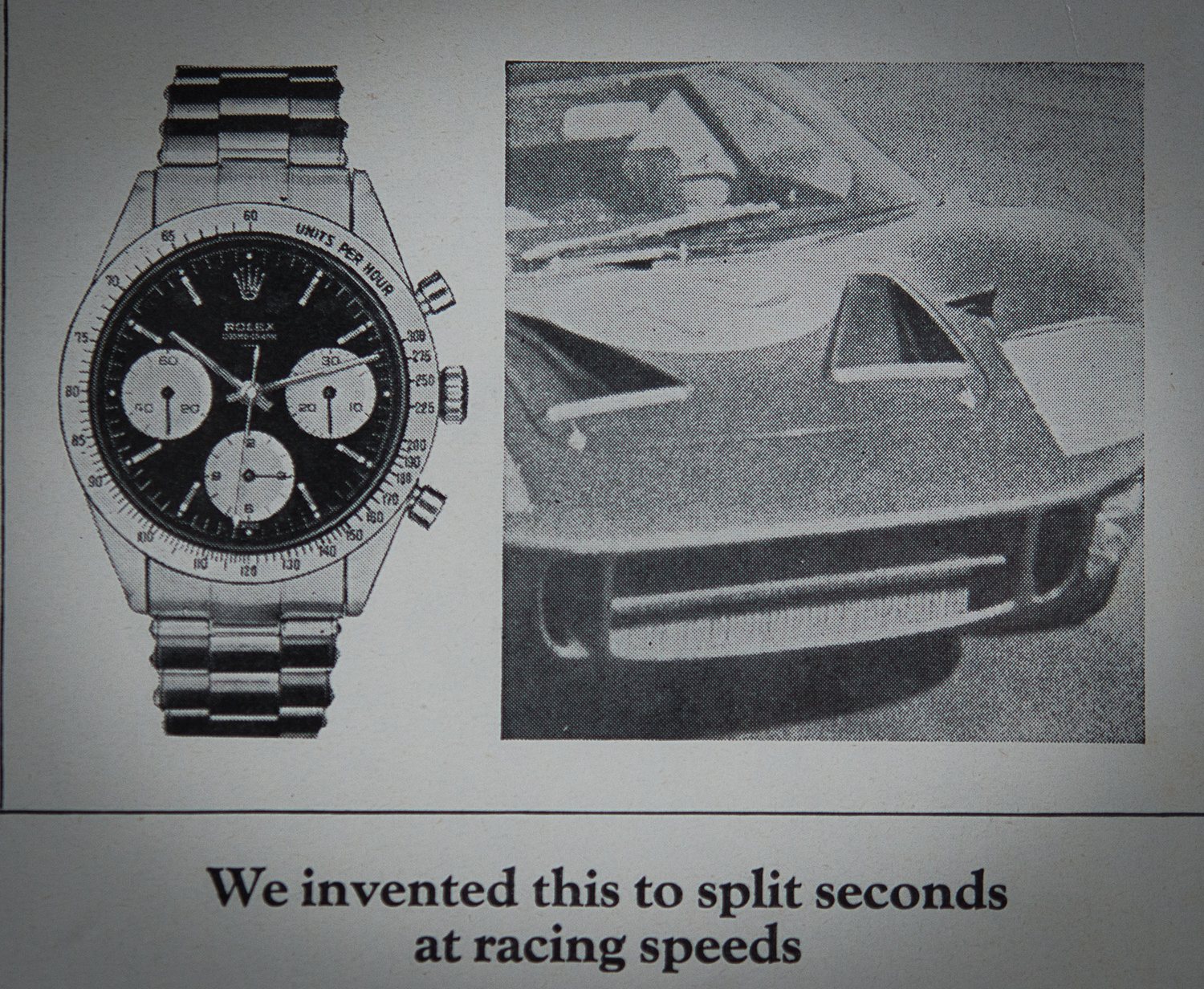
The Daytona is a watch that checks every box in the collector’s book. They embody what a vintage watch should be and look like. Valjoux Daytona’s have that quality feel that can never be replicated by a modern watch. Rolex conceived this chronograph to serve as a tool for car racing. Their status as reliable timing devices made them staples on the wrists of some of the coolest men to walk this planet, enter Mr. Paul Newman and Sir Jackie Stewart.

paul-newman-presented-by-rolex
www.rolexmagazine.com

Daytona Lineup

The Daytona family is composed of the following references: 6239, 6240, 6241, 6262, 6264, 6265, 6263, and 6269/70. All are fascinating in their own right but we have a particular penchant for the elusive Rolex Daytona 6262.

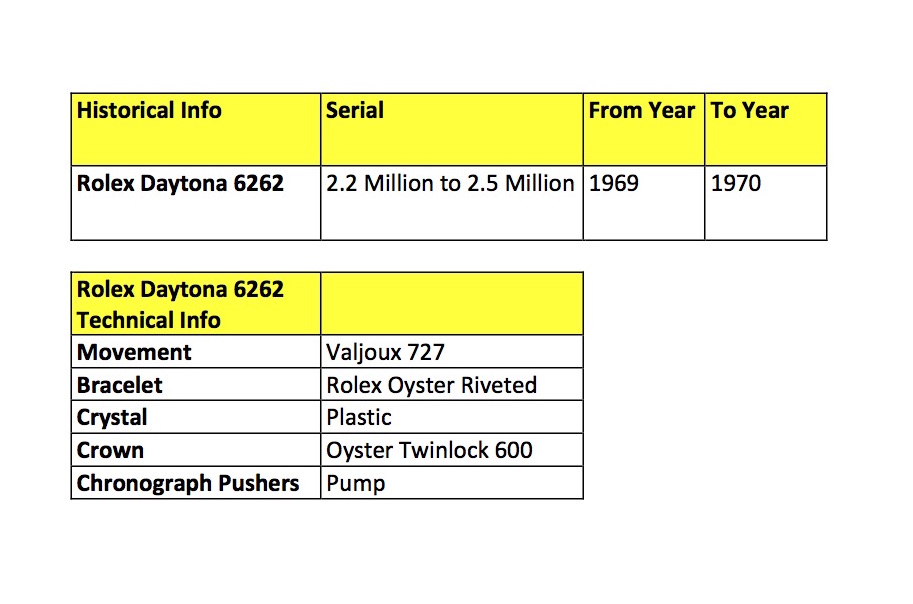
This 6262 reference is known as the transitional Daytona as Rolex manufactured them for the span of one year (1969 to 1970), making them the least produced Daytona. Well let’s not consider the 6269/70 as that’s an outlier. Records estimate only 347,000 examples of the 6262 left the manufacture between the span of 1 year. These chronographs are found with serials ranging from 2.241.000 to 2.589.000, no more no less.

1965-advertisement-daytona
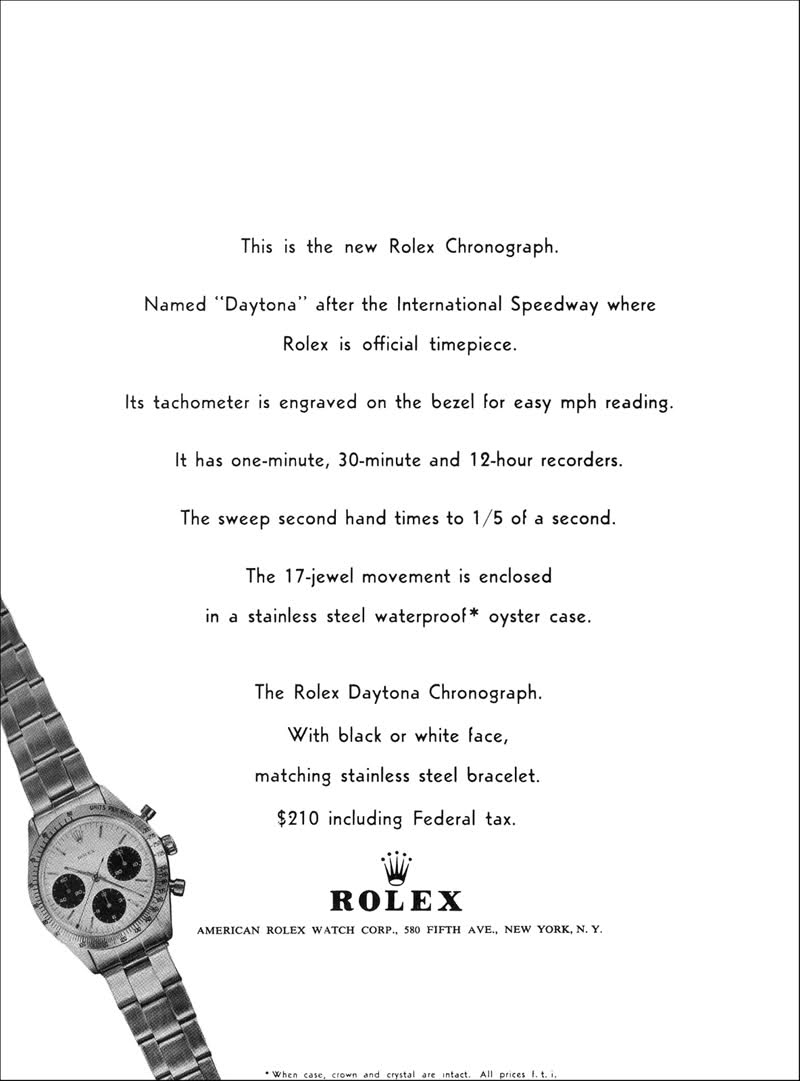
Official 1965 Rolex Advertising

The Daytona 6239 is Given a Facelift

The reason to the “transitional” moniker is Rolex’s usage of the reference to test out several features and variants for future Daytona’s. For example the 6262 was the first watch to be equipped with the final and faster beating Valjoux 727 caliber, advancing from the prior Valjoux 722. The 727 became the last manual movement used by Rolex before shifting to the automatic Zenith in the late 80’s.

Rolex also modified its highly successful Oyster case with the 6262, an edit that brought more backlash than success. Reason was the case was thicker and prone to damaging the rather luxurious 17 jewels movement inside. Rolex fans took notice of these changes and accused the brand of deviating away from manufacturing tool watches and entering the era of sporty elegance.

2658681028_77955932a2
Official Vintage Rolex Advertising

Magnificent but Short-Lived

The 6262 is seen as the direct counterpart of the 6265 as it has the same steel bezel graduated to 200 units, but lacks the screw down pushers prominently accentuating the 6265’s look. As a business move Rolex did not strike gold with the 6262. This failure has proven an advantage in the modern market as collectors now appreciate rare and low produced watches.

The Daytona 6262 can be found in three metal variants fitted with three dial types. Like any vintage tool watch the most common metal is steel. Rolex also manufactured a limited strand of 6262’s in 14K and 18K yellow gold. Now, finding a 6262 is not easy. Finding a 6262 in gold might be a near impossible feat. Assuming one is found you will need to be ready to break the bank, because it will cost a small fortune. Numbers put gold 6262’s at grand total of 30 examples made.


screen-shot-2016-09-26-at-12-21-07-pm
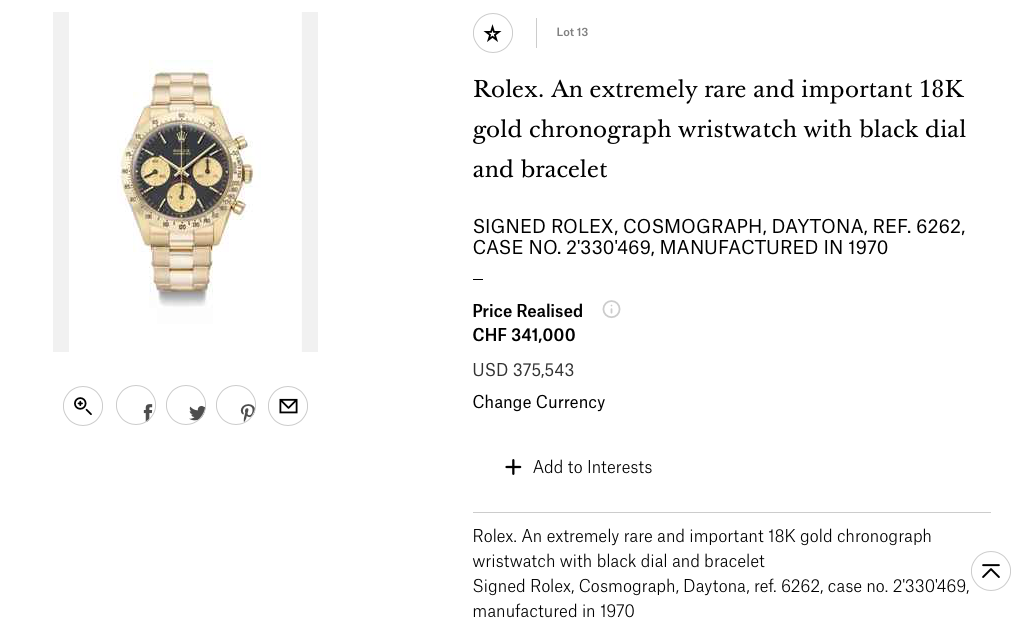
Lot 13 from Christie’s Lesson One Auction

Dial Variations

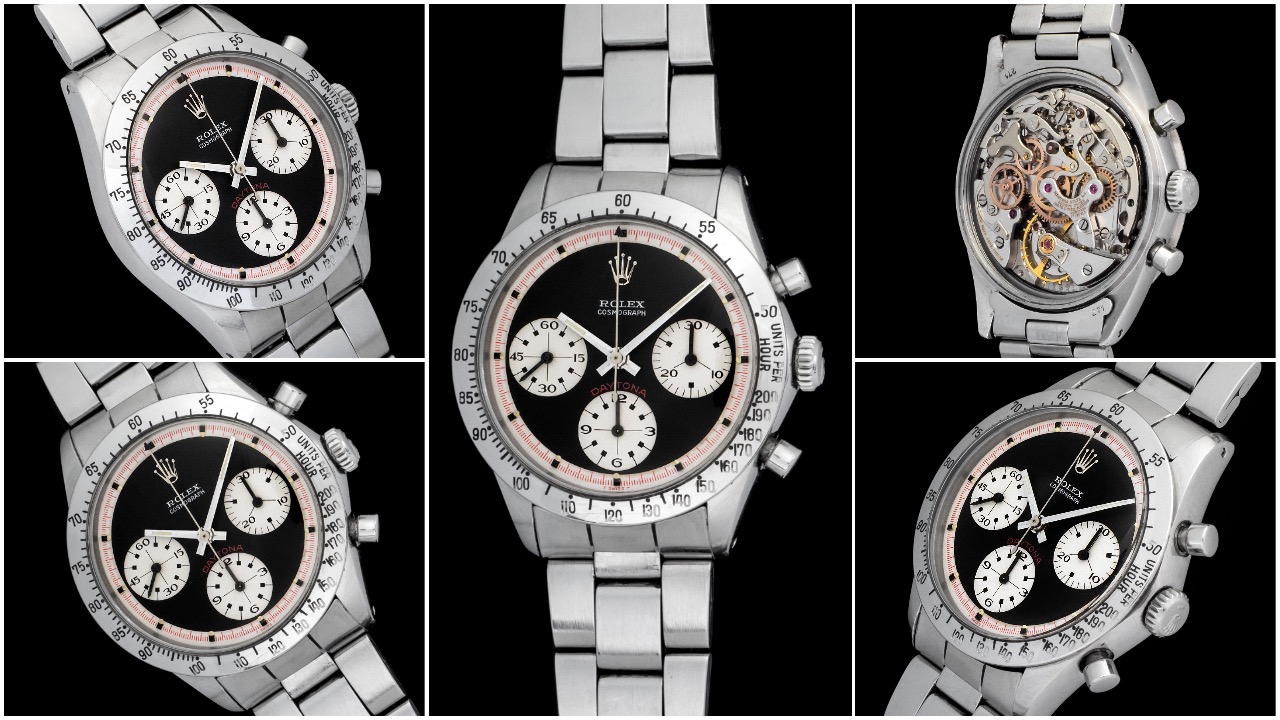
The common dials found on 6262’s are the traditional two tones. Either black face with white sub dials or white face with black sub dials. Within those variants the most coveted is the black face, as they look much nicer on the wrist. The least common type of dial is the famed exotic dial AKA the Paul Newman. These are easy to spot as the sub dial demarcations are printed with art deco lettering.

Rolex Daytona 6262 Paul Newman from Vintage Watches Miami
Daytona 6262 Paul Newman from Vintage Watches Miami

Blue Daytona

Within the dials offered in the catalogue is one that is not, as a matter of fact Rolex never foresaw this type of dial. We are talking about the blue dial. When these dials pop up at auctions or are offered by important international dealers they are referred to as Blue Daytona’s. Blues are only found on black dial Daytona’s. The way to spot them is to focus on the lettering which spells out Daytona commonly located arching above the hours sub dial. Rolex printed these letters in white but due to a chemical reaction in the paint the white turned into a blue hue. What was a Rolex error has now become a detail that commands a retail premium. Click here and here to see what a Blue Daytona looks like.

Technical Information

historical-info

Our Rolex Daytona Collection for Sale

Click here to browse through our Daytona collection for sale.


markonerolexdaytonaad_2

fbook

The Rolex Way – Made in Switzerland

There is no denying that Rolex is the king. Each and every Rolex encompasses a craftsmanship and history not replicated by any other manufacturer. It might seem easy to deviate from Rolex in the search for other types of watches but ultimately most collectors will return to the brand. Below is an official Rolex video, which captures the brand’s essence beautifully.

Rolex Submariner-Date Ref. 1680/8

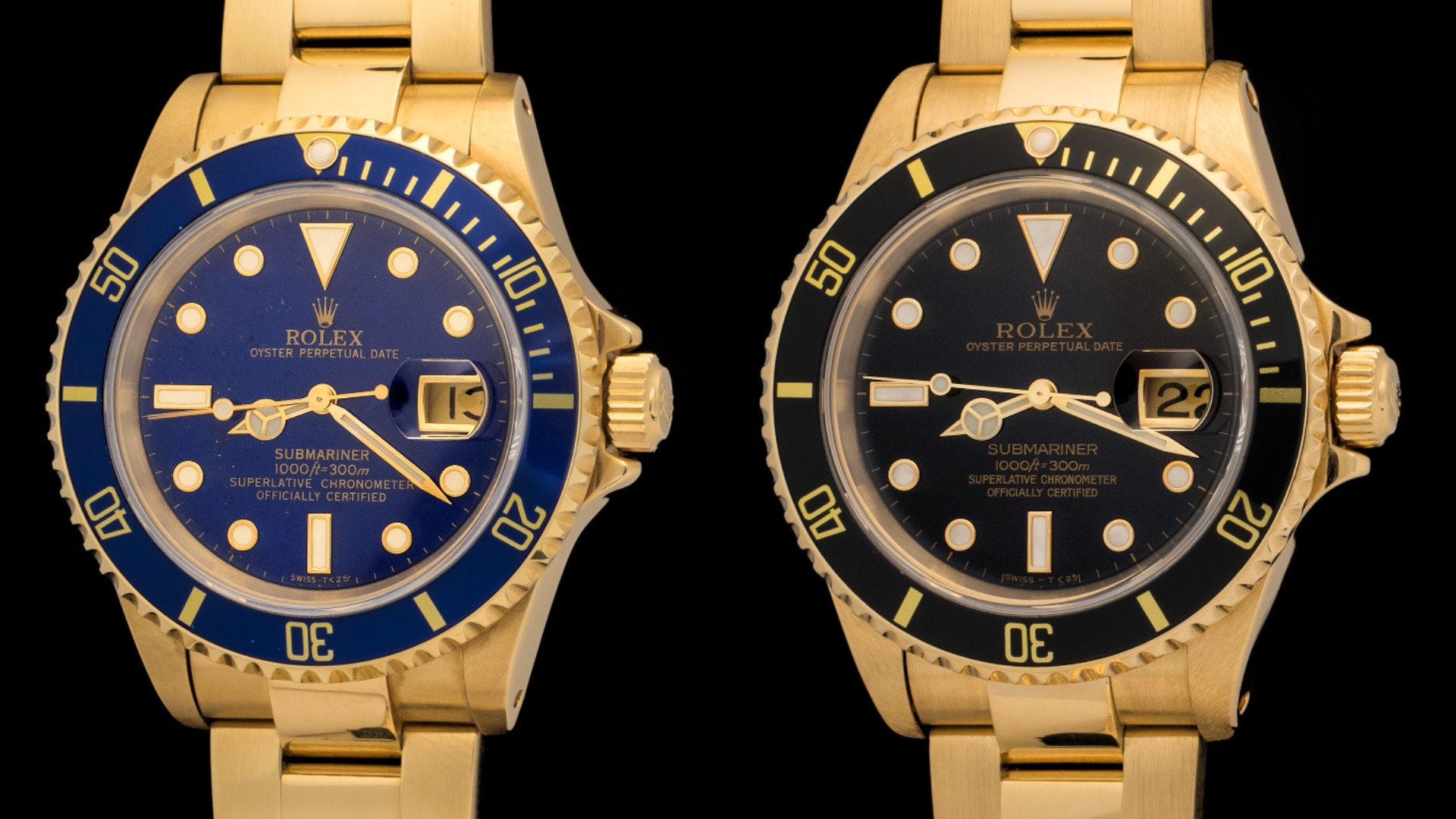
Rolex Submariner Date – The World’s First Elegant Diving Watch

Early Years

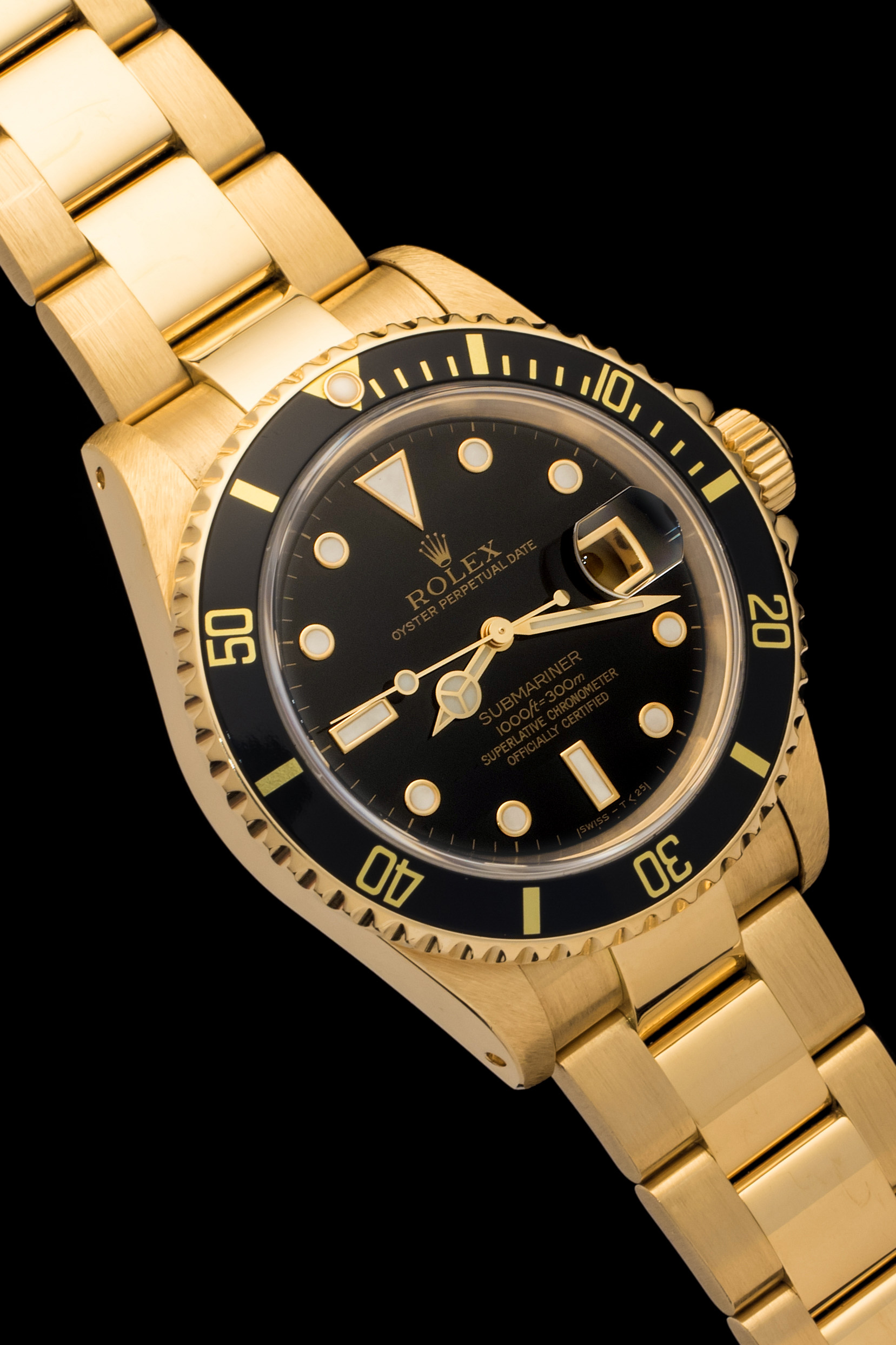
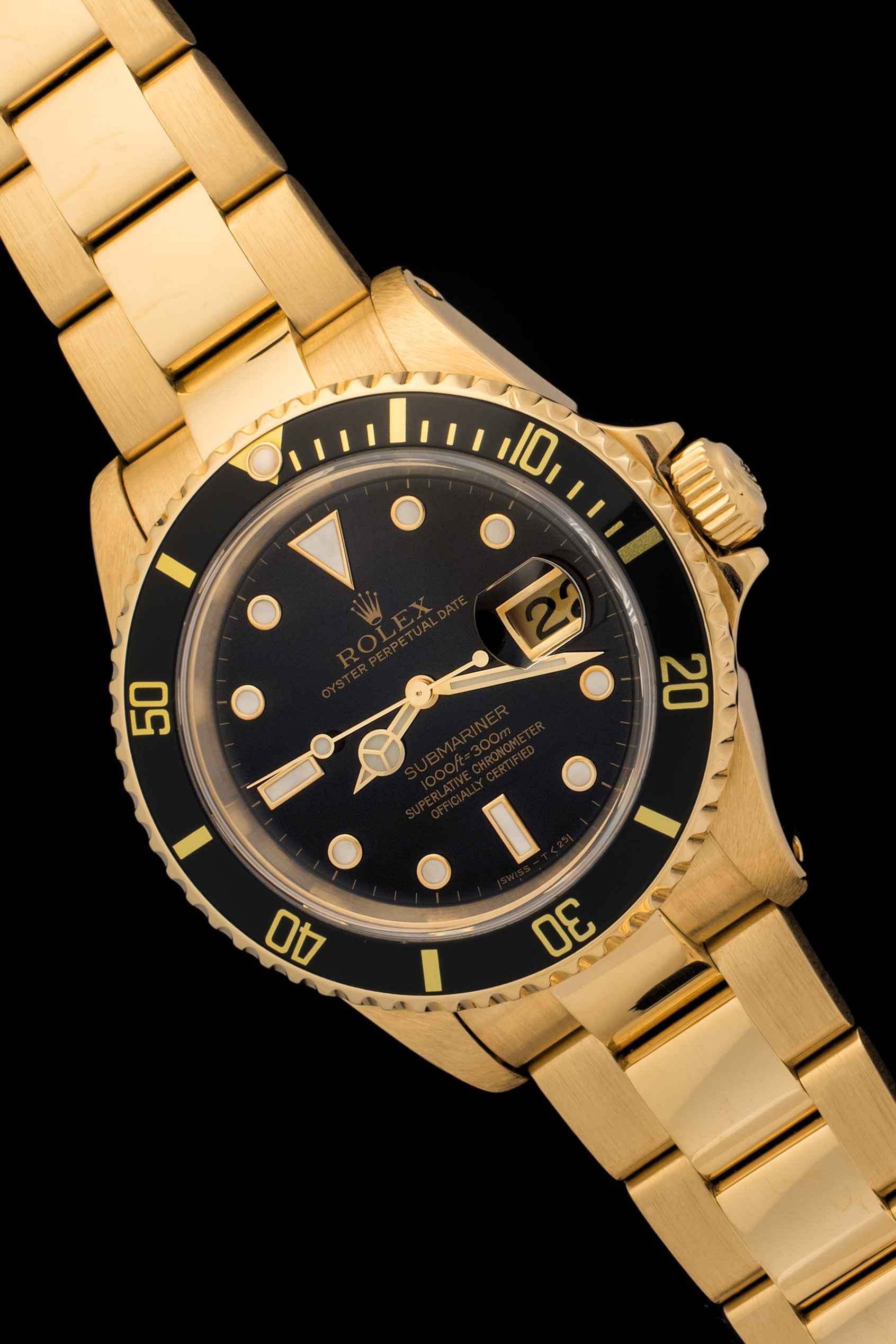
In 1967, 14 years after Basel’s release of the first Submariner Rolex introduced one of its finest creations the Submariner Date Ref. 1680. With this reference Rolex showed the world they could make equally as marvelous every day watches as they did tool watches.

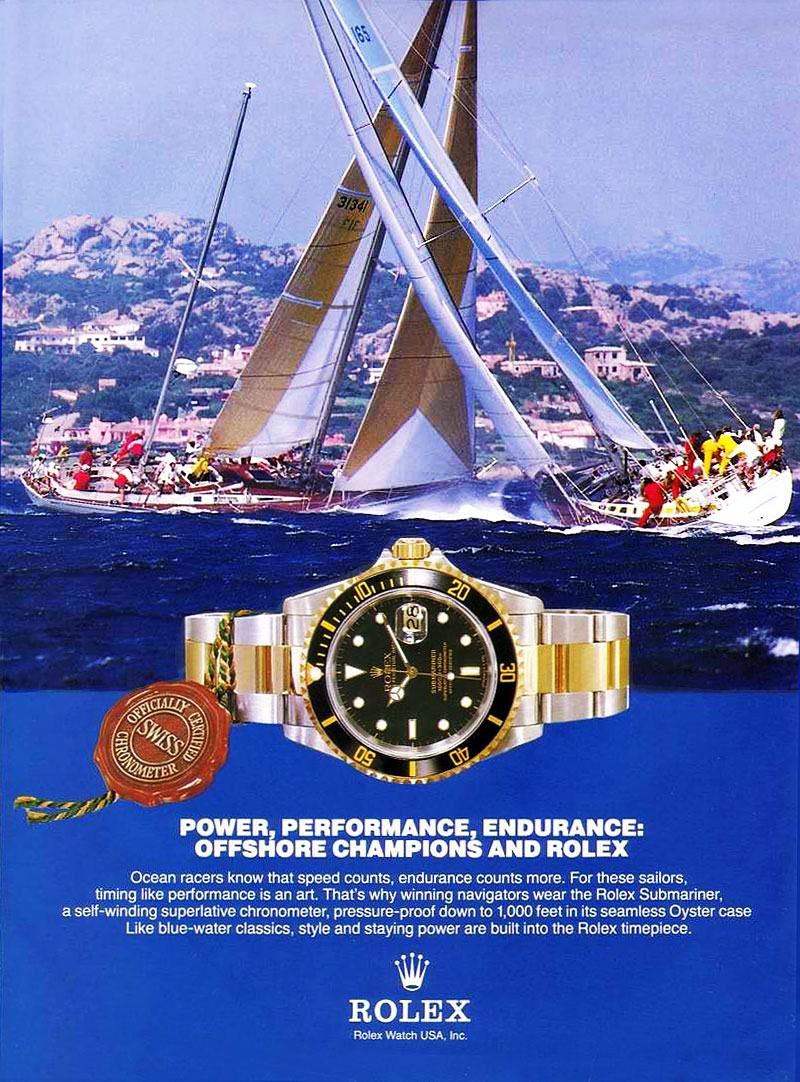
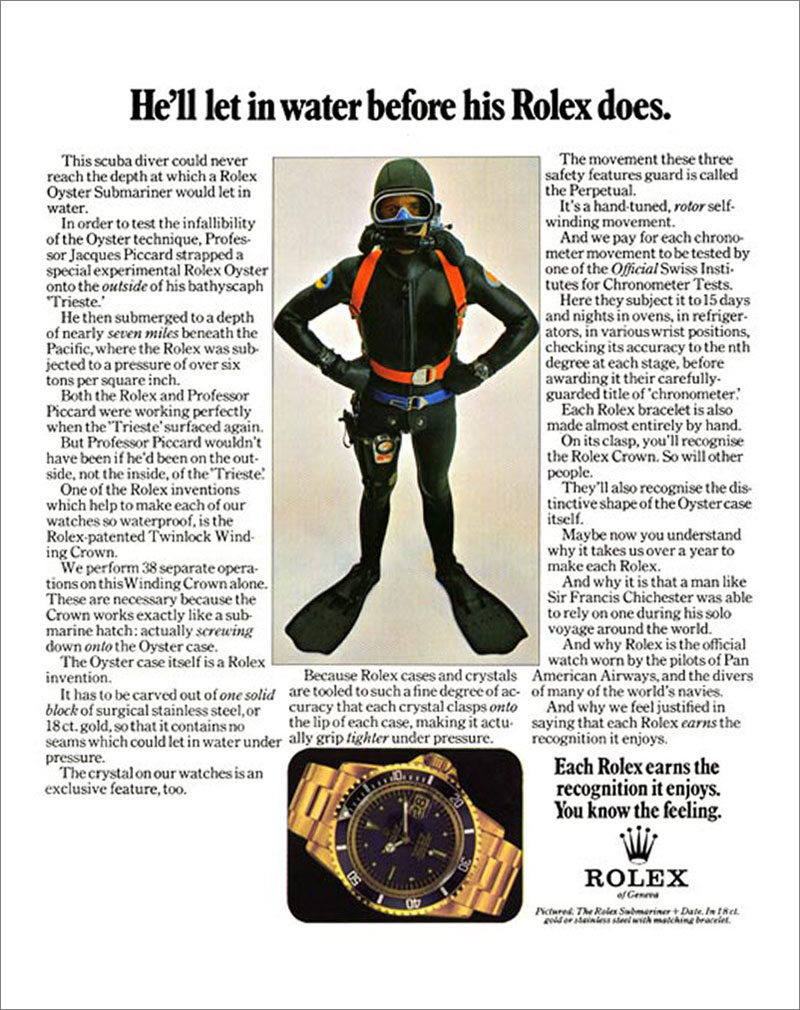
Vintage Rolex Advertising


The 1680 was the first Submariner to feature a date function, which did not come in handy when diving but it made the world of a difference when worn on a casual setting. Rolex’s underlying message with the Submariner was: “now you can keep your Rolex on forever. Take it diving but also take it to the office”. Soon after its 1967 release the 1680 became the most wearable Rolex. The rapid success of the Submariner prompted Rolex to shock the world two years later with the release of the Submariner Date in 18K yellow gold. This new permutation of Submariner showed the market that Rolex had surpassed its standing as a tool watch manufacturer and become a dynamic watchmaker.


Rolex Advertising (Circa 1970)

Dial Variations

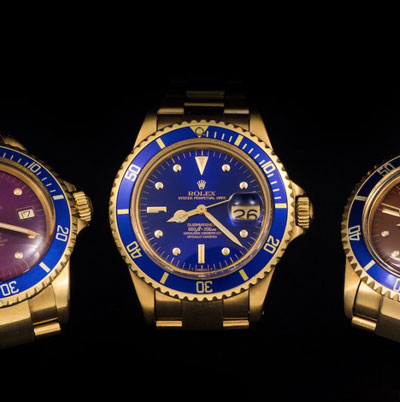
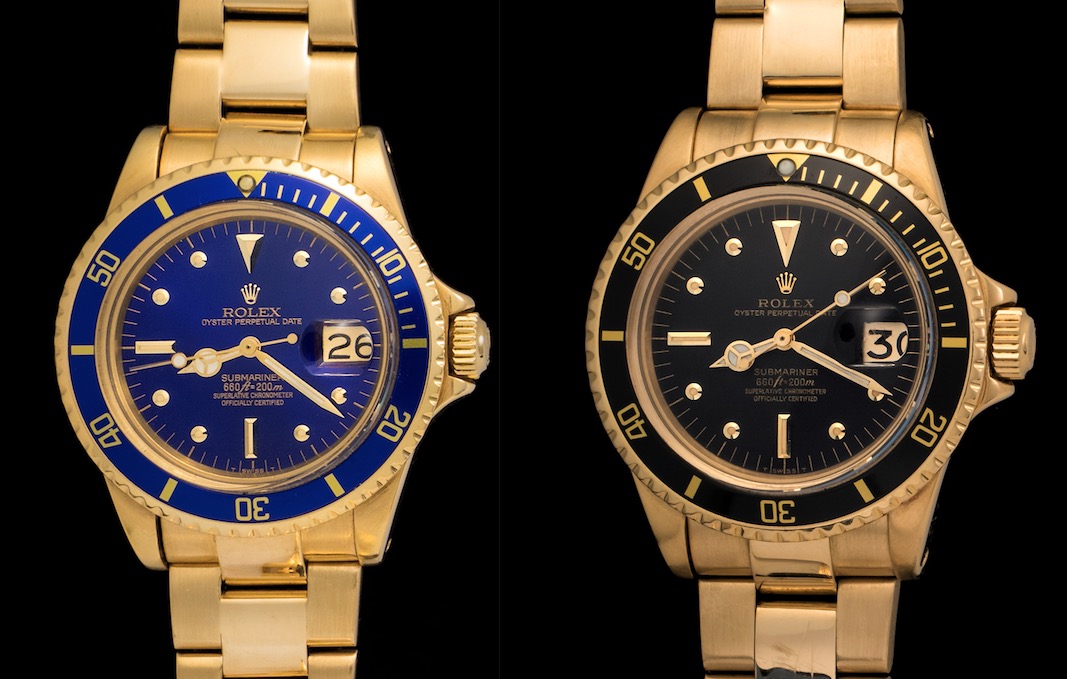
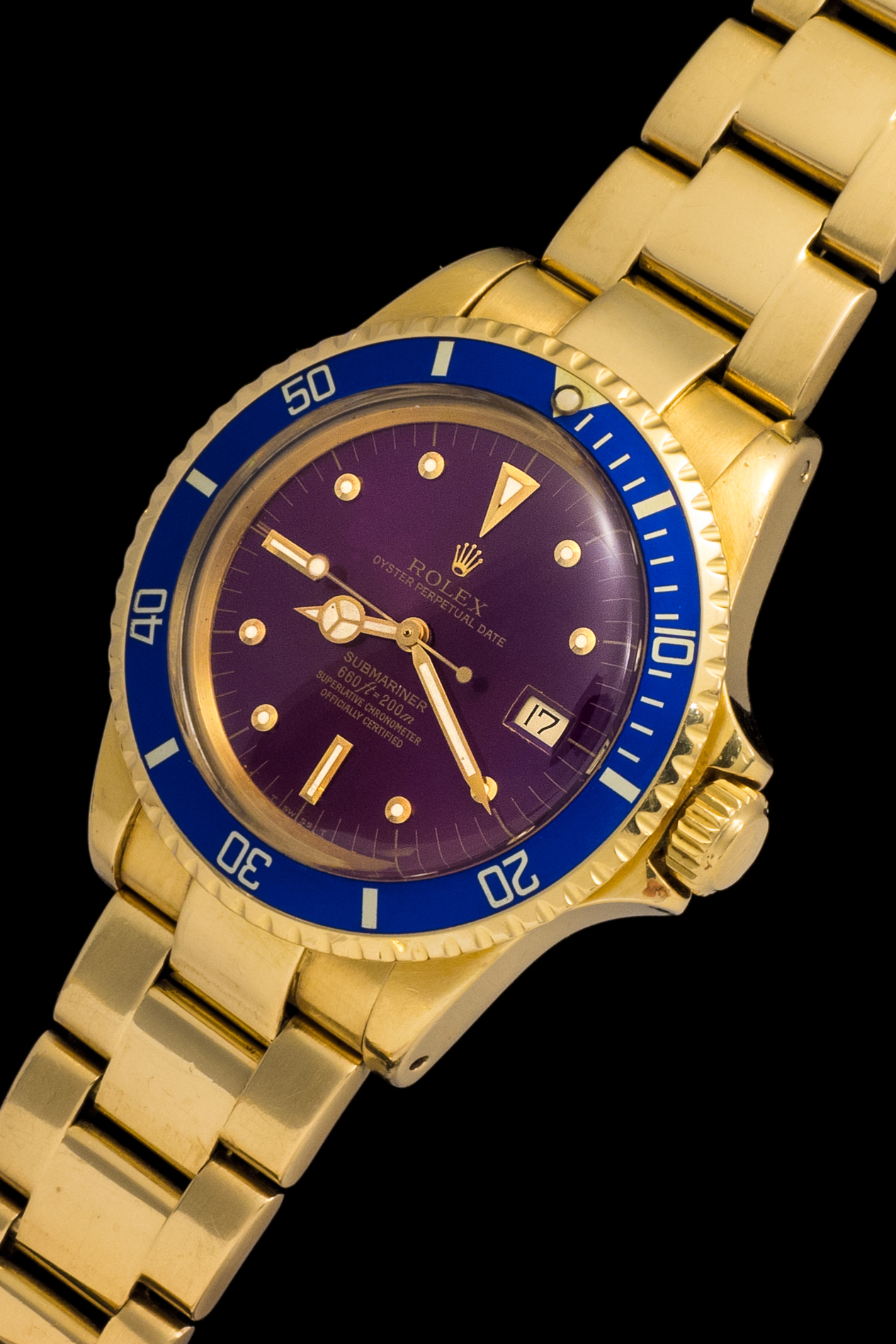
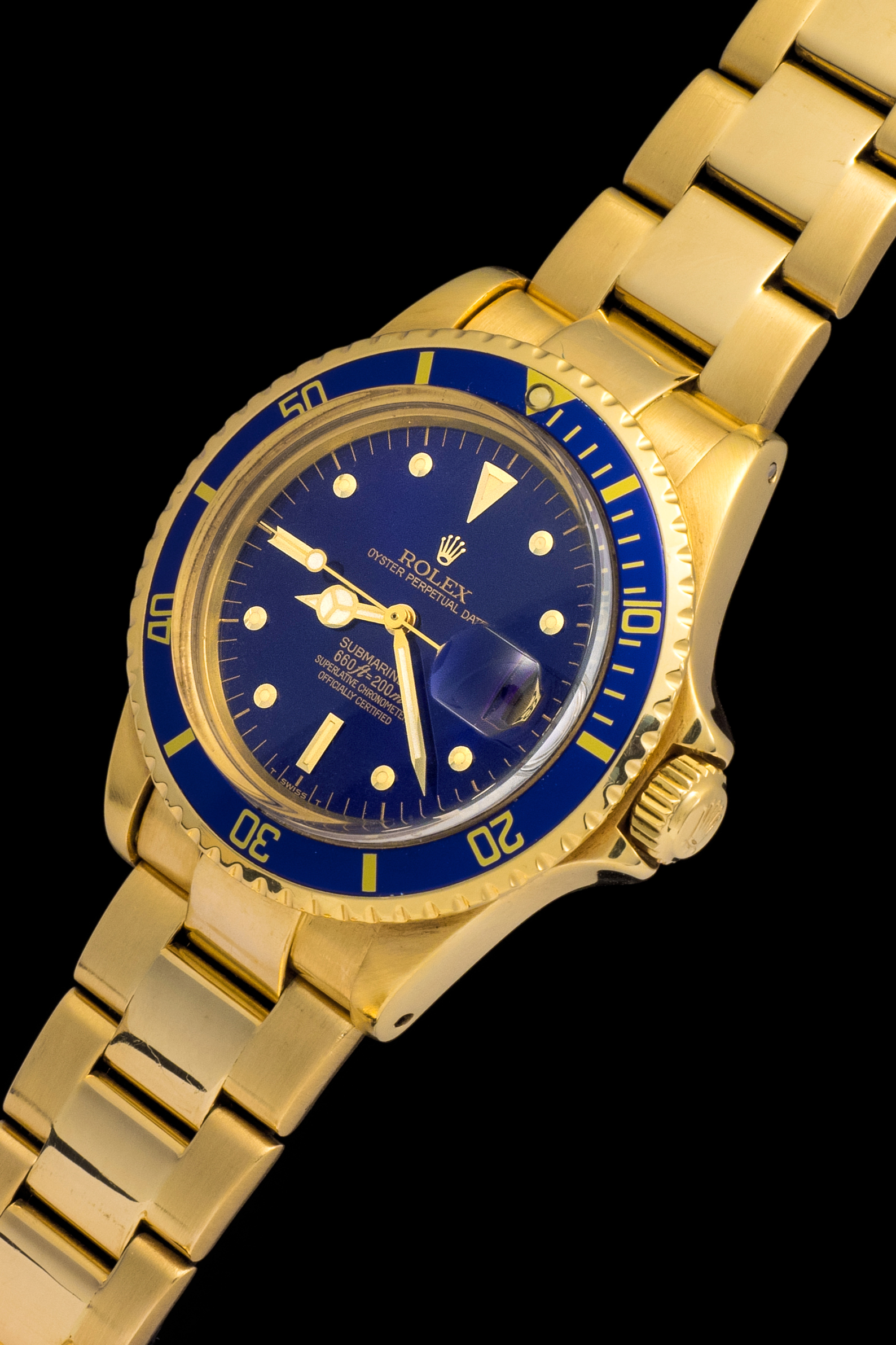
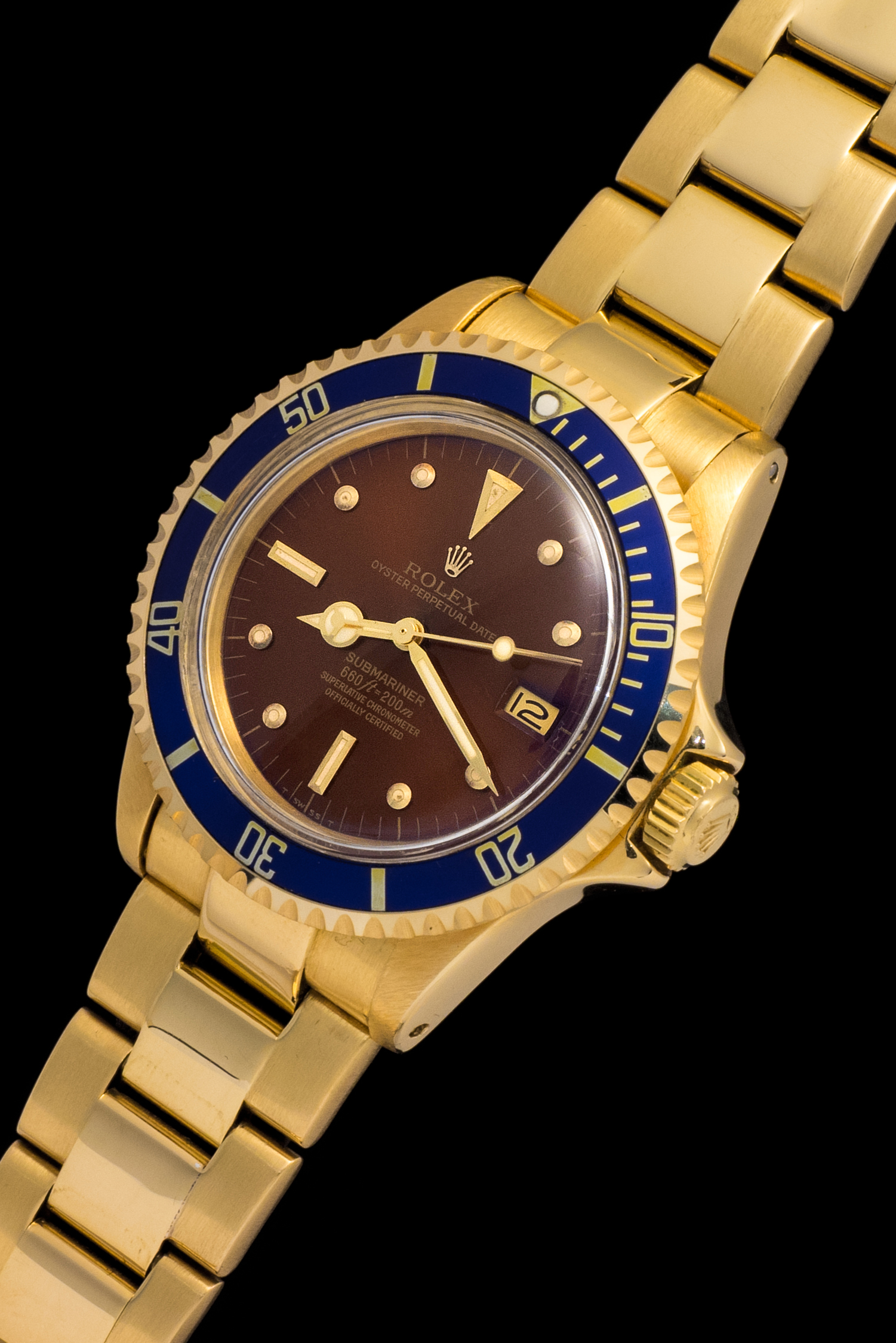
The 1680 from 1969 saw two dial variations, which will forever remain iconic. Rolex experimented with black dials and gold lettering as well as blue and gold lettering. Little did Rolex know that their blue dials would soon begin to change colors due to a pigmentation issue brought by the factory made dials. Some blue dials turned into a rich purple, others became brown, while others turned into a hue of navy blue.

dial variations

Rolex Submariner-Date  ref 1680/8″ Purple”

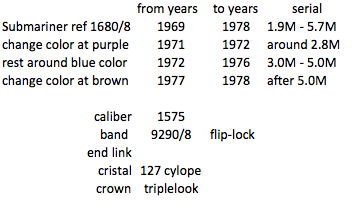
The first strand of discolored dials occurred with 1680’s manufactured around 1969. Submariners belonging to serials in the 2.8 million range turned into a strong purple color almost looking aubergine. Finding dials with this type of discoloration is very rare, as the occurrence was quickly reversed.

ROLEX SUBMARINER REF 1680/8 "PURPLE
Click on the image for more info about that watch

Rolex Submariner-Date Ref 1680/8 “blue Navy”

The second strand of discolored dials occurred with Submariners ranging from the 3 million to 5 million serials. The discoloration here was not as dramatic as the latter ones but they were equally as fascinating. These dials ranged from intense navy blue hues to others not showing strong blue colorations. Naturally navy blue dials fetch a premium whereas the others do not.

ROLEX SUBMARINER REF 1680/8 "BLUE NAVY"
Click on the image for more info about that watch


Rolex Submariner-Date Ref 1680/8 “tropical brown”

The third and last strand of discolored dials occurred with the last serial numbers belonging to the 1680, those in the 5 million range. In an effort to stabilize dial colorings Rolex decided to produce their last batch of dials using materials reserved for their new lines of upcoming sport models. The manufacture assumed that their newer dials were going to retain their factory made coloring. This notion of belief was quickly contradicted as those dials began to transform into a brownish color, the now revered Tropical dials. These dials will remain the most fascinating strand of dials ever produced by Rolex.


ROLEX SUBMARINER REF 1680/8 "BROWN"
Click on the image for more info about that watch

Collectability

The 1680 in yellow gold’s production span for nearly 10 years, ending on 1978 when Rolex introduced a newer model fitted with a sapphire crystal. Nonetheless the 1680 will remain an icon for eternity, as it was Rolex’s foray into the world of sporty/elegant watches. The key in collecting the special dials belonging to the 1680 era is to find examples with even coloring throughout the entire dial. Meaning purple dials are more sought after when the entire area is covered by the same tone of color. That being said it is important to understand that discolored Rolex dials are unique to their watch. Meaning that no two discolored dials will ever be the same. Collectors find this happening fascinating, as they appreciate the rarity of their Rolex 1680. After trial and error Rolex has only been able to master the coloring applied to dials fitted on sport models.


cat feet first


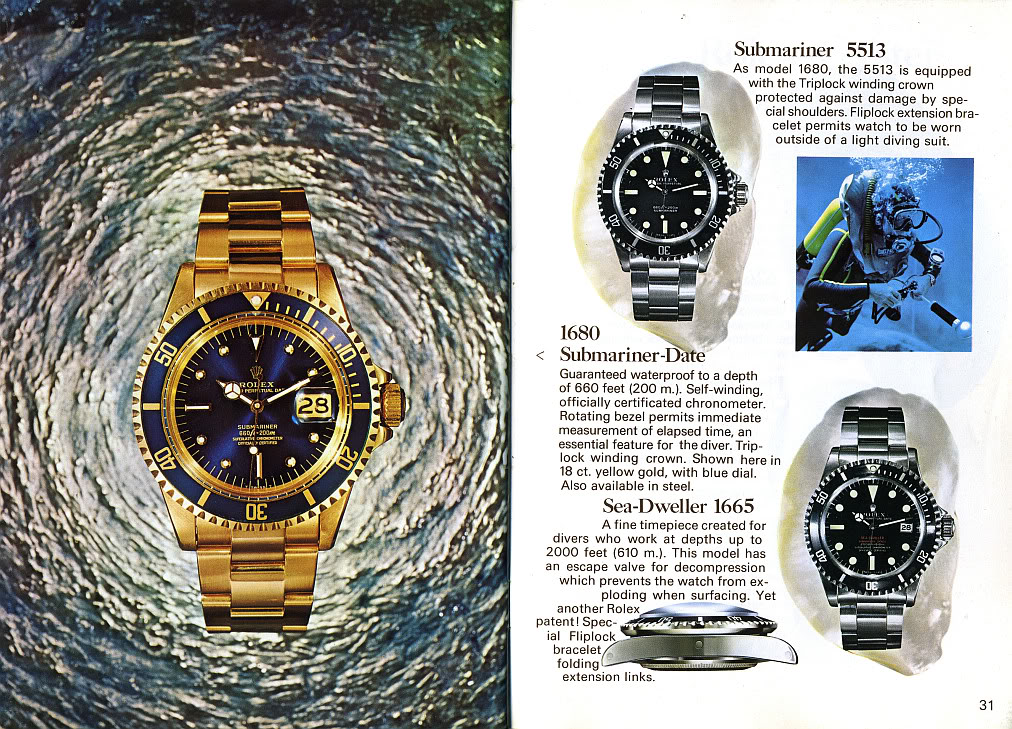
FROM ORIGINAL SUBMARINER BOOKLET:

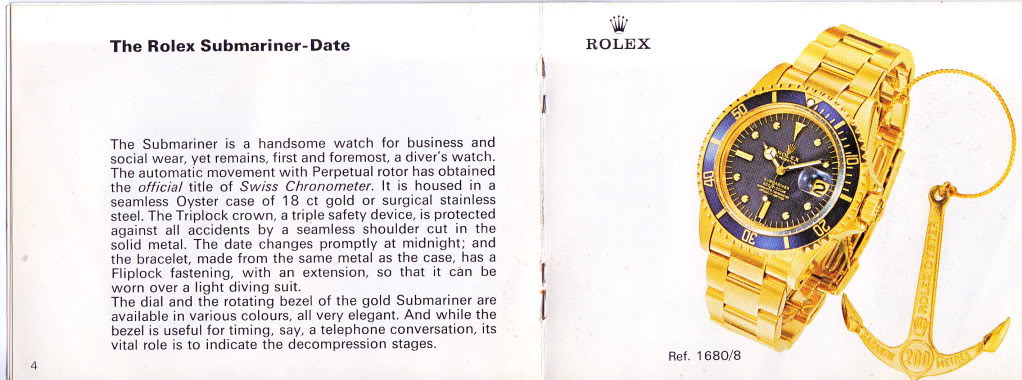
The Submariner is a handsome watch for business and social wear, yet remains, first and foremost, a diver’s watch.
The automatic movement with perpetual rotor has obtained the official title of Swiss Chronometer. It is housed in a seamless ouster case 18ct gold or surgical stainless steel. the trip look crown, a triple safety device, is protected against all accident by a seamless shoulder cut in the solid metal. the date change promptly at midnight, and the bracelet ,made from the same metal as the case ,has a flip look fastening with an extension so that it can be worn over a light diving suit.
the dial and the rotating bezel of the gold submariner are available in various colours all very elegant And while the bezel is useful for timing say a telephone conversation its vital role is to indicate the decompression stages


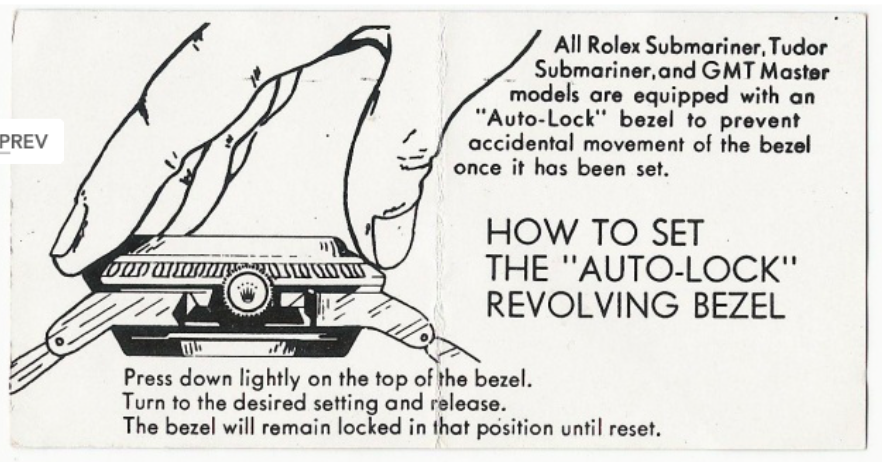
ISTRUCTION FOR USE REVOLVING BEZEL

original instruction from rolex


tech 1680:8

See our big selection of Vintage Submariner from Rolex

Rolex Day-Date: The Original History of the President’s Watch

16037771396_3dc74ff768_m
Rolex’s 6611 models that were waterproof up to 100 feet soon replaced the Day Date but it was still externally identical to the 6611. The 6611 featured the new caliber 1055 movement with its free sprung Micro-Stella balance, the first to be labeled “Superlative Chronometer Officially Certified” on the dial, and had a new accuracy standard guaranteed. The Day Date earned the nickname the “President” when Rolex apparently gave one to then President of the United States Dwight Eisenhower.
day date 6612
day date 6612

With only a few minimal changes in the case design over the years, the first large modification to the Day Date was the addition of the hack feature in 1972. This allowed the second hand to be stopped if you wanted to set the time to match an accurate source. At this time, the shape of the head was essentially the same as it is today. The “quick-set” feature solved one of the watches’ biggest problems. Introduced in the late 1970s, the quick-set was added to all Rolex models by 1983. Instead of turning the crown to speed time to change the date to the correct day, the wearer could now pull the button out half way and in an exclusive function, change the date until the correct date was displayed. The introduction of the quick-set feature also coincided with other progress for the Day Date. The inclusion of the sapphire crystal not only gave the watch a more attractive appearance but it also added to the durability of the watch. The sapphire crystal fitted tighter than the plastic glass used before and rendered the watch glass nearly scratch proof. Also in addition to the advancements structurally and internally, Rolex introduced a new number system that, for some models, is still in use for today. An extra digit was added to the model number.

day date burgundy white gold

Introduced towards the end of 1990 was the “Double Quick-Set” watch, Rolex model number 18238. This model made the setting of the Day and Date even easier as they could both be set independently from each other and the time. Rolex also expanded their Crown Collection to include all types of precious stones, although they were available with diamonds on the bezel at their debut. At the end of 2000, Rolex reintroduced the Day Date in rose gold and also with a domed sapphire mineral glass.

The “day wheel” on the Day-Date President is available in the following 26 languages: English, Spanish, Arabic, German, Chinese, Danish, Basque, Catalan, Ethiopian, Finnish, French, Greek, Hebrew, Dutch, Indonesian, Italian, Japanese, Latin, Moroccan, Norwegian, Farsi, Polish, Portuguese, Russian, Swedish and Turkish. The Rolex Day Date, famously known at the Rolex President, has become an icon for class, style, and success. It is no doubt one of the most prestigious Rolex watches available today.


Miami Antique Show: The Best Vintage Watches


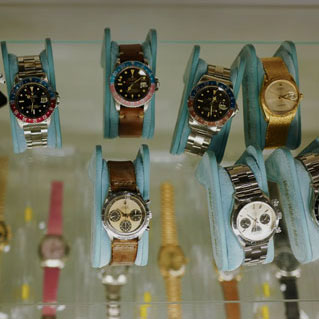
There are the antiques shows your grandparents go to, and then there is the Miami Antiques Show. Okay, who am I kidding, the Miami Antiques Show is the antiques show your grandparents go to. But, in spite of the overly air-conditioned, nothing-to-eat-but-Papa-John’s environment, the Miami show makes for some of the best vintage watch spotting this side of Parma. As always, we made our annual trek down South and here are some the best pieces we saw, broken down by provider.

credit : Hodinkee