The Golden Age of Vacheron Constantin Chronographs
Analyzing the Reference 4072 By Luca Musumeci | Vintage Watches Miami Vacheron Constantin Ref. 4072 Sector dial 1. Introduction: The Pinnacle of Elegance When discussing the golden era of mid-century chronographs, the conversation inevitably turns to the “Holy Trinity” of Swiss watchmaking. While Patek Philippe often dominates auction headlines, astute collectors have long recognized that […]
Share
Analyzing the Reference 4072
By Luca Musumeci | Vintage Watches Miami
OLYMPUS DIGITAL CAMERA
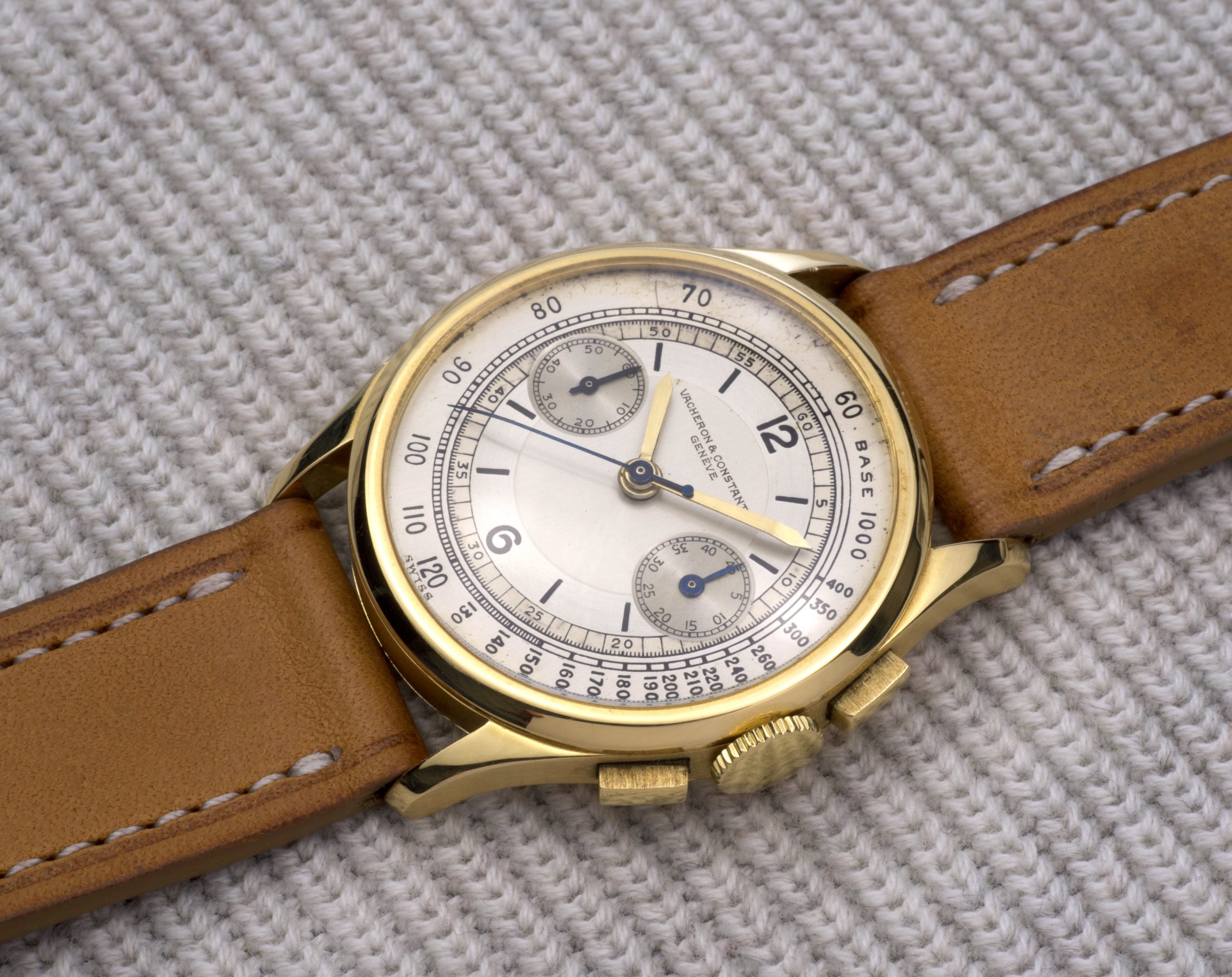
Vacheron Constantin Ref. 4072 Sector dial
1. Introduction: The Pinnacle of Elegance
When discussing the golden era of mid-century chronographs, the conversation inevitably turns to the “Holy Trinity” of Swiss watchmaking. While Patek Philippe often dominates auction headlines, astute collectors have long recognized that Vacheron Constantin produced some of the most aesthetically perfect and mechanically refined chronographs of the 20th century. At the very heart of this legacy sits the Reference 4072.
Introduced in 1938 and remaining in the catalog until the early 1970s, the reference 4072 is one of Vacheron Constantin’s most iconic and enduring chronograph designs. Despite its long production run, it remains an exceptionally rare timepiece. Total production across all metals over more than three decades reached only 1,178 examples. This scarcity, combined with its flawless proportions and exceptional movement finishing, makes the 4072 a true connoisseur’s choice.
2. Design and Dial Variations: A Study in Nuance
The reference 4072 is instantly recognizable by its elegant 34mm case, which, despite its modest dimensions by modern standards, wears with remarkable presence due to its elongated, slightly faceted lugs and thin bezel. The pushers are typically rectangular, though extremely rare early examples feature oval pushers — a detail that makes an already rare watch even more exceptional.
What truly sets the 4072 apart for collectors is the incredible variety of dial designs produced over its lifespan. A comprehensive study by horological scholars has identified at least six distinct dial variants.
The Six Dial Variants of Ref. 4072
Variant 1 (Late 1930s): Entirely printed dials with no applied hour markers. Often features sector-dial layouts, highly prized by collectors.
Variant 2 (1940s–1950s): The most common variant, featuring applied hour markers (bead or rectangular) with Arabic or Roman numerals at 12 and 6 o’clock. Outer scales often include tachymeter or telemeter.
Variant 3 (Circa 1948): The ultra-rare black enamel dial. Only a handful of examples are known to exist.
Variant 4 (Early 1940s–1950s): Features applied gold hour markers with Roman numerals XII and VI, an open seconds track, and notably larger sub-dials.
Variant 5 (The Doctor’s Watch): Defined by a unique snail scale (pulsometer and respirometer) at the center of the dial.
Variant 6: Similar to Variant 3 but with double applied hour markers at 12 and 6 o’clock and an applied gold Maltese cross.
Metal
Estimated Production
Rarity
Yellow Gold
~600 pieces
Rare
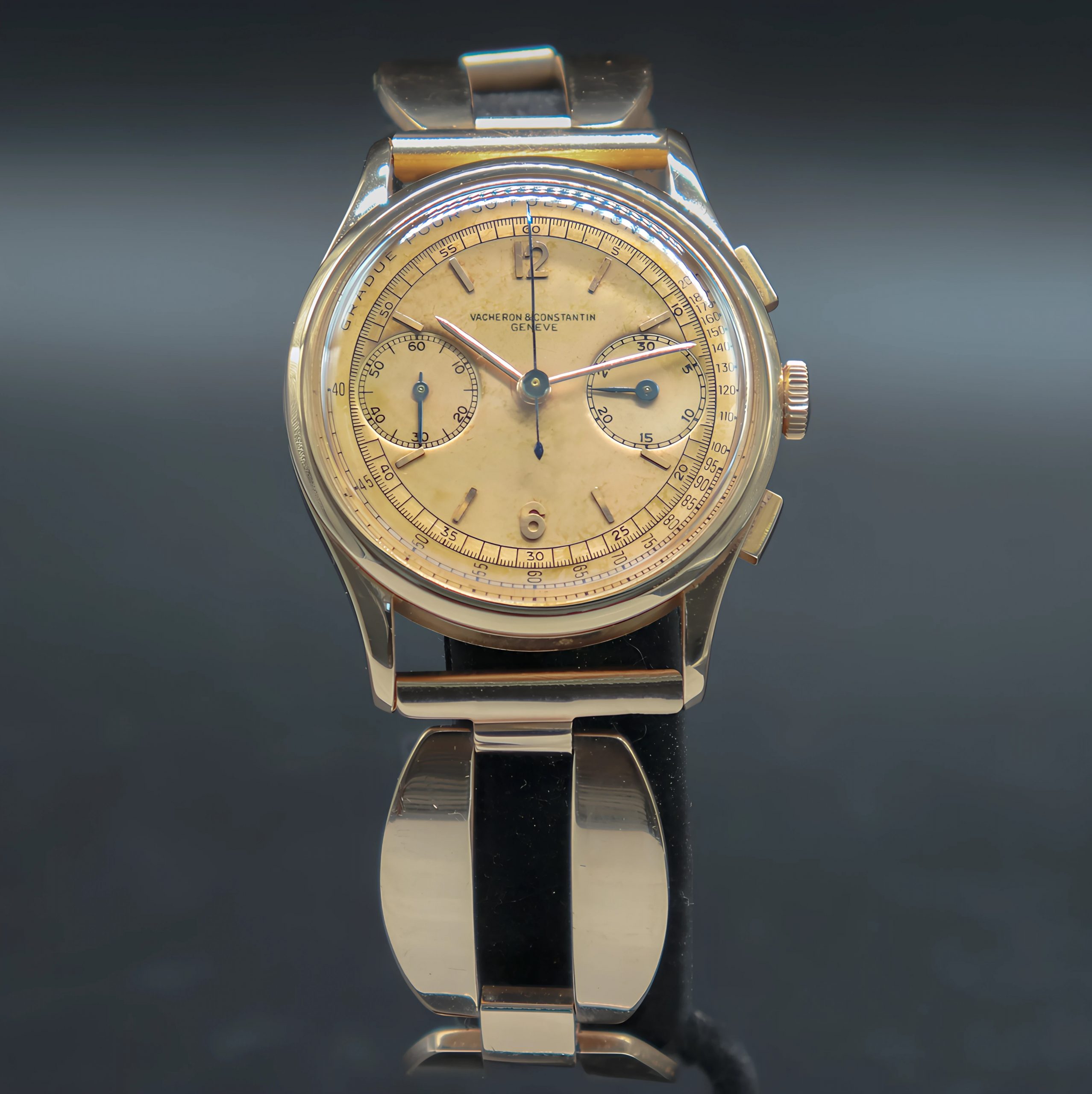
Rose / Pink Gold
~285 pieces
Very Rare
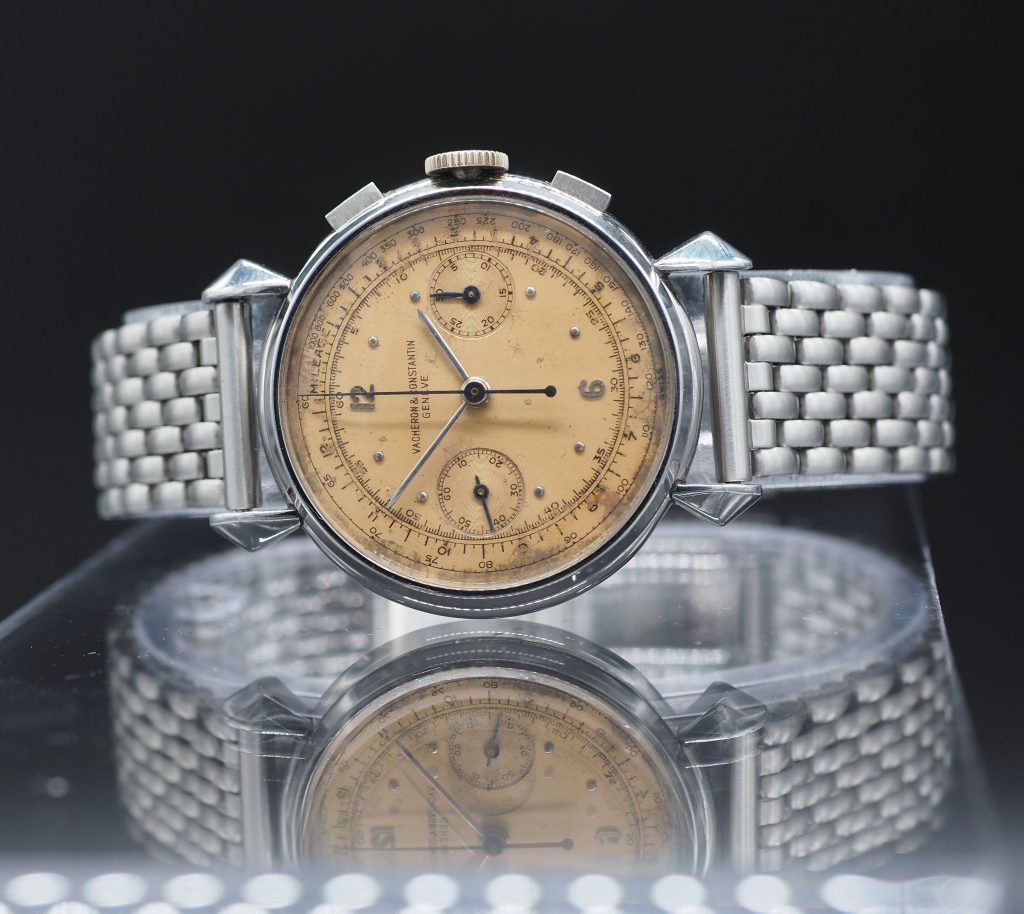
Stainless Steel
~200 pieces
Extremely Rare
Two-Tone (Steel/Gold)
< 100 pieces
Ultra Rare
3. The Heart of the Matter: Calibre 13’VZ 434
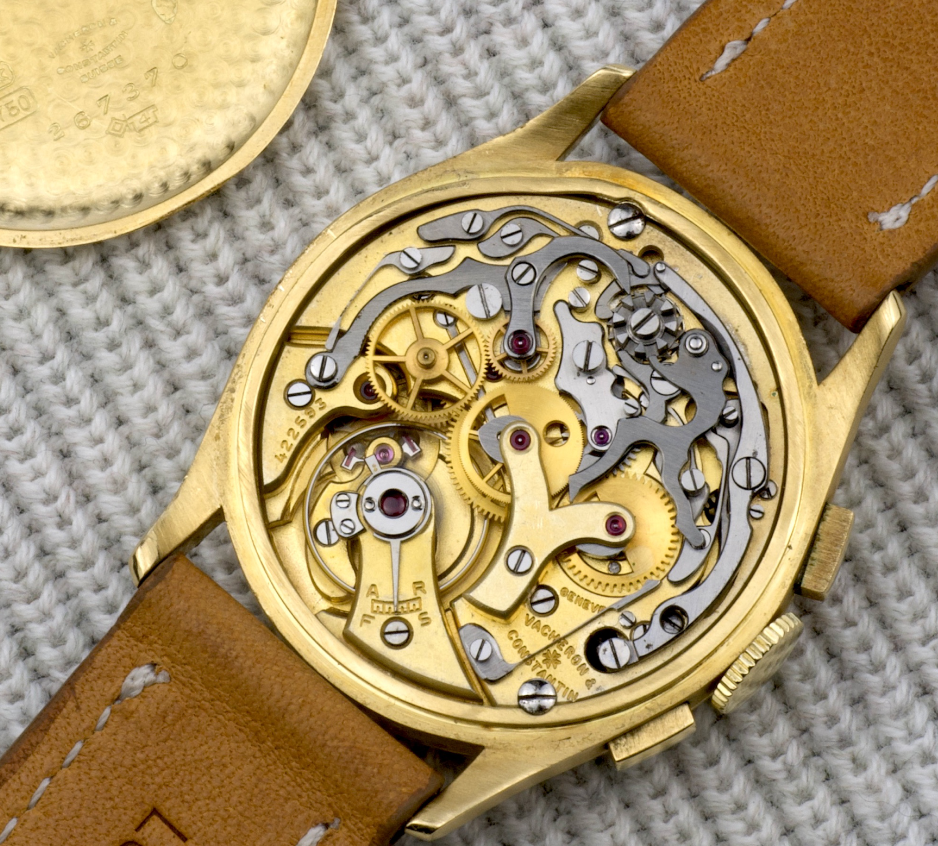
The mechanical soul of the reference 4072 is as impressive as its exterior. Vacheron Constantin utilized ébauches from Valjoux, specifically the Valjoux 22, which was heavily modified and finished to the manufacture’s exacting standards. This movement, designated as the Calibre 13’VZ 434 (and later the 13’VZ 492), represents the zenith of mid-century chronograph finishing.
Vacheron Constantin’s watchmakers applied straight graining to the flat surfaces of the steel levers, mirror-polished the screw heads and countersinks, and meticulously hand-beveled the angles of the bridges. The result is a movement that rewards close inspection with a loupe, revealing a level of artisanship rarely encountered outside of the very top tier of Swiss horology.
“This movement is based on a Valjoux 22, but has undergone the specific (very high) finishing standards of Vacheron Constantin… Having such a piece of history on the wrist is always fascinating, mainly because of what the watch represents… it has a soul!” — Monochrome Watches
4. The Allure of the Sector Dial
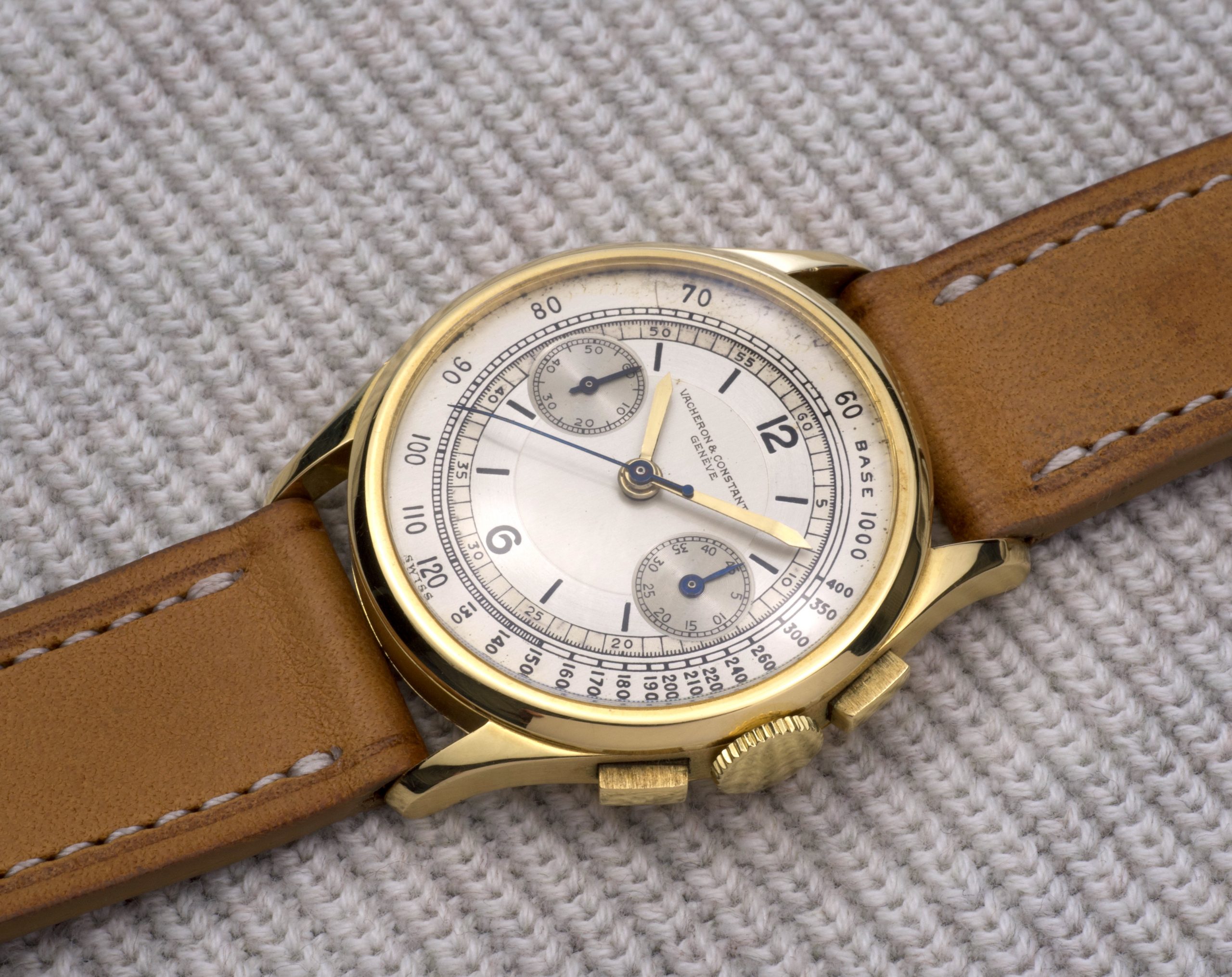
Among the various dial configurations of the reference 4072, the sector dial (often found in Variant 1) holds a special place in the hearts of collectors. Sector dials, characterized by concentric circles and distinct “sectors” for hours and minutes, were popular in the 1930s and 1940s. They offer a highly legible, almost scientific aesthetic that contrasts beautifully with the elegant case of the 4072.
The sector dial variants are incredibly rare, representing the earliest production years of the reference. Finding a reference 4072 with an original, unrestored sector dial is a significant event in the vintage watch market. The combination of the complex dial layout, the elongated lugs, and the exceptional movement makes these specific examples some of the most desirable chronographs ever produced by Vacheron Constantin.
the sector dial Ref. 4072
5. Buying Guide: Evaluating a Reference 4072
Acquiring a vintage Vacheron Constantin reference 4072 requires careful consideration and a deep understanding of the model’s nuances. Here are the key factors to evaluate.
Dial Authenticity and Condition
The dial is the most critical component of any vintage watch. For the 4072, it is essential to verify that the dial variant matches the production era of the case and movement. Many dials have been washed, reprinted, or replaced over the decades. Look for crisp printing, correct typography (especially the ampersand in “Vacheron & Constantin”), and appropriate aging. An original, untouched dial, even with some patina, is vastly preferable to a poorly executed redial.
Case Integrity
The 34mm case of the 4072 is defined by its sharp facets and elegant proportions. Over-polishing is a common issue that can ruin the watch’s aesthetic appeal. Examine the lugs carefully; they should retain their distinct shape and not appear overly rounded or thin. The hallmarks on the caseback and lugs should be visible, though some wear is expected on a watch of this age.
Movement Originality
The Calibre 13’VZ 434 should exhibit the high-level finishing characteristic of Vacheron Constantin. Ensure that all components are original and that the movement is free from significant corrosion or damage. The serial numbers on the movement and case should correspond to the correct production period.
Extract from the Archives
Whenever possible, obtain an Extract from the Archives from Vacheron Constantin. This document confirms the original configuration of the watch, including the case material, dial type, and production date, providing invaluable peace of mind for the collector.
6. The Collector’s Verdict
The Vacheron Constantin reference 4072 is not a watch for the novice. It requires a discerning eye to appreciate the subtle variations in dial typography, the crispness of the case facets, and the unparalleled finishing of the movement. For the advanced collector, acquiring a 4072 — particularly an early example with a sector dial or a rare pink gold variant — is a milestone. It represents an era when chronographs were transitioning from pure utilitarian tools to objects of immense elegance and prestige.
7. Discover the Reference 4072 at Luca Musumeci
At Vintage Watches Milano & Miami, we are thrilled to offer two exceptional examples of this legendary reference, catering to the highest echelons of vintage collecting:
Vacheron & Constantin Ref. 4072 First Series Chronograph with Sector Dial — An incredibly rare early execution (Variant 1) featuring the highly sought-after sector dial layout.
Vacheron Constantin Chronograph Pink Gold Ref. 4072 — A stunning example in the highly desirable and rare pink gold case.
Analysis of the Patek Philippe Reference 2552 in Platinum 1. Introduction to the Patek Philippe Reference 2552 in Platinum: The Patek Philippe reference 2552, affectionately nicknamed the “Flying Saucer” due to its distinctive case shape reminiscent of a flying saucer, represents an icon of twentieth-century watchmaking. Produced between 1954 and 1960, this automatic model stands […]
Patek Philippe Reference 2526: An In-depth Analysis of a Vintage Watchmaking Icon The Patek Philippe manufacture is universally recognized as a bastion of haute horlogerie, celebrated for creating timepieces of exquisite craftsmanship and profound historical significance. Among its numerous creations, the reference 2526 holds a place of particular importance. Introduced in 1953, this model marked […]