The Bulgari Serpenti Watch: 75+ Years of an Icon That Refuses to Stand Still
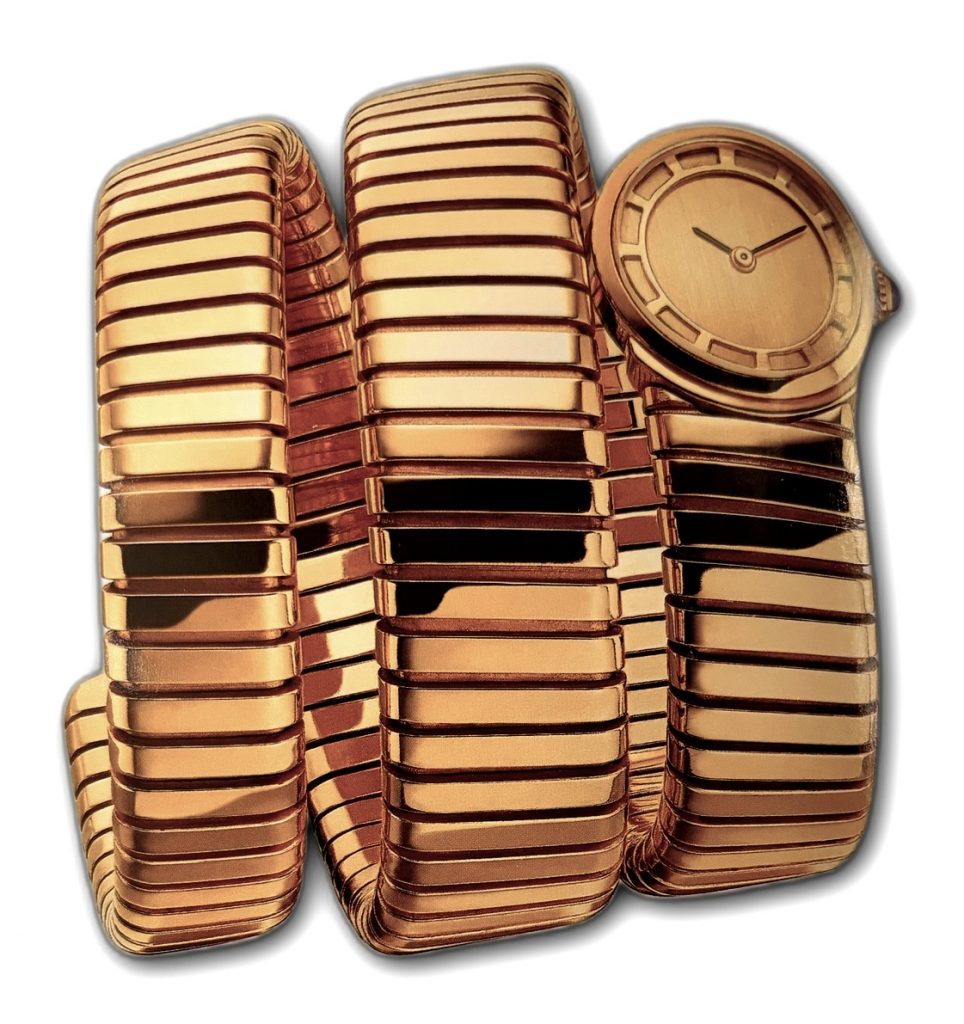
THE EVOLUTION OF AN ICON Serpenti Tubogas bracelet-watch in yellow gold, ca. 1960. BVLGARI Heritage Collection. The triple-coil Tubogas construction became the defining structural language of the Serpenti line. Imagine a serpent coiling around your wrist — not as a creature, but as a masterpiece of Italian goldsmithing that has captivated the world for over […]
Share
THE EVOLUTION OF AN ICON
Serpenti Tubogas bracelet-watch in yellow gold, ca. 1960. BVLGARI Heritage Collection. The triple-coil Tubogas construction became the defining structural language of the Serpenti line.
Imagine a serpent coiling around your wrist — not as a creature, but as a masterpiece of Italian goldsmithing that has captivated the world for over 75 years. Since 1948, the Bulgari Serpenti watch has embodied the ancient symbolism of the snake — wisdom, seduction, transformation, vitality, rebirth, and protection — while continuously reinventing itself decade after decade.
The Bulgari Serpenti is more than a timepiece. It is a continuously evolving icon that fuses Italian jewelry artistry with Swiss watchmaking, spanning from its birth in post-war Rome to the cutting-edge innovations of 2026. Bulgari calls it their “true symbol,” one that captures “energy coursing through gold and gems,” creating pieces that “pulse with irresistible magnetism.”
The Serpent Symbol: Ancient Origins, Modern Icon
The serpent motif that defines the Bulgari Serpenti collection is anchored in ancient civilizations, particularly Egyptian and Greek-Roman mythological traditions. In these cultures, the serpent symbolized eternal life, divine wisdom, and perpetual renewal — themes that resonate powerfully in a timepiece designed to mark the passage of time itself.
Bulgari’s Greek-Italian heritage connects directly to these classical traditions. Founded by Greek silversmith Sotirios Voulgaris in Rome in 1884, the house drew naturally from the ancient Roman jewelry traditions that featured snake motifs prominently. When Bulgari transformed the snake from a mere decorative element into a core brand identity in 1948, they were tapping into millennia of symbolic power.
A Chronological History: Decade by Decade
The 1940s: Birth of an Icon
1948 marks the year Bulgari created the first Serpenti bracelet-watch — a gold timepiece with a square-shaped dial and a coiled band that wrapped sinuously around the wrist. This inaugural piece was crafted using the innovative Tubogas goldsmithing technique, an avant-garde method characteristic of the “Retro” or “Machine Style” era.
The Tubogas technique — named after the coiled gas pipes that inspired its form — creates a flexible bracelet through consistent coils of gold without any soldering. The result is a band that moves with the fluidity of a living serpent.
The 1950s: The Secret Watch Emerges
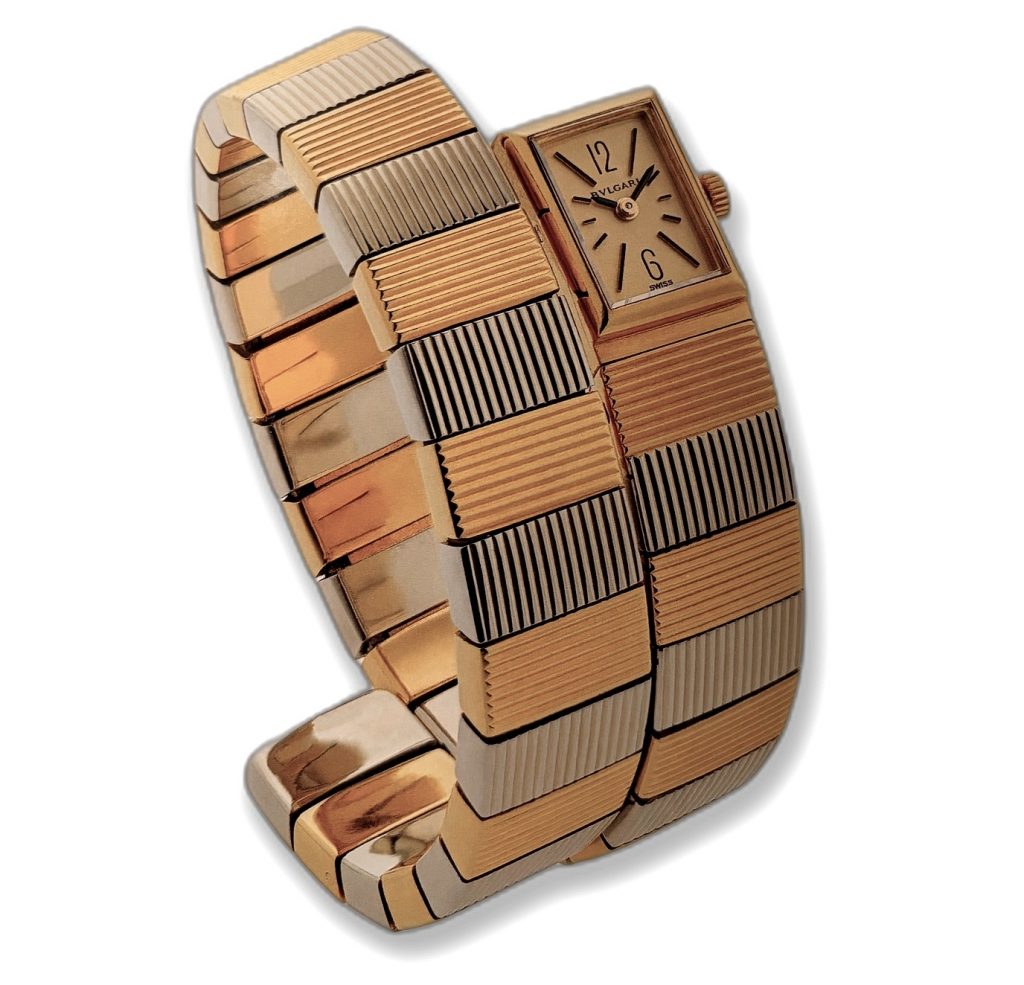
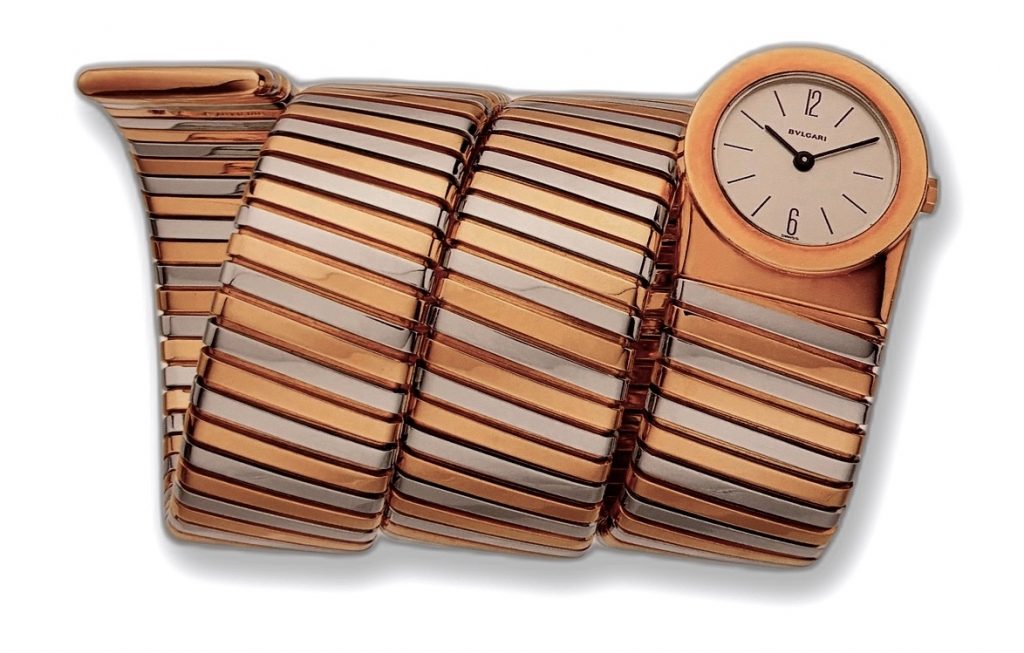
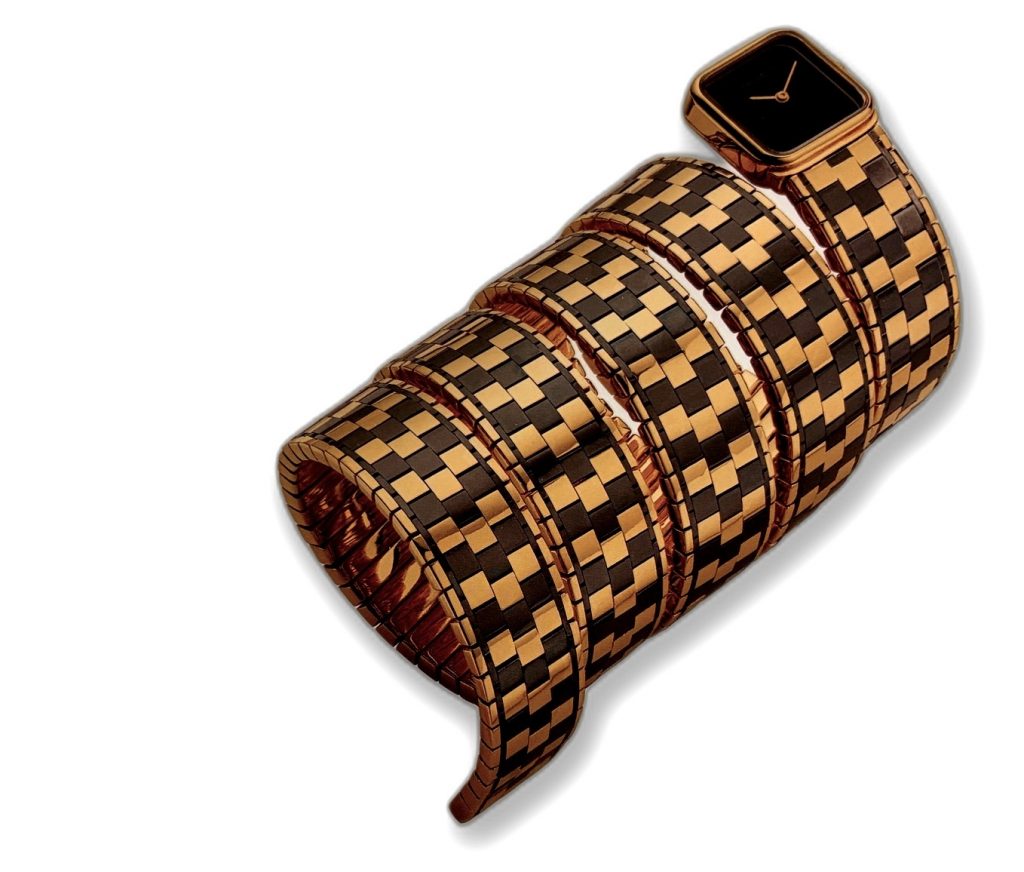
Serpenti bracelet-watch in two-colour gold (yellow and white gold), ca. 1960. BVLGARI Heritage Collection.Thecheckerboard alternation of yellow and white gold segments demonstrates Bulgari’s early mastery of contrastingmetals.
By the mid-1950s, Bulgari had developed the concept of the “secret watch” — a timepiece whose dial was hidden under a small decorative cap, typically fashioned as the serpent’s head. This innovation transformed the Serpenti from a watch that happened to look like a snake into a piece of jewelry that happened to conceal a watch.
The 1960s: Cult Status and the Elizabeth Taylor Moment
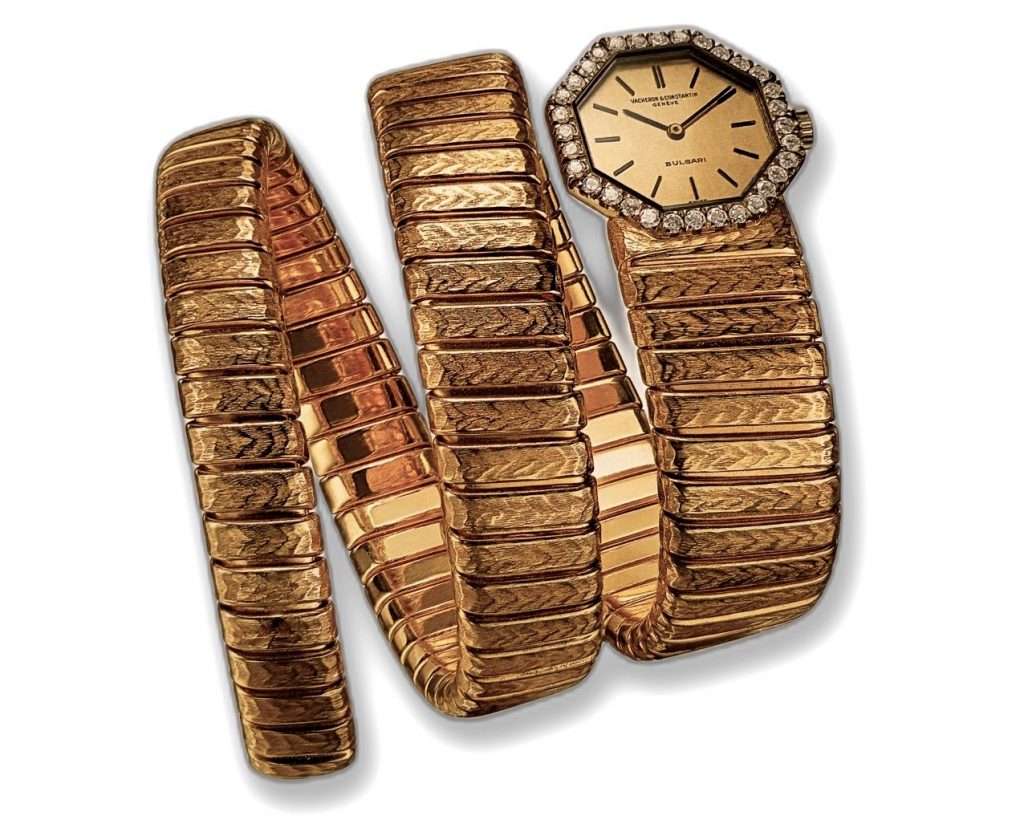
Serpenti Tubogas in satined yellow gold with diamond bezel, 1963. Movement by Vacheron & Constantin, Genève.The engraved herringbone texture and diamond bezel mark this as one of the most refined early Serpenti executions.
The 1960s elevated the Serpenti from a luxury accessory to a cultural phenomenon. The defining moment came in January 1962, when Elizabeth Taylor acquired her Bulgari Serpenti while filming Cleopatra in Rome.
“I introduced Bulgari to the world.” — Elizabeth Taylor
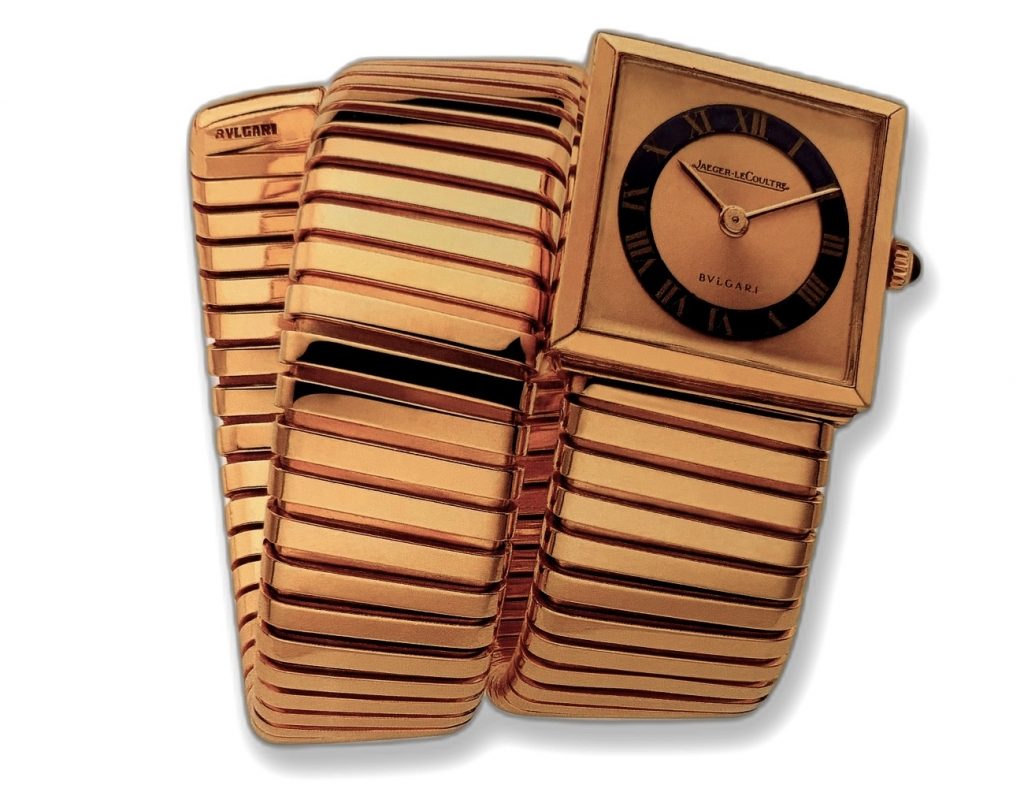
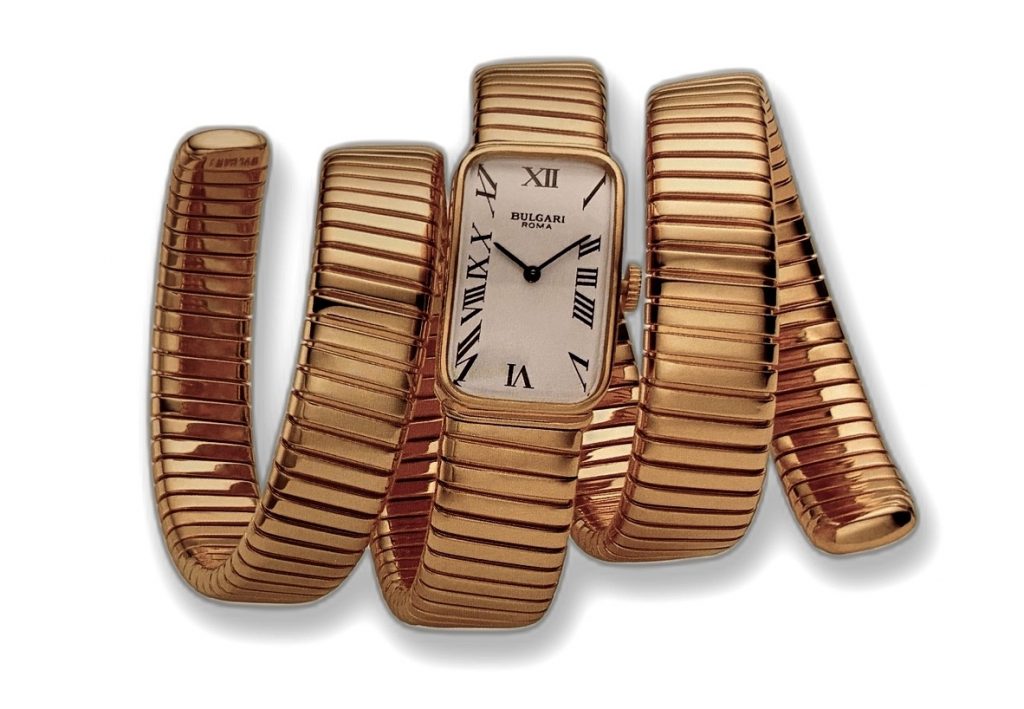
Serpenti Tubogas in yellow gold, ca. 1965. The elongated rectangular case with Roman numeral dial and the “BULGARI ROMA” signature reflect the brand’s confident Roman identity during the dolce vita era.
The 1970s: Revival and Versatility
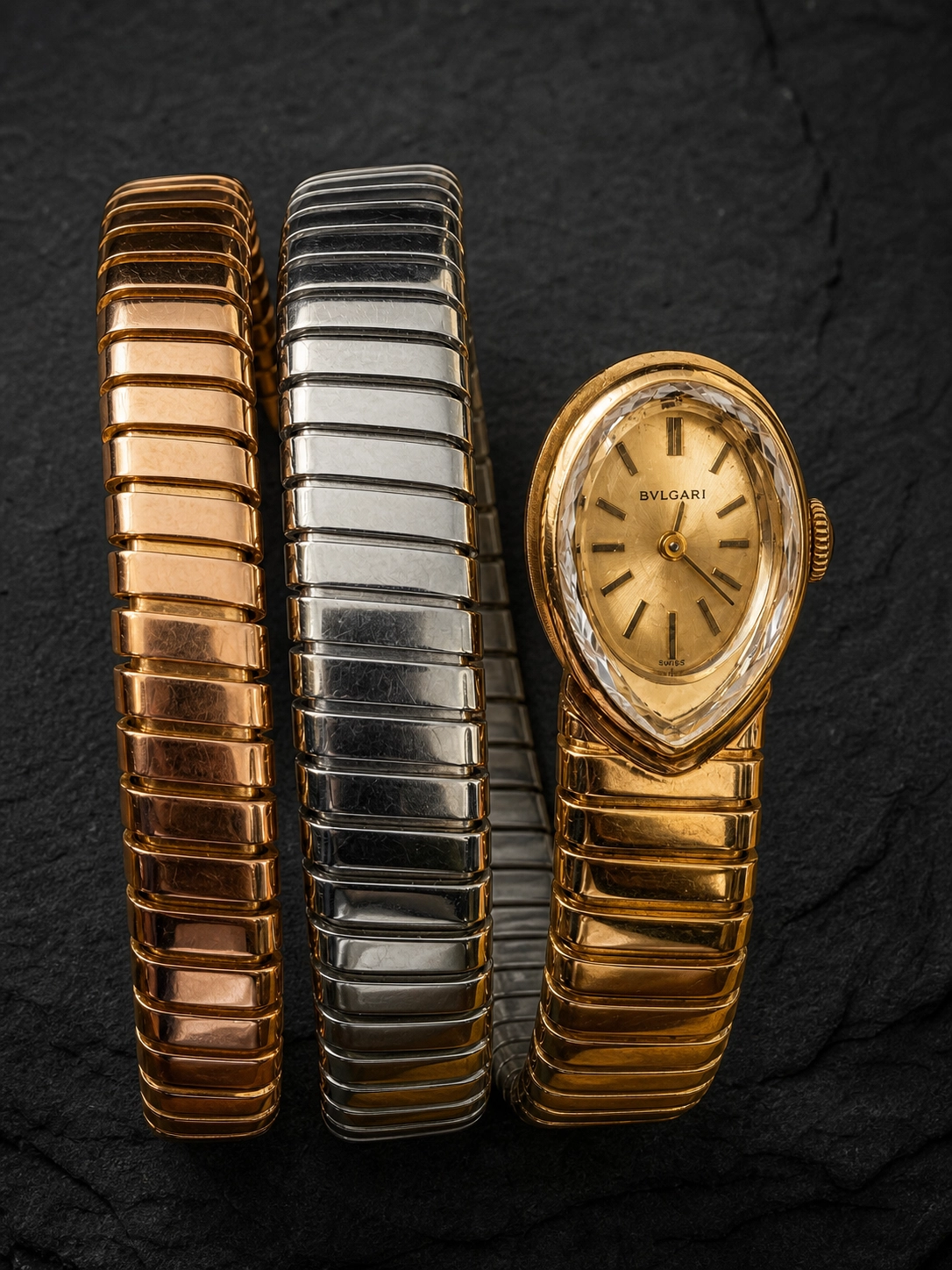
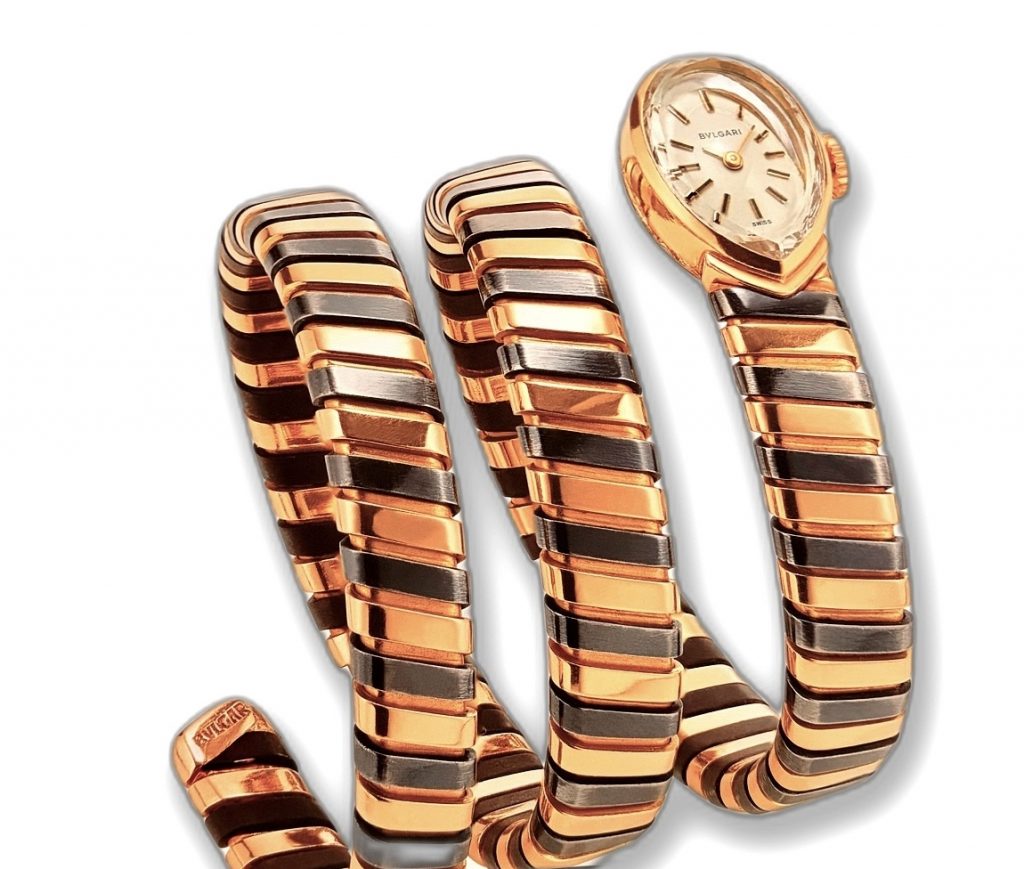
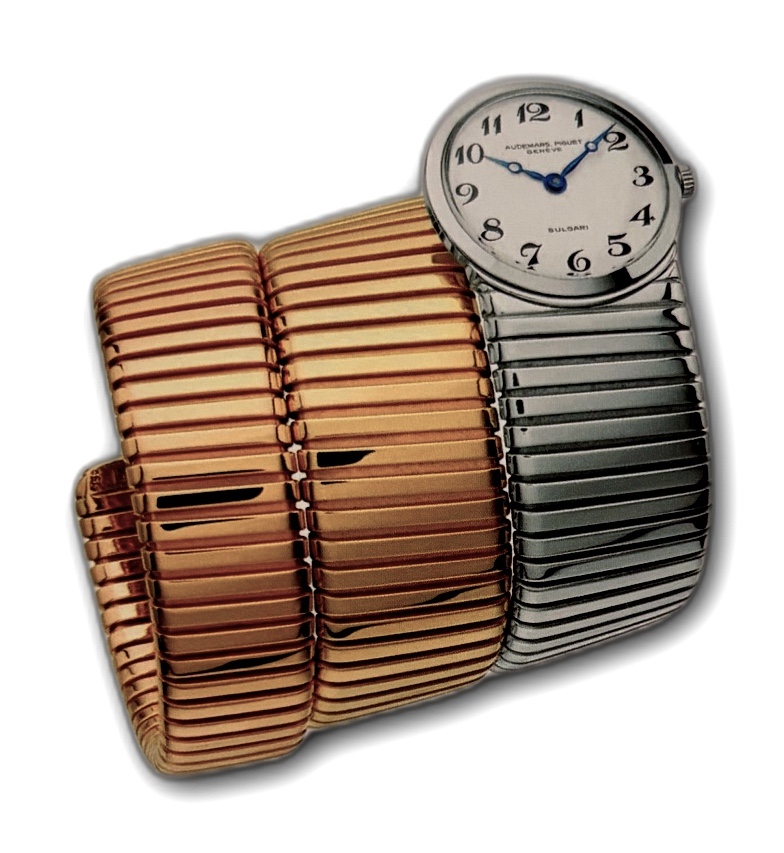
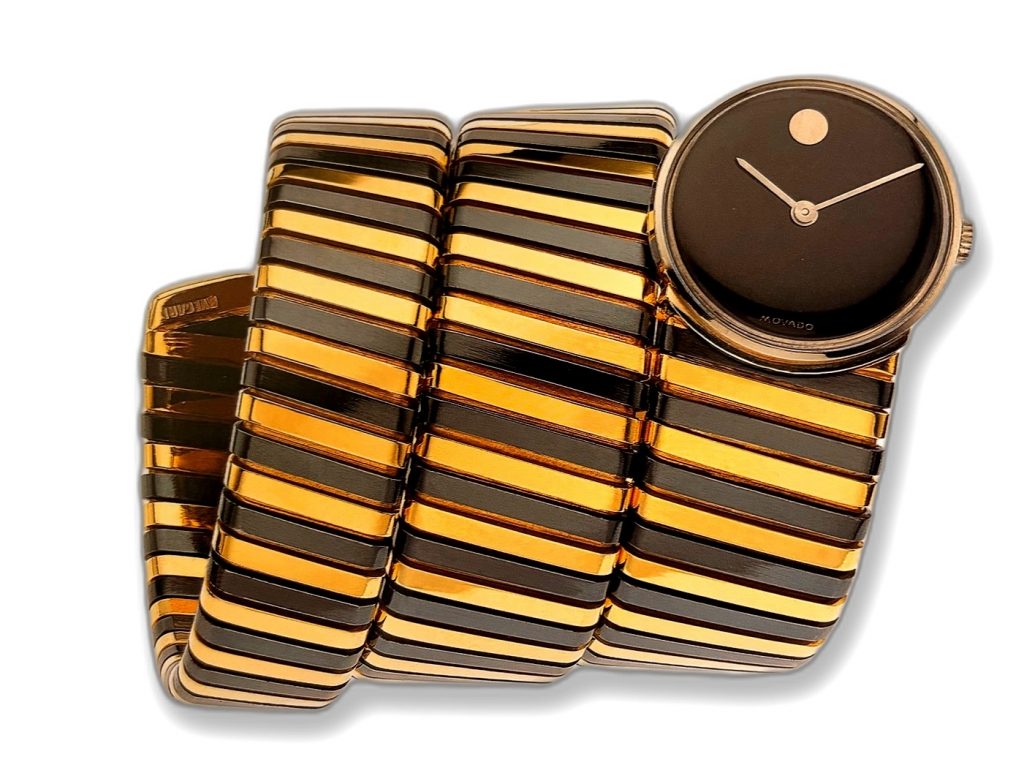
Serpenti Tubogas in yellow gold and burnished steel, ca. 1970. BVLGARI Heritage Collection.The bold alternationof polished gold and matte steel segments gives this triple-coil Serpenti a distinctly modern, graphic energy.
The Tubogas technique experienced a significant revival in the late 1960s and 1970s. This was the decade that democratized the Serpenti — at least within the realm of luxury. Two-tone gold and stainless steel combinations appeared for the first time, making the collection more accessible while maintaining its distinctive serpentine character.
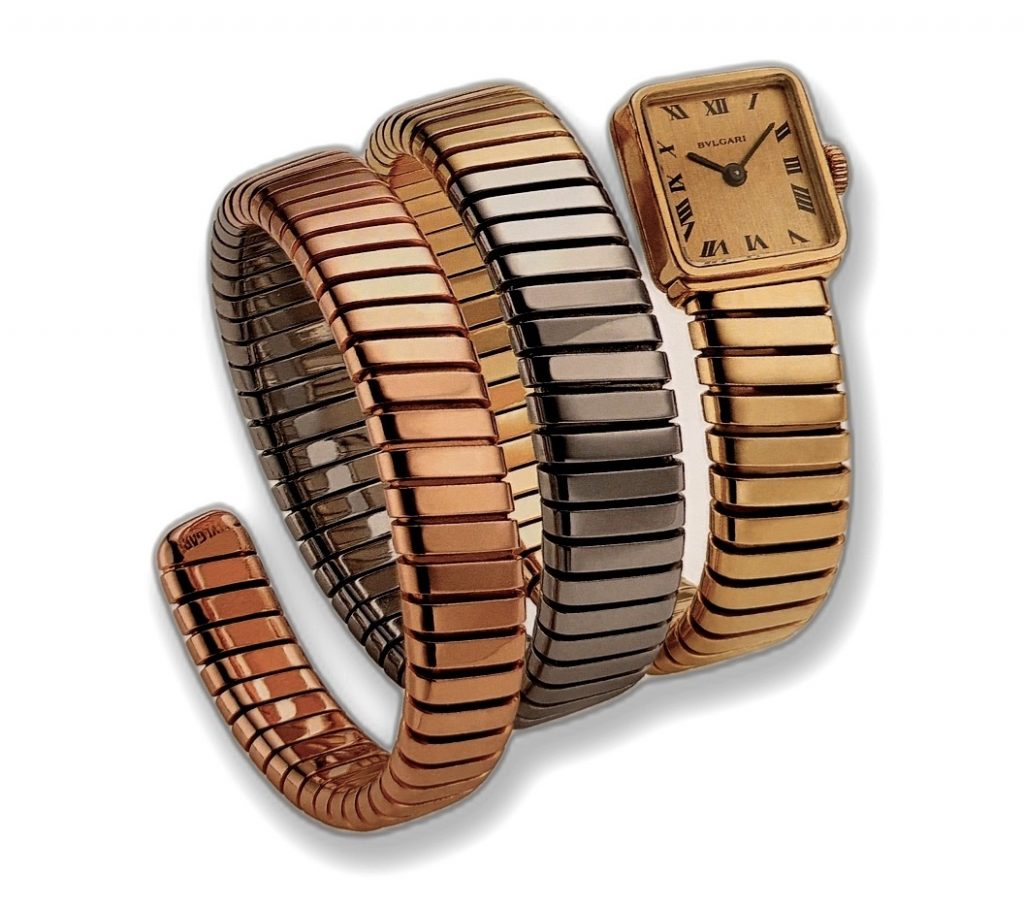
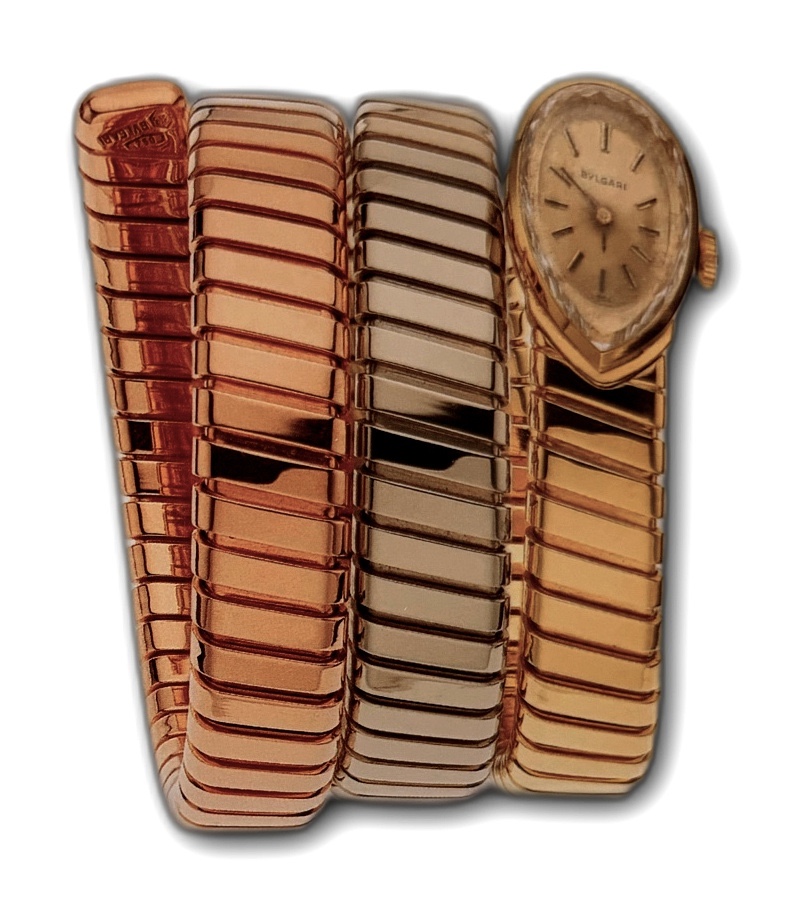
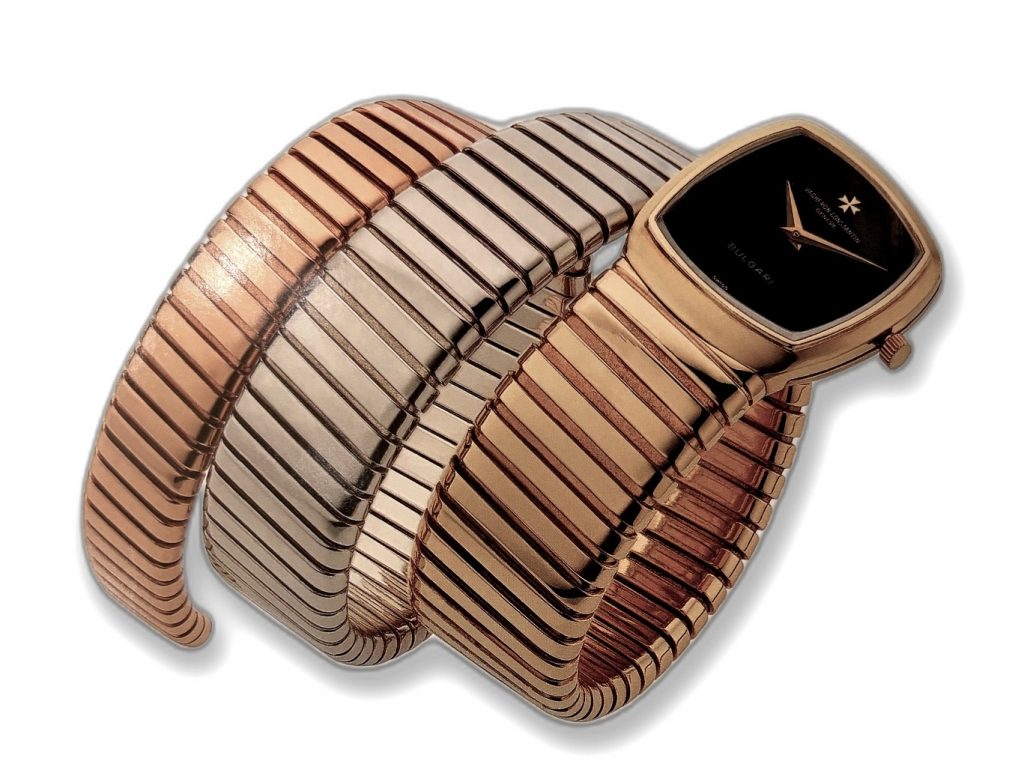
Serpenti Tubogas in three-colour gold (yellow, white, and rose gold), ca. 1970. BVLGARI Heritage Collection. A technical and aesthetic tour de force — three distinct gold alloys in a single continuous Tubogas body.
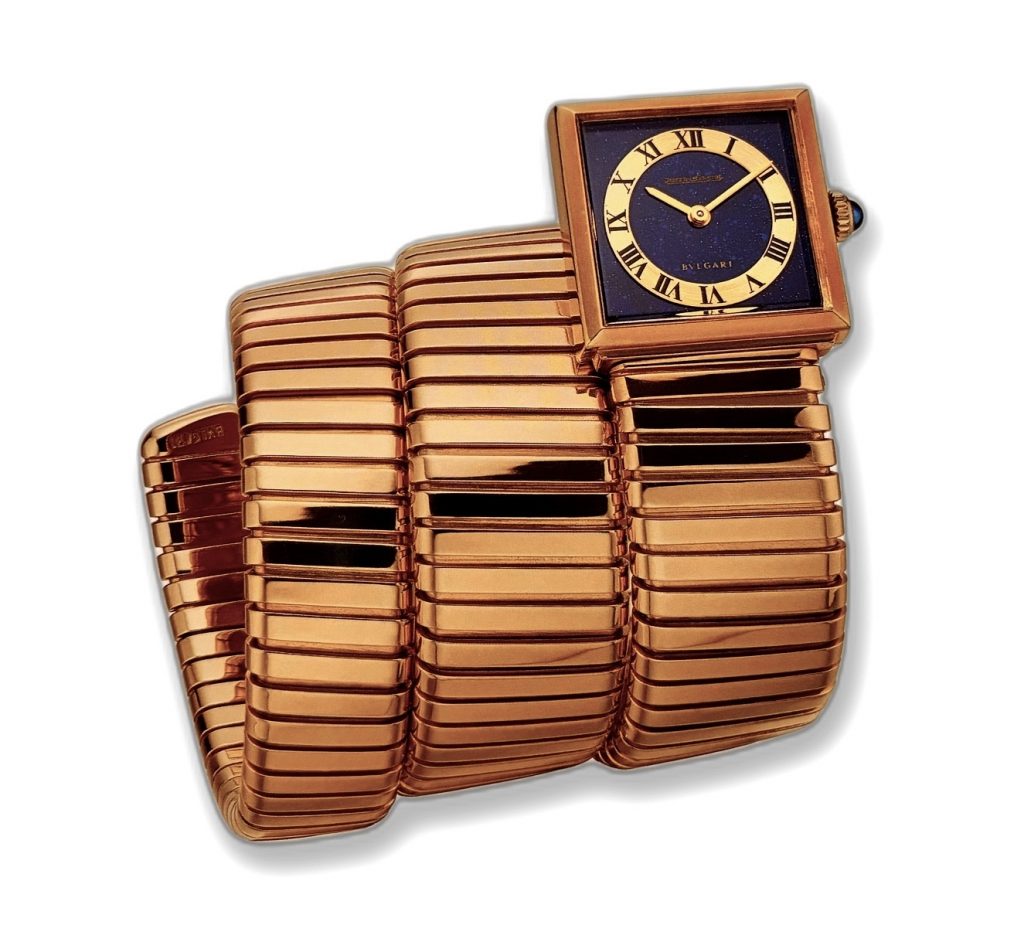
Serpenti Tubogas in yellow gold with full lapis lazuli dial, ca. 1971. BVLGARI Heritage Collection.The deep ultramarine lapis field framed by Roman numerals in gold represents the most opulent expression of Bulgari’sgemstone integration.
The 1980s and 1990s: Gold Dominance and New Forms
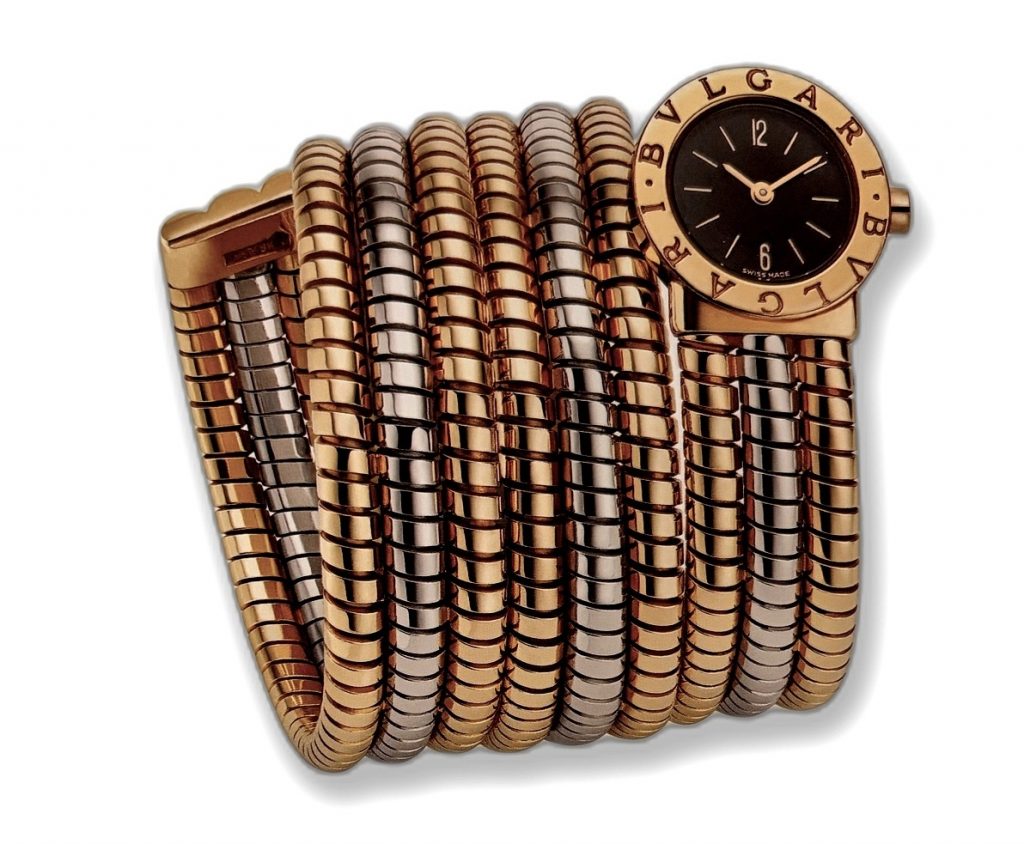
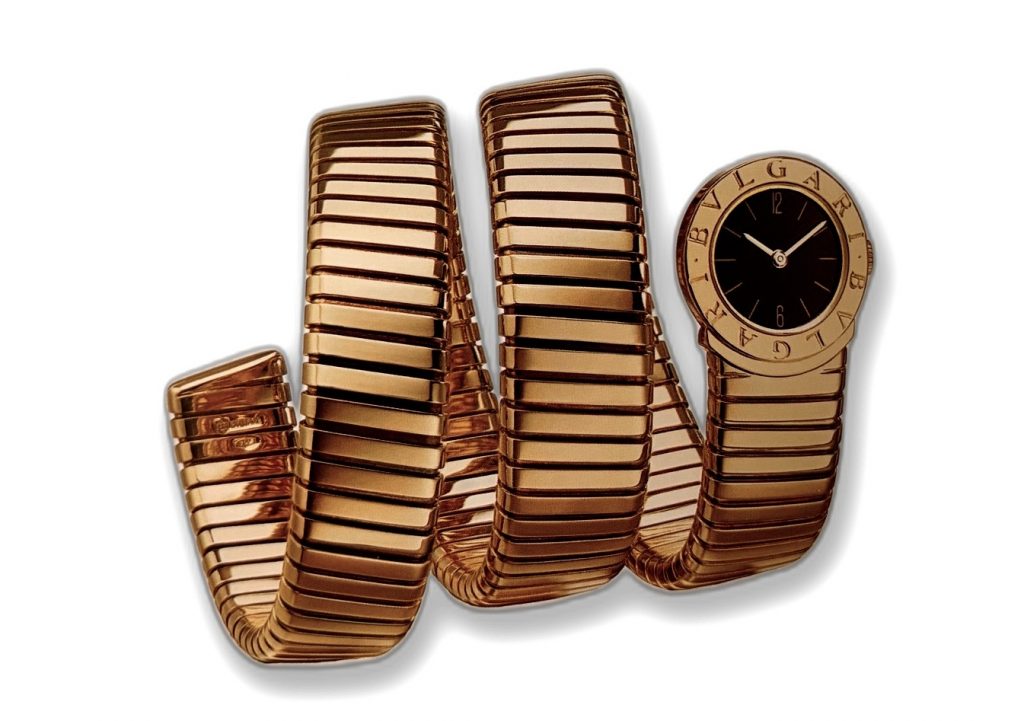
“BVLGARI BVLGARI” Serpenti Tubogas in two-colour gold, 1980. BVLGARI Heritage Collection.The extraordinary seven-turn spiral showcases the Tubogas technique at its most extravagant.
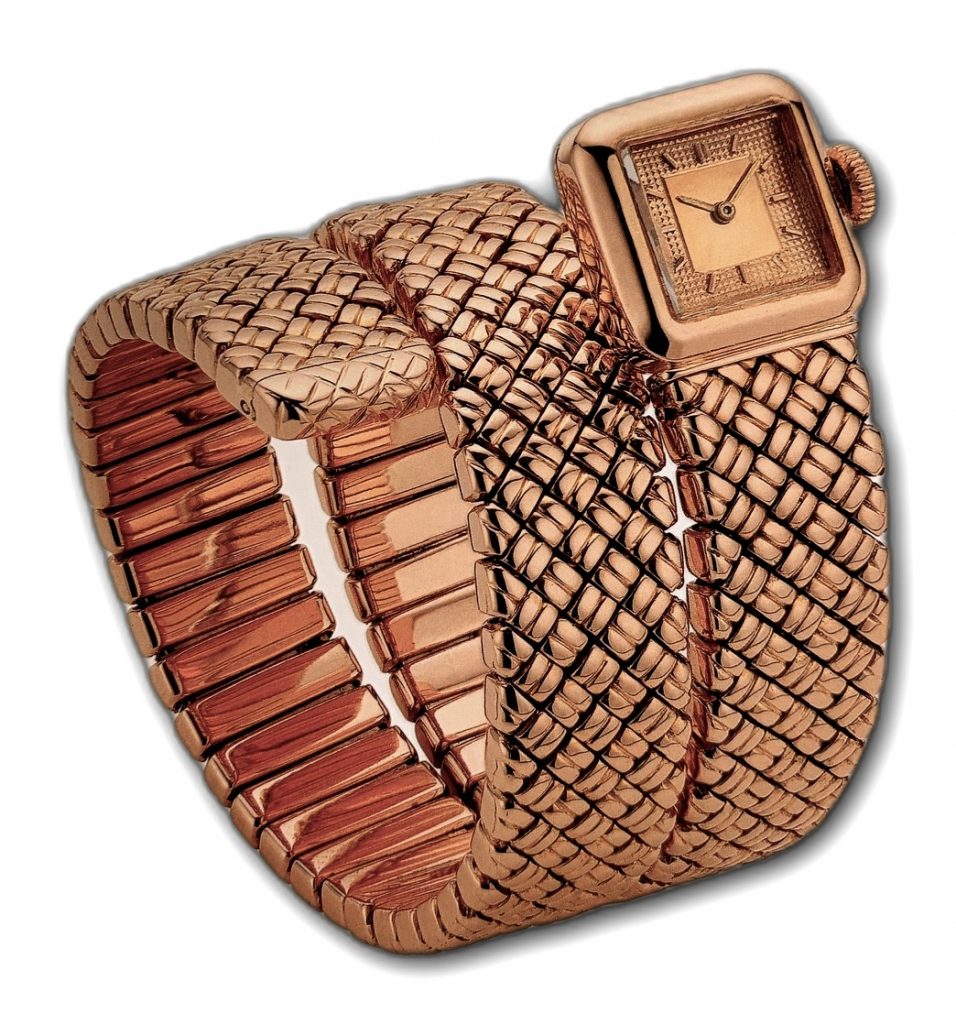
Yellow and white-gold renditions dominated the 1980s Serpenti lineup, reflecting the decade’s appetite for bold, unapologetic luxury. The 1990s brought fresh architectural thinking to the Serpenti collection, most notably with the introduction of square cases mounted on double-coiled bracelets.
Serpenti Tubogas in two-colour gold, ca. 1985. BVLGARI Heritage Collection.The round case with clean white dial represents the refined, more restrained direction of the mid-1980s Serpenti.
The 2010s and 2020s: Modern Renaissance and Technical Innovation
The 2010s represented a modern renaissance for the Serpenti, with the introduction of multiple new sub-collections like the Serpenti Incantati (2016), the Seduttori, and the Spiga.
The current decade has been defined by serious horological innovation. In 2022, Bulgari introduced the Piccolissimo (Caliber BVL 100) movement: just 12mm in diameter, 2.5mm thick, and weighing a mere 1.30 grams. In 2025, Bulgari unveiled the new Caliber BVS 100 Lady Solotempo — an automatic movement designed and assembled entirely in Bulgari’s Swiss manufacture.
Summary Tables
Table 1: Models by Era
Model
Year Introduced
Key Features
Materials
Original Serpenti
1948
Square dial, Tubogas coiled band
Gold
Serpenti Secret Watch
Mid-1950s
Hidden dial under cap
18k gold, diamonds, enamel
Elizabeth Taylor’s
1962
Cuff bracelet, concealed dial
Gold, diamonds, emeralds
1970s Tubogas Revival
Late 1960s
Two-tone metals, wearable design
Gold, stainless steel
Serpenti Seduttori
2010s
Hexagonal case inspired by scales
Steel, rose gold, yellow gold
Serpenti Spiga
2010s
Matelassé bracelet, ceramic
Steel, ceramic, rose gold
Serpenti Misteriosi
2022
Piccolissimo mechanical movement
White/rose gold, diamonds
Serpenti Aeterna
2025
Sculptural bangle design
18kt rose gold, diamonds
Serpenti Tubogas Studs
2026
Stud accents on Tubogas
Stainless steel, 18kt yellow gold
Table 2: Auctions Pricing Data
Model
Auction Price Range
Collectibility Rating
Serpenti Seduttori
$3,700 – $28,000
Moderate (entry-level)
Serpenti Tubogas
$5,200 – $57,000+
High (iconic design)
Serpenti Spiga
$7,550 – $57,000
Moderate
Serpenti Incantati
$36,900 – €39,300+
High (limited, high jewelry)
Serpenti Aeterna
Starting ~$82,000
High (new, limited)
Serpenti Secret/Misteriosi
$285,600 – $300,000+
Very High (GPHG winner)
Vintage 1960s Enamel
Auction: $1,107,038 (record)
Exceptional
Elizabeth Taylor’s Serpenti
Auction: $974,500 (2011)
Legendary (provenance)
Conclusion: The Serpent Endures
The Bulgari Serpenti is one of the longest-running, most iconic watch designs in history — over 75 years of continuous production, continuous evolution, and continuous cultural relevance. It uniquely bridges the worlds of high jewelry and serious watchmaking in a way that few other collections can claim.
For collectors and investors, the numbers speak clearly: 84% value retention, record-breaking auction results, and a trajectory of appreciation for vintage pieces that shows no signs of slowing. The serpent continues to shed its skin and be reborn — just as the Bulgari Serpenti collection reinvents itself decade after decade while remaining unmistakably, irresistibly itself.
Gallery: The Evolution of Forms
Serpenti bracelet watch in pink gold ,1957 private collection
Serpenti tubogas bracelet watch in gold with sapphire, 1959 private collection
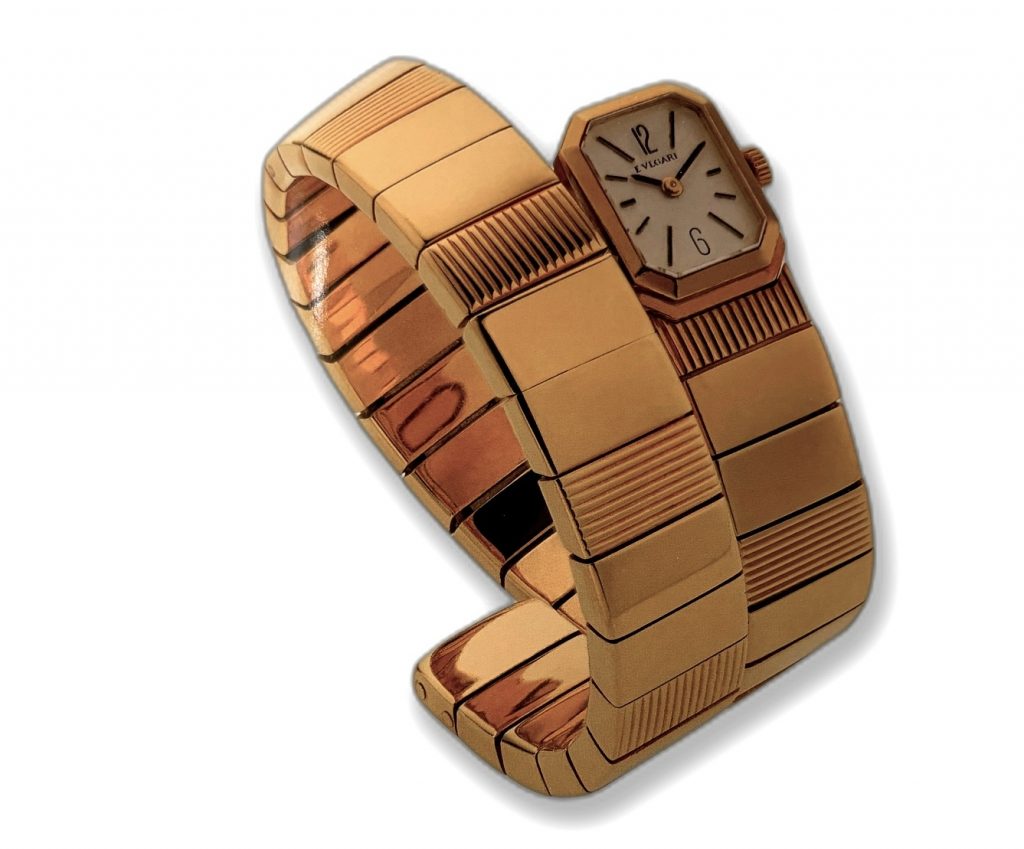
Serpenti bracelet-watch in yellow gold, ca. 1960. The octagonal case head is here paired with a clean white dial.
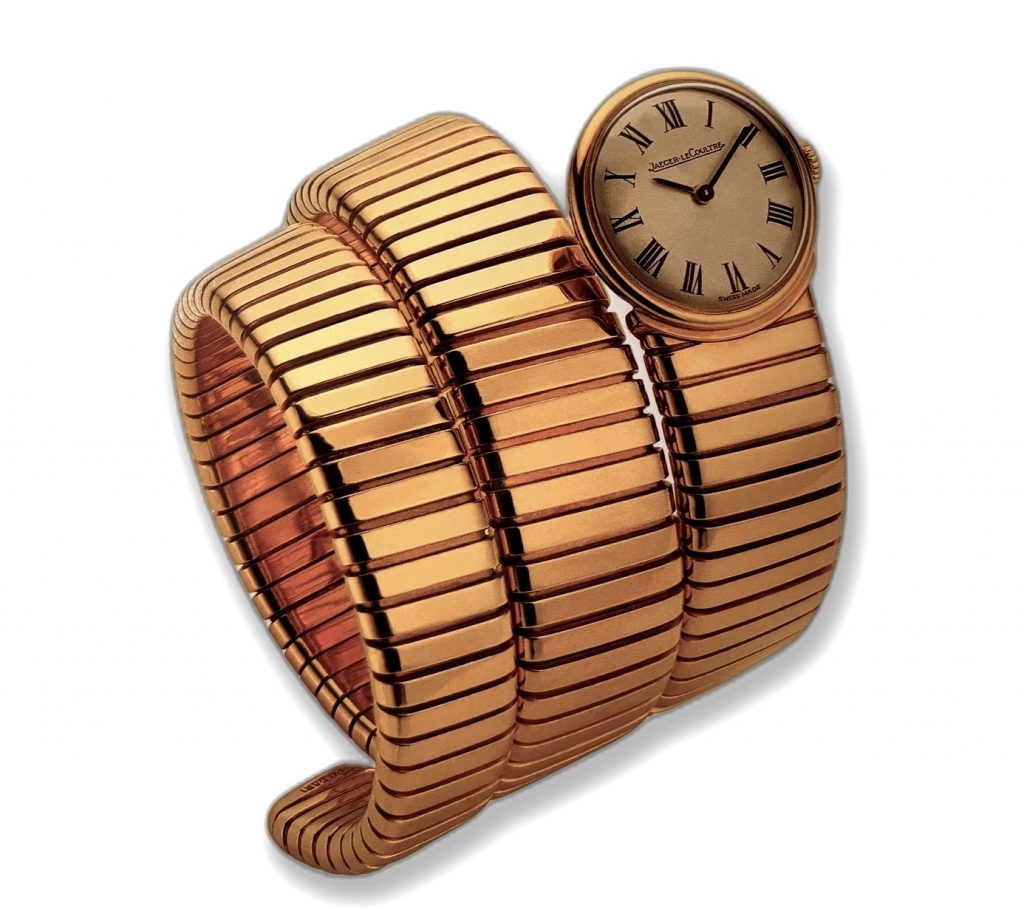
Serpenti Tubogas in yellow gold, ca. 1965. Movement by Jaeger-LeCoultre. The round case head epitomizes the opulent aesthetic of mid-1960s Bulgari.
Serpenti Tubogas in three-colour gold, ca. 1970. Movement by Vacheron & Constantin. The cushion-shaped case with black lacquer dial represents a modernist direction.
Serpenti Tubogas in yellow gold with lapis lazuli and sapphire, ca. 1971. The square case demonstrates Bulgari’s use of semi-precious stones.
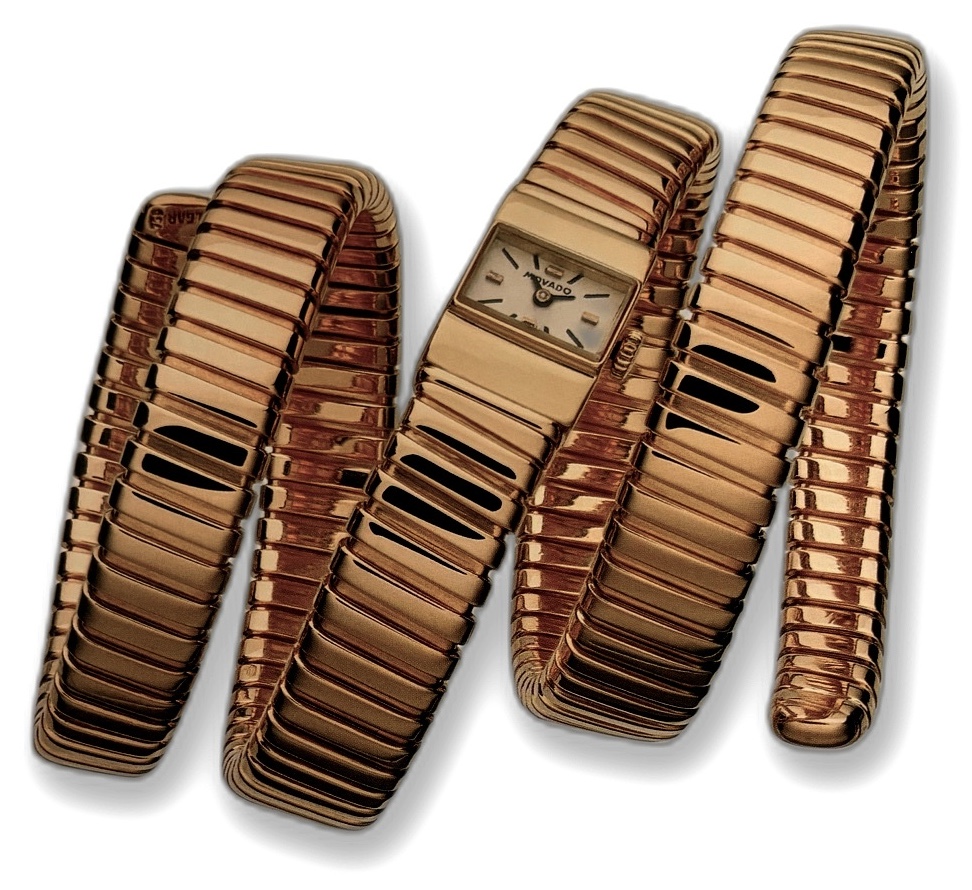
Serpenti Tubogas in yellow gold and burnished steel with Movado Museum dial, ca. 1972. An exceptional collaboration piece.
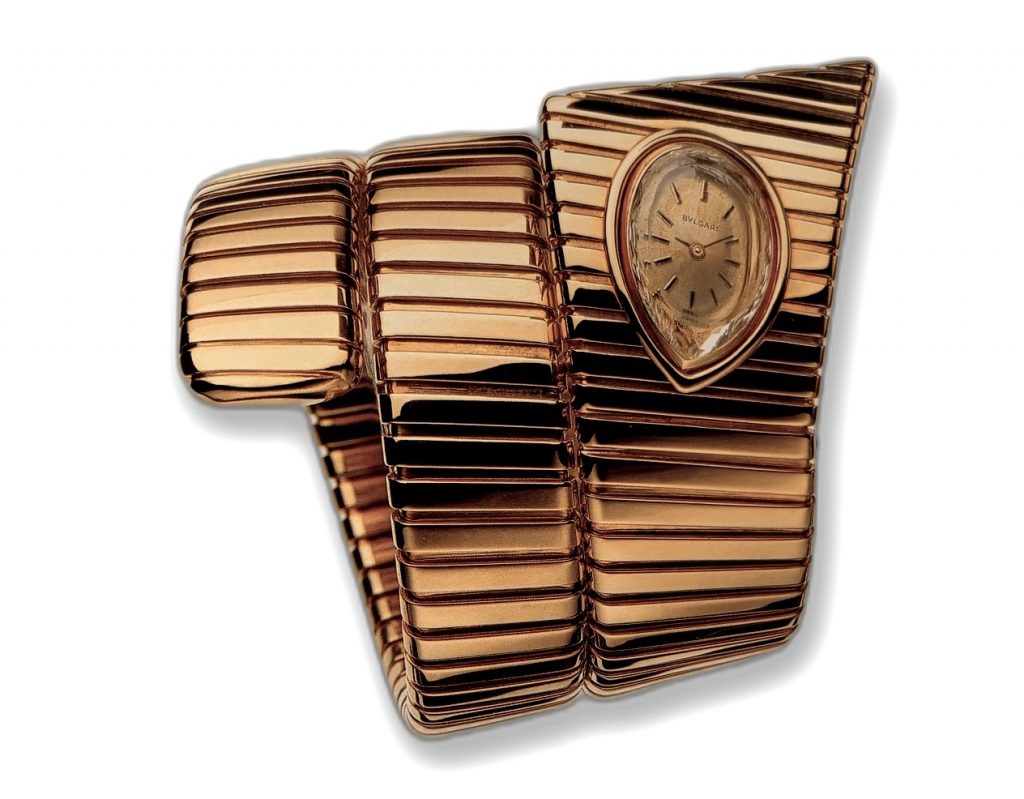
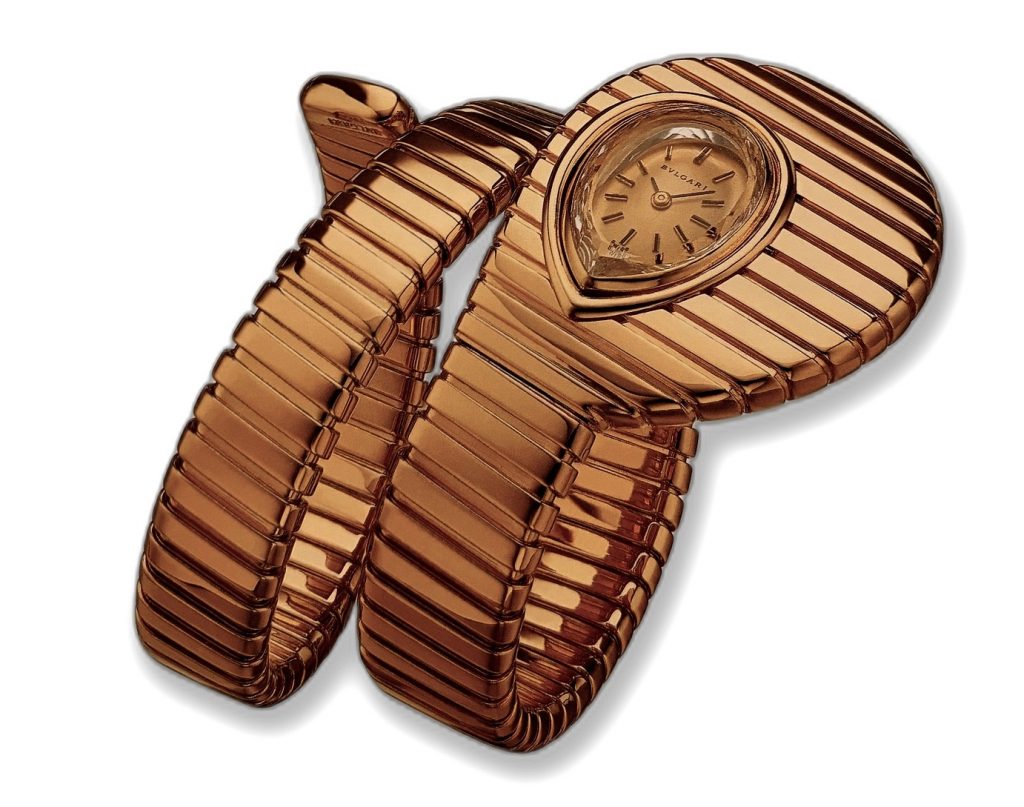
Serpenti Tubogas in yellow gold with pear-shaped case, ca. 1972. The teardrop-shaped case head illustrates Bulgari’s willingness to experiment.
Serpenti Tubogas in yellow gold, 1974. The wider, more voluminous Tubogas body reflects the decade’s taste for bold jewelry.
Serpenti bracelet-watch in yellow gold and burnished steel with woven “Intrecciato” link construction, ca. 1975.
“BVLGARI BVLGARI” Serpenti Tubogas in yellow gold, 1978. The introduction of the circular bezel marks a pivotal moment.
François Markowski and the Geneva Key Number 8 A Collector’s Guide to the Most Extravagant Case Maker in Swiss Horology There is a secret language hidden inside the case backs of vintage Swiss watches. For the uninitiated, a watch is defined by the name printed on its dial. But for the serious collector, the true […]
From “The Beast” to Modern Icon By Luca Musumeci | Vintage Watches Miami 1. Introduction: The Birth of a Giant When the Audemars Piguet Royal Oak Offshore reference 25721ST made its official debut at the 1993 Baselworld fair, it was met with a bewildered and unexpecting crowd. Designed by Emmanuel Gueit, a young designer tasked […]