Your cart is currently empty.
A collector’s deep dive into one of the rarest and most romantic time-only Rolex watches ever produced The exceedingly rare Rolex Oyster Perpetual “Galaxy” Ref. 6098 in 18k pink gold with honeycomb star dial, circa 1952–1953. In the vast and heavily studied universe of vintage Rolex, few configurations evoke as much romance, mystery, and pure […]


A collector’s deep dive into one of the rarest and most romantic time-only Rolex watches ever produced
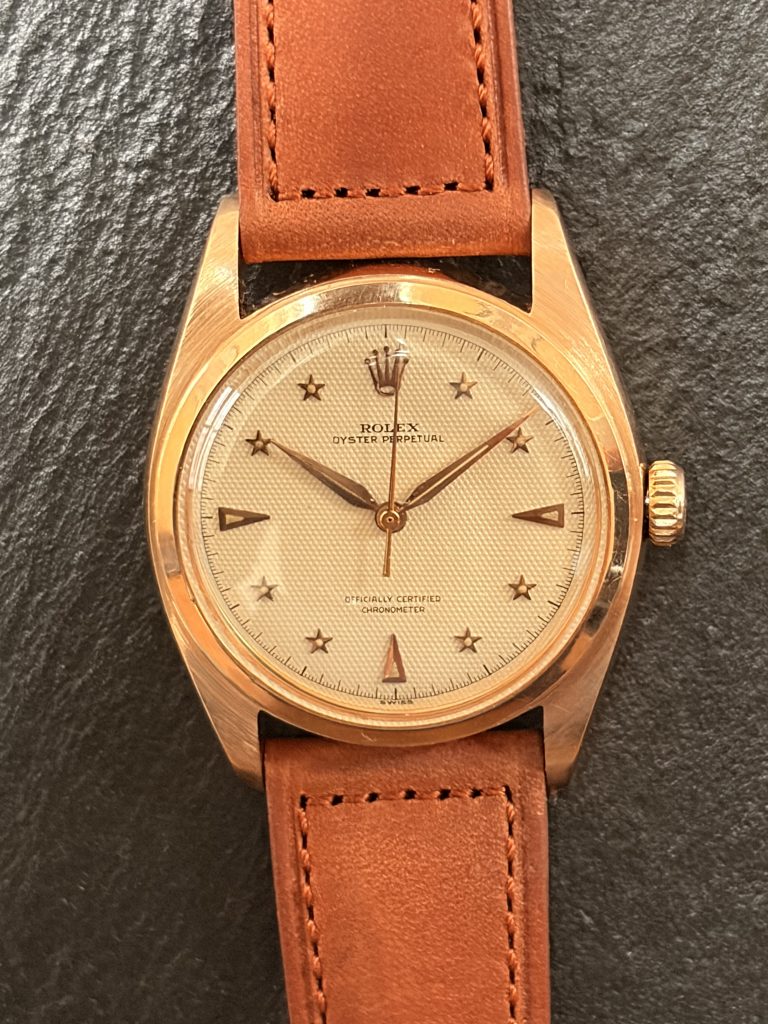
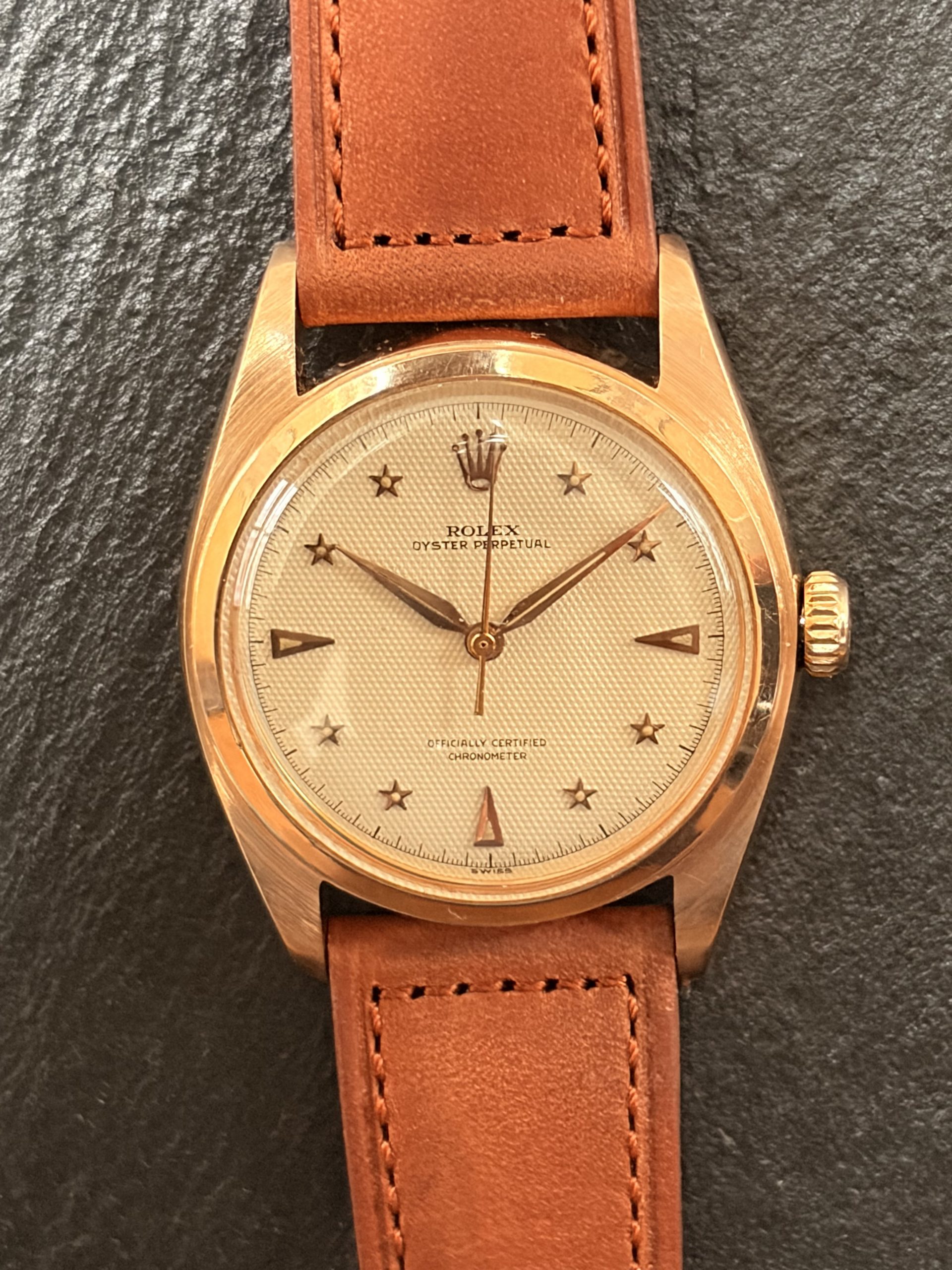
The exceedingly rare Rolex Oyster Perpetual “Galaxy” Ref. 6098 in 18k pink gold with honeycomb star dial, circa 1952–1953.
In the vast and heavily studied universe of vintage Rolex, few configurations evoke as much romance, mystery, and pure collector desire as the “Star Dials.” While the triple-calendar moon-phase Ref. 6062 “Stelline” often steals the spotlight, the true connoisseur’s choice lies in the time-only realm: the exceedingly rare Rolex Oyster Perpetual “Galaxy” Ref. 6098.
This is not merely a watch; it is a testament to a brief, playful era in Rolex’s history when the brand dared to dream beyond the utilitarian constraints of the Oyster case. Today, we explore the history, the extreme rarity, and the allure of the Ref. 6098 Galaxy — with a special focus on the almost mythical pink gold variant.
To understand the Galaxy, one must understand the era in which it was born. The early 1950s marked a period of post-war optimism and creative renaissance in watchmaking. Brands that had spent the 1940s producing strict, utilitarian military watches suddenly found themselves free to experiment with imaginative and audacious designs.
Rolex, typically known for its robust tool watches, embraced this newfound playfulness. The brand introduced dials adorned with applied gold stars for hour markers. The name “Galaxy” is not a modern collector’s invention; it was the official nomenclature used by Rolex in their 1950s marketing materials to describe these specific time-only star dial models.
The star dials were produced for a very short window, primarily between 1950 and 1953, with case numbers ranging tightly between 698,xxx and 947,xxx. The dials themselves were manufactured by the legendary dial maker Stern Frères — the same artisans responsible for the dials of the Patek Philippe 1518 and 2499. Each dial was stamped with a Stern Frères code: for example, “103·989 2”, where 103 is the Stern Frères code for Rolex, 989 refers to the dial type, and 2 indicates the second example of that particular dial produced.
“These watches are truly connoisseur’s watches. Many consider these the most sophisticated time-only Rolex watches ever made.”— e. w.
The Reference 6098 is a watch of significant proportions for its era. Collectors affectionately refer to it as the “Ovettone”(Italian for “large egg”) due to its substantial 36mm Oyster case and prominently domed case back — a design necessitated by the thickness of the automatic movement within.
The 36mm case was manufactured by Genex S.A., a renowned casemaker that was a subsidiary of Stern Frères. This is the exact same case design utilized for the legendary triple-calendar Ref. 6062, giving the 6098 a substantial, modern presence on the wrist that belies its 1950s origins. The case features a screw-down Oyster back — a hallmark of Rolex’s commitment to robustness even in their most decorative pieces.
The dial of the Galaxy is a masterpiece of mid-century texture. The matte silvered surface features a complex “honeycomb” guilloché pattern — a fine waffle-like texture that catches the light and creates an almost three-dimensional depth. This textured canvas serves as the perfect backdrop for the applied gold star indices and the faceted dagger numerals at 3, 6, and 9 o’clock. The Rolex crown appears at 12. The luminous material was applied directly to the center of each star, making the dial literally glow in low light.
Powering the 6098 is the Caliber A296 (or A260 super balance), a robust automatic perpetual movement. Because this movement was relatively thick, it necessitated the deeply domed “bubbleback” style case back.
Interestingly, several known examples of the 6098 Galaxy feature a highly unusual copper-colored gilt movement. Combined with a “double signed” interior caseback — bearing both the standard “Rolex Geneva Swiss Patented” stamp and a vertical “Montres Rolex S.A., Geneva, Swiss” engraving — scholars at Christie’s speculate that these specific watches may have been produced for special exhibition or demonstration purposes, perhaps for trade fairs or commercial presentations in the early 1950s.
| Specification | Detail |
|---|---|
| Reference | 6098 |
| Nicknames | “Galaxy” / “Stelline” / “Ovettone” |
| Production Period | circa 1950–1953 |
| Case Material | 18k Pink Gold (also yellow gold and stainless steel) |
| Case Diameter | 36 mm |
| Case Maker | Genex S.A. (subsidiary of Stern Frères) |
| Movement | Automatic — Caliber A296 / A260 super balance |
| Dial | Matte silvered honeycomb with applied gold star indices |
| Dial Maker | Stern Frères, Geneva |
| Crystal | Domed Plexiglass |
| Caseback | Screw-down, double-signed interior |
| Water Resistance | None |
| Serial Number Range | 698,xxx – 947,xxx |
When we discuss the rarity of the 6098 Galaxy, we are talking about numbers that rival the most elusive Patek Philippe complications. According to extensive research by Christie’s, Phillips, and leading independent scholars, the known public population of the Ref. 6098 with a silvered honeycomb star dial is astonishingly small.
| Configuration | Known Public Examples |
|---|---|
| Yellow Gold + Honeycomb Star Dial | 8 – 10 examples |
| Yellow Gold + Black Star Dial | 3 examples |
| Stainless Steel + Honeycomb Star Dial | 2 examples |
| Pink Gold + Honeycomb Star Dial | 1 example (the only one known) |
The following table represents every publicly documented Ref. 6098 Galaxy, compiled from Christie’s lot notes, Le Monde Edmond’s research, and the John Goldberger reference book 100 Superlative Rolex Watches:
| Case Number | Est. Year | Material | Dial | Public Record |
|---|---|---|---|---|
| 725’450 | 1950 | Stainless Steel | Honeycomb Star | Sotheby’s Hong Kong, 2008 |
| 727’060 | 1950 | Stainless Steel | Honeycomb Star | Christie’s, 2007 |
| 740’036 | 1950 | Yellow Gold | Honeycomb Star | Auction record |
| 911’992 | 1952/53 | Yellow Gold | Honeycomb Star | Auction record |
| 912’006 | 1952/53 | Yellow Gold | Honeycomb Star | Auction record |
| 912’015 | 1952/53 | Yellow Gold | Honeycomb Star | Private (Goldberger book) |
| 912’019 | 1952/53 | Yellow Gold | Honeycomb Star | Auction record |
| 912’107 | 1952/53 | Yellow Gold | Honeycomb Star | Auction record |
| 912’120 | 1952/53 | Yellow Gold | Honeycomb Star | Goldberger book |
| 919’039 | 1953 | Yellow Gold | Honeycomb Star | Christie’s, May 2023 — CHF 126,000 |
| 928’128 | 1953 | Yellow Gold | Honeycomb Star | Wind Vintage |
| 947’778 | 1953 | Yellow Gold | Honeycomb Star | Auction record |
| 947’830 | 1953 | Yellow Gold | Honeycomb Star | Christie’s, Dec 2024 — USD 100,800 |
| 947’848 | 1953 | Yellow Gold | Honeycomb Star | Private transaction |
| Unknown | 1952/53 | Pink Gold | Honeycomb Star | The only known example |
While yellow gold was the standard for luxury watches in the 1950s, pink gold was produced in vastly smaller quantities — often representing less than 10% of a reference’s total production. In the case of the 6098 Galaxy, Christie’s research is unambiguous:
“According to our research, including the present watch, only eight reference 6098 are known publicly with a yellow gold case and silvered ‘stelline’ type dial. Three examples are known in yellow gold with a black dial, three in steel with silvered dial and one example in pink gold.”— Christie’s, Lot Essay, Rare Watches, Geneva, 13 May 2023
This makes the pink gold 6098 Galaxy not just a rare watch, but a true “unicorn” in the vintage Rolex collecting sphere — a watch of which the entire known population consists of a single example.
The 6098 did not exist in isolation. It was part of a small family of time-only Rolex references that received the star dial treatment during the same brief production window.
| Reference | Case Size | Case Style | Movement | Known Star Dial Examples |
|---|---|---|---|---|
| 6024 | ~34mm | Flat Oyster | Manual wind | 2 (honeycomb only) |
| 6088 | 36mm | Oyster (Genex) | Automatic A296 | ~3 (incl. unique black dial) |
| 6098 | 36mm | Ovettone (Genex) | Automatic A296 | ~17 (all variants) |
| 6090 | 32.5mm | Bombé / “Bombay Lugs” | Auto A260 / cal. 645 | ~2 (in 14k and 18k gold) |
Of all the time-only star dial references, the 6098 is the most “collected” — in the sense that it has the largest known population and the most auction history. Yet even so, the total number of known examples across all configurations barely exceeds twenty. For context, a single year of production of a modern Rolex Datejust yields hundreds of thousands of examples.
The Rolex 6098 Galaxy represents the absolute pinnacle of time-only Rolex collecting. It combines the robust, wearable 36mm “Ovettone” case with one of the most romantic, delicate, and playful dials ever produced by Stern Frères. It is a watch that tells you the time — and nothing else — yet manages to be more desirable than almost any complicated watch from the same era.
For the collector who seeks the ultimate intersection of Rolex history, mid-century design, and extreme exclusivity, the Galaxy 6098 is the ultimate prize. It is a reminder that once upon a time, even the most serious watchmaker in the world took a moment to look up at the stars — and decided to put them on a dial.
Sources & Further Reading
[1] Le Monde Edmond — “Rolex: A closer look at star dials” (Edmond Saran, December 2018)
[2] vintage watches miami — “Rolex Stelline Star Dial Galaxy Reference 6098 in 18K Yellow Gold”
[3] WatchProSite — “Rolex 6098: Vintage Reference Guide” (September 2023)
[4] Christie’s — “Lot 34: Rolex Ref. 6098 ‘Galaxy'”, Rare Watches, Geneva, 13 May 2023
[5] Phillips — “Appreciating The History Of Rolex’s Rare, Vintage ‘Star’ Dials”
[6] Revolution Watch — “Rolex Explorer: Everything You Need to Know”