Your cart is currently empty.
From “The Beast” to Modern Icon By Luca Musumeci | Vintage Watches Miami 1. Introduction: The Birth of a Giant When the Audemars Piguet Royal Oak Offshore reference 25721ST made its official debut at the 1993 Baselworld fair, it was met with a bewildered and unexpecting crowd. Designed by Emmanuel Gueit, a young designer tasked […]



By Luca Musumeci | Vintage Watches Miami

When the Audemars Piguet Royal Oak Offshore reference 25721ST made its official debut at the 1993 Baselworld fair, it was met with a bewildered and unexpecting crowd. Designed by Emmanuel Gueit, a young designer tasked with injecting testosterone into the classic Royal Oak line, the watch was immediately dubbed “The Beast” due to its massive 42mm diameter and 16mm thickness — proportions that were virtually unheard of in the early 1990s.
The Offshore was originally conceived as an anniversary piece to celebrate 20 years of the original Royal Oak designed by Gérald Genta. However, the development took longer than expected, delaying its release to 1993. The watch was so controversial that even Genta himself reportedly expressed his dismay, claiming his original design had been “ruined.” Yet, history has proven Gueit right. The Offshore not only survived its initial criticism but went on to define the oversized luxury sports watch category, becoming a cornerstone of Audemars Piguet’s modern success.
For serious collectors, not all “Beasts” are created equal. The very first generation of the reference 25721ST holds a mythical status, particularly the first 500 pieces produced. Understanding the nuances of these early models is crucial for any collector looking to acquire a historically significant Offshore.
The most coveted of all Offshores are the first 100 pieces ever made. Audemars Piguet was initially so uncertain about the success of the “Offshore” name that they omitted it entirely from the caseback of these first 100 watches. They simply bear the “Royal Oak” engraving. Finding one of these “unmarked” early examples is akin to finding a holy grail in modern AP collecting.
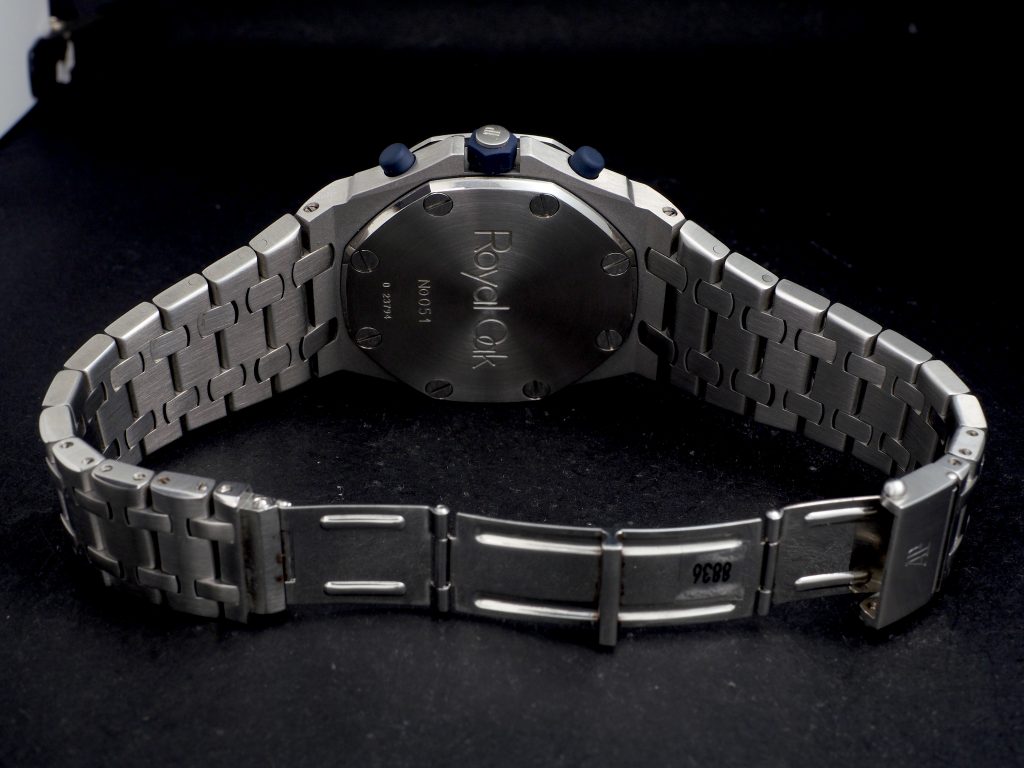
Another defining characteristic of the first 500 pieces is the bracelet clasp. These early models were fitted with a stainless steel bracelet featuring a double-folding clasp with a central piece that is thin and blade-like, completely different from the thicker, more robust clasps used in later iterations.
| Feature | First 100 Pieces | Pieces 101–500 | Post-500 Pieces |
|---|---|---|---|
| Caseback Engraving | “Royal Oak” only | “Royal Oak Offshore” | “Royal Oak Offshore” |
| Clasp Type | Thin blade-like clasp | Thin blade-like clasp | Standard thick folding clasp |
| Dial Color | Original Blue “Petite Tapisserie” | Original Blue “Petite Tapisserie” | Various |
The Offshore was not just a scaled-up Royal Oak; it was a testing ground for new materials and engineering solutions. To protect the movement from magnetic fields, Audemars Piguet housed the caliber inside an anti-magnetic soft iron inner case. Furthermore, the Offshore introduced Therban® — a high-performance elastomer — for the chronograph pushers and the crown. This use of visible rubber on a high-end luxury watch was revolutionary and paved the way for the widespread use of rubber and ceramic in haute horlogerie.
The movement powering these early Beasts was the caliber 2126/2840 (and later 2226/2840), an automatic chronograph movement based on a Jaeger-LeCoultre ébauche with a Dubois-Dépraz chronograph module.
[ Insert movement image of the Caliber 2126/2840 here ]
While the original 25721ST was crafted in stainless steel, Audemars Piguet soon realized the potential of the Offshore platform for experimentation with precious metals and exotic materials. This evolution is a critical aspect of the Offshore’s history, transforming it from a robust sports watch into a canvas for haute horlogerie.
In the late 1990s and early 2000s, Audemars Piguet began introducing the Offshore in various precious metals. The reference 25721 was produced in yellow gold (25721BA), rose gold (25721OR), and even platinum (25721PT). These models retained the massive proportions of the original Beast but added a level of opulence that appealed to a new demographic of collectors.
Among the precious metal variants, the reference 25721BC in solid white gold stands out as an exceptionally rare and desirable piece. White gold offers a stealthy luxury, appearing similar to steel at a glance but possessing a distinct heft and warmth. The production numbers for the 25721BC were incredibly low, making it a true collector’s item today. The contrast between the understated white gold case and the bold, aggressive design of the Offshore creates a fascinating dynamic that resonates with connoisseurs.

Today, the early D-series and E-series Royal Oak Offshore 25721ST models are experiencing a massive surge in collector interest. As the watch that single-handedly started the oversized watch trend, its historical importance cannot be overstated.
“I have always been attracted by this watch and its massive design and it inspires the feeling of adventure whenever I look at it… When I realised how rare some references were I decided to start this collection.” — Alfredo Paramico, renowned watch collector (via Phillips)
When considering the purchase of an early Royal Oak Offshore “The Beast,” several factors must be carefully evaluated to ensure authenticity and value.
The original dials of the early 25721ST models featured a “Petite Tapisserie” pattern, typically in a deep blue hue. Over time, these dials can develop a patina, sometimes fading to a lighter blue or even taking on a tropical, purplish tone. While patina can be desirable, it is crucial to ensure that the dial has not been refinished or replaced with a later “Méga Tapisserie” dial.
The octagonal bezel and the sharp angles of the case are defining characteristics of the Royal Oak design. Over-polishing can round off these edges, significantly diminishing the watch’s appeal and value. Look for examples with crisp, well-defined bevels and the original brushed finish on the flat surfaces.
As mentioned earlier, the bracelet clasp is a key identifier for the earliest models. Ensure that the clasp matches the production era of the watch. The bracelet itself should be tight, with minimal stretch, as replacing or repairing an integrated Royal Oak bracelet can be a costly endeavor.
Original box and papers add significant value to any vintage watch, and the early Offshore is no exception. Documentation that confirms the original sale date and serial number is highly desirable. For the ultra-rare “unmarked” first 100 pieces, provenance and expert authentication are absolutely essential.
At Vintage Watches Milano & Miami, we pride ourselves on sourcing the most significant and rare timepieces. We currently have exceptional examples of the Royal Oak Offshore available for the discerning collector:
Discover our complete Audemars Piguet collection →
Sources & Further Reading:
[1] Phillips — A Guide: The Audemars Piguet Royal Oak Offshore
[2] Monochrome Watches — The History of the Royal Oak Offshore
[3] WatchProSite — Insider: Explaining the AP Royal Oak Offshore Reference 25721ST ‘The Beast’