Your cart is currently empty.
Historical and Technical Analysis of the Platinum Breguet Reference 3617 The history of the Breguet Reference 3617 represents one of the most fascinating and complex chapters in modern horology, standing as the connecting point between the end of the Brown family’s artisanal management and the global industrial rise under the aegis of Investcorp and, subsequently, […]
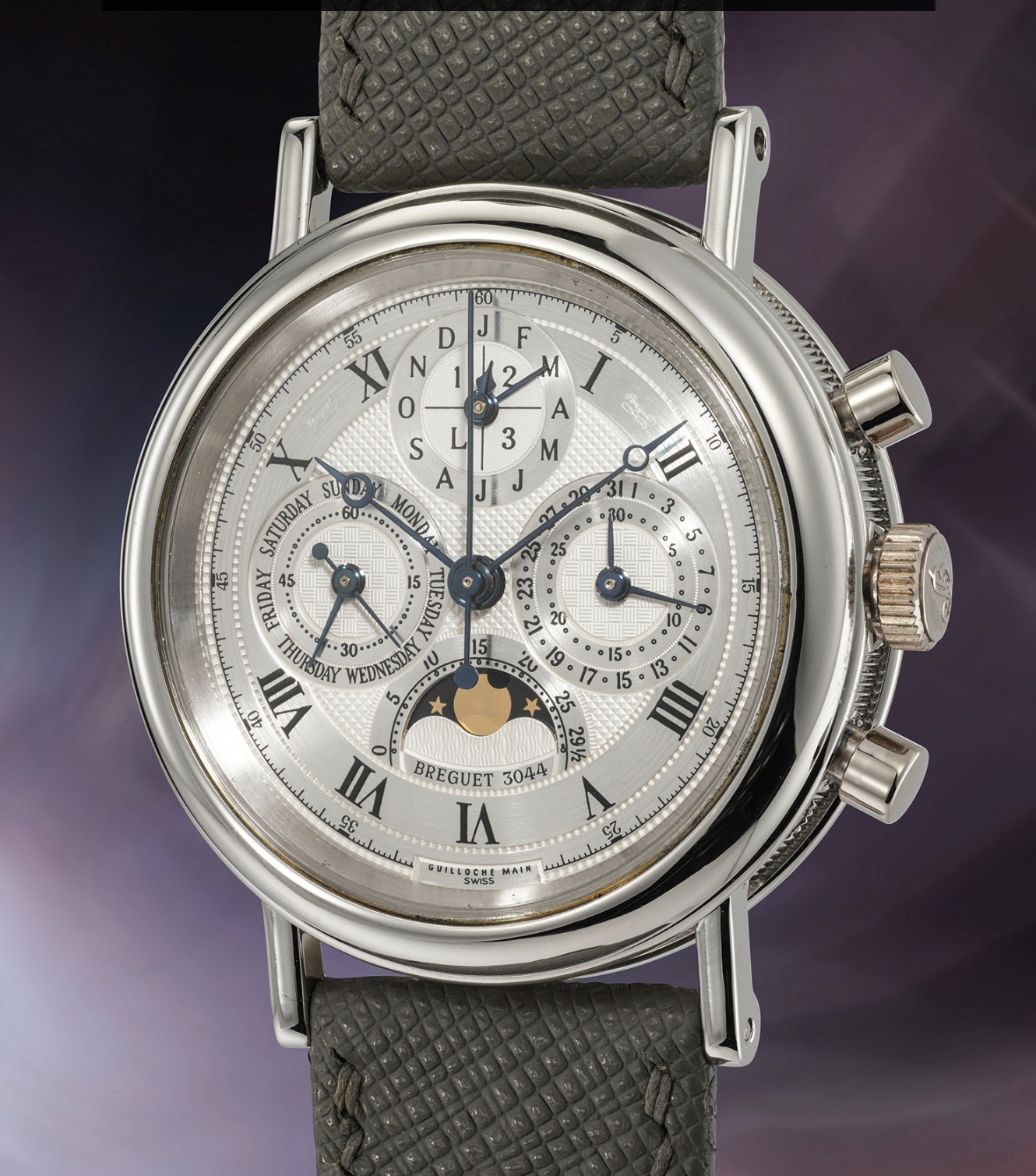


The history of the Breguet Reference 3617 represents one of the most fascinating and complex chapters in modern horology, standing as the connecting point between the end of the Brown family’s artisanal management and the global industrial rise under the aegis of Investcorp and, subsequently, the Swatch Group. This timepiece is not simply a high-level complication, but embodies the philosophy of “Neo-Vintage,” a period in which Daniel Roth’s technical mastery met the resources of a large financial group to bring the name of Abraham-Louis Breguet back to the top of the world’s horological pyramid.
To fully understand the birth of reference 3617, it is necessary to analyze Breguet’s turbulent corporate path in the 20th century. After being led for a century by the Brown family (1870-1970), the manufacture passed into the hands of the Chaumet brothers, owners of the eponymous Parisian high jewelry maison. The Chaumets had the intuition to restore the brand’s prestige and, in 1975, hired a young and talented master watchmaker: Daniel Roth. Roth spent years studying the historical pieces preserved in the Place Vendôme museum and in the manufacture’s archives, with the aim of translating the aesthetic canons of the 18th century — originally conceived for pocket watches — into the proportions of a contemporary wristwatch.
In 1987, due to the Chaumet brothers’ financial difficulties, Breguet was acquired by Investcorp, an investment fund based in Bahrain. Under the new ownership, the manufacture experienced unprecedented expansion, increasing sales approximately tenfold in a decade. In 1991, Investcorp founded the “Groupe Horloger Breguet” (GHB) and in 1992 took a fundamental step: the acquisition of Nouvelle Lemania. This move allowed Breguet to have total control over the production of its own movements, transforming Lemania into the group’s true internal manufacture.
Reference 3617 was born right at the beginning of the 1990s, in this climate of industrial and technical fervor. It represents the evolution of the perpetual calendar chronograph concept, one of the noblest and most difficult combinations to achieve in mechanical horology. If reference 3050 had been one of the first automatic perpetual calendars of the Roth era, the 3617 elevated the complication by introducing the manual-winding chronograph based on the Lemania architecture, creating a direct link with the tradition of the great pocket watch complications.
| Year | Key Event | Impact on Production |
|---|---|---|
| 1970 | Acquisition by Chaumet | Beginning of the aesthetic recovery of A.L. Breguet’s historical codes. |
| 1975 | Hiring of Daniel Roth | Definition of Breguet’s “modern” style: coin-edge, guilloché, pomme hands. |
| 1987 | Acquisition by Investcorp | Financial strengthening and opening to new global markets. |
| 1991 | Creation of Groupe Horloger Breguet | Structuring of a holding company dedicated to luxury horology. |
| 1992 | Acquisition of Nouvelle Lemania | Vertical integration of complicated caliber production. |
| 1999 | Acquisition by Swatch Group | Definitive consolidation under the leadership of Nicolas Hayek. |
The beating heart of the Breguet 3617 is the caliber 533 QP, a movement that represents one of the absolute pinnacles of mechanical chronometry. This engine is based on the legendary Lemania 2310, a movement architecture so refined that it has been adopted by the most prestigious Swiss houses. It is the same base caliber that powers the Patek Philippe 3970 and 5070, as well as some of the most celebrated references from Vacheron Constantin and Roger Dubuis.
The caliber 533 QP is a manual-winding chronograph with function sorting via a column wheel, integrated with a perpetual calendar module developed in collaboration with Dubois Depraz. Its architecture is characterized by impeccable manual finishing, with bridges decorated with “côtes de Genève,” deep and polished anglage, and the use of a balance spring with a Breguet overcoil, which guarantees superior isochronism.
The movement beats at a frequency of 18,000 vibrations per hour (2.5 Hz), a choice that recalls the tradition of classical horology and allows one to admire the slow and majestic movement of the oversized balance wheel. It features 21 jewels and is adjusted in five positions to ensure maximum chronometric precision in various conditions of use.
The dial of reference 3617 organizes the numerous pieces of information in a surprisingly legible manner, following a cross layout derived from large pocket watches. The functions are distributed as follows:
One of the crucial aspects for the expert collector is the ability to distinguish reference 3617 from reference 3610 (which preceded it) and from reference 5617 (which followed it starting from the late 1990s). Although the general aesthetic appearance may seem similar, there are subtle constructive differences that define their era and collectible value.
Reference 3610, introduced in the very early 1990s, was originally conceived with a solid case back. Reference 3617 introduced the transparent sapphire crystal case back, finally allowing one to admire the finishes of the caliber 533 QP, a detail that quickly became essential for haute horlogerie enthusiasts. However, the case back of the 3617 is a “snap-back,” while subsequent models would introduce more complex closure systems.
Around 1998, Breguet launched reference 5617, making several incremental modifications that reflect the more advanced industrialization under the Swatch Group. Among these, the winding crown stands out: in the 3617 the crown is flat and unbranded, faithful to Daniel Roth’s minimalist style, while in the 5617 the crown is thicker and features the embossed “B” logo. Furthermore, the moon phase disc in the 5617 often features a human face (“moon face”), while in the 3617 the moon is typically represented in a smooth and abstract manner.
| Characteristic | Reference 3617 | Reference 5617 |
|---|---|---|
| Case Back | Transparent, snap-back. | Transparent, often secured with 7 screws. |
| Crown | Flat, unbranded. | Thick, with embossed “B” logo. |
| Moon Phases | Smooth moon, no-face. | Anthropomorphic moon, moon-face. |
| Case Diameter | 38 mm (extended to 40 mm in rare PT). | 38 mm. |
| Guillochage | Dominant vertical orientation in moon phases. | Horizontal orientation in moon phases. |
Reference 3617 is not only a triumph of mechanics but also of decorative craftsmanship. The dial is made of solid silvered gold and entirely hand-decorated with various types of guillochage (“guilloché main”), a technique that consists of engraving geometric patterns using manual lathes. This is not a purely ornamental choice: Breguet used different patterns to visually delimit the watch’s functions without having to add heavy demarcation lines.
The dial of the 3617 features a masterful combination of motifs:
The case features the famous fluted “carrure” (coin-edge), which requires extremely precise mechanical machining and subsequent hand finishing to achieve the typical texture similar to the edge of a coin. The lugs, straight and thin, are manually soldered to the case and equipped with screw bars, a detail that testifies to the manufacture’s attention to robustness and build quality, representing the absolute pinnacle of technical production.
Provenance from a key figure in the brand’s history acts as a value multiplier. A watch that has passed through the hands of someone who actively contributed to Breguet’s rebirth in a fundamental market like Italy carries with it a narrative that transcends the physical object. This makes the piece not only a technical rarity but a historical document of the “resurrection” of mechanical haute horlogerie post-quartz crisis.
Although reference 3617 was produced in yellow, white, and rose gold, the platinum version remains the most coveted and difficult to find. Platinum is an extremely difficult metal to work with; due to its density and toughness, it requires specific tools and much longer processing times compared to gold. This difficulty is reflected in an extremely limited production: it is estimated that the total number of chrono-perpetual reference examples (3610, 3617, 5617) produced between 1992 and 2002 does not exceed 300-400 pieces in total, of which only a tiny fraction are in platinum.
Wearing a platinum Breguet 3617 represents the essence of “stealth wealth” (discreet wealth). Unlike gold, platinum has a deep white luster that can be confused with steel by an untrained eye, but its considerable specific weight conveys to the owner a feeling of unparalleled substance and value.
Reference 3617 occupies a unique position in modern horology for several reasons that go beyond simple rarity:
Analysis of auction data and private transactions indicates that examples of reference 3617 in platinum tend to maintain or increase their value over time, especially when they present excellent preservation conditions (“unpolished” or with intact factory finishes). The presence of an archive extract confirming the manufacturing date and any special order is a fundamental element to consolidate the watch’s status as an investment piece.
In conclusion, the platinum Breguet Reference 3617 is not just a luxury watch, but a historical pillar that documents the return of one of the world’s oldest manufactures to the glories of the past. Its genesis during the Investcorp era, its architecture based on the Lemania 2310 caliber, and its refined aesthetics place it at the pinnacle of modern collecting.
Reference 3617 represents the opportunity to own a piece of mechanical history where manual craftsmanship had not yet been supplanted by mass production, and where every engraving on the dial and every chamfer on the movement’s bridges tell the story of an unprecedented horological rebirth.
Regardless of market fluctuations, Reference 3617 will remain a benchmark for anyone seeking the perfect union between Abraham-Louis Breguet’s 18th-century tradition and the technical excellence of the late 20th century.
As a testament to the importance of this reference, the specific example pictured in the photograph is of particular historical interest, as it originally belonged to Giovanni Sutti, owner of one of the most significant luxury watch distribution companies in Italy and, among other prestigious brands, a distributor of Breguet. Subsequently, this very same example passed into the hands of Alfredo Paramico, one of the most influential collectors and market-makers on a global scale. Paramico, a former investment banker and creator of the Precious Time Fund, is celebrated for having owned some of the rarest watches in the world — including a steel Patek Philippe reference 1518. His well-known predilection for Breguet watches from the neo-vintage era (often referred to as “Pre-A” or early 1990s pieces) has contributed enormously to reigniting international interest in these references. The fact that a collector of his caliber chose the 3617 stands as definitive testimony to the absolute historical and technical relevance of this model.