Your cart is currently empty.
The Ultimate Collector’s Buying Guide: From the 1956 Origins to the Ref. 118206 A comprehensive guide for the collector who demands the very best of the best Collector’s Foreword By Luca Musumeci There are watches that tell time, and watches that tell a story. The Rolex Day-Date has been telling both since 1956, gracing the […]
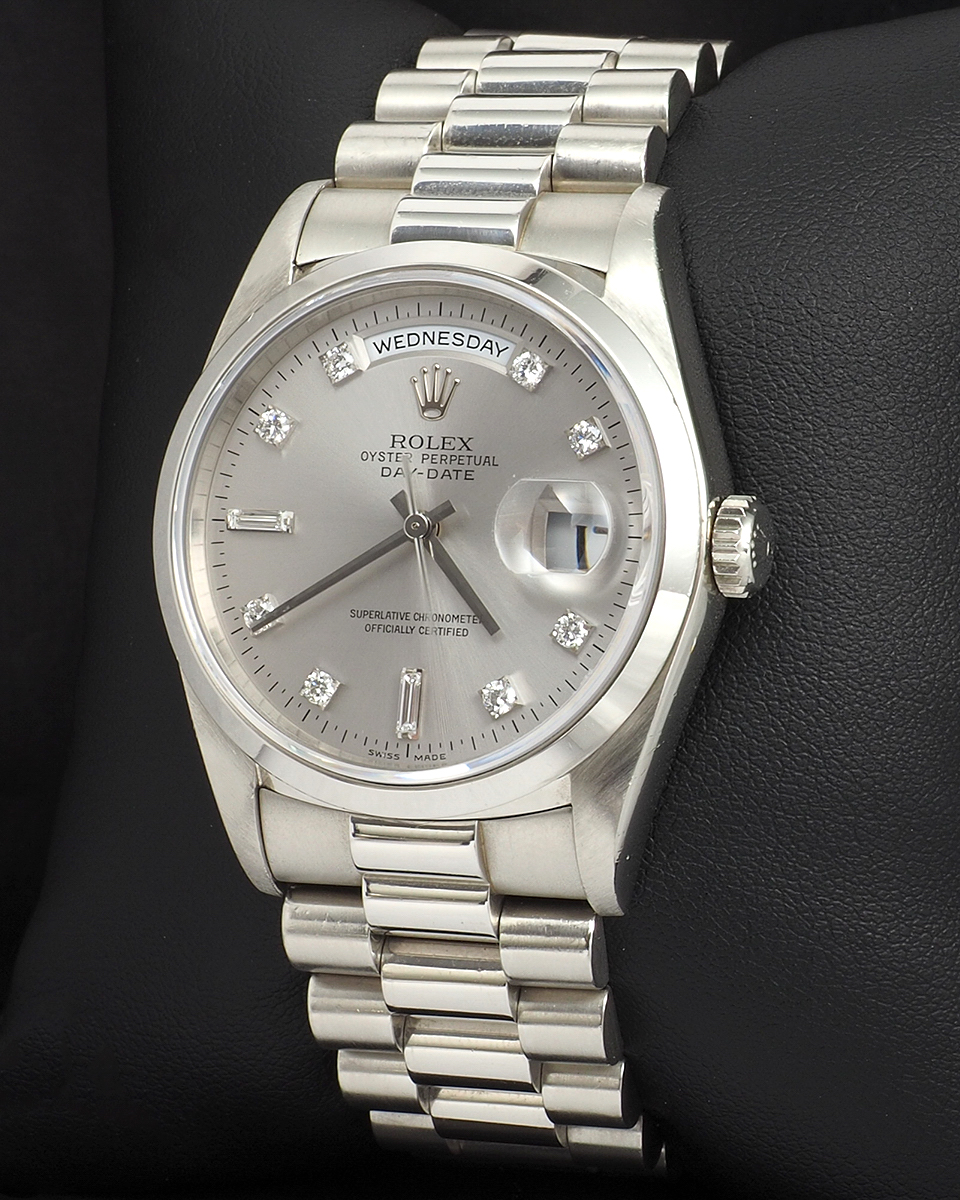


The Ultimate Collector’s Buying Guide: From the 1956 Origins to the Ref. 118206
A comprehensive guide for the collector who demands the very best of the best
Collector’s Foreword By Luca Musumeci
There are watches that tell time, and watches that tell a story. The Rolex Day-Date has been telling both since 1956, gracing the wrists of presidents, kings, and visionaries who understood that the right watch communicates far more than words ever could. Yet within the already rarefied world of the Day-Date — a watch available exclusively in precious metals — there exists a tier so exclusive that even seasoned collectors pause at its sight: the Day-Date in 950 platinum.
This guide is written for the collector who wants to understand not just what a platinum Day-Date is, but why it occupies the absolute apex of the Rolex hierarchy. From the extraordinarily rare first examples of 1956 to the refined reference 118206 that carried the torch into the new millennium, we trace the complete lineage of the platinum President, examining the technical evolution, the manufacturing challenges, the historical pricing, and the key differences between each generation.
1. The Platinum Challenge: Why This Metal Defines the Pinnacle
To appreciate the significance of a platinum Day-Date, one must first understand the material that makes it exceptional. Rolex employs 950 platinum — an alloy of 95% pure platinum and 5% ruthenium — a composition that yields a metal of extraordinary density, permanence, and visual distinction. Unlike gold, which is alloyed down to 75% purity (18 karats) and mixed with copper, silver, or palladium, platinum is used in a state of near-purity. This makes it denser, heavier, and far more demanding to work with.
The manufacturing challenges of platinum are well-documented in metallurgical literature. A diamond cutting tool that can polish thousands of gold cases to a perfect mirror finish will often wear out after polishing fewer than ten platinum cases before the surface quality deteriorates to an unacceptable level]. The fundamental problem is that platinum, despite being ductile and workable in many respects, causes severe and rapid tool wear during machining. As one industry technical paper notes:
“It takes three times longer to produce a platinum case than one in gold, as slower tool speeds and lower pressures have to be applied to platinum to minimise friction and tool wear.”
Even the slightest contamination during the manufacturing process can cause craters, fissures, or an “orange-peel” effect on the case surface . This means that producing a platinum Day-Date requires not only more time but also a higher level of artisanal skill at every stage of production. Rolex’s master craftsmen must work with heightened precision, using specialized tooling that is replaced far more frequently than in gold production.
The result of all this effort is a watch that weighs approximately 20% to 25% more than its 18-karat gold equivalent — a constant, tactile reminder of the extraordinary metal on the wrist. Platinum is also approximately thirty times rarer than gold in the Earth’s crust, and global annual production of platinum is a fraction of gold production. This inherent scarcity, combined with the manufacturing difficulty, ensures that Rolex produces platinum Day-Dates in significantly smaller quantities than gold versions, preserving the model’s status at the very summit of the catalog.
2. The Signature of Platinum: The Ice Blue Dial
Before tracing the chronological evolution of the platinum Day-Date, it is essential to understand its most iconic visual signature: the Ice Blue dial, also referred to as the “Glacier Blue” dial. This distinctive, cool-toned dial — a pale, luminous blue reminiscent of glacial ice — is exclusive to platinum Day-Dates . It does not appear on yellow gold, rose gold, or white gold versions of the watch.
This exclusivity is deliberate. Rolex uses the Ice Blue dial as a visual declaration of the metal beneath: a signal to those who know that the watch on the wrist is not merely gold, but platinum. The color is achieved through a careful manufacturing process and has become so synonymous with the platinum Day-Date that many collectors consider it inseparable from the model’s identity. When you see an Ice Blue dial on a Day-Date, you are looking at platinum.
3. The Early Platinum Day-Dates: 1956–1977
The Genesis: References 6510 and 6511 (1956–1957)
The Day-Date made its debut on January 27, 1956, at the Geneva Salon. It was the world’s first wristwatch to display both the date and the day of the week spelled out in full in a dedicated aperture at 12 o’clock . From its very first day in the catalog, Rolex offered the Day-Date in precious metals only: yellow gold, rose gold, white gold, and platinum . This was not a later addition — platinum was part of the original vision.
Reference 6510 featured a smooth bezel, while reference 6511 wore a fluted bezel. Both were powered by the outsourced Caliber 1035, which unfortunately suffered from technical issues with the date-advance mechanism . As a result, both references were produced for only one year. The total production across all metals was extremely limited, and the platinum variants are among the rarest Day-Dates in existence. Estimated platinum production for both references combined is likely fewer than 50 pieces worldwide.
The First Refinement: Reference 6611 (1957–1959)
To resolve the mechanical shortcomings, Rolex introduced reference 6611 in 1957, powered by the improved Caliber 1055 [2]. This movement, with 25 jewels and a beat rate of 18,000 vibrations per hour, earned the watch the designation “Superlative Chronometer Officially Certified” — a phrase that remains on Rolex dials to this day . The Alpha hands replaced the earlier Dauphine style, and the characteristic “pie-pan” dial — with its sloped, downward-angled edge — became a defining feature of the era.
The platinum version of the 6611 is another exceptional rarity. Produced for only two years, estimated platinum production is fewer than 100 pieces. These early platinum Day-Dates are the ultimate prize for vintage Rolex collectors, combining historical importance with extreme scarcity.
The Classic Era: The 1800 Series (1959–1977)
Around 1959, Rolex launched the 1800 series, which would become the quintessential vintage Day-Date. The reference 1803 — in yellow gold with a fluted bezel — is the most recognized and commonly encountered vintage Day-Date, having been produced for nearly two decades . However, the platinum variants within this series are a different matter entirely.
In the 1800 series, the platinum Day-Date was typically identified by reference 1802 (smooth bezel) or reference 1804 (diamond-set bezel) . These watches retained the acrylic crystal and the pie-pan dial, and were powered by the Caliber 1555 — the first fully in-house Day-Date movement, featuring a free-sprung Micro-Stella balance . In the mid-1960s, the Caliber 1556 was introduced with a slightly higher beat rate of 19,800 vibrations per hour, and in 1972 a hacking feature was added to allow for more precise time-setting.
The 1800 series ran for approximately 17 years, and total Day-Date production across all metals during this period is estimated between 500,000 and 700,000 units. The platinum fraction is estimated at approximately 2% to 3%, suggesting a total of roughly 10,000 to 20,000 platinum pieces produced over the entire run. While this sounds significant in absolute terms, it must be understood in context: spread across nearly two decades and distributed globally, these watches are far rarer in the market than the numbers suggest. A platinum 1802 or 1804 commands a substantial premium at auction over its gold counterparts.
4. The Modern Platinum Day-Date: 1977–2000
The Single Quickset Generation: Reference 18026 (1977–1988)
In 1977, Rolex introduced the five-digit Day-Date series, marking a significant modernization of the model. The platinum reference for this generation was the 18026, featuring the smooth bezel that would become the traditional signature of the platinum Day-Date . The companion references in other metals — such as the 18038 in yellow gold with a fluted bezel, or the 18039 in white gold — are frequently confused with the platinum model by less experienced buyers. The 18026 is the platinum reference; the 18039 is white gold.
This generation brought two major improvements. First, the acrylic crystal was replaced by a scratch-resistant sapphire crystal — a change that Rolex implemented on the Day-Date earlier than on any other model, reflecting the watch’s status as the brand’s flagship . Second, the “pie-pan” dial was replaced by a flat dial surface, creating a larger, more legible appearance. Hidden beneath the caseback was the new Caliber 3055, operating at 28,800 vibrations per hour and introducing the “single quickset” feature. For the first time, the wearer could advance the date independently by pulling the crown to the second position, without having to rotate the hands past midnight. However, setting the day of the week still required the laborious process of advancing the hands.
During its 11-year production run, the 18026 remained extremely rare. The total 180xx series production across all metals is estimated at approximately 200,000 units, with the platinum 18026 accounting for an estimated 2,000 to 4,000 pieces — roughly 1% to 2% of total production.
The Double Quickset and the Ice Blue Signature: Reference 18206 (1988–2000)
The introduction of the reference 18206 in 1988 represents a watershed moment in the history of the platinum Day-Date. This model is the one that most collectors consider the definitive expression of the classic platinum President, and for good reason: it combines the most important mechanical upgrade in the model’s history with the full establishment of the Ice Blue dial as the platinum Day-Date’s exclusive visual identity.
The mechanical upgrade was the Caliber 3155, which introduced the “double quickset” function — the ability to set both the date and the day of the week independently from the central timekeeping hands [4]. This seemingly simple feature transformed the daily usability of the watch. For a collector who does not wear the Day-Date every day, the ability to quickly correct both calendar displays without spinning the hands through multiple days is an enormous practical improvement.
Aesthetically, the 18206 era is when the Ice Blue dial became firmly established as the platinum Day-Date’s signature . While earlier platinum models had been available with various dial options, the 18206 era saw the Glacier Blue dial become the default and most desirable choice. The combination of the cool, silvery-white platinum case, the smooth polished bezel, and the pale blue dial creates a visual harmony that is impossible to replicate in gold. It is understated, sophisticated, and immediately recognizable to those who know.
The 18206 was produced from 1988 to 2000, a 12-year run. Total 182xx series production is estimated at approximately 150,000 units across all metals, with the platinum 18206 accounting for an estimated 1,500 to 3,000 pieces.
5. The Turn of the Millennium: Reference 118206 (2000–2009)
The year 2000 brought the six-digit 118xxx series, and with it the reference 118206 — the platinum Day-Date that carried the model into the new millennium. From a movement perspective, the 118206 retained the proven Caliber 3155, ensuring continuity of the double quickset function and the 48-hour power reserve.
The most significant changes were structural. The President bracelet underwent a fundamental transformation: the hollow center links of previous generations were replaced with solid platinum links. This was a major upgrade in both quality and value. The hollow links of earlier models were prone to stretching over time, particularly given the weight of platinum, and a stretched bracelet is both aesthetically displeasing and expensive to restore. The solid links of the 118206 bracelet are far more durable and add considerable weight to the overall watch, making it feel even more substantial on the wrist.
Additional refinements included a redesigned case with broader, high-polished lugs, an improved Crownclasp for better security, and the addition of an engraved “ROLEX ROLEX ROLEX” inscription on the rehaut (the inner bezel ring), along with the watch’s unique serial number [2]. This last feature was introduced across the 118xxx series as an anti-counterfeiting measure and serves as a useful authentication point for collectors.
The 118206 was produced until approximately 2009, when it was succeeded by the 218206 (the 41mm Day-Date II). Estimated production of the 118206 is in the low thousands, maintaining the tradition of extreme exclusivity that defines the platinum Day-Date lineage.
6. Platinum vs. Gold: A Collector’s Comparison
Understanding the differences between a platinum Day-Date and its gold counterparts is essential for any serious collector. The distinctions go far beyond the material itself.
| Feature | Platinum Day-Date | 18kt Gold Day-Date |
| Metal Purity | 950‰ (95% pure) | 750‰ (75% pure) |
| Density | ~21.45 g/cm³ | ~15.5 g/cm³ |
| Weight on Wrist | Noticeably heavier | Lighter |
| Signature Dial | Ice Blue (exclusive) | Various (not Ice Blue) |
| Traditional Bezel | Smooth (polished) | Fluted (standard) |
| Production Numbers | ~1–2% of total Day-Date output | ~90%+ of total output |
| Manufacturing Time | ~3x longer than gold | Standard |
| Historical Price Premium | ~80–100% over gold | Baseline |
| Visual Tone | Cool, silvery-white | Warm (yellow/rose) or rhodium-plated (white) |
The smooth bezel of the platinum Day-Date deserves special mention. While gold Day-Dates have traditionally been offered with the fluted bezel as the standard configuration, the platinum version has historically worn a smooth, polished bezel. This design choice is deeply intentional: the smooth bezel is the more understated option, allowing the platinum to speak for itself without the visual “noise” of the fluting. It is the choice of those who know, rather than those who wish to show. As one collector succinctly noted, the platinum Day-Date with a smooth bezel is “a discrete and private pleasure” [6].
7. Historical Pricing: The Cost of the Pinnacle
The platinum Day-Date has always commanded a substantial premium over its gold counterparts. The following table provides approximate historical retail prices, illustrating the consistent premium that platinum has commanded throughout the model’s history.
| Era | Platinum Reference | Gold Reference | Approx. Platinum Retail | Approx. Gold Retail | Premium |
| 1980s | 18026 | 18038 (YG) | ~$12,000–$15,000 | ~$6,000–$8,000 | ~90–100% |
| Early 1990s | 18206 | 18238 (YG) | ~$15,000–$18,000 | ~$8,000–$10,000 | ~80% |
| Late 1990s | 18206 | 18238 (YG) | ~$17,000–$20,000 | ~$9,000–$11,000 | ~80% |
| c. 2000 | 118206 | 118238 (YG) | ~$22,000–$25,000 | ~$12,000–$14,000 | ~75–80% |
Note: All prices are approximate historical retail estimates. Actual prices varied by market, authorized dealer, and specific dial/bezel configuration. Sources: Crown & Caliber, Chrono24 historical data, collector community records.
The premium reflects three compounding factors: the intrinsic value of the raw material, the dramatically higher manufacturing cost due to the difficulty of machining platinum, and the deliberate scarcity of production. Rolex has never sought to maximize platinum Day-Date output; rather, the brand has consistently maintained the model’s position as the ultimate expression of the Day-Date concept.
8. Estimated Production Numbers by Platinum Reference
The following estimates are based on available historical data, collector community records, and proportional analysis of known total Day-Date production figures. They should be understood as informed approximations rather than confirmed figures, as Rolex does not publish production data.
| Reference | Production Years | Estimated Total DD Production | Estimated Platinum Fraction | Estimated Platinum Pieces |
| 6510 / 6511 | 1956–1957 | ~500–1,000 (all metals) | Very small | < 50 pieces |
| 6611 | 1957–1959 | ~2,000–5,000 (all metals) | Very small | < 100 pieces |
| 1802 / 1804 | 1959–1977 | ~500,000–700,000 (all metals) | ~2–3% | ~10,000–20,000 pieces |
| 18026 | 1977–1988 | ~200,000 (all metals) | ~1–2% | ~2,000–4,000 pieces |
| 18206 | 1988–2000 | ~150,000 (all metals) | ~1–2% | ~1,500–3,000 pieces |
| 118206 | 2000–2009 | ~100,000 (all metals) | ~1–2% | ~1,000–2,000 pieces |
Note: These are estimates based on available research and collector community data. Rolex does not publish official production figures.
9. The Caliber Evolution: The Engine Behind the Crown
The mechanical heart of the Day-Date evolved significantly over the decades covered by this guide. Understanding the caliber history is essential for dating and evaluating any platinum Day-Date.
| Caliber | Approximate Period | Key Features |
| 1035 | 1956 | Outsourced; date advance issues |
| 1055 | 1957–1959 | 25 jewels, 18,000 vph; first “Superlative Chronometer” |
| 1555 | 1959–mid 1960s | First fully in-house; free-sprung Micro-Stella balance |
| 1556 | Mid 1960s–1977 | 19,800 vph; 26 jewels; hacking added in 1972 |
| 3055 | 1977–1988 | 28,800 vph; single quickset date; sapphire crystal era |
| 3155 | 1988–2015 | Double quickset (day + date); 31 jewels; 48h power reserve |
10. Collector’s Buying Guide: What to Look For
10.1 Authentication: Platinum or White Gold?
The most common mistake among less experienced buyers is confusing a platinum Day-Date with a white gold model. The key identifiers are as follows. The reference number is the most reliable indicator: platinum references end in -06(e.g., 18026, 18206, 118206), while white gold references end in -39 (e.g., 18039, 18239, 118239). The dial is also a strong indicator: the Ice Blue dial appears exclusively on platinum models. Finally, weight is a practical test: a platinum Day-Date will feel noticeably heavier than a white gold equivalent of the same size.
10.2 The Dial: Condition is Everything
The Ice Blue dial is the soul of the platinum Day-Date, and its condition is paramount. Inspect for any fading, discoloration, or moisture damage around the day and date apertures. Original factory dials in excellent condition are significantly more valuable than refinished examples. Any signs of unauthorized polishing or repainting will substantially reduce the watch’s collector value.
10.3 The Case: Preserving the Geometry
Platinum is a soft metal in the sense that it scratches relatively easily, but unlike gold, it does not lose material when scratched — the metal displaces rather than removes. This means that a platinum case can be polished back to a near-original condition more successfully than gold. However, excessive or improper polishing by non-specialist watchmakers can round the edges and destroy the precise geometry of the case. Always prefer a watch with original, sharp case geometry, even if it shows honest wear, over one that has been improperly “restored.”
10.4 The Bracelet: Hollow vs. Solid Links
For references prior to the 118206, the President bracelet featured hollow center links. Inspect these carefully for stretching, as a stretched bracelet is a significant defect. For the 118206 and later, the solid links are far more durable. A complete, original bracelet in good condition is essential for maximum collector value.
10.5 Documentation and Service History
As with all vintage and pre-owned Rolex watches, the presence of original box, papers, and service history significantly enhances value. For a platinum Day-Date, a documented service history from an authorized Rolex service center is particularly important, as it confirms the authenticity of all components and ensures the movement has been maintained to factory standards.
11. Why the Platinum Day-Date Remains the Ultimate Rolex
The platinum Day-Date occupies a unique position in the world of luxury watches. It is not merely the most expensive version of an iconic watch; it is the embodiment of a philosophy. Rolex has always positioned the Day-Date as the watch for those who have achieved the highest levels of success. The platinum version takes this concept to its logical conclusion: it is the Day-Date for those who demand not just the best, but the absolute best.
The manufacturing difficulty, the raw material scarcity, the exclusive Ice Blue dial, the traditional smooth bezel, the weight on the wrist — all of these elements combine to create a watch that is simultaneously the most understated and the most significant in the Rolex catalog. It does not shout. It does not need to. Those who know, know.
For the collector, the platinum Day-Date offers something increasingly rare in the modern watch market: a watch that is both historically significant and genuinely scarce. The early references — the 6511, the 6611, the 1802 — are true artifacts of watchmaking history, produced in tiny numbers and surviving in even smaller quantities. The later references — the 18026, the 18206, the 118206 — offer the combination of historical significance, mechanical excellence, and the visual perfection of the Ice Blue dial. Each generation tells a chapter of the same story: the story of the watch that sits at the very top of the world’s most recognized luxury watch brand.
Summary Technical Specifications: Platinum Day-Date References
| Parameter | Ref. 6510/6511 | Ref. 6611 | Ref. 1802/1804 | Ref. 18026 | Ref. 18206 | Ref. 118206 |
| Years | 1956–57 | 1957–59 | 1959–77 | 1977–88 | 1988–2000 | 2000–09 |
| Case | 36mm Pt | 36mm Pt | 36mm Pt | 36mm Pt | 36mm Pt | 36mm Pt |
| Caliber | 1035 | 1055 | 1555/1556 | 3055 | 3155 | 3155 |
| Crystal | Acrylic | Acrylic | Acrylic | Sapphire | Sapphire | Sapphire |
| Dial | Various | Various | Various | Various | Ice Blue | Ice Blue |
| Bezel | Smooth/Fluted | Smooth/Fluted | Smooth/Diamond | Smooth | Smooth | Smooth |
| Quickset | None | None | None | Date only | Day + Date | Day + Date |
| Bracelet | Hollow | Hollow | Hollow | Hollow | Hollow | Solid |
| Est. Platinum Prod. | < 50 | < 100 | 10,000–20,000 | 2,000–4,000 | 1,500–3,000 | 1,000–2,000 |
Guide written for informational and collecting purposes. Production numbers are estimates based on available research and collector community data. Rolex does not publish official production figures. Historical prices are approximate and should not be used as a basis for purchasing decisions.