Your cart is currently empty.
Audemars Piguet Bamboo: An Exhaustive Investigation into Organic Iconography and Technical Innovation in 1980s Haute Horlogerie 1. Introduction: The Geopolitical and Horological Landscape of the Post-Quartz Era The history of Audemars Piguet in the last quarter of the 20th century is often reduced to a single hegemonic narrative: the launch of the Royal Oak in […]
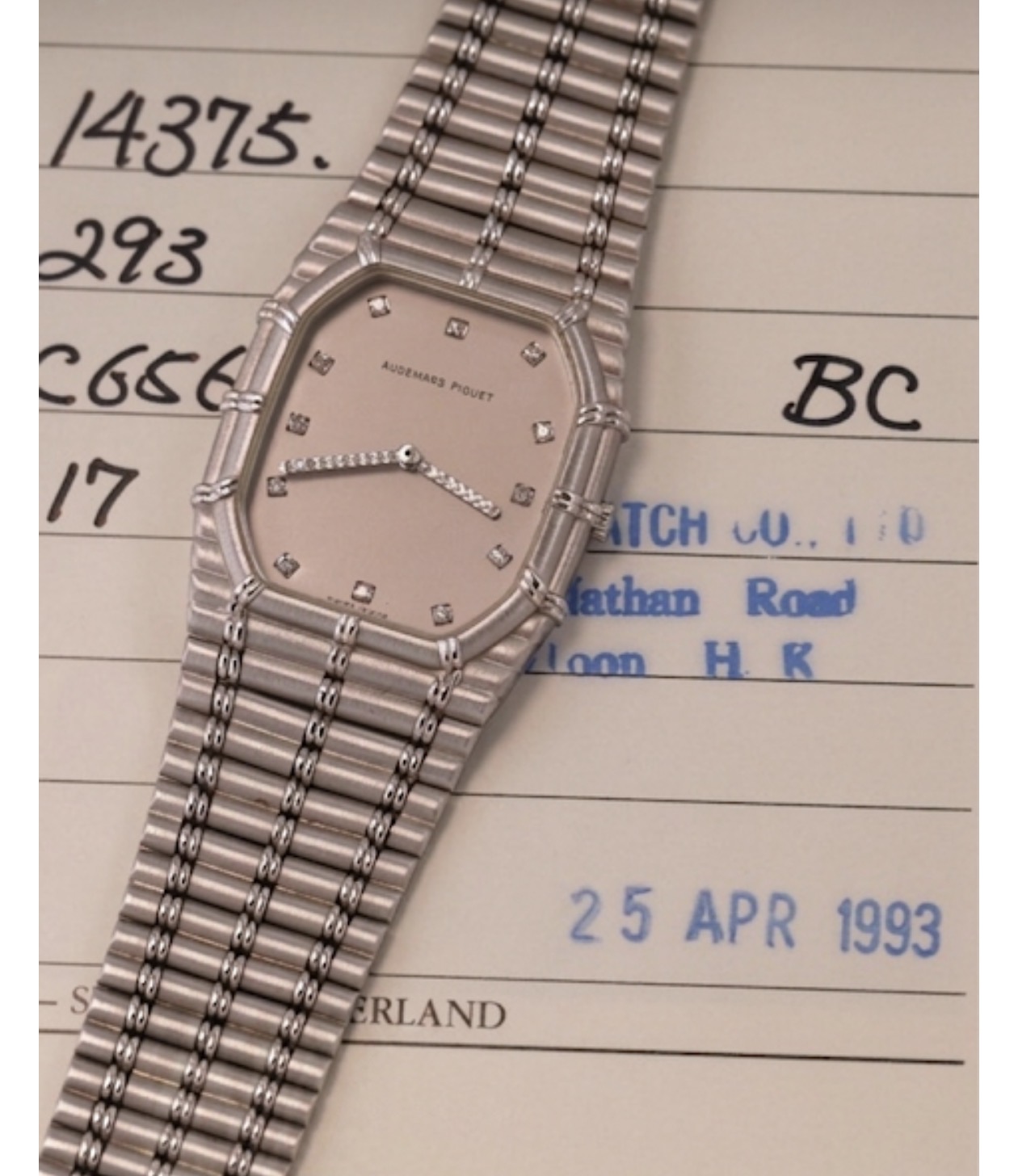


The history of Audemars Piguet in the last quarter of the 20th century is often reduced to a single hegemonic narrative: the launch of the Royal Oak in 1972 and the subsequent birth of the luxury steel sports watch concept. However, this tunnel vision risks obscuring a chapter that is equally crucial, if not more representative of the zeitgeist, known as the manufacture of Le Brassus’ “Classique” era. It is in this context, characterized by radical formal and material experimentation, that the Audemars Piguet Bamboo collection was born and thrived.
Introduced in the late 1970s and consolidated as a catalog pillar throughout the 1980s until the late 1990s , the Bamboo line does not represent a simple styling exercise, but a complex strategic response to the Quartz Crisis. At a time when the Swiss watchmaking industry saw its exports decimated by the precision and affordability of Japanese technology, Audemars Piguet chose not the path of conservatism, but that of creative audacity. The Bamboo collection embodies this philosophy: watches that were primarily jewelry, sculptural bracelets in solid gold that “happened” to tell time, inverting the traditional functional hierarchy of watchmaking.
This monographic report aims to dissect the history, technique, and aesthetics of the Bamboo model. Through the analysis of archival documents, period catalogs, and contemporary auction results, we will explore how this timepiece, designed under the direction of the visionary Jacqueline Dimier, became not only an icon of 1980s “Power Dressing,” but also the vehicle for fundamental technical innovations, including Audemars Piguet’s first historic foray into the use of technical ceramic.
To understand the genesis of the Bamboo, it is imperative to analyze the economic climate of the 1980s. After the inflationary turmoil of the 1970s, the following decade saw a return to ostentatious opulence. Yellow gold, overshadowed by the industrial steel of the previous decade, made a powerful comeback as a primary status symbol. In this scenario, the “Holy Trinity” manufactures (Audemars Piguet, Patek Philippe, Vacheron Constantin) had to reinvent themselves.
Audemars Piguet, in particular, adopted a two-pronged strategy: on the one hand, the Royal Oak for the sporty-chic market, and on the other, the “Classique” and shaped lines for international high society clientele, from the Middle East to the United States. The Bamboo was conceived to compete directly with giants of integrated design like the Piaget Polo and the Cartier Panthère, while offering a level of manual finishing and construction complexity typical of the Vallée de Joux.
While the Royal Oak (1972) and the Cobra (Ref. 5403, early 1970s) bear the indelible signature of Gérald Genta, characterized by aggressive lines and industrial or reptilian geometries, the Bamboo marks the transition to a softer, more naturalistic aesthetic. This shift is attributed to the creative direction of Jacqueline Dimier, a pivotal figure in Audemars Piguet’s history, often celebrated for her ability to interpret and “feminize” the brand’s robust language, adapting it even to the male audience with a new sensibility.
Dimier took the helm of the design department at a time when the dividing line between haute horlogerie and haute joaillerie was thinning. Her vision for the Bamboo was not to create a watch with an attached bracelet, but a continuous organic object, where case and bracelet were indistinguishable. The inspiration, as the name suggests, derived from the bamboo plant, a symbol of “lightness and flexibility” in Eastern cultures, but also evocative of that “tropical paradise” that represented the lifestyle aspiration of the era’s elite.
The hallmark of the design is the structure of the links. Unlike the flat, angular links of the Royal Oak, or the woven Milanese mesh of the Cobra, the Bamboo features cylindrical links, modeled to resemble the stalks (culms) of the plant. These solid gold cylindrical sections are interspersed with thinner connecting rings, simulating the nodes of the bamboo.
This visual rhythm does not stop at the junction with the case. The bezel itself is crafted to appear as a natural extension of the bracelet wrapping around the dial. It is segmented at the hour markers, creating a visual continuity that transforms the watch into a continuous cuff. However, despite its monolithic appearance, the construction required extreme flexibility to ensure comfort on the wrist, a significant engineering challenge for the goldsmiths of Le Brassus.
Period brochures describe an extraordinarily complex finishing process, necessary to give the gold that organic and silky shine typical of the Bamboo. The polishing process involved three distinct stages, rarely mentioned in modern industrial production:
This level of attention to detail explains why the Bamboo was positioned in an extremely high price bracket, often surpassing steel sports models.
The most critical structural element of the Bamboo is its integrated bracelet. In the 1980s, the ability to produce gold bracelets that were both solid and flexible was the true testing ground for a luxury manufacture.
Unlike modern bracelets, designed with removable links via exposed screws for easy adjustment, the early Bamboo bracelets (particularly the B series and early C series) were constructed as semi-permanent pieces of jewelry. There were no external screws. The links were held together by invisible internal pins, pressure-fitted and riveted.
The Problem of “Hack Jobs”: This construction has generated one of the most significant issues for modern collecting. At the time, shortening the bracelet required the intervention of an expert goldsmith capable of “drilling” or extracting the internal pins without damaging the gold. Unfortunately, many inexperienced or hasty jewelers opted to physically cut the excess links and resolder the bracelet, or worse, remove the links destructively. Today’s collectors define these interventions as “hack jobs.” A “full length” Bamboo bracelet (about 20 cm) that is fully intact is a rarity today and commands a significant premium on the market, as restoring a poorly shortened bracelet is almost impossible without cannibalizing another watch.
The standard closure was a “jewelry clasp” (ladder or jewelry style), often with a raised AP logo that served as a release mechanism. However, there was an upgrade option for a deployant (hidden) clasp, which offered greater security and a cleaner aesthetic. The ergonomics were studied so that the bracelet would follow the natural curve of the wrist without pinching the skin, a result achieved thanks to the perfect calibration of the spaces between the bamboo “nodes.”
One of the historically most overlooked aspects of the Bamboo collection is its pioneering role in Audemars Piguet’s materials science. Long before the Royal Oak Offshore made ceramic a “cool” and sporty material in the 2000s, the Bamboo introduced it into the manufacture’s lexicon as a decorative and functional element.
The Turning Point Year: 1986 Audemars Piguet archives unequivocally confirm that “The Bamboo collection introduces the use of ceramic in Audemars Piguet” in 1986. This innovation was driven not only by aesthetic needs but by the desire to experiment with scratch-resistant materials in high-wear areas.
Ceramic Configurations:
The ceramic models were not “full ceramic” like today. They were hybrid watches, primarily in 18k yellow gold, where the connecting rings (the bamboo nodes) or intermediate links were made of technical ceramic.
The production of the Bamboo, extending for almost two decades, generated a plethora of references. Thanks to the cross-analysis of catalogs and auction results, it is possible to reconstruct a detailed taxonomy.
Audemars Piguet used a precise coding system for case materials :
The following table summarizes the identified models, their technical characteristics, and known configurations.
| Reference | Category / Size | Movement | Distinctive Features | Historical Notes |
| 25621/614 | Jumbo (33mm) | Automatic (Cal. 2120/2130) | Moon Phases, Day, Date | The “Grail” of the collection. Sold by Christie’s in 2021. Extremely rare. |
| 14485BA | Men’s (27mm) | Automatic | Date, Central 21k Gold Rotor | Standard automatic model for men. Reduced thickness. |
| 56205 | Men’s (27mm) | Quartz (Cal. 2508) | Extra-plat, 2 hands | The most widespread men’s version (“Time Only”). Also available in manual. |
| 56219.681AN | Men’s (27mm) | Quartz | Yellow Gold & Black Ceramic | Historic model for the use of ceramic. Bezel with 48 diamonds. |
| 56208.636 | Men’s High Jewelry | Quartz | Full Pavé (421 diamonds on case/bracelet) | Highest jewelry “Rivière” model. Dial with 296 diamonds. |
| 66193 | Ladies (Small) | Quartz | Extra-plat | Standard women’s version. Available with or without diamonds (Ref. 66193.661). |
| 66220.681AN | Ladies (Small) | Quartz | Yellow Gold & Black Ceramic | Women’s version of the ceramic model. Bezel with 40 diamonds. |
| 14376BC | Men’s / Unisex | Manual (Cal. 2003) | White Gold, Ultra-Thin Movement (1.64mm) | For the purists. Houses the legendary ultra-thin manual caliber. |
| 66116.636 | Ladies High Jewelry | Quartz | Full Pavé (250 diamonds) | Women’s high jewelry version. |
| 66172BA | Ladies | Quartz | Diamond Pavé Dial | Sold in online auction by Christie’s. |
The perception of size has drastically changed from the 1980s to today.
The Bamboo collection embodies Audemars Piguet’s technological transition. While the Royal Oak 5402 defended the honor of the automatic, the Bamboo embraced quartz not as a compromise, but as a technical solution for elegance.
The majority of Bamboos are equipped with quartz movements. It is crucial to emphasize that in the 1980s, high-end Swiss quartz (like the Cal. 2508) was considered a luxury product. It allowed for the creation of ultra-thin watches without the need for daily winding, a feature appreciated by clientele who viewed the watch primarily as jewelry. These movements were decorated (even if hidden) and built to be repairable, not disposable.
For the most demanding collectors, AP offered the Bamboo with historic mechanical movements.
If the shape of the case defines the Bamboo’s silhouette, the dial defines its soul. The 1970s and 1980s saw an explosion in the “Stone Dials” trend, and the Bamboo was a privileged canvas for this art.
These dials are carved from thin slices of semi-precious minerals. Their crafting is highly risky: cutting a stone to a thickness of less than a millimeter without fracturing it requires absolute mastery.
Among all the variants produced, one stands above the rest for its complexity and rarity: the Ref. 25621.
This model represents the pinnacle of AP’s watchmaking art applied to the Bamboo form.
For much of the 2000s, the Bamboo (like many integrated gold and quartz watches) was ignored. The restrained dimensions and excessively “baroque” style did not fit well with the trend of oversized sports watches (Panerai, Hublot, Royal Oak Offshore). Many examples were melted down for their gold value, drastically reducing the number of surviving pieces.
Starting in 2020, the market underwent a seismic shift driven by a new generation of collectors and influencers (cited in reports as the “Geezer Watch” trend). The saturation of the steel sports watch market pushed attention toward vintage gold pieces, with unusual shapes and integrated bracelets. The Bamboo has been rediscovered as a “Grail” for trendy collectors.
For those intending to acquire or study a Bamboo today, there are critical elements to evaluate, resulting from the analysis of the model’s historical issues.
The Audemars Piguet Bamboo is not simply a watch; it is a historical document that chronicles the resilience and creativity of Swiss watchmaking in the face of the most severe crisis in its history. Under the guidance of Jacqueline Dimier, AP transformed the threat of quartz into an opportunity to explore new forms of ultra-thin elegance, blending the goldsmith’s art with precision engineering.
From a technical standpoint, the Bamboo deserves a place of honor for having introduced ceramic into the workshops of Le Brassus as early as 1986, anticipating trends that would explode decades later. From an aesthetic standpoint, it remains one of the most successful interpretations of the “organic” theme in industrial design, capable of transforming the rigidity of gold into the suppleness of a plant.
Today, as the collecting world rediscovers the value of 1980s stylistic audacity, the Bamboo emerges from the shadow of the Royal Oak to reclaim its status as an icon. It is not a watch for everyone: it requires wrist presence, personality, and a sophisticated understanding of luxury that goes beyond mere brand recognition. It is, to all intents and purposes, a piece of wrist sculpture.